

In This Article
Bootstrapped startups win with lean marketing: define your ICP, run a 90-day content system, and leverage AI, organic social, email, and referrals.
Updated:
Trusted by 1,000+ teams
Startups use Averi to build
content engines that rank.
For startups with limited budgets, marketing can feel daunting, but it’s possible to achieve results without spending excessively. Traditional methods, like hiring full-time marketers or agencies, can be too expensive, while juggling freelancers often wastes time. However, lean strategies like content marketing, social media engagement, and leveraging an AI-powered content strategy can help startups grow effectively. Here are the key takeaways:
Understand Your Audience: Define your Ideal Customer Profile (ICP) and craft messaging that addresses their pain points. Tools like Google Analytics and LinkedIn Groups can help you gather insights.
Content Marketing: Focus on problem-solving guides, tutorials, and comparison posts. Use a system like the content machine to create and publish consistently.
AI Tools: Platforms like Averi AI can automate content production, saving time and reducing costs.
Social Media: Identify the platforms your audience uses most and post consistently. Engage with your audience and consider partnerships with micro-influencers.
Email Marketing: Build and segment your email list, automate sequences, and track performance to improve engagement.
Partnerships and Referrals: Collaborate with complementary businesses and set up referral programs to expand reach without heavy spending.
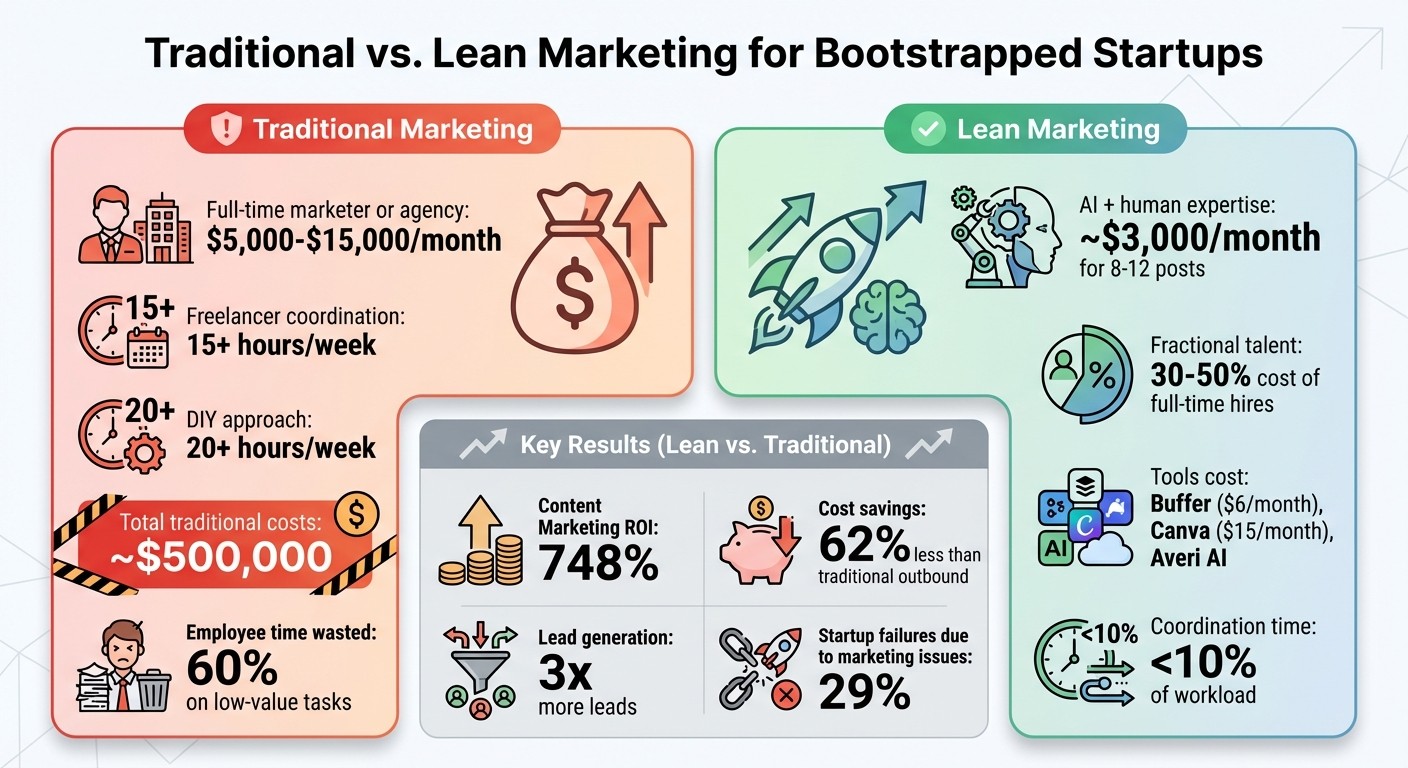
Traditional vs Lean Marketing Costs for Bootstrapped Startups
Fundamentals for Startups: Bootstrapped Marketing
1. Know Your Audience and Message
Before you spend a single dollar on marketing, you need to understand two things: who you're speaking to and what you're saying. Without this clarity, even the best campaigns can fall flat. It's worth noting that marketing missteps contribute to 29% of startup failures[1].
Start by defining your Ideal Customer Profile (ICP). This means identifying details like age, location, interests, spending habits, and, most importantly, the challenges your product solves[5]. Create three distinct ICPs to represent different audience segments, focusing on their pain points, search behaviors, and content preferences[1]. Use tools like Google Analytics to track visitor demographics and behavior[5]. Engage with prospects directly by joining LinkedIn groups where they discuss their challenges[6], or run surveys and focus groups to uncover what they care about most[7].
Once you have a clear picture of your audience, craft messaging that speaks directly to their needs. This isn't about rattling off features; it's about showing how your product solves a problem they already recognize. Establish your Unique Value Proposition (UVP) by highlighting what sets your solution apart from the competition[7].
"Every day without thought leadership is a day your competitors are building the audience that could have been yours"[1]
Structure your messaging to attract "problem-aware" traffic - those who know they have an issue but haven't yet found a solution[1]. Start by defining the problem in terms your audience understands, explain the consequences of ignoring it, and offer a framework for evaluating solutions. This approach builds trust and positions you as an expert, ultimately boosting conversion rates across your marketing channels[1]. Next, let's dive into defining your ICP to effectively target your audience.
1.1 Research and Define Your Ideal Customer Profile (ICP)
Your ICP forms the backbone of every marketing decision you make. Without it, you're essentially guessing. Fortunately, there are free tools that can help you build a strong ICP.
Begin with Google Business Profile, which is free and ensures your business shows up in local searches[4][8]. Businesses listed on Google My Business are 70% more likely to attract visits and 50% more likely to secure purchases[4]. Adding photos to your profile can increase requests for directions by 42%[4]. Pair this with Google Analytics to track visitor demographics, their origins, and what they do on your site[5].
Focus on niche markets with specific audiences instead of trying to appeal to everyone[5]. Assess the size of your target market and evaluate the demand for your offering to set realistic goals[5]. Study your competitors to identify areas they're neglecting - these gaps are opportunities for you to stand out[9]. Tailoring your messaging to specific markets can significantly impact your bottom line, as 84% of businesses report[9].
Segment your audience based on location, needs, or behavior, allowing you to create personalized content that resonates with each group[8]. Test small-scale initiatives, like localized landing pages or region-specific campaigns, to identify where your efforts yield the best results[9]. This targeted approach ensures you don't waste resources on audiences unlikely to convert. With a well-defined ICP, you can now craft messaging that addresses your audience's specific challenges.
1.2 Write Clear Messaging That Addresses Pain Points
Generic messaging doesn't work. If you want to grab attention, your content needs to focus on specific problems and offer credible solutions.
Develop "problem-aware" content that uses the same language your audience does to describe their struggles, positioning your product as the expert solution[1]. Dive into customer support chats, emails, and reviews to identify recurring themes - these are the pain points your messaging should target[10]. Use AI tools to analyze sentiment on social media and reviews to gather additional insights[11].
Organize your keywords based on the stage of the customer journey and how difficult they are to rank for[1]. Prioritize queries that indicate someone is searching for a solution but hasn't yet decided on a specific category. Establish a clear point of view (POV) that highlights what makes your approach stand out from your competitors, filling gaps in existing content[1].
Tailor your messaging using insights from your ICP to align with individual behaviors and preferences[10]. Interestingly, 72% of startup leaders report that AI has helped improve upselling and cross-selling efforts, boosting revenue without the constant need to acquire new customers[10]. Build messaging that evolves over time, reinforcing your authority and building on previous content rather than starting from scratch each time[1].
Tool | Purpose | Cost |
|---|---|---|
Google Business Profile | Boost local visibility and "near me" search results | Free |
Google Analytics | Track audience demographics and behavior | Free |
LinkedIn Groups | Network with B2B prospects and research their needs | Free |
Monitor search rankings and keyword intent | Free | |
Surveys/Focus Groups | Collect direct feedback on customer pain points | Low to Free |
2. Build a Low-Cost Content Marketing System
After defining your Ideal Customer Profile (ICP) in Section 1, the next step is creating a system that reliably produces impactful content. While content marketing can deliver up to 748% ROI and generate 67% more leads[1], many bootstrapped startups struggle to maintain consistency. It’s no surprise - founders are already juggling product development and customer outreach, leaving little room for publishing the 16+ posts per month that could generate 4.5x more leads[1].
The solution? Treat content creation as a system, not a series of isolated projects. Enter the 90-Day Content Engine. Start with 14 days of strategy, followed by a sprint to produce 8–10 posts, and then settle into a rhythm of publishing 2–3 posts weekly[1]. This approach emphasizes momentum over perfection, giving you the chance to refine your strategy as you see what resonates.
Focus on formats that deliver high returns by addressing your audience’s pain points. Problem-aware guides, which tackle challenges your ICP is already grappling with, position you as an expert while drawing in qualified traffic[1]. Unlike fleeting social media posts, these guides have a long shelf life, continuing to generate leads well after publication. Avoid generic content like "what is X" articles. Instead, craft frameworks, comparisons, and step-by-step guides that showcase your expertise in solving real problems.
"Content marketing doesn't require an enterprise budget to work. It requires the right system, executed consistently." - Zach Chmael, Head of Marketing, Averi AI[1]
Set clear benchmarks to measure progress. By day 90, aim to have 24–30 posts published, 50–100 keywords ranking, 500–2,000 monthly organic visitors, and 50–200 email subscribers[1]. These targets provide enough data to identify what’s working and where to double down. With a system in place, the next step is choosing content formats that deliver lasting benefits.
2.1 Pick High-ROI Content Formats
Not all content is created equal. For startups with limited resources, it’s essential to focus on formats that keep generating value long after publication, rather than chasing short-lived trends.
Problem-aware pillar content should be the foundation of your strategy. These comprehensive guides, typically 1,500–3,000 words, address specific challenges your ICP is researching. Unlike surface-level posts, these pillars establish authority and rank for multiple related keywords, bringing in visitors actively seeking solutions.
Structure these guides to answer the questions your audience has before making a decision. Define the problem in their language, explain the risks of ignoring it, and provide a framework for evaluating solutions. This positions you as a trusted advisor, not just another vendor.
How-to guides and tutorials are especially effective for product-led startups. These articles not only demonstrate your expertise but also naturally showcase your product in action. They tend to rank well for long-tail keywords and often attract backlinks from other sites referencing practical advice.
Comparison content, like "X vs. Y" or "Best tools for Z", captures high-intent traffic from prospects evaluating their options. These posts require a balanced, well-researched approach - avoid turning them into thinly veiled sales pitches. Acknowledge where competitors excel while clearly outlining your unique advantages.
Avoid formats that demand constant updates, such as daily social media posts or trend-focused articles. These pieces lose relevance quickly and drain resources. Instead, channel your efforts into evergreen content that compounds in value over time. A single, well-optimized guide can generate leads for years, while a dozen mediocre posts fade into obscurity.
Content Format | Time Investment | Lifespan | Best For |
|---|---|---|---|
Problem-Aware Pillars | 8–12 hours | 2+ years | Building authority, ranking for keywords |
How-To Guides | 4–6 hours | 1–2 years | Showcasing expertise, product education |
Comparison Posts | 6–8 hours | 1–2 years | Capturing high-intent traffic |
Case Studies | 10–15 hours | 1–2 years | Proving results, sales enablement |
News/Trend Posts | 2–3 hours | 1–2 weeks | Only if highly relevant to your audience |
Once you’ve chosen your content formats, the next challenge is producing enough material consistently without overwhelming your team.
2.2 Use AI Tools like Averi AI to Automate Content Work
Traditional content production often forces startups into tough choices: expensive agencies charging $5,000–$15,000 per month, time-intensive freelancer coordination taking 15+ hours weekly, or DIY approaches that consume over 20 hours a week[1]. AI tools offer a smarter alternative, handling research, drafting, and optimization while keeping human oversight for strategy and quality.
AI users report a 47% boost in productivity, saving an average of 12 hours per week by automating repetitive tasks[2]. Specifically for content, AI tools can reduce marketing costs by 10–15% while increasing efficiency[2]. The key is to integrate AI as part of your system, not just as an occasional helper.
Averi AI is a prime example of this approach. It starts by analyzing your website to understand your voice and positioning, then continuously researches your market to uncover high-potential topics. Once you approve a topic, it conducts in-depth research with credible sources, applies your brand context, and generates SEO-optimized drafts. You can refine the content collaboratively and publish directly to platforms like Webflow, Framer, or WordPress - no tedious copy-pasting required.
The real advantage lies in how AI retains context. Unlike agencies or freelancers who may treat each project as a blank slate, Averi AI builds a library of your brand voice, improving content quality over time. This compounding effect makes it more effective than human-only workflows.
For seed-stage startups, combining AI with human expertise can produce 8–12 posts a month for around $3,000 - less than the salary of a junior marketer and far cheaper than agency retainers[1].
"Every month you delay building a content engine is a month closer to running out of options." - Zach Chmael, Head of Marketing, Averi AI[1]
Choose tools that integrate seamlessly into your workflow. Features like direct CMS publishing, automated internal linking, and built-in SEO optimization reduce the manual labor that often makes content production feel overwhelming.
2.3 Track Performance and Improve Over Time
Producing content efficiently is only half the battle - tracking its performance is equally important. Publishing consistently is valuable, but publishing the right content is what drives results. Without tracking, you’re left guessing which topics resonate and which don’t.
From day one, set up attribution to connect specific content pieces to conversions and pipeline activity[1]. Use Google Analytics to monitor traffic, time on page, and engagement. Google Search Console can help you track keyword rankings, while email signups tied to specific content reveal what’s attracting your most engaged readers.
Organize your metrics into three tiers:
Leading indicators: Metrics like traffic, time on page, and engagement show how content performs immediately.
Middle indicators: Metrics such as marketing qualified leads (MQLs) and sales qualified leads (SQLs) reveal which pieces drive prospects further down the funnel.
Lagging indicators: Metrics like revenue, customer acquisition cost (CAC), and lifetime value (LTV) demonstrate long-term ROI[2].
For bootstrapped startups, focus on leading and middle indicators, as they provide quicker feedback for iteration. Establish a weekly review routine - every Monday, evaluate performance to prioritize your content queue. Refresh posts ranking in positions 10–20 to push them to page one, and optimize high-traffic posts with low conversion rates by adding stronger calls-to-action. This iterative process ensures your content strategy evolves based on what works.
3. Grow Through Organic Social Media and Community
Once you’ve established a solid content foundation, organic social media becomes a powerful growth tool. With 246 million active users in the United States and 71% of consumers saying social platforms influence their buying decisions [12][13], social media offers startups a direct line to potential customers. The real challenge? Choosing the right platforms and creating content that connects without overextending your resources.
Social media isn’t just about broadcasting - it’s about building genuine connections. Unlike paid ads that disappear when the budget runs out, organic social media creates lasting relationships that grow over time. In fact, 78% of small businesses report gaining new customers through social media [15].
"A startup's social media isn't just a marketing channel. It's a direct product feedback loop, a community-building engine, and a brand-defining platform all rolled into one." – Viral Marketing Lab [12]
The first step is to identify where your audience spends their time and focus on mastering one or two platforms before expanding. This targeted approach helps avoid the burnout that comes from trying to be everywhere at once.
3.1 Choose the Right Platforms for Your Audience
Not all social media platforms are created equal. Instead of chasing trends or spreading yourself too thin, focus on where your Ideal Customer Profile (ICP) actively engages with industry news and recommendations [12].
B2B startups often find LinkedIn and X (formerly Twitter) to be the most effective. LinkedIn generates 40% of high-quality leads for B2B marketers, making it a go-to for SaaS companies, professional services, and enterprise tools [12]. Long-form articles, case studies, and thought leadership posts perform well here. Meanwhile, X excels at real-time engagement with tech enthusiasts, journalists, and industry influencers through concise updates, polls, and threaded discussions.
B2C brands, on the other hand, thrive on visually driven platforms like Instagram, TikTok, and Pinterest. Instagram and TikTok are particularly effective for reaching Millennials and Gen Z with Reels, Stories, and behind-the-scenes content. By 2025, 78% of consumers are expected to prefer discovering products through short-form videos [12]. Pinterest serves planners and shoppers researching home goods, DIY projects, and wellness products, making it ideal for e-commerce startups.
Platform | Best For | Primary Audience | Key Content Format |
|---|---|---|---|
B2B (SaaS, Services) | Professionals, Decision-Makers | Articles, Case Studies, Updates | |
X (Twitter) | B2B & B2C (Tech, News) | Journalists, Tech Enthusiasts | Short Text, Polls, Threads |
B2C (E-commerce, Lifestyle) | Millennials & Gen Z | Reels, Stories, Carousels | |
TikTok | B2C (Apps, Consumer Goods) | Gen Z & Younger Millennials | Authentic Vertical Video |
B2C (Home, DIY, Wellness) | Planners & Shoppers | High-Quality Images (Pins) |
To ensure you’re targeting the right platforms, spend time observing your audience in online communities like subreddits, Slack groups, and Facebook groups. Pay attention to the language they use, the problems they’re discussing, and the platforms they mention most often. This groundwork ensures your efforts are focused where they’ll make the biggest impact.
Also, match your platform choice to the type of content your team can realistically create. If you excel at writing, LinkedIn is a natural fit. If video feels more authentic, TikTok and Instagram Reels are excellent options. Once you’ve chosen your platforms, it’s time to craft content that resonates without breaking the bank.
3.2 Create Authentic Content on a Budget
Producing engaging content doesn’t have to mean spending a fortune.
"Big brands spend millions faking the authenticity that startups have by default. Lean into it." – Viral Marketing Lab [12]
Startups can leverage their natural authenticity by following the 80/20 rule: 80% educational content and 20% product-focused [12]. Share behind-the-scenes moments, customer success stories, and lessons learned. This "building in public" approach not only humanizes your brand but also delivers value to your audience.
User-generated content (UGC) is another budget-friendly option. Encourage customers to share their experiences with your product and tag your brand. Then, reshare their posts as testimonials [14][18]. For video content, focus on short-form formats like Reels, TikTok videos, and YouTube Shorts, which currently offer the highest organic reach for startups [14][15]. A smartphone and natural lighting are often all you need to create compelling videos.
Engagement is equally important. Follow the "10x engagement rule", dedicating as much time interacting with your audience as you do creating content [12]. A simple routine - Commenting, Listening, Mentioning, Messaging, Posting, Following, and Sharing (CLMMPFS) - can help trigger algorithms and boost visibility [15].
"Consistency crushes frequency." – Viral Marketing Lab [12]
Consistency is key. Posting three times a week is more effective than sporadic bursts of activity followed by silence. Tools like Averi AI can simplify the process by handling brainstorming, drafting, and scheduling, leaving you free to focus on adding your brand’s unique voice [12].
3.3 Work with Micro-Influencers and Partners
Beyond your own content, partnerships can significantly extend your reach. Micro-influencers - those with 1,000 to 10,000 engaged followers - are often more effective (and affordable) than high-profile celebrities [16]. Instead of paying for sponsored posts, build authentic relationships with these influencers by involving them in focus groups, co-presenting at events, or inviting them to contribute to your blog [16].
"I recommend identifying one or two individuals and [engage] with them organically. For example, include them in a focus group or research study, ask them to co-present at a conference or have them write a blog post for your website." – Amy Fisher, Vice President, Padilla [16]
Collaborations with complementary businesses can also amplify your efforts. Partner with startups that serve the same audience but offer different products or services. Co-host webinars, create joint content, or develop referral programs that benefit both parties [14].
Finally, turn your most loyal customers into brand ambassadors. Feature them in social media posts, case studies, and testimonials. Considering that 70% of consumers are more likely to buy from brands they follow on social media [15], authentic endorsements can carry significant influence.
Engage in LinkedIn groups, industry forums, and private Facebook communities where your audience gathers [17][19]. By answering questions, sharing insights, and building relationships, you’ll not only establish trust but also drive organic growth over time.
4. Use Email Marketing to Keep Customers Engaged
Email marketing continues to be one of the most effective ways for bootstrapped startups to drive engagement and ROI. While SEO strategies often take months to show results, email campaigns can deliver measurable outcomes in just weeks [1][2]. The secret lies in building a strong email list, automating your outreach, and refining your approach through data-driven insights. Let’s dive into how you can create a responsive email list to achieve these goals.
4.1 Build and Segment Your Email List
The foundation of successful email marketing is a quality email list. To grow yours, offer something of value in exchange for sign-ups. Lead magnets - like webinars, free templates, or downloadable guides - are particularly effective when paired with dedicated landing pages [20]. Platforms such as Mailchimp (up to 250 contacts), Kit (up to 10,000 subscribers), and beehiiv (up to 2,500 subscribers) offer free plans that are ideal for startups just getting started [20].
Segmentation is what separates personalized email campaigns from generic spam. Use tags to categorize subscribers based on their interests - whether they signed up for a webinar, downloaded an ebook, or expressed interest in a specific product. This ensures your follow-up emails feel relevant and engaging. As Anna Burgess Yang explains:
"Kit makes it easy for me to create landing pages and email sequences. I now have a well-oiled process for launching something new in Kit and segmenting the subscribers into different groups with tags." [20]
For B2B startups, segmentation can go even deeper. Use CRM data points like website activity or purchase history to track customer journeys and trigger highly targeted emails. Free tools like Buffer's "Start Page" make it easy to create professional landing pages for social media bios, helping you capture leads without upfront costs [20].
4.2 Set Up Automated Email Sequences
Once someone subscribes to your list, an automated welcome sequence should kick off immediately [20]. These sequences nurture leads without requiring constant manual effort, freeing you to focus on other priorities. Set up behavior-based triggers for common scenarios: welcome emails for new subscribers, nurture campaigns for prospects, or re-engagement emails for inactive users.
Just as marketing automation tools streamline your workflow, email automation allows your team to dedicate more time to strategy and personalization. Tools like Averi AI can assist in brainstorming email copy, drafting sequences, and maintaining a consistent brand voice - all while letting you focus on the bigger picture.
Consistency is key when it comes to email marketing. Companies that send weekly newsletters report 3.5x higher conversion rates compared to those that email only once a month [1]. Start with a manageable schedule, even if it’s just one email per week, and let automated sequences handle the heavy lifting. From there, your focus should shift to improving engagement metrics like open rates and click-through rates.
4.3 Improve Open Rates and Click-Through Rates
The subject line often determines whether your email gets opened or ignored. Experiment with different subject lines to identify what resonates with your audience. While AI tools can help generate ideas quickly, don’t forget to inject your own personality to keep the messaging genuine.
Each email should have one clear call-to-action (CTA). Whether you’re encouraging readers to check out a blog post, sign up for a webinar, or explore a new feature, make the goal of the email obvious. Monitor metrics like open rates, click-through rates, and unsubscribe rates to refine your campaigns. This iterative, data-driven approach ensures continuous improvement.
As Mike Mantell, a Relationship Coach, shares:
"I find it pretty easy to make lists to distinguish where signups from different lead magnets came from. It has the basic functionality I need for email marketing." [20]
To ensure your emails reach inboxes rather than spam folders, consider using specialized email platforms that prioritize deliverability. As your list grows, upgrading to paid plans can unlock advanced features like A/B testing, detailed analytics, and deeper CRM integrations, which can further enhance your campaigns.
5. Grow Through Partnerships and Referrals
In a lean marketing system, partnerships and referrals are a natural complement to content and social media strategies, offering a reliable route to growth. Without the luxury of a paid advertising budget, strategic partnerships and word-of-mouth referrals can become your most effective tools. The trick lies in teaming up with businesses that cater to the same audience but don’t compete with you, creating opportunities to share that audience in ways that benefit both sides.
5.1 Find Businesses to Partner With
The first step is identifying companies that align with your Ideal Customer Profile (ICP) while offering services that complement yours. For instance, if you're a B2B SaaS startup, consider businesses your audience already trusts - such as industry publications, software tools, or service providers they frequently rely on. Look for gaps in competitors' offerings and connect with businesses that fill those gaps.
Strong partnerships should feel like a natural extension of your growth strategy. One way to achieve this is by creating free tools or side projects that solve a problem for your partner's audience. Take Buffer, for example. They developed a "Transparent Salary Calculator", which, while not directly tied to their social media product, resonated with their audience and increased job applications by 2.2x in just one month [3]. These types of projects, often referred to as "invisible marketing", make it easier for partners to promote your work because they provide genuine, practical value.
"The best marketing is when you don't know it's marketing" [3]
Once these partnerships are established, they can serve as a springboard for referrals, creating a cycle of mutual growth.
5.2 Set Up a Simple Referral Program
Happy customers are some of your most persuasive marketers. A referral program can turn them into active promoters with minimal investment. The most effective programs use a two-sided reward system, where both the referrer and the new customer receive tangible benefits. This model is widely adopted - over 90% of referral programs use it - because it creates a win-win situation [21].
Consider Dropbox’s approach: their referral program offered extra storage to both parties, resulting in a 60% increase in signups. Over time, 35% of their daily signups came through referrals [22][23]. For startups on a tight budget, product-related rewards - like free features, additional storage, or service credits - are a cost-effective way to incentivize participation while keeping users engaged with your product [22][23].
Keep the process simple and quick. Features like one-click sharing, pre-written messages, and unique referral links can streamline the experience. Timing also matters - prompt users to share right after they’ve had a positive interaction, such as completing a purchase, hitting a milestone, or giving a high Net Promoter Score (NPS) [22][23]. To ensure the program works as intended, manually process rewards for the first 10–20 referrals and adjust as needed [23].
Once your referral program is up and running, you can expand your reach by connecting with media and influencers.
5.3 Reach Out to Media and Influencers
Instead of hiring pricey PR agencies, build direct relationships with journalists, bloggers, and influencers in your industry.
"Meeting people and building relationships is how you sustainably spread word-of-mouth awareness with customers" [3]
One effective tactic is the feedback loop strategy: reach out to influencers for input on a piece of content before publishing it. Once it’s live, follow up and ask them to share it. Groove used this approach in 2013 and gained 5,000 new email subscribers in just five weeks [3]. Use free tools like Submit.co to find publications that cover startups, and set up Google Alerts to track mentions of your brand so you can respond quickly [3].
When pitching to media or influencers, craft personalized emails with a compelling story angle or unique data. For example, StatusPage founder Steve Klein focused on "founder storytelling" rather than product features. His blog post, "5 Steps to $5,000 in Monthly Recurring Revenue", drove 10% of all website traffic two years after it was published [3]. To stay organized, track your outreach efforts in a simple CRM to ensure follow-ups don’t slip through the cracks [20].
6. Improve Conversions and Scale What Works
Once you've gained traction through content, partnerships, and referrals, the next logical step is to refine your existing channels for better results. When your content and outreach strategies are already in place, the focus should shift to improving conversion rates. It's worth noting that marketing challenges contribute to 29% of startup failures, second only to the lack of product-market fit at 34% [1]. Even small improvements in traffic and conversions can lead to significant gains without increasing your budget.
Start by auditing your current strategies to identify quick wins.
6.1 Test and Improve Key Conversion Points
Take a close look at your content to pinpoint areas where conversions are falling short. For instance, identify high-traffic posts that aren't driving much action or pages ranking between positions 10–20 in search results. These underperforming assets can often be revitalized by adding lead magnets or clearer calls-to-action. Research shows that businesses publishing content weekly experience conversion rates 3.5 times higher than those posting monthly [1].
6.2 Re-Engage Visitors with Remarketing
Most first-time visitors don’t convert. That’s where remarketing campaigns come in. These low-cost strategies allow you to re-engage potential customers who interacted with your content but didn’t take the next step. Tools like Google Ads Remarketing Lists for Search Ads (RLSA) or AdRoll (starting at $36/month) make it easy to target users who’ve already shown interest [24].
Pair these efforts with cross-channel automation, such as email sequences or retargeting ads, to deliver personalized messages based on each visitor’s prior engagement. This multi-touch approach keeps your brand top-of-mind and increases the likelihood of conversions.
6.3 Double Down on Proven Channels
After optimizing your conversion points, focus your energy on the channels that consistently deliver results. Content marketing, for example, costs 62% less than traditional outbound marketing while generating three times as many leads [1][2]. Unlike paid ads, the impact of well-crafted content endures over time [1][3].
Take StatusPage as an example. Between 2014 and 2015, the team grew their monthly recurring revenue from $5,000 to $25,000 in just four months by capitalizing on a single high-performing blog post. Even two years later, that post accounted for 10% of their total website traffic [3]. Similarly, Drift leveraged a blog post on product marketing that was naturally climbing in search rankings. By building targeted backlinks and refreshing the content, they secured the #4 organic ranking on Google for the competitive term "product marketing" [3].
"Not every post takes off, but the ones that we do strike sweet take off, really fly, hit the bull and win a steak."
– Steve Klein, Founder, StatusPage [3]
To replicate this success, use tools like BuzzSumo or Parse.ly to identify your highest-performing content. Update and promote these pieces to maximize their potential [24]. For content stuck on the second page of Google, consider targeted outreach and strategic updates to push those keywords into the top 10 [3]. This approach offers compounding returns, unlike the linear growth typical of paid acquisition [1].
Conclusion: Work Smarter with Limited Resources
Bootstrapped marketing is all about efficiency - understanding your audience, creating messages that resonate, and building a lean content strategy that maximizes existing strengths. This streamlined approach ties back to the practical strategies shared earlier.
Traditional marketing can be a resource drain, often requiring nearly $500,000 and consuming 60% of employee time on tasks that add little value [2]. In contrast, lean teams are turning to fractional talent and smart tools, achieving executive-level strategies at just 30–50% of the cost of full-time hires [2].
Affordable tools like Averi AI, Buffer (starting at $6/month), and Canva (starting at $15/month) make running campaigns manageable while reducing coordination efforts to less than 10% [2]. These tools align seamlessly with the efficient workflows discussed throughout this guide.
Content marketing stands out as a cost-effective powerhouse, delivering a 748% ROI, costing 62% less than traditional outbound methods, and generating three times the leads. The key is consistency - publishing weekly, monitoring progress, and refining strategies over time to maintain visibility and impact.
Start small, learn quickly, and reinvest in what works. As Mikael Cho [3] wisely said:
"The best marketing is when you don't know it's marketing."
FAQs
How can startups define their Ideal Customer Profile (ICP) on a tight budget?
Defining an Ideal Customer Profile (ICP) when resources are tight begins with tapping into the free data you already have. Dive into your website analytics, sign-up forms, early customer feedback, and social media activity. Look for patterns in company size, industry, location, or user behavior. These insights can often give you a clear picture of your target audience without the need for costly tools.
Once you've outlined an initial ICP, test your assumptions with affordable experiments. For instance, run small-budget ads - spending as little as $5–$10 - on platforms like LinkedIn or Facebook, targeting the audience you’ve identified. Monitor metrics such as click-through rates or sign-ups to gauge interest. Additionally, tools like Google Forms can be used to create free surveys, allowing you to ask potential customers why they’re interested in your product or service. Their responses can reveal valuable insights into their needs and challenges, helping you refine your profile further.
To ensure your ICP becomes a practical tool, make it accessible and actionable for your team. Incorporate it into your marketing strategies, content plans, and sales outreach efforts. Treat it as a living document - update it regularly as you gather new data. By combining the power of free resources, low-cost testing, and continuous refinement, startups can build a strong ICP without stretching their budgets.
What are the best types of content for driving long-term engagement and generating leads on a budget?
For bootstrapped startups, SEO-optimized blog posts are a powerful tool for driving long-term engagement and generating leads. Well-written, keyword-focused articles not only draw in organic traffic but can also be repurposed into various formats like newsletters, social media posts, or downloadable resources. Publishing consistently - around 2–3 posts per week or starting with an initial batch of 8–10 articles - can establish a steady flow of content that continues to deliver results over time.
Combining these blog posts with weekly email newsletters keeps your audience engaged and provides a platform to showcase your latest content. Adding case studies that highlight real-world successes can further help turn website visitors into potential customers. By incorporating AI-powered tools into the content creation process, startups can maintain both quality and frequency, all while staying budget-friendly. This strategy allows you to achieve meaningful results without the need for a large marketing investment.
How can AI tools like Averi AI help startups streamline their marketing efforts on a budget?
AI tools like Averi AI are helping startups turn small marketing teams into powerful content creators. By automating tasks such as drafting content, creating briefs, and making revisions, Averi takes care of time-intensive jobs like copywriting, SEO tagging, and resizing assets - all while maintaining brand consistency. Its built-in review features and seamless integration with tools like CMS and CRM make managing campaigns more straightforward than ever.
With Averi, startups can develop and execute comprehensive marketing plans in as little as 48 hours, eliminating the need for hefty budgets or outside agencies. This means a lean team can achieve results that rival a $500,000 marketing budget for just $100,000. By automating repetitive tasks, Averi not only delivers high-ROI content but also frees up valuable resources, allowing teams to focus on strategy and driving growth.
Related Blog Posts

Zach Chmael
CMO, Averi
"We built Averi around the exact workflow we've used to scale our web traffic over 6000% in the last 6 months."
Your content should be working harder.
Averi's content engine builds Google entity authority, drives AI citations, and scales your visibility so you can get more customers.