
In This Article
Practical SEO for media and entertainment: audience research, structured content, technical fixes, and AI-driven workflows.
Updated:
Trusted by 1,000+ teams
Startups use Averi to build
content engines that rank.
SEO for the media and entertainment industry is all about ensuring your content - whether it’s about shows, artists, or news - reaches the right audience. With consumers spending an average of 6 hours daily on media and 39% canceling at least one streaming service in the past six months, standing out is crucial. Key challenges include fast-paced news cycles, episodic content management, and regional restrictions, all requiring a tailored approach.
Key Takeaways:
Goals: Focus on discoverability (organic sessions, keyword rankings), engagement (time on page, social shares), and revenue (conversions, ad revenue).
Research: Use tools like Google Trends and SEMrush to analyze audience intent and competitor strategies. Target evergreen, time-sensitive, and branded keywords.
Content Structure: Organize sites with clear URL hierarchies for shows, seasons, and episodes. Optimize metadata, internal links, and schema for better visibility.
Technical SEO: Address site speed, mobile usability, Core Web Vitals, and pagination issues. Use structured data like
TVEpisodeorTVSeriesto boost results.Content Optimization: Update underperforming pages, refresh metadata, and test changes to improve rankings. AI tools can streamline repetitive tasks like keyword grouping and metadata creation.
By combining structured content, technical improvements, and AI-driven workflows, media brands can improve discoverability and audience engagement.
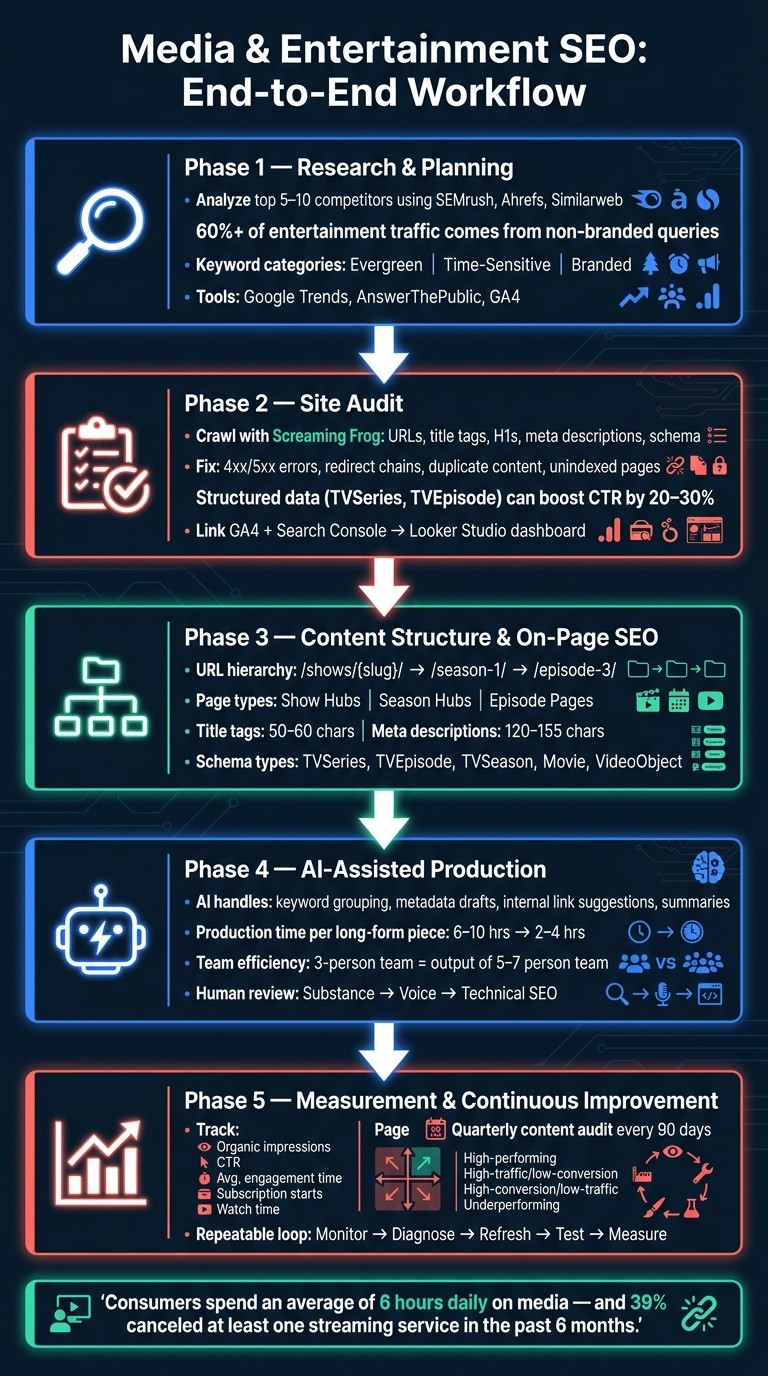
Media & Entertainment SEO: End-to-End Workflow
SEO and the digital news media: From the workplace to the classroom
Research and Planning for Media SEO
Effective SEO strategies for media and entertainment require a solid foundation of research and planning before any content is created. This process uncovers audience intent, competitor strategies, and content opportunities. Skipping this step can lead to underperforming content and wasted effort.
Audience and Industry Analysis
Start by gathering audience insights through tools like GA4 and platform-specific dashboards. These provide data on demographics and behavior. To understand the competition, analyze the top 5–10 players in your niche using platforms like SEMrush, Ahrefs, and Similarweb. These tools reveal high-performing content formats and traffic distribution across the U.S. market.
A 2023 Semrush study found that over 60% of organic traffic for entertainment websites stems from non-branded queries, highlighting the importance of targeting intent-driven, topic-focused keywords beyond just show or brand names. [2]
For instance, if a competitor excels in episode recaps but lacks FAQ markup and has a slow mobile site, this presents a clear opportunity. Break down competitor strengths and weaknesses by format - whether it's TV, podcasts, or gaming - and create a simple list of opportunities. These findings set the stage for precise keyword targeting.
Keyword Research and Intent Mapping
Divide your keyword research into three categories: evergreen, time-sensitive, and branded queries.
Evergreen keywords like "best horror series on streaming" or "top true crime podcasts" provide consistent traffic and should form the backbone of your content hubs.
Time-sensitive keywords, such as new season release dates or award results, can generate traffic spikes. Having pre-designed templates ready ensures you can publish quickly when news breaks.
Branded keywords related to your own shows, characters, or platforms need well-structured landing pages to avoid losing brand SERPs to third-party sites like Wikipedia or review platforms.
Tools like Google Trends can help you compare search interest over time for terms like "[show name] cast" versus "[show name] ending explained", while also identifying regional trends in the U.S. Use AnswerThePublic to uncover specific questions fans are asking, such as "Is [show] based on a true story?" or "What order should I watch [franchise]?" These can be turned into FAQ pages or detailed explainers. Assign keyword clusters to specific page types - show hubs, episode pages, or supplemental content - to create a clear roadmap for content optimization.
Content and Site Audit for Media Properties
With audience insights and keyword strategies in hand, the next step is auditing your existing content to spot gaps and areas for improvement. Use Screaming Frog to crawl your site and export data on URLs, title tags, H1s, meta descriptions, canonical tags, status codes, and schema markup. Categorize each URL by its type - such as show hub, episode page, or news article - to identify where content is lacking or entirely absent.
Look for and address issues like 4xx/5xx errors, redirect chains, duplicate content, and unindexed pages. Implement structured data (e.g., schema.org/TVSeries, TVEpisode) to enhance rich results, which studies suggest can improve click-through rates by 20–30%. [2] Link GA4 and Search Console to a Looker Studio dashboard to monitor page performance. This allows you to prioritize updates to underperforming pages before investing in new content creation.
Content Production and Optimization
After thorough research and audits, the next step is to create and refine media content using a structured, scalable approach.
Structuring Content for Shows, Episodes, and Catalogs
Media sites thrive on well-organized catalog structures. Each show, season, and episode should have its own hub, supported by clear URL hierarchies that align with search intent.
For example, a clean URL structure might look like this:
/shows/{show-slug}/ → /shows/{show-slug}/season-1/ → /shows/{show-slug}/season-1/episode-3/
This setup not only simplifies maintenance but also helps Google crawl your site more effectively. To avoid keyword cannibalization, assign specific search intents to each page type. For instance:
Show hubs: Ideal for queries like "[Show Name] streaming" or "[Show Name] official site."
Season hubs: Perfect for searches such as "[Show Name] season 2 episodes" or release date information.
Episode pages: Focus on detailed queries like recaps, ending explanations, or guest cast details.
Ensure logical internal linking between episodes, seasons, and show hubs to provide a seamless navigation experience for users and search engines.
On-Page SEO for Media Content
Once your page structure is in place, on-page optimization becomes the key to standing out. Start with title tags that include the show name, season or episode, and a target keyword. For example: "The Expanse S03E05 Recap & Ending Explained | [Brand]" - aiming for 50–60 characters.
Use H2s and H3s to answer common audience questions. Sections like "Where to Watch [Show Name] in the U.S.", "Full Cast", or "Season 3 Episode Guide" not only improve user experience but also align with popular search queries. Write meta descriptions of 120–155 characters that are clear, engaging, and naturally written. For example: "Stream Season 3 of [Show Name] on [Platform]. Episode guides, cast info, and behind-the-scenes content - all in one place."
Structured data is another critical piece. Implement schema types such as TVSeries, TVEpisode, TVSeason, Movie, and VideoObject in JSON-LD format to help search engines better understand your content. Populate fields like episodeNumber, seasonNumber, datePublished, actor, director, and aggregateRating. Additionally, link related entities (e.g., TVSeries → containsSeason → TVSeason → TVEpisode). Wistia reports that optimizing video metadata and using video schema can increase organic traffic to video landing pages by 20–30% [4].
SEO Element | Best Practice for Media Content | AI Leverage Point |
|---|---|---|
H1 & Subheadings | Include target keywords in H1 and subheaders | Generate outline structures based on top-ranking content |
Metadata | Unique titles and descriptions for every episode | Create multiple variations for testing |
Internal Links | Add 3–5 links to related episodes or show hubs | Identify natural placement opportunities |
Visuals | Use descriptive alt text for all thumbnails/stills | Generate alt text from image descriptions |
Structured Data | Use schemas like | Draft JSON-LD templates from episode data |
Using AI Tools to Speed Up Content Workflows
Manually producing optimized pages for hundreds of episodes or titles can be overwhelming. AI tools can take over repetitive tasks, allowing your team to focus on strategy and creativity.
Here’s how an AI-assisted workflow might look: an SEO strategist defines the objective - say, creating recaps and metadata for each episode in a season. A tool like Averi can then generate topic clusters, draft summaries, create meta descriptions, and suggest internal links while incorporating your brand’s tone and style.
The human editor steps in for a three-phase review:
Substance: Add original insights and verify facts.
Voice: Ensure the content feels natural and engaging.
Technical SEO: Check H1s, structured data, and internal linking.
Averi’s research shows this approach can cut production time for a single long-form piece from 6–10 hours to just 2–4 hours [3]. A three-person team using this method can produce the same output as a traditional five- to seven-person team [3].
Always conduct thorough fact-checking as a final step after integrating AI-generated content. With production streamlined, focus shifts to strengthening technical SEO for even better results.
Technical SEO for Media Platforms
Site Architecture for Media Catalogs
A solid site structure is essential for managing large media catalogs with hundreds of titles spanning various genres. Using a topic cluster model helps Google understand the relationships between content. For instance, grouping related shows, genres, or themes under main "pillar" pages and linking supporting content consistently creates a clear hierarchy. This approach not only improves navigation for users but also ensures link equity flows effectively across the site.
Pagination often poses challenges for large catalogs. Poor implementation can result in uncrawled content, so it's better to use static HTML-based "load more" buttons or implement rel="next" and rel="prev" attributes to guide search engines through paginated content.
Page Performance and Core Web Vitals
Media platforms often rely on high-quality visuals, videos, and audio, which can bog down page load times. To counteract this, lazy-load off-screen images and videos to improve loading speeds and enhance metrics like Largest Contentful Paint (LCP), a critical element of Google's Core Web Vitals.
Mobile-first design is non-negotiable. Compress images using formats like WebP to reduce file sizes and test every template - whether it's an episode page, season hub, or show landing page - on mobile devices before considering desktop performance. A slow-loading page, especially for an individual episode, can signal poor quality to Google, potentially harming rankings across your entire catalog. Prioritizing speed and mobile usability ensures a seamless experience for users and supports broader SEO goals.
Platform-Specific SEO for Media Distribution
Media brands often extend beyond their websites to platforms like YouTube, podcast directories, and app stores, each with its own ranking system. On YouTube, long-form content such as interviews, behind-the-scenes features, or episode recaps performs well. Optimize video titles and descriptions with relevant keywords, and include timestamped chapters to boost watch time and improve visibility in search snippets.
For podcast directories like Spotify and Apple Podcasts, treat episode titles and descriptions like title tags and meta descriptions. Use guest names, topics, and clear value propositions in episode titles to enhance click-through rates. In the app store (Google Play and Apple App Store), focus on optimizing the app's title, subtitle, and keyword field with the same level of care as you would for on-page SEO. Adding captions and subtitles to video content also improves accessibility and keeps users engaged, even when they watch without sound.
By optimizing for these external platforms, media brands can expand their visibility and complement their on-site SEO strategies. Regularly monitor performance using AI tools to ensure these tactics continue to deliver results.
Platform | Primary Ranking Signal | Key Optimization Action |
|---|---|---|
YouTube | Watch time & CTR | Timestamped chapters, keyword-rich descriptions |
Apple Podcasts | Engagement & keyword match | Episode titles featuring guest names and topics |
Spotify | Saves & completion rate | Clear show descriptions and consistent episode naming |
App Store | Keyword field & ratings | Optimized title, subtitle, and keyword field |
Measurement and Continuous Improvement
Key Metrics and Dashboards for Media SEO
The right metrics are the foundation of effective decision-making. For media and entertainment brands, it’s not enough to track simple traffic figures - you need to understand how audiences interact with your content and whether those interactions lead to meaningful outcomes.
Core metrics can be grouped into three primary areas: discovery (organic impressions, click-through rates, and the ratio of branded to non-branded sessions), engagement (average session duration, scroll depth, and watch time from organic traffic), and conversion (subscription starts, ad revenue tied to organic visits, and actions like "Add to Watchlist"). By consolidating these metrics into a single dashboard, you can get a clear, unified picture of performance.
A practical way to achieve this is by combining Google Analytics 4 and Google Search Console data into a Looker Studio dashboard. Set up separate panels for each stage of the funnel and segment data by content type - such as show pages, episodes, news articles, and catalog pages. Sitewide totals can obscure important trends, so this segmentation is critical. Annotating the dashboard with key events, like new season launches or major campaigns, helps distinguish between temporary spikes and sustained growth. These insights feed directly into refining content strategies and technical improvements.
Metric | What It Tells You |
|---|---|
Organic impressions | How often your pages appear in search results |
CTR by page/query | Effectiveness of titles and meta descriptions |
Avg. engagement time | How well your content holds attention |
Subscription starts from organic | SEO’s direct impact on business goals |
Watch time from organic sessions | Engagement quality for video-heavy content |
Content Refresh and Testing Strategies
Media sites often have pages that once performed well but have since declined. A quarterly content audit - every 90 days - can help identify and address these issues before they escalate. Divide pages into four categories: high-performing (maintain), high-traffic but low-conversion (fix CTAs), high-conversion but low-traffic (improve SEO), and underperforming (refresh, consolidate, or retire).
For pages with strong impressions but weak clicks, small adjustments - like updating titles or meta descriptions - can make a big difference. Test these changes by tweaking one element, waiting 2–6 weeks, and then reviewing CTR data in Search Console. Pages ranking in positions 11–30 for key terms are excellent candidates for targeted updates, such as expanding content or adding internal links, to push them closer to the first page.
If a page has had minimal organic traffic for 6–12 months and shows little potential value, consider consolidating it into an evergreen hub or archiving it. This approach reduces clutter and strengthens your site’s overall authority. Regular content refreshes like these create a strong foundation for ongoing optimization.
Using AI to Monitor and Improve SEO Performance
AI tools have made it easier to stay on top of SEO performance by automating tasks like detecting traffic drops, ranking shifts, or URL cannibalization. This allows teams to focus on solving problems rather than combing through data.
For example, tools like Averi connect performance data with actionable recommendations. It can pinpoint specific opportunities, such as a page ranking at position #8, and suggest steps to move it to the first page. It might also flag when a competitor has published related content or identify low-competition keywords that are highly relevant. This creates a repeatable process: monitor → diagnose → refresh → test → measure [1].
Automated alerts in platforms like Ahrefs or Semrush can further enhance this strategy by notifying your team of significant keyword shifts. Documenting every test with a hypothesis, the date, the change made, and the results builds a valuable knowledge base over time. This record helps you understand what works best for your audience and content, creating a feedback loop for continuous improvement.
Conclusion
SEO in the media and entertainment world is a continuous effort shaped by how audiences search. Fans aren’t just casually browsing - they’re hunting for specific shows, episodes, cast members, and franchises. Their searches often revolve around release dates, season finales, and major moments in pop culture. A generic approach to keywords simply doesn’t cut it.
The strategy outlined here - focused on intent-driven research, structured content, on-page and technical optimizations, and ongoing measurement - functions as an interconnected system. Each component strengthens the others. For instance, a well-organized catalog not only improves technical SEO but also makes content easier to find. In turn, this enhanced discoverability feeds valuable insights back into your analytics, enabling smarter, continuous improvements.
AI tools like Averi can make this process far more efficient. Tasks that used to consume hours - like grouping keywords, writing episode metadata, identifying underperforming pages, or suggesting internal links - can now be done much faster. As Averi explains:
"AI doesn't replace any of the roles on their team. It removes the repetitive, energy-draining parts of those roles, leaving the high-value work - strategy, editing, creative thinking, customer insight - for the humans." [3]
By integrating AI, teams can streamline their workflows from idea to publication while achieving measurable improvements in SEO performance.
The media brands that will excel in organic search are those that treat SEO as a foundational element, not an afterthought. This means weaving it into every phase of release planning, standardizing templates for new pages, and scheduling regular updates aligned with your content calendar. The ultimate objective is to create a system that builds momentum - where each new release, update, or optimization adds value to the foundation already in place.
Start with a clean site structure, use structured data, and focus on audience-driven keyword strategies. Then, let AI help you scale and maintain your SEO efforts for long-term success.
FAQs
How do I choose between show hubs, season pages, and episode pages for SEO?
To effectively target search intent, use show hubs, season pages, and episode pages strategically:
Show hubs: Ideal for broad searches about an entire series. These pages act as a central resource, linking to individual seasons and episodes, and providing an overview of the show.
Season pages: Best for season-specific queries. These pages can focus on particular themes, story arcs, or key details unique to that season.
Episode pages: Perfect for highly detailed searches, such as those about an episode's title, cast, or plot summary.
Boost visibility for each page type by incorporating relevant keywords, structured data, and internal links to create a seamless navigation experience.
Which schema types should I use for TV shows, episodes, and videos?
Using schema types such as TVEpisode, TVSeries, and VideoObject can significantly improve how your TV-related content is organized and displayed in search results. These structured data types allow search engines to better interpret your content, ensuring it’s categorized correctly and presented in a way that grabs attention.
For example, TVSeries can be used to provide detailed information about an entire show, including its title, genre, and cast. Meanwhile, TVEpisode dives deeper into individual episodes, highlighting specifics like episode numbers, summaries, and air dates. Lastly, VideoObject is perfect for embedding video content, offering metadata like duration, upload dates, and thumbnail images.
By implementing these schema types, your content becomes more accessible and appealing to both search engines and users, boosting its visibility in search results.
What SEO metrics best link organic traffic to subscriptions or ad revenue?
To link organic traffic to subscriptions or ad revenue, key SEO metrics to focus on include organic traffic growth, keyword rankings, engagement rates, and content-attributed conversions such as email signups, demo requests, or trials. These metrics provide insight into how well your content encourages actions that directly impact revenue.
Related Blog Posts

Zach Chmael
CMO, Averi
"We built Averi around the exact workflow we've used to scale our web traffic over 6000% in the last 6 months."
Your content should be working harder.
Averi's content engine builds Google entity authority, drives AI citations, and scales your visibility so you can get more customers.