

In This Article
Seven-step framework for agencies to scale SEO with audits, content ops, link building, AI, and measurement tied to leads and revenue.
Updated:
Trusted by 1,000+ teams
Startups use Averi to build
content engines that rank.
Managing SEO for agencies requires a structured, scalable approach to handle multiple clients effectively. Without clear systems, inefficiencies can derail progress and impact results. Here's a quick summary of how agencies can streamline SEO processes and deliver measurable outcomes:
Client Discovery & Strategy: Use intake forms and discovery calls to align SEO goals with business objectives. Collect essential data like website details, target geographies, and KPIs.
Audits: Conduct technical and content audits using tools like Screaming Frog and Google Search Console. Prioritize tasks based on impact and effort.
Workflows: Implement clear roles using a RACI model and project management tools like Asana or Monday.com to avoid delays.
Keyword Research: Focus on search intent and group keywords into topic clusters for better content planning.
Content Production: Standardize briefs, use AI tools like Averi for drafting, and maintain human oversight for quality.
Link Building: Combine guest posting, digital PR, and broken link building to build authority.
Performance Tracking: Use tools like GA4 and Looker Studio to measure results, focusing on leads, traffic, and rankings.
Key takeaway: Agencies succeed in SEO by building repeatable systems, leveraging AI for efficiency, and aligning efforts with client business goals.
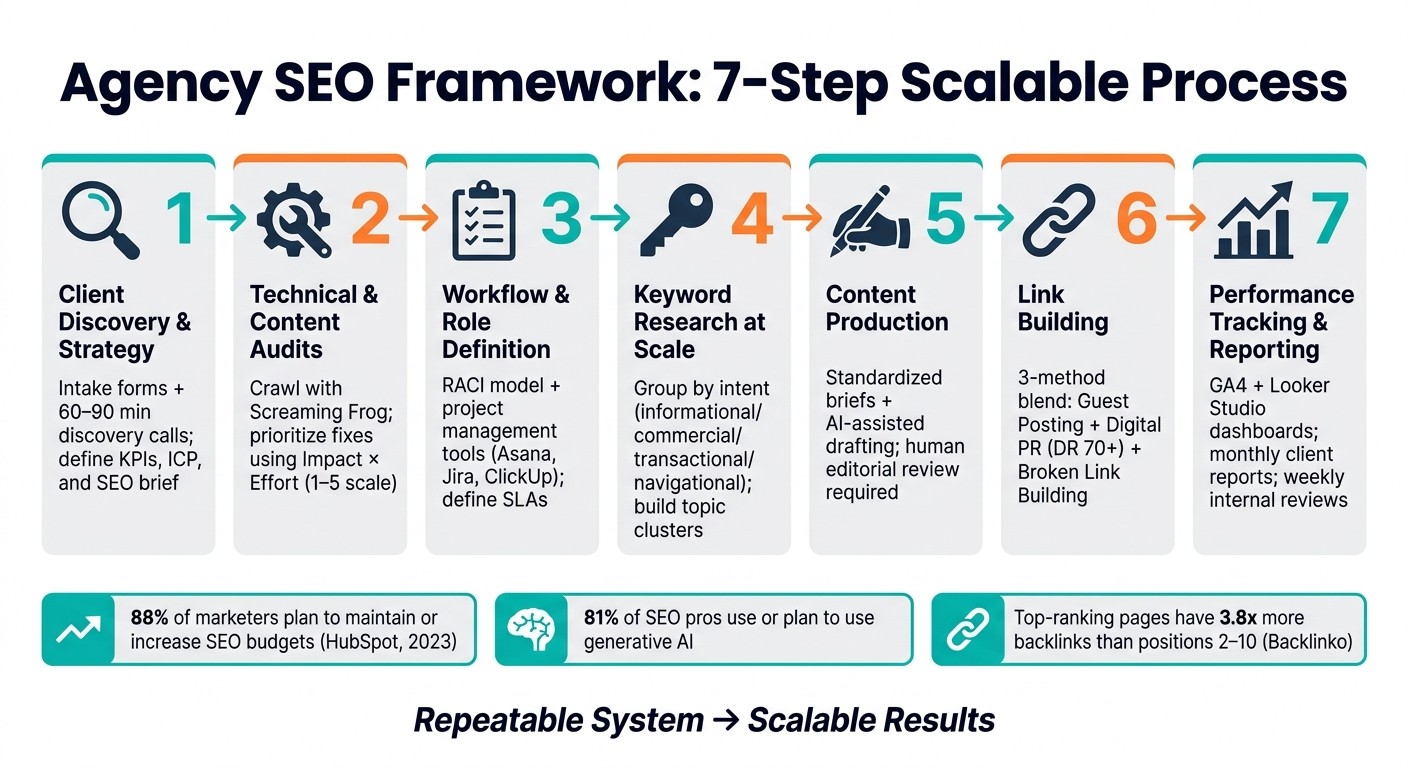
Agency SEO Framework: 7-Step Scalable Process
The Best AI SEO Workflow for Agencies (to rank clients #1 in ChatGPT)
Building a Scalable SEO Framework for Agencies
Managing SEO for multiple clients can quickly become chaotic without a structured approach. Instead of constantly adding team members to handle the workload, agencies can benefit from a well-designed framework. This system should include intake and discovery, technical and content audits, strategy and planning, execution workflows, and reporting. By applying the same structure across all accounts, you eliminate inefficiencies and ensure consistent results for every client.
Standardizing Client Discovery and Strategy
Kick off every client relationship with an intake form and a detailed discovery call lasting 60–90 minutes. The intake form collects essential information like the client’s website URL, CMS, target products or services, U.S. geographic focus, average deal size in dollars, and access credentials for GA4 and CRM data. The discovery call digs deeper, tying SEO goals to business objectives. Questions like "What revenue or lead targets do you want SEO to support over the next year?" or "What is the dollar value of a qualified lead for your business?" help connect SEO efforts to measurable outcomes.
Following the call, compile a concise SEO Brief summarizing the client’s business goals, ideal customer profile (ICP), priority pages, target geographies, and KPIs such as organic sessions or sales-qualified leads. This one-pager becomes the foundation for the strategy, ensuring alignment with what the client values most. Getting client approval on this brief before moving forward helps avoid scope creep and keeps all efforts focused.
For competitor analysis, tools like Ahrefs and Semrush are invaluable for identifying organic competitors - websites ranking for similar keywords, even if they aren't direct business rivals. Evaluate competitors based on metrics like organic traffic, domain rating, backlink profiles, and content quality. To identify keyword gaps, use Averi AI to group competitor keywords by topic and intent, highlighting opportunities based on traffic potential and relevance to the client’s goals.
With the strategy defined, move seamlessly into audits to uncover actionable insights.
Running Technical and Content Audits
A consistent approach to technical audits ensures efficiency and thoroughness. Start by crawling the site using Screaming Frog, check indexation through Google Search Console, and review performance metrics via PageSpeed Insights and Semrush or Ahrefs.
Rather than overwhelming clients with raw data, organize findings in a spreadsheet divided into tabs for indexation, on-page elements, performance, internal links, and structured data. Assign each issue a score based on impact × effort (on a 1–5 scale) to prioritize tasks effectively. Focus the initial sprint on high-impact, low-effort fixes, such as resolving critical 404 errors, optimizing metadata on high-impression pages with low click-through rates, and improving the top 20 landing pages. Tools like Averi can process the audit findings, generate a prioritized task list, and create a client-friendly summary, making it easier to transition from analysis to action.
Once the audits are complete, clearly define roles and workflows to ensure smooth execution.
Defining Workflows and Ownership
Unclear roles can derail even the most well-planned SEO campaigns. A 2023 Databox survey of digital agencies revealed that "lack of standard processes" was a leading cause of project delays - not ineffective tactics. To address this, implement a RACI model for every account. Under this model:
The SEO strategist handles research and task prioritization.
The content lead oversees briefs and production.
The development team or client IT manages technical implementation.
The account manager ensures seamless communication and manages expectations.
Pair the RACI framework with a project management tool like Asana, Jira, ClickUp, or Monday.com. Use standardized task templates for recurring activities such as "publish new blog post" or "implement redirect mapping." Establish a rhythm with weekly internal standups, biweekly sprint planning, and monthly performance reviews with clients. Define service level agreements (SLAs) upfront, setting clear timelines for content approvals, technical implementations, and reporting. Incorporating tools like Averi AI into these workflows can further streamline processes and reduce bottlenecks. When roles and responsibilities are clear, tasks get done faster, and nothing slips through the cracks.
Keyword Research and Content Strategy for Agencies
A well-structured framework for keyword research and content planning can deliver consistent results across multiple client accounts. Here's how to create a scalable strategy that works efficiently for agencies managing diverse clients.
Running Keyword Research at Scale
Start with a repeatable process that can be adjusted for each client. Begin by analyzing existing data - pull search queries from Google Search Console, review top-performing pages, and incorporate insights from the client. Common questions from prospects often make excellent seed keywords.
Expand these seed keywords with tools like Ahrefs and Semrush to create comprehensive keyword lists. Google Keyword Planner can validate search volume and cost-per-click (CPC) data, which also gives insight into commercial intent. Once you’ve compiled your list, classify each keyword by search intent - whether it’s informational, commercial, transactional, or navigational. To ensure accuracy, check the search engine results pages (SERPs) in an incognito browser. According to Semrush's 2023 State of Content Marketing report, 45% of marketers who prioritize search intent in their research rate their efforts as "very successful", compared to only 13% who rarely do.
Organize your findings in a shared database, such as Google Sheets or Airtable, with standardized fields like keyword, U.S. monthly search volume, keyword difficulty, CPC (in USD), intent, funnel stage (TOFU/MOFU/BOFU), topic cluster, and target URL. This centralized system simplifies onboarding, client updates, and tracking progress.
Once your keyword list is ready, group terms into logical topic clusters.
Building Topic Clusters and Content Calendars
Instead of targeting individual keywords, group related terms into topic clusters. Each cluster should center on a broad pillar page, supported by subtopics that address specific aspects of the theme. This approach not only builds authority but also provides a structured content roadmap.
Focus on themes that align closely with your client’s key revenue drivers. For example:
A B2B SaaS client might have a cluster around "project management software for small businesses", with supporting pages on pricing, feature comparisons, and how-to guides.
A local dental practice in Austin could focus on "dental implants in Austin, TX", with subpages covering costs, procedure expectations, and comparisons.
Plan content calendars at least 3–6 months ahead. Assign publish dates, content types, target keywords, funnel stages, writers, and distribution channels. Incorporate U.S. seasonality trends - like tax season, Q4 budget cycles, and major holidays - using tools like Google Trends and GA4 to ensure content is released when demand is highest.
Using AI for Content Planning
AI tools can streamline content planning while maintaining brand consistency. They quickly transform keyword lists into actionable content plans. For example, Averi automates topic ideation by analyzing competitor content, tracking trends, and identifying high-potential keywords tailored to each client’s audience. Instead of manually combing through reports, Averi generates a prioritized list of content ideas, complete with suggested titles, keywords, and angles.
Averi also uses persistent brand memory to keep each client’s context intact. By analyzing the client’s website during setup, it learns their products, voice, and audience, applying this knowledge to every piece of content. This ensures that even the 100th article aligns with the client’s strategy without requiring constant re-briefing. According to Averi, this approach reduces production time from about 3.8 hours per post to just 9.5 minutes, and lowers costs from $611 to $131 per post [2].
"You don't need more time for content. You need a system that creates content without requiring your time." - Zach Chmael, Head of Marketing, Averi [2]
Leverage AI for repetitive tasks like clustering keywords, drafting briefs, and generating outlines. However, keep a strategist involved to ensure the content aligns with search intent and business objectives before moving into production.
Content Production and On-Page Optimization at Scale
This stage connects the dots between planning and distribution in a streamlined SEO workflow. Once your content calendar is finalized and keyword clusters are assigned, the focus shifts to producing high-quality content across all client accounts.
Crafting Standardized Content Briefs
A well-prepared brief reduces the need for multiple revisions. Each brief should include key details like the target keyword, search intent, primary audience (e.g., "U.S.-based marketing directors at agencies with 10–50 employees"), funnel stage, suggested H1/H2 structure, 3–7 secondary keywords, internal link targets with anchor text, meta title and description guidelines, word count range, and tone preferences.
Scaling production efficiently requires using templates tailored to specific content types - one for blog posts, another for landing pages, and a different one for case studies. Locking sections that remain constant across clients, such as brand voice, compliance rules, and internal linking priorities, allows these elements to auto-fill in every brief. This leaves account managers to focus solely on SEO-related fields. Agencies that integrate brand positioning and internal link strategies directly into briefs report fewer revision rounds - often by 20–40% - which directly improves profitability [5][6].
For high-volume production, such as 80+ pieces monthly across multiple clients, consider a tiered briefing system. Use comprehensive briefs for cornerstone content, streamlined briefs for supporting posts, and mini briefs for quick updates like adding FAQs or refreshing statistics. This structure keeps workflows manageable without overwhelming your team. Once briefs are standardized, AI can help accelerate drafting and editing.
AI-Assisted Drafting and Optimization
AI serves as a valuable drafting tool when guided properly. By providing a complete brief and instructing the AI to flag unverifiable statistics, you can enhance efficiency. For long-term clients, including a few sample articles as style references ensures the AI aligns with the desired tone and structure.
Tools like Averi take this a step further by maintaining a persistent brand memory for each client. After analyzing a client’s website during setup, it retains critical details such as product positioning, voice, and audience insights. This allows Averi to automatically apply these elements to drafts without requiring re-briefing. On the on-page optimization front, Averi can generate internal link suggestions, meta titles, descriptions, and FAQ blocks - streamlining tasks that often slow down editors.
However, human oversight remains essential. Every AI-generated draft should be reviewed by an editor to verify facts, update placeholder statistics with current data, and ensure the content aligns with the intended search intent. Once optimized, the content is ready for publishing.
Publishing and CMS Workflow Integration
Manually uploading content to a CMS can lead to errors in formatting, broken links, or missing metadata. To avoid these pitfalls, establish a clear handoff process with defined responsibilities for each stage - drafting, editorial review, SEO review, uploading, quality assurance, and publishing.
Averi simplifies this by supporting direct publishing to platforms like WordPress, Webflow, and Framer. This eliminates the need for copy-pasting and ensures that formatting, metadata, and internal links remain intact. Before hitting publish, use a pre-publish checklist to verify key elements such as title tag length (around 60 characters), meta description length (150–160 characters), header hierarchy, canonical tags, image alt text, internal links, and mobile responsiveness. Embedding this checklist into your CMS workflow helps maintain consistent quality across all client content.
Link Building and Performance Tracking
Once content production and publishing are running smoothly, the next step is building site authority and demonstrating results to clients. These two tasks - link acquisition and performance tracking - are what set apart agencies that build long-term client relationships from those that struggle with retention.
Scalable Link-Building Strategies
Backlinks remain one of Google's most influential ranking factors. In fact, Backlinko's analysis of 11.8 million search results found that the top-ranking page on Google has, on average, 3.8 times more backlinks than pages ranking in positions 2–10 [7]. That gap doesn’t close on its own, making a repeatable and multi-faceted approach to link acquisition essential for agencies.
A practical strategy blends three key methods: guest posting, digital PR, and broken link building.
Guest posting provides predictable link volume when you maintain a vetted list of industry blogs and trade publications tailored to each client’s niche. Success hinges on pitching topics backed by data that resonate with the publication’s audience - not just your client’s goals. Using branded or natural anchor text, rather than exact-match commercial phrases, is critical [3][8].
Digital PR campaigns require more effort but can secure high-authority links (often from domains with a Domain Rating of 70+). U.S.-specific data assets, such as consumer surveys, government dataset analyses, or cost comparisons in USD, tend to perform well - especially when timed around events like the Q4 shopping season or tax season.
Broken link building strikes a middle ground. It’s moderately scalable, cost-effective, and easy to systematize using tools like Ahrefs or Semrush. These tools help identify 404 pages on relevant domains that still hold backlinks, creating opportunities for outreach.
Regardless of the method, link quality always outweighs quantity. Focus on sites with at least 1,000 U.S. organic visits per month, real editorial standards, and a clear connection to your client’s industry. Google’s spam policies explicitly target large-scale guest posting networks and link exchanges, even if placements appear editorial [8]. To stay compliant, maintain a blacklist of low-quality domains, limit the use of exact-match anchors, and regularly audit your clients’ backlink profiles to catch and address toxic links before they cause issues.
Once your link-building strategy is solid, the next step is to measure its impact through detailed performance tracking.
Performance Tracking and Client Reporting
After securing backlinks, the focus shifts to translating these efforts into measurable business outcomes. Performance tracking ties link-building and content efforts directly to results that matter to clients. According to a 2022 survey by Search Engine Journal, the KPIs clients care about most are leads and sales, organic traffic, and keyword rankings [9]. While rankings are important, they’re not the end goal - clients want tangible business results. That’s why tools like GA4 and Google Search Console should be verified and linked from the outset of every client engagement.
Effective reporting should cover three layers of data:
Link output: Track new referring domains by quality tier, anchor text distribution, and target URLs.
Page performance: Monitor rankings, U.S. organic traffic, engagement, and conversions for pages receiving backlinks.
Domain-level trends: Analyze total referring domains, overall organic traffic sessions, and impression share in Google Search Console.
Internally, prioritize weekly reviews of page rankings and traffic. For clients, provide monthly reports and conduct full strategy reviews quarterly. This cadence aligns with industry norms, as 79% of agencies report SEO performance to clients at least monthly [10].
To streamline reporting, tools like Looker Studio can integrate GA4, Google Search Console, and backlink data into a single, reusable dashboard. This approach reduces reporting time from hours to just 15–20 minutes of review and customization per client [1]. Moreover, tools like Averi can close the reporting loop by turning analytics into actionable insights. For example, it can flag a blog post ranking at position #8 and suggest on-page optimizations to push it into the top three, or alert you when a competitor publishes on a topic your client hasn’t covered [2].
Key Takeaways for Agency SEO Success
For SEO agencies, success hinges on treating SEO as a well-structured system. A clear, repeatable process with defined responsibilities ensures smoother delivery, higher quality, and healthier profit margins. Without this structure, inefficiencies creep in, deadlines get missed, and results suffer.
The key is aligning your strategy with business outcomes that clients care about - such as qualified leads, pipeline impact, and revenue growth - rather than focusing solely on rankings. A 2023 HubSpot State of Marketing survey revealed that 88% of marketers investing in SEO plan to maintain or increase their budgets year over year [11]. This highlights how much clients value tangible results. Agencies that consistently tie their efforts to measurable outcomes not only retain clients longer but can also justify premium pricing.
AI plays a major role in scaling these efforts. Currently, 81% of SEO professionals either use or plan to use generative AI for tasks like content ideation, drafting, and reporting [12]. The most effective approach leverages AI for repetitive, time-consuming tasks - such as keyword clustering, creating briefs, writing initial drafts, and generating reports - while human strategists focus on prioritization, quality assurance, and client relationships. Agencies can also hire vetted experts to fill specialized gaps in their delivery teams.
An example of this in action is Siege Media's SEO program for Shutterfly, which led to a 1,667% increase in monthly organic traffic over 8 months. By consistently producing high-quality content and acquiring targeted links, they grew traffic from 6,000 to over 106,000 visits [4]. This wasn’t the result of a one-off campaign but a disciplined, repeatable process executed with strategic insight.
To achieve similar success, agencies should build a strong framework, assign clear ownership, incorporate AI for efficiency without compromising quality, and focus on delivering outcomes that truly matter. These principles are the foundation for consistent, scalable SEO success.
FAQs
What should an agency collect in client discovery to set SEO goals?
To establish effective SEO goals, agencies need to start by collecting baseline data during the client discovery phase. This includes analyzing current search rankings, organic traffic, engagement metrics like time spent on pages, and conversion rates. It's equally important to document operational details such as cycle time, output volume, and cost per content piece, while also considering qualitative aspects like error rates and adherence to the style guide.
Beyond the numbers, a deeper understanding of the client’s brand pillars, ideal customer profiles, and pain points is essential. This ensures that SEO strategies are not just about improving metrics but are also aligned with the client’s broader business goals and values.
How do you prioritize audit fixes across multiple client sites?
To prioritize audit fixes effectively, adopt a data-driven strategy. Start by tracking essential metrics - such as traffic, rankings, and conversions - through a centralized dashboard. This setup allows you to keep a clear overview of performance and identify trends.
Pinpoint high-impact opportunities by evaluating factors like search volume, keyword difficulty, and traffic potential. These insights help you focus on areas with the most growth potential. Additionally, leverage tools to keep an eye on competitor content and keyword rankings. Set up automated alerts for significant ranking drops, such as slipping below position 15, so you can respond quickly.
By concentrating your efforts on areas with the highest potential for improvement, you'll maximize the impact of your optimizations.
How do you prove SEO results with leads and revenue, not just rankings?
To show how SEO contributes to your bottom line, implement automated tracking that ties your content to revenue. Tools like Looker Studio can integrate data from Google Analytics 4 and Search Console, helping you connect website traffic and search rankings directly to conversions. Prioritize tracking these key outcomes:
Lead Generation: Identify which content pieces drive signups, trial requests, or other lead-conversion actions.
Sales Attribution: Pinpoint specific content that plays a role in triggering sales calls or purchases.
Growth Trends: Keep an eye on the growth of your organic pipeline and refine your strategy using performance insights.
This approach ensures your SEO efforts are clearly linked to measurable business results.
Related Blog Posts

Zach Chmael
CMO, Averi
"We built Averi around the exact workflow we've used to scale our web traffic over 6000% in the last 6 months."
Your content should be working harder.
Averi's content engine builds Google entity authority, drives AI citations, and scales your visibility so you can get more customers.