

In This Article
PropTech startups can build trust and pipeline by publishing targeted, data-driven content, using AI to scale and measuring results.
Updated:
Trusted by 1,000+ teams
Startups use Averi to build
content engines that rank.
Content marketing is crucial for PropTech startups to overcome challenges like low brand recognition, long sales cycles, and complex buyer decision-making. By focusing on educating buyers, addressing objections early, and building trust, startups can generate leads and grow their presence. Research shows 57% of B2B purchase decisions are made before contacting sales, and 73% of buyers consume 3–7 pieces of content before engaging with a vendor. This makes content marketing a cost-effective way to drive results compared to paid advertising.
Key takeaways for PropTech content strategies:
Focus on outcomes like reducing vacancies or improving income, not just features.
Use data-driven storytelling to position your startup as a trusted advisor.
Create content aligned with buyer personas and their specific needs.
Leverage AI tools for content marketing to streamline creation, research, and performance tracking.
A well-executed content strategy can drive organic traffic, generate quality leads, and establish authority in the PropTech space. Start small, publish consistently, and refine based on performance data to build momentum over time.
Building a Content Marketing Strategy for PropTech
A content strategy is much more than just a schedule of posts - it’s a structured plan aimed at achieving specific goals. Research from the Content Marketing Institute reveals that 64% of successful B2B marketers have a documented content strategy, compared to only 19% of those struggling to see results. For PropTech startups, success begins with a clear understanding of the audience you're addressing.
Defining Your Target Audience and Buyer Personas
To connect with your audience effectively, segment them based on roles, asset types, and portfolio sizes. The needs of a regional property manager handling 15 Class B properties in the Sun Belt are vastly different from those of an institutional asset manager overseeing a 5,000-unit multifamily portfolio.
For each persona, pinpoint their primary goals - such as lowering vacancy rates or reducing maintenance expenses - and identify what drives their buying decisions. Use customer interviews and sales-call recordings to gather these insights. For example, a detailed persona for a maintenance automation startup might look like this: "Operations Director at a 1,200-unit multifamily operator in the Midwest, focused on cutting average maintenance resolution times and overtime labor costs." This level of detail ensures every piece of content you create is relevant and purposeful.
Finding High-Impact Content Topics
The best content ideas often come directly from within your business. Sales objections, customer support tickets, and demo questions are goldmines for identifying what matters most to your audience. For instance, if property managers frequently ask about integration with systems like Yardi or AppFolio, that’s a clear signal to create a guide addressing those concerns.
Combine this internal feedback with keyword research tools like Ahrefs or Semrush to uncover topics such as "self-guided apartment tours" or "state-by-state online rent payment laws." Map these topics to the different stages of your personas’ buying journeys.
Organize your content into pillars - broad themes that establish authority over time. Examples for PropTech could include Operational Efficiency, Tenant Experience, Investment & Returns, and Compliance & Risk. These themes can guide the creation of articles, case studies, and guides. Industry events like NMHC OPTECH and CREtech are also excellent sources of inspiration, as their session titles often highlight pressing issues operators and investors are looking to solve.
Choosing the Right Content Formats
The format of your content should align with your audience’s decision-making process and preferred platforms. For B2B buyers, focus on formats that reduce perceived risks, such as detailed case studies showcasing financial results, ROI calculators tailored to U.S. rent levels, and step-by-step implementation guides. These formats address questions before prospects even ask them.
Tailor content complexity to the nature of the deal. High-value enterprise transactions may require in-depth whitepapers or webinars, while simpler SaaS offerings benefit from quick how-to guides and comparison articles. Interactive tools, like cap rate calculators, allow prospects to input their own data and see potential outcomes. This approach not only educates but also builds trust, setting the stage for using AI tools to streamline the research, creation, and analysis of your content strategy.
Using AI Tools to Run Content Workflows
With a well-thought-out content strategy in place, AI tools can simplify and accelerate every stage of the content creation process. For lean PropTech startups juggling product development and fundraising, producing high-quality content often feels like an uphill battle. AI tools, however, take on the repetitive and time-intensive tasks, freeing up teams to focus on critical strategic decisions.
The 2024 State of AI report by HubSpot highlights that marketers leveraging generative AI save over three hours per content piece during drafting and editing alone [4]. For startups publishing weekly, these time savings can be redirected toward closing deals or refining products.
Automating Content Research and Planning
Finding the right topics to write about often takes more time than the actual writing. AI tools significantly cut down this effort, transforming hours of manual research into minutes. For instance, Averi analyzes your website to understand your positioning, identifies gaps in competitors' strategies, and organizes keyword opportunities by search intent. The result? A prioritized content queue with titles, target keywords, and strategic insights - no more staring at a blank page.
This is especially helpful in the PropTech sector, where keywords are highly specialized. Phrases like "multifamily IoT", "automated lease management", and "smart building ROI" cater to unique audiences at different stages of their buying journey. AI tools can group these terms into broader content themes, such as Operational Efficiency or Tenant Experience. By aligning publication schedules with key U.S. leasing seasons or major industry events like NMHC OPTECH, your content lands at the right time for maximum impact.
Drafting, Editing, and Reviewing Content with AI
Once a topic is selected, AI tools can take over the heavy lifting of drafting. Platforms like Averi can produce detailed, 2,500+ word drafts optimized for both SEO and GEO, ensuring your content ranks on Google and is referenced by AI search tools like ChatGPT or Perplexity. These tools are now part of 25% of all Google searches as of 2026 [3].
However, human oversight is still critical - especially in a field like PropTech, where accuracy is paramount. AI can flag over-the-top claims, such as replacing "guaranteed 20% NOI increase" with a more realistic, data-backed range. But subject-matter experts should always verify figures, regulatory references, and technical claims before publishing. This hybrid workflow, combining AI efficiency with human expertise, typically requires about two hours per week for reviews, edits, and performance checks.
"We built Averi around the exact workflow we've used to scale our web traffic over 6,000% in the last 6 months." - Zach Chmael, CMO, Averi
Publishing Content and Tracking Performance
The manual steps of publishing - copying content into a CMS, formatting, and scheduling - can drain momentum. Tools like Averi eliminate these bottlenecks by automating the entire publishing process. From meta tags and internal links to featured images, everything is handled seamlessly. It even queues derivative assets for multi-channel distribution, ensuring your content reaches the widest possible audience.
Performance tracking is where the process comes full circle. By integrating with platforms like Google Search Console and GA4, Averi provides insights into what’s working. You can see which posts are driving demo requests, which keywords are climbing the ranks, and which pieces need updates. Over time, this data-driven feedback loop helps refine your strategy, building a smarter, more authoritative content library in the PropTech space. By combining publishing and analytics, AI tools ensure your content strategy evolves with every post.
Measuring the Results of Your Content Marketing
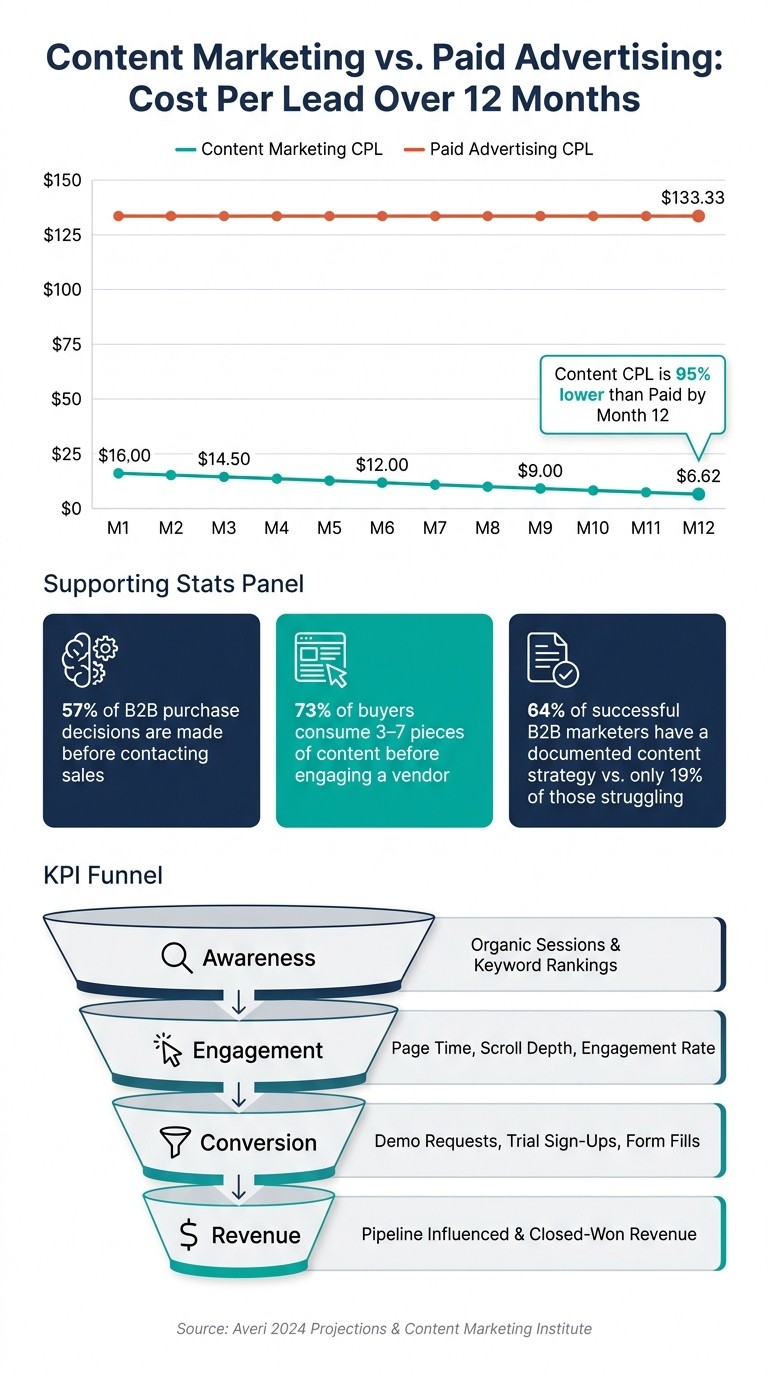
Content Marketing vs. Paid Advertising: Cost Per Lead for PropTech Startups
Publishing content is only the beginning. To truly understand its impact, you need to track the right metrics and analyze what’s driving success - or what’s falling flat.
KPIs to Track
At the top of the funnel, metrics like organic sessions and keyword rankings reveal whether your content is being discovered. Moving further down, engagement rate, page time, and scroll depth show how effectively your content holds attention. At the bottom, demo requests, trial sign-ups, and form submissions measure how well it drives conversions and nudges potential customers toward action.
For PropTech startups, two additional metrics stand out. First, cost per lead (CPL) from content compared to paid channels is crucial. According to projections from Averi, content-driven CPL can drop from $16.00 in the first month to $6.62 by the twelfth month, while paid advertising CPL remains at a steady $133.33 during the same time frame [1]. Second, tracking AI citation readiness is increasingly important as tools like ChatGPT and Perplexity become key players in search behavior. With AI Overviews now appearing in 25% of Google searches, ensuring your content is referenced by these systems can significantly expand its reach [3].
Funnel Stage | Key Metrics | Tools |
|---|---|---|
Awareness | Organic sessions, keyword rankings, impressions | GA4, Google Search Console, Ahrefs |
Engagement | Page time, scroll depth, engagement rate | GA4, Google Tag Manager |
Conversion | Demo requests, sign-ups, form fills | GA4 goals, HubSpot, Salesforce |
Revenue | Pipeline influenced, closed-won revenue | CRM (HubSpot, Salesforce) |
These metrics provide a foundation for refining your content efforts and maximizing their impact.
Using Data to Improve Your Strategy
Once you’ve gathered performance data, the next step is to use it to fine-tune your content strategy. Regular reviews of your metrics can reveal actionable patterns. For example, posts with high impressions but low click-through rates might need updated meta titles or descriptions. Content with strong engagement but weak conversions could benefit from a clearer or more compelling call to action. Posts ranking in positions #8–12 may simply need a refresh or expert input to push them onto the first page.
In addition to weekly check-ins, adopting a 90-day content refresh cycle can help maintain your content’s relevance. Posts that go untouched for more than three months often lose their eligibility for AI citations and risk dropping in rankings. Proactively updating these posts keeps your content library competitive without requiring a complete overhaul.
"The analytics layer closes the loop. What's working feeds back into the queue. What's underperforming gets flagged." - Zach Chmael, Head of Marketing, Averi [3]
For PropTech startups, segmenting performance by property type or buyer persona can further sharpen your focus. For instance, if content targeting multifamily asset managers converts at 7%, while content for general property managers lags at 1%, it’s clear where to concentrate your efforts. Platforms like Averi can automatically identify these trends, ensuring that your next wave of content is informed by what’s delivering results.
Conclusion: Growing Content Marketing Over Time
Key Points to Remember
Content marketing works like a snowball - it builds momentum over time. Successful PropTech startups understand this and treat it as a long-term investment. Three core principles set enduring content apart: addressing real-world stakeholder challenges, using AI to scale efforts efficiently, and maintaining a rigorous measurement framework.
AI tools make it easier for lean teams to produce high-quality content consistently and at lower costs compared to traditional methods. At the same time, regular performance reviews - tracking metrics like traffic, MQLs, and pipeline influence - help identify which efforts to expand and which to revise.
These elements work together seamlessly: content focused on audience needs performs better in search, AI allows you to create more of it, and ongoing measurement ensures your strategy evolves effectively. By following these principles, you can build and scale a content strategy that delivers lasting results.
Next Steps for PropTech Startups
Start small and stay focused. Within your first 30 days, pick one or two key content themes directly tied to your ideal customer profile's pain points - topics like "cutting maintenance expenses" or "boosting tenant retention" work well. Publish one targeted blog post per week, using AI tools to handle research and draft creation. Afterward, have a subject-matter expert refine the content with insights specific to the PropTech industry before publishing.
Once your initial content is live, let data guide your next moves. If content targeting a specific persona or property type performs better, shift focus to that area for your next wave of posts. While initial results may take a few months to gain traction, they’ll grow as your domain authority increases and your content clusters become more robust [1][2]. For instance, Buildium, a U.S.-based property management software company, centered its content strategy on educating landlords. Over time, its library of guides and reports ranked for hundreds of niche keywords, evolving into a major customer acquisition channel as the company scaled to over 17,000 customers.
"The gap between 'AI is transforming content marketing' and 'I have a working content operation that generates leads while I sleep' is enormous. It's the gap between understanding that electric cars exist and building a Tesla factory." - Zach Chmael, CMO, Averi [3]
Start with one streamlined workflow, track the results, and refine your approach. The PropTech startups that succeed in content marketing aren’t necessarily the ones that publish the most upfront - they’re the ones that stay consistent, adapt based on performance, and let their efforts grow over time.
FAQs
How do I choose the right PropTech buyer personas?
To identify the right PropTech buyer personas, zero in on specific roles within companies at particular stages of growth, each with unique challenges. Begin by creating detailed Ideal Customer Profiles (ICPs) that consider job titles, industries, and company sizes. Use tools like automated research to validate these personas - this could include analyzing traffic to your website and studying your competitors. Tailor your content pillars to align with their pain points and objections, ensuring your strategy directly addresses their real-world needs.
Which content formats drive the most demos for PropTech?
To drive demo requests for PropTech, prioritize content formats that cater to capturing demand. Formats like listicles, how-to guides, and comparison articles are particularly effective, as they directly address user search intent while aligning with growth objectives.
Boost conversions by strategically aligning content types with demo request goals. Use comparison playbooks to emphasize your product's strengths, and embed clear, data-backed calls-to-action (CTAs) within your content. These CTAs should guide readers seamlessly toward signing up for a demo.
How long does it take for content marketing to generate pipeline?
Content marketing is a long game - it doesn’t deliver instant results. Developing topical authority and climbing search rankings requires a steady, well-planned approach. By starting with 8 posts per month and gradually increasing to over 80 posts by the tenth month, you can build momentum. While the early months may show little change, this deliberate pacing is crucial. Over a six-month period, this strategy creates a noticeable edge in visibility and authority, setting you apart from competitors.
Related Blog Posts

Zach Chmael
CMO, Averi
"We built Averi around the exact workflow we've used to scale our web traffic over 6000% in the last 6 months."
Your content should be working harder.
Averi's content engine builds Google entity authority, drives AI citations, and scales your visibility so you can get more customers.