

In This Article
Practical branding guide for seed-stage startups: define purpose, create a minimum viable brand, use AI for content, and scale consistently.
Updated:
Trusted by 1,000+ teams
Startups use Averi to build
content engines that rank.
90% of startups fail within their first five years. Among these, 29% cite marketing challenges as a key reason. Yet, many seed-stage founders delay branding efforts, focusing instead on product development or funding. This is a costly mistake.
A strong brand establishes trust, differentiates your startup, and aligns your team. It’s not about spending big - it’s about clarity and consistency. Startups with blogs generate 35% more leads, and publishing weekly content can boost conversions by 320%. Here’s how to build a brand that works:
Define Purpose, Vision, and Values: Identify why you exist, where you’re headed, and how you operate. Avoid generic values like "Teamwork"; focus on specific, actionable principles.
Position Your Brand: Answer key questions about your audience, problem, solution, and differentiation. Use a clear positioning statement to stand out.
Create a Minimum Viable Brand (MVB): Start with a simple logo, two colors, one typeface, and consistent messaging. Prioritize strategy over expensive visuals.
Leverage AI content creation strategies: Automate content creation, publishing, and analytics to save time and resources. AI tools can generate 4–6 posts per month for as little as $99. Implementing an AI content engine can further streamline this process from idea to publication.
Investing $15,000 in branding now can save up to $60,000 in rebranding costs later. Build trust with investors and customers, and set the foundation for growth. Keep it simple, consistent, and focused.
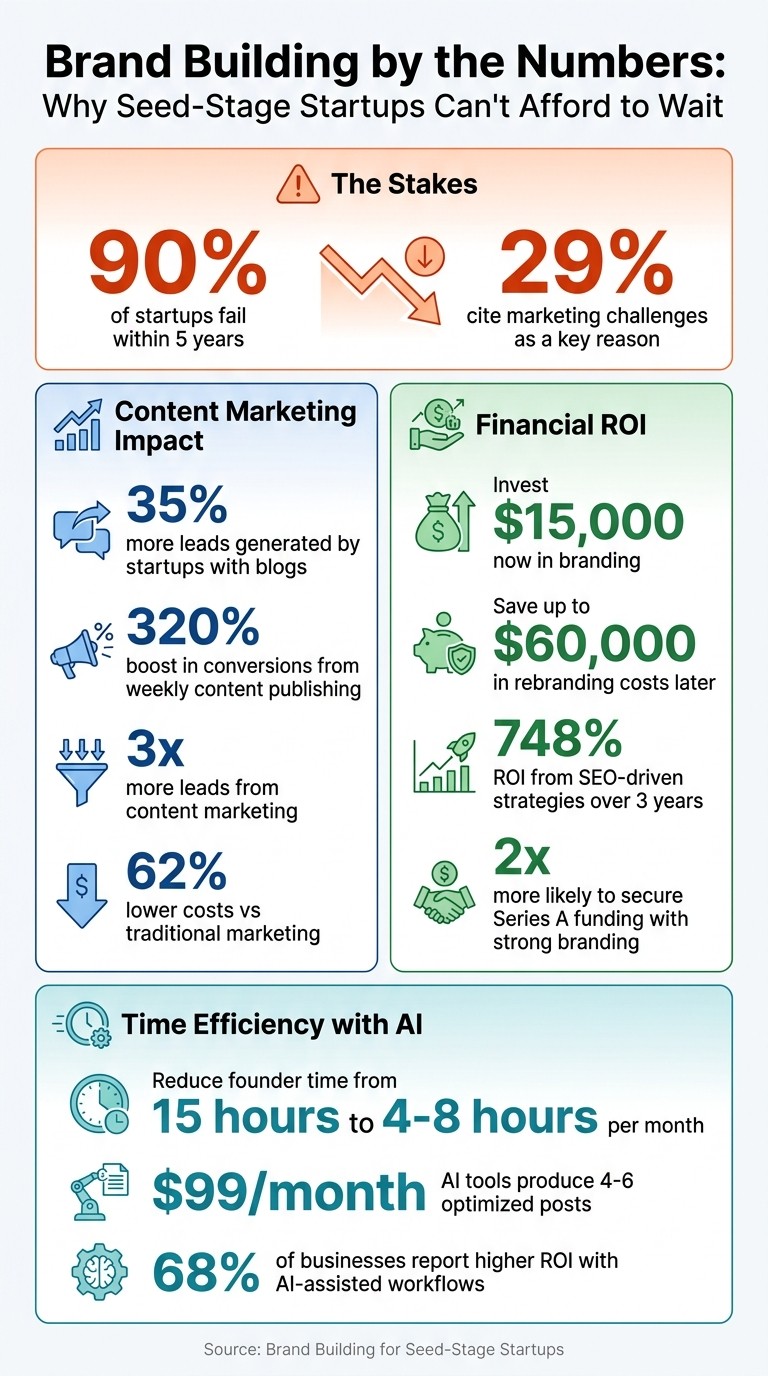
Key Branding Statistics and ROI for Seed-Stage Startups
Startup Branding Strategies That Actually Work: Build a Cohesive Brand Identity
Building Your Brand Foundation
Establishing credibility for your startup begins with building a strong brand foundation. At the seed stage, this foundation should be a concise document that answers essential questions about your identity and direction. It will serve as a guide for everything from messaging and visuals to hiring decisions and your product roadmap.
Purpose, Vision, and Values
Start with the basics: your purpose (why you exist), your vision (where you’re headed), and your values (how you operate). Your purpose should address a specific, validated pain point. Your vision should outline the long-term impact you aim to achieve, while your values should reflect principles that drive daily actions.
Avoid generic values like "Teamwork." Instead, create meaningful, action-oriented statements that reflect your unique approach to collaboration and decision-making [3]. As the founder, this is your responsibility - you know the customer pain points, market gaps, and future goals better than anyone else.
"Sharing before you're ready... even if the thought isn't a completely formed idea, sharing early allows others to weigh in." – Max Yoder, CEO, Lessonly [1]
To shape your messaging, conduct 5–8 customer discovery interviews. Focus on recurring themes, the language customers use to describe their problems, and the outcomes they prioritize [6]. Incorporate their words directly into your messaging to ensure it resonates from the start. Document all of this in a straightforward Brand Foundation Doc, including your Ideal Customer Profile (ICP), positioning statement, and brand voice guidelines [5].
Brand Positioning
Once you’ve defined your core identity, it’s time to position your brand to stand out in the market. Start by answering critical questions: Who is your audience? What problem do you solve? What benefit do you deliver? Who are your competitors? How do you differ? Where is the market heading? [9] Use this information to craft a positioning statement following this formula:
"For [audience] who [problem], [Company] is the [category] that [differentiation] because [proof]." [6]
Leverage competitive mapping to identify gaps in the market. For instance, if competitors focus heavily on speed but customers care more about accuracy, that gap is your opportunity [10]. Build content aimed at buyers ready to make decisions, such as comparison pages ("Product X vs. Competitor Y") or guides like “Best [Category] for [ICP]” [5].
When allocating your branding budget, focus 40% on strategy and 60% on visual identity [6]. Many startups make the mistake of pouring their budget into a logo and color palette without first establishing a strategic foundation. As brand strategist Artyom Dovgopol explains:
"A $10K logo with zero positioning work is a $10K decoration. A $5K positioning exercise with a $2K visual identity creates a foundation that scales for three years." [6]
At this stage, all you need is a Minimum Viable Brand (MVB): a clear positioning statement, core messaging, a simple logo, two colors, and one typeface [6]. This is enough to appear credible to both investors and customers without overspending. Save the more elaborate brand system for when you reach Series A and are scaling toward a larger team and broader market presence.
Creating a Consistent Brand Identity
Once you've laid the groundwork for your brand, the next step is to craft verbal and visual elements that make your positioning tangible and memorable. At this early stage, you don't need an exhaustive brand guide. Instead, focus on building a Minimum Viable Brand - a framework that's consistent enough to establish trust while staying manageable without a dedicated design team. With this in place, every interaction with your audience should reflect your core values and positioning.
Messaging and Brand Voice
Your brand voice is the personality that shines through in everything you communicate. Unlike tone, which adapts to different situations (like speaking formally in a meeting versus casually with friends), your voice remains steady and recognizable [11]. At this stage, your voice often mirrors the founder's personality, creating authenticity by weaving your founding story and key insights into a narrative that resonates [2][6].
A great starting point is to define your brand archetype - a universal character framework like "The Hero", "The Jester", or "The Sage." This helps content creators maintain a cohesive personality across all messaging [11]. For instance, Mailchimp embraces "The Jester" archetype, using quirky humor to make marketing tasks feel less daunting and more engaging [11]. Your chosen archetype should align with your brand promise and the gap you're addressing in the market. For example, a fintech company might lean toward a confident and authoritative voice, while a lifestyle brand could focus on warmth and approachability [2].
Once you've identified your voice, refine it into three or four defining adjectives (e.g., "bold, approachable, precise") and document these in a simple editorial style guide. Include practical elements like "Always Say" and "Never Say" lists, preferred adjectives, and tone variations for different platforms - formal for reports, conversational for social media [11][5]. This guide will save time and ensure consistency across all communications. As Tony Ahn, a startup marketer, explains:
"Your brand voice remains the same, but your tone... will be different, much like how your actual voice stays pretty consistent, but your tone changes with context." [11]
Before finalizing your messaging, test it. Allocate $100–$200 for LinkedIn ads targeting different audience segments to see which voice and positioning resonate most [12]. This small trial can help you avoid costly missteps later. Once your messaging is clear, focus on aligning your visual design to complete your Minimum Viable Brand.
Visual Design on a Budget
Your visual identity is just as important as your messaging. It needs to reflect your brand's foundation while appearing polished enough to instill confidence in investors and customers. However, it's easy to overspend on design without first solidifying your positioning.
For seed-stage startups, a budget of $5,000–$15,000 is sufficient to develop a visual identity, including a logo, two core colors (primary and accent), and one typeface [6]. To keep costs down, opt for free Google Font families unless your brand's positioning calls for a premium option [6]. This streamlined approach ensures consistency without requiring a full-time designer. Platforms like Webflow or Framer ($15–$39/month) offer high-quality website templates that eliminate the need for custom development [8]. For ongoing design needs, Canva Pro is a practical choice, fitting within a "Growth Tier" marketing budget of $300–$500/month [5][8].
To stand out, choose a distinct color palette and typography [6]. Instead of creating an exhaustive brand book, develop a one-page style guide that outlines logo placement, color codes, and font sizes [6]. This is enough to maintain consistency across key assets like pitch decks, social media, and your website. Investing $15,000 in your brand identity now can save you up to $50,000 in rebranding costs and months of confusion when you scale to Series A [6].
Using AI Tools for Brand Execution
Once the groundwork is set, AI tools give startups the ability to execute their branding with speed and precision. For seed-stage founders, content marketing is a proven strategy - it generates three times more leads at 62% lower costs compared to traditional marketing methods [5]. However, juggling product development, customer engagement, and funding rounds often leaves little time for consistent content creation. This is where AI-powered tools step in, automating tedious workflows and freeing up valuable hours.
Automating Content Strategy and Creation
AI content platforms like Averi simplify the entire content process, from research to publication. These tools pull data directly from your website, creating a detailed Brand Core memory that informs every piece of content, going far beyond the capabilities of basic tools [5]. Using this data, the AI generates a content plan based on competitor gaps, keyword opportunities, and current trends. The result? A prioritized list of topics targeting high-intent keywords.
The AI doesn’t stop at planning - it drafts SEO-optimized content designed for modern search engines. This includes concise answer blocks (40–60 words) and FAQ sections aimed at earning citations from advanced language models [4][5]. Each draft is packed with sourced statistics - 15 to 20 hyperlinks per post - to establish immediate credibility [8]. This process shifts the focus from creating content to simply reviewing and approving it. For example, an AI content engine priced at $99 per month can produce 4–6 optimized posts monthly, cutting founder involvement from 10–15 hours to just 4–8 hours [8]. Zach Chmael, CMO of Averi, highlights this efficiency:
"We built Averi around the exact workflow we've used to scale our web traffic over 6000% in the last 6 months. It's intuitive, efficient, and highly customizable." [4]
By automating the heavy lifting, founders can focus their energy where it’s needed most, while their marketing strategy runs smoothly in the background.
Simplifying Collaboration and Publishing
AI tools don’t just streamline content creation - they also make collaboration and publishing more efficient. Instead of jumping between platforms, teams can refine AI-generated drafts within a single editing environment. Once edits are complete, the content is published directly to platforms like Webflow, Framer, or WordPress [4][8]. Need to tweak tone or expand a section? Highlight it, and the AI adjusts the content instantly, all within the same tool.
With every saved draft, the AI becomes more effective at tailoring future content [5]. This integrated approach is especially beneficial for lean teams working with limited budgets. A $140/month tool stack - including the AI engine and hosting - can rival the output quality of a $3,000/month freelance setup, all while ensuring consistency [8]. Efficiency is key: dedicating 1–2 hours weekly to review and approve a month’s worth of drafts can replace the need for daily content creation [5][8].
Tracking Performance and Improving Over Time
AI analytics go beyond surface metrics like impressions and clicks. These tools provide actionable insights, such as tracking keyword rankings, identifying trending topics, and suggesting updates to improve underperforming content [5]. This data helps teams refine their approach - deciding what to expand on, what to refresh, and which angles to explore based on competitor activity.
As the system gathers more data, its recommendations and performance improve. Publishing content weekly can lead to 320% more conversions compared to monthly schedules [4], and 68% of businesses report higher ROI when leveraging AI-assisted workflows [5]. Over time, this creates a self-sustaining engine, allowing founders to focus on product development while their content strategy continues to build brand visibility.
Scaling and Activating Your Brand
Once your brand foundation and content systems are set, the next step is to bring your brand to life across every touchpoint. At the seed stage, you don’t need a massive marketing team or a lengthy manual. Instead, focus on straightforward, actionable guidelines that anyone on your team can follow. These should align tightly with growth strategies that produce tangible results.
Creating Brand Guidelines
Brand guidelines should be practical, not overwhelming. A concise guide of 8 to 15 pages is often enough to outline your positioning, voice, and visual identity basics [6][13]. Start with the essentials: your elevator pitch, an engaging homepage headline, a brief company description, and a simple positioning framework. For instance:
For [audience] who [problem], [Company] is the [category] that [differentiation] because [proof] [6].
These foundational messages are far more impactful than just a logo or color scheme. They’ll appear everywhere - pitch decks, customer emails, and even internal communications.
Consistency across your team is critical. As High Alpha emphasizes:
"Everyone owns the brand! ... From your engineer to your customer success manager, everyone should take the time to learn the basics of the brand" [1].
To achieve this, offer brief training sessions for employees and contractors. Provide ready-to-use templates for content briefs, social media posts, and presentations. These tools reduce decision fatigue and ensure your brand is presented consistently [2][5]. This is especially vital when nearly half of early-stage founders manage all marketing efforts themselves, often with less than an hour per day to spare [5].
Don’t forget to revisit your brand guidelines annually to ensure your messaging stays relevant [6].
Aligning Brand with Growth Strategies
Once your team understands and applies these guidelines, the next step is to align your brand seamlessly with your growth tactics. By building on a clear brand foundation and leveraging AI content systems, you can amplify your impact.
Consistency in brand activation fuels growth by keeping your audience engaged. Move away from one-off campaigns and focus on repeatable content systems designed to attract high-intent buyers. Bottom-of-funnel content - like comparison pages ("Product vs. Competitor") or "Best of" lists - can be particularly effective for reaching prospects who are ready to make decisions [5]. Embedding your brand into these systems ensures a steady flow of engagement and measurable growth.
Founder-led content, especially on platforms like LinkedIn, is another powerful tool. It helps build trust and authority, even as your product evolves. As Zach Chmael, CMO of Averi, explains:
"Content marketing doesn't require an enterprise budget to work. It requires the right system, executed consistently" [5].
Financially, this approach is efficient. A seed-stage budget of about $1,000 per month - covering an AI content engine, hosting, and basic analytics - can save founders between $1,200 and $3,500 in opportunity costs [8]. This strategy reduces founder involvement from 20 hours to just 2 hours per month, creating a self-sustaining content engine that boosts visibility while freeing up time for product development. Additionally, startups with strong branding are twice as likely to secure Series A funding [13].
Conclusion
In the seed stage, building a brand is all about focus rather than chasing perfection. By honing in on a clear positioning statement, consistent messaging, and a straightforward visual identity, startups can establish credibility with investors, customers, and early hires. As Mark Ritson, Professor of Marketing at Melbourne Business School, aptly states:
"Get the startup marketing strategy right and almost everything else falls into place. Get it wrong and nothing else will save you - not the world's best creative director, not the world's biggest media budget" [6].
This focused approach isn't just strategic - it’s cost-effective. Investing $15,000 in a strong brand foundation can save up to $60,000 in rebranding expenses, eliminate a year of brand confusion, and double as market research to fine-tune messaging [6][7]. Additionally, publishing content weekly can generate 320% more conversions compared to monthly efforts, while SEO-driven strategies can achieve an impressive 748% ROI over three years [4][8].
AI tools like Averi make this process manageable even without a full marketing team. By automating tasks like research, drafting, and publishing, founders can cut their time commitment from 15 hours to just 4–8 hours per month - all while maintaining consistency [8]. The goal is to create a content engine: a repeatable system that compounds over time, helping build a loyal audience without relying on ads or algorithms [7].
FAQs
What should a seed-stage Brand Foundation Doc include?
A seed-stage Brand Foundation Doc lays the groundwork for your startup by defining its purpose, values, and positioning. It serves as a clear guide to who you are, what you offer, and why it matters. Typically, it includes messaging frameworks, audience insights, and visual identity guidelines to maintain a consistent brand voice. This document is essential for aligning your team, establishing credibility, and standing out as you grow with limited resources.
How do I write a clear positioning statement for my startup?
To craft a clear positioning statement, pinpoint what your startup delivers, identify your target audience, and highlight the distinct value you bring. Emphasize the problem your business addresses, the specific customers you aim to serve, and what makes your solution different from others. A well-defined statement not only supports your branding goals but also builds trust, draws in the right audience, and provides direction for your marketing strategies - especially crucial for startups navigating early growth with limited resources.
What’s the cheapest 'minimum viable brand' I can launch with?
When it comes to creating a basic yet effective brand, the cost usually falls between $5,000 and $15,000. At the lower end, around $5,000, you can cover essentials like a positioning statement, core messaging, a logo, two colors, and one typeface - enough to establish credibility. Spending less could risk undermining your brand's trustworthiness, while going over $15,000 is often unnecessary for businesses in the seed stage. This range strikes a balance, enabling early growth while laying a solid foundation for scaling your brand in the future.
Related Blog Posts

Zach Chmael
CMO, Averi
"We built Averi around the exact workflow we've used to scale our web traffic over 6000% in the last 6 months."
Your content should be working harder.
Averi's content engine builds Google entity authority, drives AI citations, and scales your visibility so you can get more customers.