

In This Article
YC startups use bottom-of-funnel keywords, programmatic pages, and AI/GEO workflows to scale organic traffic and signups.
Updated:
Trusted by 1,000+ teams
Startups use Averi to build
content engines that rank.
YC startups face a unique challenge: achieving rapid growth within just 12 weeks before Demo Day. Traditional SEO, with its long timelines, doesn't work here. Instead, these companies focus on high-intent keywords that drive signups, automate processes, and embrace AI tools for faster results.
Key takeaways:
Bottom-of-funnel keywords: Terms like "Copy AI alternatives" convert 3–10x better than general queries.
Programmatic SEO: Automating thousands of landing pages tailored to specific queries drives massive traffic (e.g., Zapier's 5M monthly visits).
Generative Engine Optimization (GEO): Optimizing content for AI tools like ChatGPT ensures brands are cited in AI-generated answers.
AI tools: Platforms like Averi and Traconomics streamline keyword clustering, content creation, and performance tracking.
Results: YC startups like Copysmith achieved a 553% increase in organic signups, while Betterhalf grew traffic by 11,377% in just months. These strategies prove that lean teams can achieve 400% annual traffic growth by focusing on scalable, AI-driven SEO systems.
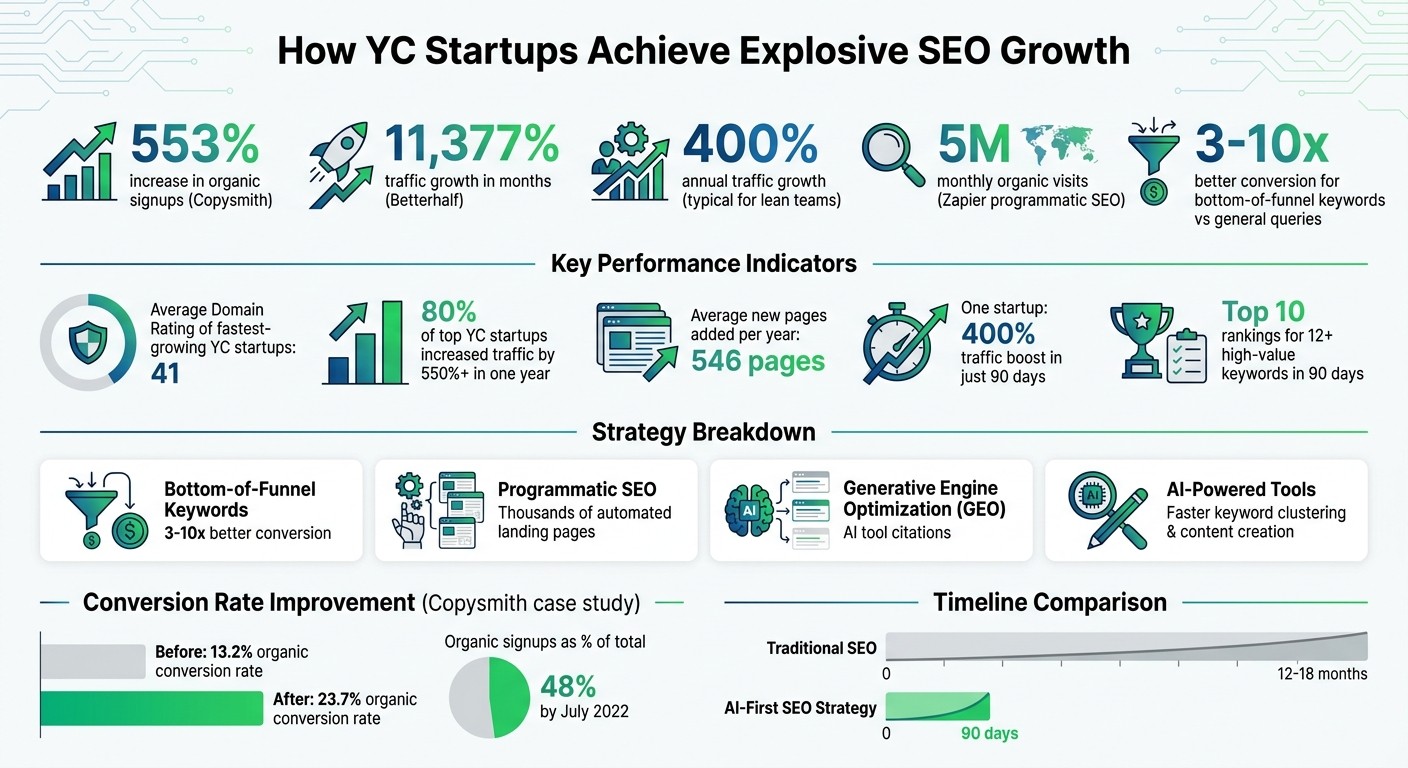
YC Startup SEO Success Metrics and Growth Statistics
Core SEO Principles YC Startups Use
YC startups are rewriting the SEO playbook, focusing less on traditional metrics and more on strategies that directly drive business outcomes. Instead of chasing high-volume keywords or obsessing over Domain Rating, they zero in on search terms that connect with users who genuinely need their product. Notably, the fastest-growing YC startups average a modest Domain Rating of just 41[4][7].
Technical SEO Basics
For YC startups, technical SEO is the bedrock of their strategy. They prioritize essentials like fast-loading sites, clean architecture, and proper schema markup to ensure a solid foundation for search visibility[2]. Many also embrace programmatic SEO, creating thousands of templated landing pages to capture a wide range of search queries.
Take Zapier, for example. They developed a programmatic system that automatically generates tens of thousands of pages, each tailored to specific combinations of its 5,000+ app integrations. These pages include details on app utility, setup instructions, and ready-to-use templates, driving over 5 million organic visits every month[1]. This isn't about manual content creation - it's engineering applied to SEO.
Modern YC companies also optimize their pages for generative AI models like ChatGPT and Perplexity by incorporating clear citations, FAQs, and schema[5]. They enhance their credibility by building entity profiles on platforms like Crunchbase and Wikidata[2]. As TRAC Blog aptly noted:
"The game is no longer about classic keyword stuffing or backlinks alone - it's about AI SEO and GEO (Generative Engine Optimization)"[5]
This emphasis on GEO aligns seamlessly with their precise content strategies.
Content and Keyword Approach
When it comes to content, YC startups focus on bottom-of-funnel (BoFu) keywords - terms that signal strong buyer intent, such as comparisons, alternatives, and specific "how-to" queries. These keywords often convert at rates 3–10 times higher than broader educational searches[1].
A prime example is Copysmith, which shifted its focus to buyer-intent terms like "Copy AI alternatives." This move led to a 553% spike in monthly signups and nearly doubled its conversion rate[6].
Another standout is Veed.io, which used a "Brute Force SEO" strategy to scale its business to $40M ARR without external funding. Founders Saba Cannajad and Tim targeted over 500 high-intent long-tail keywords (e.g., "crop video", "add text to video") and created dedicated landing pages and YouTube content for each. As Saba Cannajad explained:
"It was just brute force. We knew we wanted to make something in video, and we decided to just outwork everyone on the search results page"[3]
YC startups also prioritize refreshing older content to improve rankings. HubSpot pioneered this tactic, doubling its organic traffic in just 12 months by updating existing assets rather than solely producing new content[1].
SEO Framework | Key Focus | Example Startup |
|---|---|---|
Programmatic | Automating page creation for diverse keyword combinations | Zapier, Canva |
Brute Force | Creating specific pages for long-tail keywords | Veed.io |
BoFu/Comparison | Targeting users actively evaluating tools | Monday.com, Copysmith |
Community-Led | Leveraging user-generated templates that rank |
This targeted approach to keywords is paired with rigorous analysis of user intent.
User Intent and Data Analysis
YC startups go beyond tracking search rankings - they measure the real-world impact of their SEO efforts. Keywords are evaluated based on whether they attract users who genuinely need the product. As Averi Resources puts it:
"SEO content should be evaluated on business potential, not just search volume. High-traffic posts that attract the wrong audience don't drive growth"[1]
The key is identifying urgent problems that users are actively trying to solve. For instance, Veed.io created entry points for specific technical actions like "Convert MOV to MP4", guiding users directly into its video editor[3].
Additionally, YC startups use AI tools to enhance their keyword research. Beyond traditional Google rankings, they assess how AI assistants like ChatGPT and Claude reference their brand in response to specific queries[2]. Analytics tools like PostHog help them refine SEO landing pages and optimize conversion funnels based on actual user behavior.
The results speak for themselves: 80% of the fastest-growing YC startups have increased traffic by over 550% in a single year by scaling niche content pages[4]. In one standout case, a YC-backed startup achieved a 400% surge in organic traffic in just 90 days by adopting an AI-first SEO and GEO strategy[2].
Tools and Workflows YC Companies Use
YC startups operate with lean, automated systems that allow founders to stay focused on their products while letting content efforts grow steadily over time. These startups are embracing AI-first workflows for research, production, and optimization - cutting out the inefficiencies of traditional agencies or freelancer coordination. This approach extends into platform automation, content creation, and real-time performance tracking.
AI SEO Platforms
Platforms like Averi and Traconomics have become essential for YC companies, condensing processes that once took weeks into just days[5][1]. These tools are key to implementing fast, data-driven strategies. They handle tasks like keyword clustering, creating competitor-informed content briefs, and mapping internal links.
Beyond optimizing for traditional search engines, startups are now focused on Generative Engine Optimization (GEO) - ensuring their brand gets cited by AI tools like ChatGPT, Perplexity, and Claude. To achieve this, they test prompts weekly to identify which brands AI assistants recommend for specific queries. They then refine their content with schema markup and FAQs to position themselves as the "default answer"[5][2]. As Traconomics put it:
"The truth is stark: startups that rely on 2015-era SEO will be invisible by 2026"[5].
Automated Content Production
For product-led companies, programmatic SEO serves as the backbone of scalable growth. Zapier has implemented a system that auto-generates tens of thousands of landing pages, each tailored to one of its 5,000+ app integrations. This strategy has driven over 5 million organic visits per month - all without manual content creation[1]. Similarly, Copysmith (YC W21) targeted buyer-intent keywords like "Copy AI alternatives", using automated workflows to scale their content production efficiently[6].
These platforms don’t just churn out content - they ensure consistency with the brand’s voice and context. For instance, Averi archives every article to maintain a unified tone across all outputs[1]. Once the content is live, startups rely on continuous performance tracking to ensure each piece contributes to measurable business outcomes.
Performance Monitoring and Iteration
Conversion metrics are the ultimate focus for YC startups. Tools like PostHog allow them to track how SEO visitors interact with their products and refine conversion funnels accordingly. For example, Veed.io monitored over 500 landing pages, optimizing each for specific actions like "trim video" or "convert MOV to MP4", which helped the company scale to $40M ARR[3].
YC Startup SEO Examples
These examples showcase how YC startups tackled time constraints by using targeted, AI-driven SEO strategies.
Positional: Growing Inbound Traffic
Copysmith, a YC-backed AI copywriting startup, turned organic search into their main acquisition channel by prioritizing buyer intent over broad educational keywords. Between November 2021 and July 2022, they achieved a 553% increase in monthly organic signups, growing from 529 to 3,457. During the same period, traffic rose by 489%, and their organic conversion rate jumped from 13.2% to 23.7% - a significant improvement. By July 2022, organic search was responsible for 48% of their total signups[6].
Their strategy was laser-focused: instead of chasing high-volume keywords like "AI writing", they targeted bottom-of-funnel terms such as "Copy AI alternatives" and "best copywriting tools for agencies."
Meanwhile, Betterhalf, an Indian matchmaking platform from YC W21, increased traffic by a staggering 11,377% in 2022. They achieved this by creating niche landing pages tailored to specific audiences, such as "Tamil brides", and developing detailed astrological compatibility content[4]. These efforts laid the groundwork for further SEO experimentation among YC startups.
RankScience: AI-Powered SEO Testing
Another example highlights how a YC startup significantly reduced SEO timelines through AI-powered methods.
One unnamed YC-backed B2B SaaS company employed Traconomics' AI SEO and Generative Engine Optimization (GEO) framework, slashing the typical 12–18 month SEO process down to just 90 days. By blending traditional SEO techniques with optimization for AI search engines like ChatGPT and Perplexity, they went from no visibility to achieving top 10 rankings for 12+ high-value keywords. This effort led to a 400% boost in organic traffic[2].
Their approach included entity profiling on platforms like Crunchbase and Wikidata, implementing structured schema markup, and adding FAQ sections designed to make their content easily referenceable by AI models. As Traconomics put it:
"SEO doesn't need 18 months if done with AI-first strategy"[2].
Similarly, Veed.io adopted an aggressive strategy focusing on long-tail keywords. By targeting over 500 high-intent terms such as "trim video", "add subtitles", and "convert MOV to MP4", they created dedicated landing pages for each keyword. These pages featured clear calls-to-action and accompanying YouTube tutorials, ensuring visibility on both search engines and video platforms. This relentless effort helped them scale to $40M ARR. Co-founder Saba Cannajad summed it up:
"It was just brute force. We knew we wanted to make something in video, and we decided to just outwork everyone on the search results page"[3].
What Startups Can Do Now
Top-performing YC startups are harnessing AI to create scalable systems and shorten growth timelines. An impressive eight out of ten of these companies saw their traffic grow by over 550% in just one year, despite having an average Domain Rating of only 41 [4].
Build Scalable SEO Systems
To scale effectively, start with structured content templates. Instead of brainstorming every single article, focus on formats like how-to guides, listicles, troubleshooting solutions, and location-specific pages. By leveraging these templates, leading YC startups were able to add an average of 546 new pages to their websites in just one year [4].
If your product involves multiple variables - like integrations or diverse use cases - programmatic SEO can be a game-changer. Companies like Zapier have excelled by auto-generating pages for integrations, allowing vast amounts of content to be created with minimal manual effort [1]. Let your data do the heavy lifting instead of crafting every page individually.
Don’t overlook the value of optimizing older content. Target low-competition keywords (those with a Difficulty score between 20–40) to build early authority before moving on to more competitive terms. Once your system is running smoothly, AI can help fine-tune and enhance its performance.
Use AI and Data to Improve SEO
AI offers startups a powerful way to refine their SEO strategies. It can take over repetitive tasks like keyword clustering, creating internal linking maps, drafting content briefs, and monitoring backlinks. This frees up your team to focus on higher-level strategy. For example, one YC-backed B2B SaaS company used an AI-driven SEO strategy to secure top 10 rankings for 12+ high-value keywords and achieved a 400% boost in traffic in just 90 days [2].
To measure success, track metrics that truly matter: keyword rankings (top 3/10), impressions, click-through rates, Core Web Vitals, and organic conversions. Additionally, start experimenting with prompt optimization - treat prompts as you would new keywords. Monitor how large language models (LLMs) like Claude or Gemini reference your brand and adjust your content to improve AI-generated citations [2][5]. This evolving approach, known as Generative Engine Optimization (GEO), is already helping startups stand out in competitive markets.
Conclusion
SEO serves as a powerful engine for sustained growth, offering returns that continue to build over time. Unlike paid advertising, which requires constant investment, well-crafted content keeps drawing in traffic long after it’s published. For YC-backed companies, this makes SEO a vital tool for demonstrating product-market fit and ensuring capital efficiency. In fact, it often becomes a critical factor in securing Series A funding [2][5].
Looking at the strategies discussed earlier, the success of these startups highlights the importance of scalable systems and automation. Companies like Copysmith and Veed.io show how focusing on targeted, automated SEO can replace expensive paid channels while driving consistent growth [3][6].
What sets the SEO strategies of YC companies apart is their emphasis on scalability over isolated tactics. By leveraging programmatic pages, content templates, and AI-powered workflows, these lean teams manage to outperform much larger competitors. For example, Zapier attracts over 5 million organic visits each month through its automated integration pages [1]. Similarly, the top YC Winter 2021 alumni achieved impressive traffic growth by creating hundreds of pages using repeatable frameworks [4].
FAQs
Which high-intent keywords should my startup target first?
Startups aiming to grow should zero in on long-tail keywords and solution-oriented queries that directly address user needs. Phrases like "best SaaS tools for [problem]" or "how to improve [specific metric]" are prime examples, as they typically face less competition while offering stronger conversion opportunities. Additionally, focusing on location-specific pages or addressing niche problem statements can attract high-intent visitors and pave the way for meaningful growth.
When does programmatic SEO make sense for my product?
Programmatic SEO is a great fit for products that thrive on large-scale, data-driven content, especially when targeting long-tail search traffic. It's particularly useful for SaaS and B2B startups looking to generate leads quickly without requiring significant resources. This strategy works best for products with multiple variations, integrations, or use cases that can be systematically optimized. By leveraging automated content creation, startups can achieve fast and scalable organic growth.
How can I get my brand cited in AI answers like ChatGPT?
To position your brand for inclusion in AI-driven answers like those from ChatGPT, you need to focus on boosting your online presence and credibility. Start by creating well-structured, high-quality content that demonstrates expertise. Secure backlinks from trusted and reputable websites, as these strengthen your authority. Ensure your brand is consistently mentioned on platforms such as Crunchbase and Wikidata, which are frequently referenced by AI systems. Additionally, work to establish a strong presence on industry blogs and respected directories. These efforts collectively enhance your chances of being cited by AI models.
Related Blog Posts

Zach Chmael
CMO, Averi
"We built Averi around the exact workflow we've used to scale our web traffic over 6000% in the last 6 months."
Your content should be working harder.
Averi's content engine builds Google entity authority, drives AI citations, and scales your visibility so you can get more customers.