

In This Article
Create a scalable Series A brand with clear purpose, consistent voice, and AI-driven content workflows to grow on a budget.
Updated:
Trusted by 1,000+ teams
Startups use Averi to build
content engines that rank.
Building a brand at the Series A stage is about creating a clear, consistent identity that drives growth without overspending. Here's how to establish a scalable brand system while managing limited resources:
Why It Matters: 22–29% of startups fail due to marketing missteps, and 70% of B2B buyers make decisions before contacting sales.
Challenges: Marketing budgets range from $5,000 to $30,000/month, while agencies charge $20,000–$40,000/month. Small teams need efficient solutions to compete.
Solution: Use AI tools to handle repetitive tasks (80% of the work) while focusing human effort on strategy and refinement (20%).
Key Steps:
Define Brand Identity: Establish purpose, values, messaging, and visual elements for consistency.
Leverage AI Tools: Automate content creation, maintain brand voice, and optimize for SEO without a full team.
Combine AI with Human Input: Use AI for drafts and research, then refine with human oversight for quality.
By blending AI efficiency with human judgment, startups can produce high-quality content, build recognition, and grow within budget constraints.
Core Elements of Brand Identity
When you're at the Series A stage, your brand needs to evolve into a clear and documented system that anyone on your team can follow. The goal isn't perfection - it's about creating a structure that can grow with you. The foundation of this system rests on three key elements: your purpose and values, your messaging and voice, and your visual identity. Nail these, and you'll have a framework that ensures consistency even as your team and brand expand.
Define Your Brand Purpose and Values
To establish a strong identity, focus on four strategic pillars: vision, mission, values, and purpose. Your vision is the future you're working toward. The mission outlines the steps you take daily to achieve that vision [4]. Values act as the guiding principles for hiring, company culture, and customer relationships. Finally, your purpose explains why your company exists beyond just generating revenue.
Documenting these elements is crucial for consistency. Interestingly, while 64% of top-performing content marketers create brand voice guidelines, only 23% use them to train AI tools [3]. This disconnect often leads to mixed messaging. Without a unified reference, your content may lack cohesion. Start by conducting a competitor audit: analyze how others in your space position themselves and what customers highlight - both good and bad - in reviews [4]. From there, identify what sets your brand apart. Organize your findings into a messaging board with clear sections: Who (your audience), What (the problem you solve), How (your solution), Why (your purpose), and Tone/Style [4].
Once your purpose is solidified, the next step is to develop a consistent brand voice.
Build Consistent Brand Messaging and Voice
Your brand's voice is its personality - whether it's warm and approachable or formal and authoritative. While tone may shift depending on the situation, the voice itself should remain steady [4]. Vague descriptions like "professional but friendly" aren't actionable. Instead, define your voice using four dimensions: Tone (e.g., conversational or authoritative), Language Level (simple or complex), Perspective (first-person "we" or third-person), and Personality Traits (3–5 defining adjectives) [3].
To make this actionable, create "do's and don'ts" lists that specify preferred words, phrases, and metaphors, as well as terms to avoid. Include examples of "on-brand" and "off-brand" messaging - 3–5 sample paragraphs for each - to clearly illustrate the differences [3]. This attention to detail matters: consistent brand presentation has been shown to boost revenue by 10% to 33% [3]. When your messaging is uniform across platforms - whether it's your website, emails, or ads - it builds trust and makes your brand instantly recognizable.
Once your voice is locked in, the next step is to ensure your visual identity matches the same level of consistency.
Design a Visual Identity That Grows With You
Your visual identity - comprising your logo, color scheme, and typography - should be designed for instant recognition and scalability [4]. At this stage, you don't need a full rebrand, but you do need a Minimal Viable Brand (MVB). This includes a simple logo, name, tagline, and core messaging that establish credibility without requiring a major investment before you've fully validated product-market fit [5].
Choose a color palette with 2–3 primary colors and 2–3 accent colors. Select one or two typefaces that work well across both digital and print formats. Outline clear guidelines for spacing, logo variations (such as full-color, monochrome, or icon-only formats), and minimum size requirements. Store these assets and guidelines in a shared folder accessible to everyone on your team, including contractors. This ensures that every visual element consistently represents your brand. As you grow, this solid foundation will make it easier to branch into new channels while maintaining a cohesive look and feel.
Using AI to Scale Brand Building
Once your brand's foundation is solid, AI can take your messaging to the next level by amplifying and streamlining your efforts. For Series A startups, where scaling content production is critical, building an AI content engine, tools like Averi simplify brand-building by automating repetitive tasks while staying true to your brand identity.
Analyze Brand Voice and Market Position with AI
Averi's "Brand Core" module is designed to extract key insights from your website, including details about your products, positioning, ideal customers, and tone of voice. This data is stored and used in future content creation, so there’s no need to repeatedly reintroduce your brand’s essence. By automating this analysis, businesses can reduce manual audits by 70–80%, as the AI flags tone inconsistencies and identifies keyword gaps effortlessly [6][7].
Automate Content Creation and Publishing
After defining your brand voice, AI can step in to create SEO-friendly drafts that align with your style, even publishing them directly to your CMS. Averi integrates with platforms like Webflow, Framer, and WordPress, eliminating tedious copy-pasting and reducing formatting errors. Teams using these tools report 40–60% faster production times, increasing their output from 2–3 pieces to over 10 per month [1][6]. For instance, a SaaS startup used AI to automate weekly blog posts, boosting website traffic by 40% in just three months - all while maintaining a consistent brand voice. This level of automation allows businesses to scale efficiently without sacrificing quality.
Combine AI Execution with Human Judgment
The best results come from a collaborative workflow where AI handles the heavy lifting, and humans fine-tune the details. This "AI–Human–AI–Human" cycle starts with AI conducting research and drafting content, followed by human editors refining the tone, adjusting for SEO, and giving final approval. As Averi Academy explains:
"The productivity promise of AI evaporates when every output requires substantial editing to fix voice issues." – Averi Academy
Averi vs. Marketplaces and AI Writing Tools
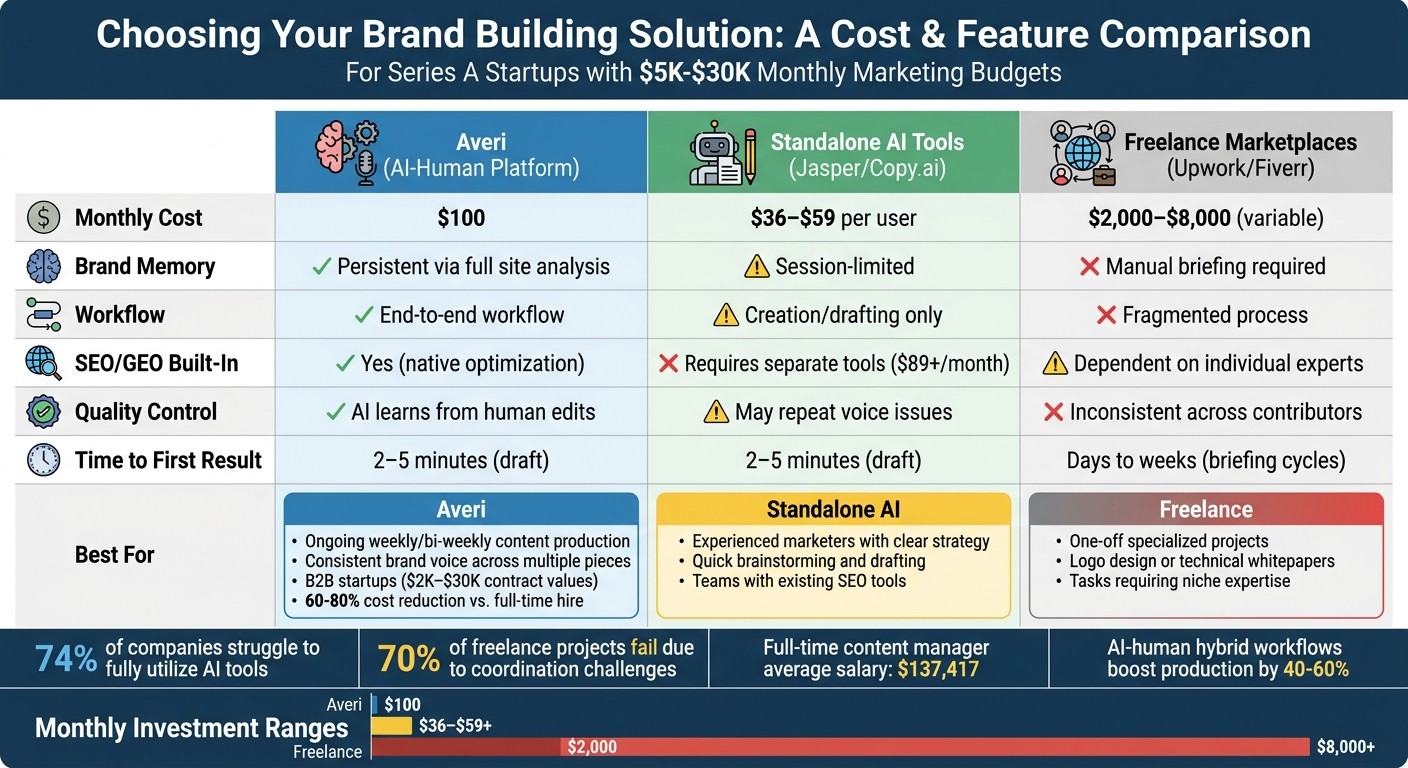
Averi vs AI Tools vs Freelance Marketplaces: Feature and Cost Comparison for Series A Startups
For Series A startups, building a strong brand requires both strategic focus and efficient content creation. The AI strategy tools you use play a critical role in scaling your brand identity effectively.
Founders often weigh three main options: AI platforms like Averi (which blend AI capabilities with human oversight), freelance marketplaces like Upwork or Fiverr for specialized tasks, and standalone AI tools like Jasper or Copy.ai for quick drafting. Each approach has unique strengths, but the right choice depends on your goals and resources. Below, we break down who benefits most from each, compare their features, and identify when Averi is the ideal solution.
Who Benefits Most From Each Approach
Averi is tailored for B2B startups with contract values ranging from $2,000 to $30,000. It’s designed for companies that need consistent, SEO-optimized content but lack the budget for a full marketing team. Averi streamlines everything - from strategy and research to drafting and publishing - solving the fragmentation that leaves 74% of companies struggling to fully utilize AI tools [8].
Freelance marketplaces work well for one-off tasks requiring specific expertise, such as logo design or technical whitepapers. However, managing freelancers often leads to high coordination costs and inconsistent quality, with 70% of projects failing due to these challenges [2].
Standalone AI tools, like ChatGPT ($20/month) or Jasper ($59/month per user), are best for marketers with a clear strategy who need faster content drafting. These tools, however, require manual input for each session and don’t retain a consistent understanding of your brand [8].
The key differentiator is brand memory. Tools like Jasper learn your writing style through sample inputs, while Averi’s Brand Core goes deeper. By analyzing your website, Averi understands your products, target audience, and competitive edge. This allows Averi to apply your brand context consistently across all content, avoiding the voice inconsistencies common with generic AI tools.
Comparing Features: Averi vs. Alternatives
Feature | Averi | Standalone AI (Jasper/Copy.ai) | Freelance Marketplaces |
|---|---|---|---|
Monthly Cost | $100 | $36–$59 per user | $2,000–$8,000 (variable) |
Brand Memory | Persistent via full site analysis | Session-limited | Manual briefing required |
Workflow | End-to-end workflow | Creation/drafting only | Fragmented process |
SEO/GEO Built-In | Yes (native optimization) | Requires separate SEO tools | Dependent on individual experts |
Quality Control | AI learns from human edits | May repeat voice issues | Inconsistent across contributors |
Time to First Result | 2–5 minutes (draft) | 2–5 minutes (draft) | Days to weeks (briefing cycles) |
Averi’s standout features include its all-in-one workflow, persistent brand intelligence, and built-in SEO/GEO optimization. These capabilities ensure high-quality, consistent content production. However, it does require initial input from founders to set up brand voice and approve content.
Standalone AI tools are cost-effective and flexible for brainstorming but lack strategic guidance and require additional subscriptions for SEO tools, like Surfer SEO ($89+/month). Their integration into broader workflows is also limited.
Freelance marketplaces provide access to specialized human expertise for niche projects, but they often involve time-consuming coordination and can result in inconsistent brand messaging.
When Averi Stands Out
Averi is the best choice when your goal is ongoing content production using content strategy software that drives organic growth. It’s ideal for startups publishing weekly or bi-weekly, targeting both traditional search engines and AI-driven platforms like ChatGPT or Perplexity. Averi ensures a consistent brand voice across multiple pieces of content without the expense of hiring a full-time content manager (average salary: $137,417) [2].
This platform shines for startups using the "Alternative Model", which combines AI-driven workflows for speed with fractional human expertise for strategic direction. This approach can cut costs by 60–80% compared to hiring full-time staff [2]. As Zach Chmael, CMO of Averi, puts it:
"Your content IS your sales team when you can't afford a sales team" [2].
This strategy is particularly relevant as 70% of B2B buyers complete most of their journey before speaking to a sales rep. Additionally, AI-driven search visitors convert at rates 4.4 times higher than traditional organic traffic [2].
Choose Averi if you’re looking to consolidate your marketing tools and avoid the fragmentation that undermines brand consistency - something 88% of marketers aim to address by 2025 [3]. For experienced marketers needing faster drafts, standalone AI tools may suffice. For one-off projects, freelance marketplaces remain a practical option. But for scalable, consistent brand-building, Averi is hard to beat.
Series A Brand Building Examples
Case studies highlight how combining AI tools with human expertise can amplify brand consistency and content production while keeping costs manageable.
Example 1: Boosting Content Production Without Sacrificing Quality
A B2B startup built thought leadership at scale to overcome a classic Series A hurdle: they needed to scale up content production to stay competitive but lacked the resources for a full-fledged content team. Their solution? A hybrid approach using AI for speed and humans for precision.
The company uploaded 50 of their top-performing content pieces into Averi's Brand Core, enabling the AI to learn their specific technical tone and messaging. With this foundation, the AI could draft content in just 2–5 minutes. A human reviewer would then spend 15 minutes refining these drafts, ensuring technical accuracy and brand alignment.
Within six months, this approach delivered three times the content output while maintaining a 90% brand consistency score [3]. The human review process was critical - it caught subtle mismatches in tone and added the technical depth that AI alone couldn't achieve.
This example demonstrates how AI can handle repetitive tasks efficiently, freeing up human talent to focus on ensuring quality and maintaining brand integrity.
Example 2: Crafting a Unified Brand Voice
Vector, a graphics software company, opted for a different strategy during its growth phase. Under the leadership of Head of Marketing Jess Cook, they established a "CEO content engine" to amplify their CEO’s authentic voice across multiple platforms, ensuring consistent messaging while scaling content output.
Cook explained their process:
"The AI gets me about 80% of the way there and a quick 15-minute review and edit gets the posts to 99%" [9].
This collaboration helped CEO Joshua Perk grow his LinkedIn following from 7,000 to 11,000 and quadruple inbound demo requests [9]. The team’s secret? They documented their brand voice with incredible detail - defining specific language styles, preferred metaphors, and the ideal level of technical complexity. This upfront effort resulted in consistently high-performing content, proving that maintaining brand consistency across channels can boost revenue by 10% to 33% [3].
These examples highlight practical, scalable strategies for Series A startups to establish and grow their brands effectively. By leveraging AI and human expertise together, companies can achieve both creativity and consistency at scale.
Conclusion: Build a Brand That Scales
For Series A startups, the challenge is creating a recognizable brand quickly without blowing through your budget. The answer isn’t about picking sides between AI efficiency and human creativity - it’s about combining the strengths of both to create a system that grows and improves over time.
Start by laying a solid groundwork. Define your brand’s purpose clearly, document your voice with concrete examples (avoiding vague descriptors), and establish living brand guidelines that can adapt as you scale. From there, integrate AI tools like Averi to handle drafting, maintain consistency, and simplify publishing. Let human expertise focus on the strategic calls, creative details, and quality checks that keep your brand genuine. This blend of AI and human input brings together speed and thoughtful strategy.
The numbers back this up: AI-human hybrid workflows can boost content production by 40–60% and increase engagement by 2.3× compared to content generated solely by AI [1]. By setting up workflows where AI drafts in 2–5 minutes and experts refine in 15–30 minutes, you establish a sustainable rhythm for creating impactful content [3].
To put this into action, audit your current brand assets against your defined purpose and explore tools like Averi that retain your brand’s identity. Use attribution tracking to measure how your content impacts your sales pipeline, then test a pilot campaign with clear goals before scaling. Pay attention to recurring edits and let those insights fine-tune your process. Tools like Averi help keep things efficient, ensuring your brand grows with consistent, data-driven decision-making.
Winning brands at the Series A stage don’t just churn out content - they build systems that improve with every piece. As your content library expands and you gather more data, you’ll shift from founder-led scrappiness to a smooth-running marketing engine. This frees you up to focus on what matters most: building your product and serving your customers.
FAQs
What should my minimal viable brand include at Series A?
At the Series A stage, a brand needs to establish a strong, clear identity that sets the foundation for growth. Prioritize your core messaging, brand voice, and visual identity to ensure your brand is both recognizable and credible. Consistency is key - maintain a unified presence across all platforms to build trust. Leverage AI tools to streamline content creation, but always keep a human touch to ensure your voice stays authentic. Develop a scalable content strategy with proper oversight to support your brand’s growth and long-term visibility.
How can I keep AI-generated content on-brand without heavy editing?
To keep AI-generated content aligned with your brand while minimizing editing time, it's essential to use AI tools capable of understanding and replicating your brand's voice. Start by creating detailed brand guidelines that outline your tone, voice, and messaging priorities. Use these guidelines to craft precise prompts for the AI, ensuring it produces content in line with your expectations. Regular reviews of the AI's output allow you to fine-tune these prompts, ensuring continuous improvement. By blending AI capabilities with human oversight, you can achieve efficient, consistent, and brand-focused content creation.
How can I measure whether brand content is driving pipeline?
To evaluate whether your brand content is contributing to pipeline growth, focus on metrics that connect content efforts to lead generation and sales outcomes. These include downloads, form submissions, and content views. Attribution models and tools are essential for tracking how content engagement translates into qualified leads or sales opportunities.
Key performance indicators to monitor include:
Website traffic: Gauge the volume of visitors driven by your content.
Lead conversion rates: Measure how effectively content turns visitors into leads.
Engagement metrics: Analyze interactions such as time spent on pages or social shares.
For a deeper understanding, leverage multi-touch attribution models and integrate CRM data to assess how content influences pipeline growth at various stages of the buyer's journey. This approach provides a clearer picture of content's role in driving meaningful business results.
Related Blog Posts

Zach Chmael
CMO, Averi
"We built Averi around the exact workflow we've used to scale our web traffic over 6000% in the last 6 months."
Your content should be working harder.
Averi's content engine builds Google entity authority, drives AI citations, and scales your visibility so you can get more customers.