How to Build a Content Pipeline That Runs While You Build Product

Averi Academy
Averi Team
8 minutes

In This Article
Automate a 5-step content pipeline—strategy, idea queue, AI drafts, CMS publishing, and analytics—to publish consistent, high-impact posts with just 2 hours/week.
Updated:
Trusted by 1,000+ teams
Startups use Averi to build
content engines that rank.
You don’t need more time for content - you need a system that works for you. Businesses publishing 16+ posts monthly see 3.5x more traffic, but most founders struggle to balance content creation with product development. The solution? An automated content machine that reduces effort while delivering consistent results.
Here’s the 5-step process:
Define your strategy: Identify your audience, goals, and content priorities.
Build a content queue: Automate topic generation and ranking to maintain a steady flow of ideas.
Automate creation and editing: Use AI tools for research, drafting, and editing, saving hours per post.
Streamline publishing: Directly integrate with your CMS to eliminate manual uploads and errors.
Track performance: Use analytics to refine your process and focus on high-impact content.
With just 2 hours per week, you can produce 8–12 posts monthly - far more than traditional methods. This system minimizes costs, maximizes efficiency, and lets you focus on growing your business while your content works in the background.
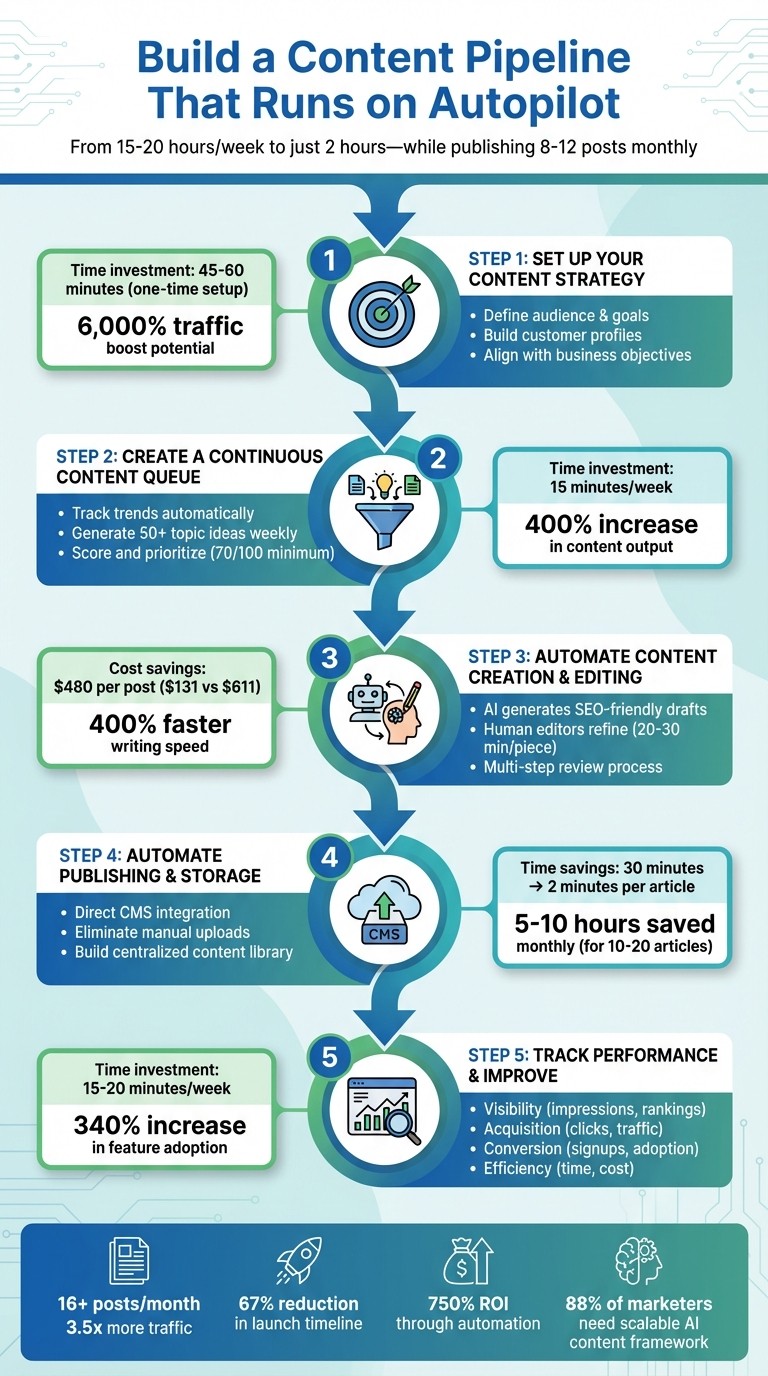
5-Step Content Pipeline Automation Process for Founders
Step 1: Set Up Your Content Strategy
Define Your Audience and Goals
Start by identifying who your audience is and what you want to accomplish. Build detailed customer profiles that include their demographics, challenges, and how your content can provide solutions. This isn’t just about knowing your audience - it’s about tying those insights to measurable business outcomes.
For example, instead of creating content without a clear purpose, align it with goals like boosting organic traffic, generating leads, or improving customer retention. Focus on how addressing specific pain points can directly impact these metrics. Make sure your strategy also emphasizes consistency in brand voice, SEO performance, and delivering a great reader experience.
Spend 10–15 minutes refining these profiles to pinpoint high-quality leads. Then, map your content to business objectives with a full-funnel marketing strategy with pieces like conversion guides, nurturing emails, or posts tailored to specific channels.
Use Automation to Build Your Strategy
After defining your audience, streamline your planning process with automation. AI tools can analyze your website and competitor data to generate a comprehensive content plan. This plan will outline your positioning, brand voice, and areas where content is lacking.
For instance, Averi’s system can scan your website to understand your business, suggest ideal customer profiles, evaluate competitors, and create a content roadmap. You can refine this plan in about 10 minutes, and a full setup takes just 45–60 minutes. This approach has shown impressive results, such as a 6,000% traffic boost over six months [7][8].
AI tools handle tasks like keyword analysis, style enforcement, and readability checks, freeing your team to focus on creative decisions and messaging. While AI identifies opportunities, you remain in control of the final direction and strategic choices.
How I Use AI to Automate Content Creation - Step-by-Step (FULL GUIDE)
Step 2: Create a Continuous Content Queue
With your strategy in place, the next step is ensuring a steady pipeline of relevant content ideas. This means setting up a system that keeps ideas flowing without relying on weekly brainstorming sessions. The aim is to build a queue that consistently generates, organizes, and prioritizes topics, so you're never scrambling for inspiration.
Track Trends and Opportunities
Automate the process of spotting emerging topics, keywords, and gaps in competitor strategies. Tools like Averi AI can connect with platforms like Google Trends and social media to monitor rising search queries and industry discussions in real time. For example, if a high-intent search query suddenly spikes by 200%, Averi AI can generate over 50 topic ideas each week tailored to your strategy and audience [4][5].
Consider this: one media company increased its content output by 400% and organic traffic by 250% while slashing production costs by 60%. Another organization shortened the time to update case studies from three days to just three minutes [5].
To streamline this process, integrate sources like Reddit discussions, YouTube comments, and SEO tools into a centralized system that performs daily scans. This setup can deliver 20–30 well-researched ideas every month, all aligned with a content marketing strategy that drives leads.
Prioritize and Approve Topics
Once you've gathered ideas, rank them using a scoring system. Evaluate factors like search volume (e.g., above 1,000 monthly searches), low competition, alignment with business goals like lead generation, and how quickly a trend is gaining traction. Many frameworks suggest setting a minimum score - such as 70 out of 100 - for topics to make it into your production queue [4][6].
Averi AI simplifies this by using algorithms to rank topics based on their potential ROI. The top 10% of ideas are sent to your dashboard for review. In just 15 minutes each week, you can approve, reject, or tweak these high-priority topics using collaborative tools [2]. This streamlined process eliminates common delays, such as unclear deadlines or manual handovers, cutting approval times by 80% and enabling the production of hundreds of content pieces monthly [4][3].
Organize your queue by content type - such as tutorials, comparisons, or thought leadership pieces - to ensure you're addressing every stage of the buyer journey. Conduct bi-weekly reviews to keep your queue aligned with the strategy you outlined in Step 1. This prevents your content from drifting off course and keeps the focus on high-impact topics.
With a well-structured and prioritized queue, you're ready to move on to automating content creation in the next phase.
Step 3: Automate Content Creation and Editing
Once you've established a solid content queue, the next step is to speed up the process without sacrificing quality. Automating parts of the creation and editing process allows you to transform approved ideas into publishable content faster. AI tools can handle the heavy lifting of research and drafting, while human input ensures the final product aligns with your brand and maintains accuracy.
Use AI for Drafts and Research
AI tools can take your target keywords, brand guidelines, and competitor insights and turn them into structured, SEO-friendly drafts. These drafts often include hyperlinked sources, FAQ sections, and concise summaries. For example, Averi AI simplifies this process by analyzing keywords and adhering to your style guide to produce consistent first drafts [4][10]. Each draft comes with built-in checks, making the review process more efficient.
The benefits of AI in content production are striking. It can boost writing speed by up to 400% and reduce costs by 50% per article [1]. On average, AI-assisted content creation costs $131 per piece compared to $611 for traditional human-only workflows [2]. Enterprise teams using similar systems can produce hundreds of articles monthly by integrating SEO keywords and existing knowledge bases directly into their pipelines [10].
To adopt this approach, start by feeding your AI tool with essential inputs like keywords, brand guidelines, and competitor data. Use it to generate outlines and drafts, and test the process with a small batch of 10–15 pieces over two weeks. Measure both time savings and quality improvements [4][10]. For a seamless workflow, integrate your AI tool with existing systems through APIs and automate tasks like link validation, style compliance, and keyword checks. This setup allows humans to focus on higher-level tasks like fact-checking and strategic alignment [4].
Refine with Human Collaboration
AI can deliver a solid first draft, but human editors are essential for adding the finishing touches. Spend about 20–30 minutes per piece refining the content to match your brand voice and ensuring accuracy [2]. This stage is critical for tasks that require creativity, strategic thinking, and nuanced decision-making - areas where AI falls short [4][3].
Streamline the editing process by using automated routing tools to assign drafts to editors for review. Features like track changes, commenting, and version control help maintain organization and avoid file confusion [4][3]. Workflow automation tools like Zapier or Make can handle notifications and task handoffs, while CMS platforms enable collaborative, real-time editing [3][6]. In Averi's editing interface, editors can request AI to rewrite, expand, or adjust specific sections while adding their own insights and addressing technical details [2].
This multi-step review process - AI drafting, human editing for tone and accuracy, and final review by a subject matter expert - has been shown to improve content quality and SEO performance for 67% of businesses that implement it effectively [2].
The result is a highly scalable system capable of producing hundreds of high-quality pieces every month. Bottlenecks like manual handoffs and delays are minimized, and structured pipelines can deliver up to 750% ROI through automation [4]. Additionally, each new piece of content enriches your Library in Averi, enabling automatic internal linking, content clustering, and smarter drafts for future projects [9][7].
Step 4: Automate Publishing and Storage
Connect Directly to Your CMS
Manually publishing content can be a headache - it’s slow, error-prone, and often leads to formatting issues, broken links, or missing images. Direct CMS integrations take this hassle off your plate. With native integrations, you can send fully formatted, metadata-complete content straight to your site without the need for copy-pasting.
For example, Averi’s direct integration with platforms like Webflow, Framer, and WordPress eliminates manual uploads, saving 20–30 minutes per post [2]. This kind of efficiency is a game-changer for teams managing frequent publishing schedules. While tools like Zapier offer connections to thousands of apps, they require custom setup for each workflow. On the other hand, AI tools like Jasper often demand manual work to connect with your CMS [2].
Automating the publishing process can shrink upload times from 30 minutes to just 2 minutes per article [2]. For teams publishing 10–20 articles a month, this translates to 5–10 hours saved monthly. That’s time you can reinvest in other areas, like refining your product or brainstorming new content ideas, while keeping your publishing schedule on track.
Build a Centralized Content Library
Every article you publish isn’t just a one-off - it’s a resource. A centralized content library ensures all your work is stored in one searchable location, making it easier to revisit past pieces, reuse research, and suggest internal links automatically. This kind of system forms the backbone of a smarter content strategy. Each new addition strengthens your AI’s understanding of your brand voice, product messaging, and content structure [2].
The benefits add up over time. Think of your library as your "Brand IQ", a growing repository that helps your AI refine your voice and reduce the need for future edits [2][13]. When creating new drafts, the system can pull from this library to recommend internal links, identify content clusters, and maintain consistency across your site. Tracking metrics like the number of internal links suggested and implemented can further enhance your site’s architecture and SEO performance [2].
To measure success, focus on key metrics like production efficiency (how much content you produce without increasing team size), deployment speed (how quickly drafts go live), and library utility (how often stored content is reused or adapted) [11][12]. Teams that embrace creative automation often see a 50–60% reduction in production time [11]. Regularly reviewing these metrics helps you identify strengths and pinpoint areas for improvement. A centralized content library doesn’t just preserve your work - it’s a foundation for smarter workflows and better performance tracking.
Step 5: Track Performance and Improve
Monitor Metrics and Trends
Publishing content is just the beginning - what sets a successful strategy apart is how well you track and adapt based on performance. Instead of drowning in complicated dashboards, focus on four main categories: visibility (impressions and keyword rankings), acquisition (clicks and traffic sources), conversion (signups and feature adoption), and efficiency (production time and cost per asset).
AI-powered tools can simplify this process by automating performance tracking while also analyzing competitor activity and spotting content gaps. For example, platforms like Averi can monitor market trends and competitor content, surfacing opportunities and providing actionable recommendations. If a blog post is close to ranking on page one, AI can suggest specific updates to push it higher.
To stay on top of this, dedicate 15–20 minutes each week to reviewing a centralized dashboard. Focus on three areas: your top-performing content (to replicate success), underperformers (to improve or retire), and strategic content engine for new keyword opportunities. This routine keeps you informed without eating up your time. In fact, automating workflows can cut data analysis time by up to 50% [1].
Metric Category | Metrics | Improvement Action |
|---|---|---|
Visibility | Impressions, Keyword Rankings, AI Citations | Add updated data or FAQs to improve rankings. |
Acquisition | Clicks, CTR, Traffic Source | Refine meta-descriptions or headlines to boost engagement. |
Conversion | Lead Gen, Feature Adoption, Signups | Adjust calls-to-action based on what drives conversions. |
Efficiency | Production Time, Cost per Asset | Streamline workflows or refine AI prompts to reduce bottlenecks. |
By focusing on these metrics, you can take immediate and informed actions to improve your content's performance.
Act on Recommendations
Once you’ve gathered performance data, the next step is turning those insights into actionable strategies. Data is only as useful as the changes it inspires. To close the feedback loop, use what you’ve learned to refine your content process. For example, if a piece performs well, analyze why - maybe it’s the tone, structure, or keyword strategy - and incorporate those elements into your future content. If something underperforms, AI tools can help determine whether it needs a refresh, better internal links, or if it should be retired altogether.
Just as automation has streamlined content creation, AI-driven insights now make continuous improvement possible. Advanced platforms even optimize for GEO, structuring content to align with AI model citations. This creates a self-sustaining content engine, ensuring your strategy evolves with each cycle. Use performance data to decide which high-performing content deserves paid promotion and which topics could benefit from follow-up pieces to build a more comprehensive cluster.
In August 2025, a mid-stage B2B SaaS company leveraged Averi’s AI tools and workflows to support a feature launch. By coordinating 94 pieces of content across multiple channels within 48 hours and optimizing in real-time based on engagement data, they saw a 340% increase in feature adoption during the first week and reduced their typical launch timeline by 67% [1].
Conclusion
Creating a content pipeline that operates seamlessly alongside product development starts with streamlining your workflow. By following the five steps outlined here - establishing a strategy, maintaining a steady content queue, automating creation and editing, publishing directly to your CMS, and monitoring performance - you can transform content creation from a tedious chore into an efficient system. When automation connects these stages, your marketing efforts become consistent and scalable without diverting focus from your core product goals.
The advantages of automation are clear. Companies publishing 16 or more blog posts each month see 3.5 times more inbound traffic compared to those with inconsistent posting schedules [1][2]. AI tools also help reduce production expenses, saving an average of $480 per blog post [2]. Additionally, automation can slash the time spent on content creation from 15–20 hours a week to just 2 hours, making the process far less time-intensive [2].
The benefits don’t stop there - they grow over time. An automated content pipeline creates a compounding effect, where each new piece of content strengthens SEO performance and audience engagement without requiring a proportional increase in effort [4]. A well-maintained content library continues to drive traffic and boost visibility, while analytics provide insights to refine your strategy. This feedback loop helps you focus on topics and formats that deliver the best results, ensuring your resources are used effectively [4][6].
Tools like Averi AI take this process further by managing the entire workflow - from strategy and research to drafting, publishing, and analytics - all in one platform. Once you input your brand guidelines and audience details, the system continuously optimizes your content plan [7][8]. It tracks trends, queues relevant topics, and suggests actionable next steps, giving you control with minimal effort [7][8]. This approach addresses the needs of the 88% of marketers seeking a scalable AI-driven content framework [14].
With an automated content pipeline in place, your marketing efforts become a background operation that supports your team’s focus on innovation. The result is a self-sustaining engine that drives lead generation, enhances visibility, and fuels growth - a perfect harmony between content strategy and product development that defines modern marketing success.
FAQs
What’s the minimum setup to start this pipeline?
To kick off your content pipeline, begin by outlining your content strategy. Spend about 15 minutes identifying key pillars, specific topics, and how often you plan to publish. Next, dedicate around 45 minutes to creating a reusable content brief template and a style guide to ensure consistency. Use Averi AI to automate the creation of content drafts, then refine and polish them for quality. Engage your team for tasks like writing, editing, and optimizing for SEO, sharing the templates to simplify collaboration. With this approach, most of these steps can be completed in just a few hours.
How do I keep AI-written posts accurate and on-brand?
To keep AI-generated posts accurate and aligned with your brand, start by setting clear guidelines that define your brand’s voice, tone, and compliance standards. Update these guidelines regularly to reflect any changes as your brand grows or evolves. Always include human oversight in the process - have drafts reviewed and polished by a person before they go live. By pairing automated tools with human editing, you can catch mistakes, maintain consistency, and ensure the content stays true to your brand’s messaging and personality.
What metrics show the pipeline is working?
Key metrics that highlight how well a pipeline is performing include cycle time, lead time, deployment frequency, accuracy, and ROI. Together, these metrics provide insights into efficiency, speed, quality, and the overall impact on business outcomes. Prioritizing these indicators helps ensure the pipeline delivers measurable and meaningful results.
Related Blog Posts

Zach Chmael
CMO, Averi
"We built Averi around the exact workflow we've used to scale our web traffic over 6000% in the last 6 months."
Your content should be working harder.
Averi's content engine builds Google entity authority, drives AI citations, and scales your visibility so you can get more customers.