How to Build SEO Momentum Before You Can Afford a Marketing Team

Averi Academy
Averi Team
8 minutes

In This Article
Grow organic traffic without a marketing team: use free tools for keyword research, optimize pages, leverage AI for content, and earn quality backlinks.
Updated:
Trusted by 1,000+ teams
Startups use Averi to build
content engines that rank.
Achieving steady SEO growth without a marketing team is possible by focusing on low-cost, high-impact strategies. Startups can generate organic traffic and leads by prioritizing content creation, keyword optimization, and link-building - all while using free or affordable tools. Here’s how:
Start with Keywords: Use free tools like Google Search Console, Google Trends, and AnswerThePublic to identify the terms your audience is searching for. Focus on high-intent keywords to drive conversions.
Optimize Existing Pages: Improve rankings for pages sitting on Google’s 2nd or 3rd page by refining titles, meta descriptions, and internal links.
Leverage AI for Content Creation: Use AI tools to draft content quickly, focusing on long-tail keywords and high-conversion formats like comparison pages and pricing guides.
Build Backlinks: Partner with non-competing businesses, guest post on niche sites, and join industry communities to earn quality links.
Track and Adjust: Use free analytics tools like Google Search Console to monitor performance, update underperforming pages, and analyze competitors.
SEO Strategy - The One-Hour Guide to SEO, Part 1
Research and Keyword Strategy Basics
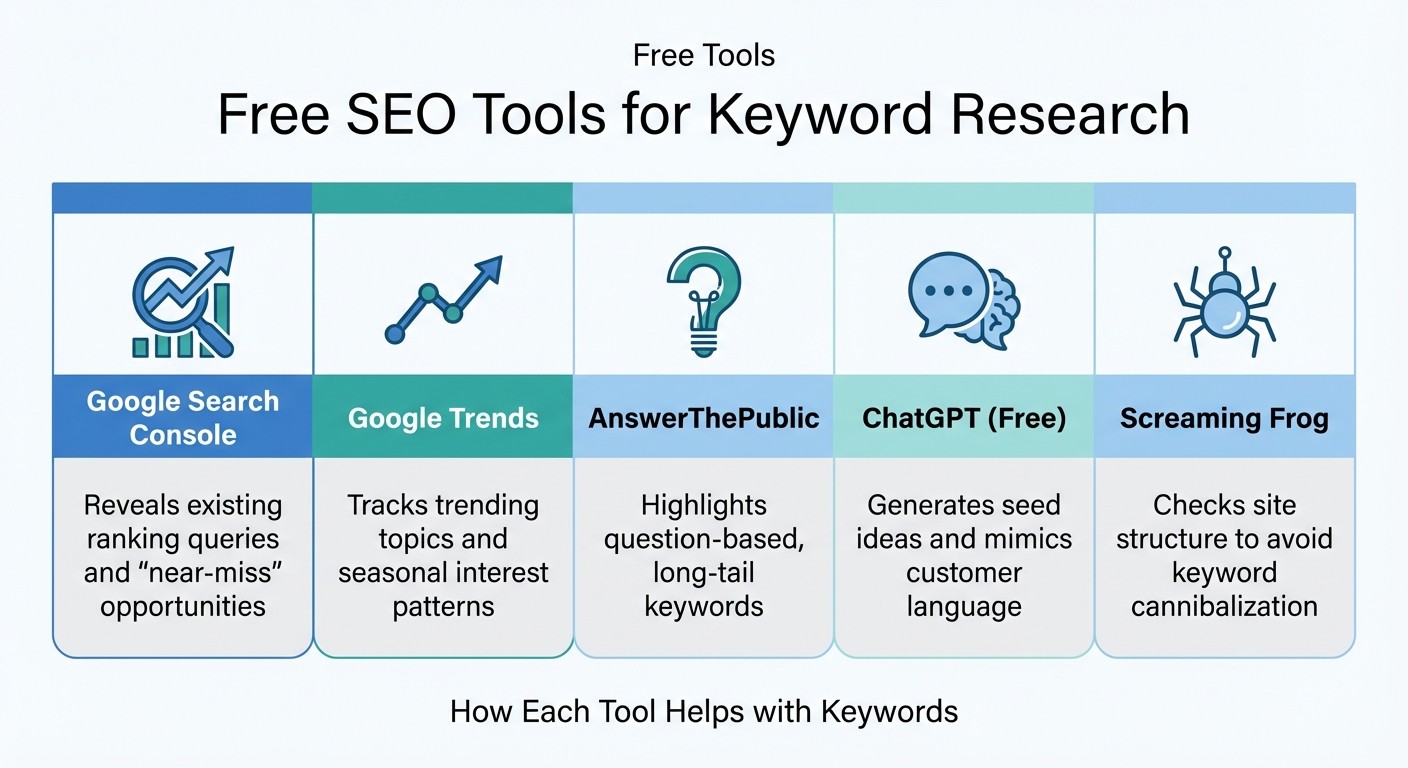
Free SEO Tools Comparison for Startups: Features and Use Cases
Keyword research doesn’t have to be complicated or require pricey tools. The main objective is straightforward: figure out what your customers are searching for and create content that matches those needs. Plenty of free tools can help you uncover actual search behavior. For instance, Google Search Console highlights the queries already bringing traffic to your site and identifies "near-miss" keywords sitting on pages 2 or 3 - keywords that might only need a little push to reach page 1 [1]. Google Trends can help you spot rising topics and seasonal shifts in interest, while AnswerThePublic reveals long-tail, question-based keywords that mirror how people naturally phrase their searches. Even ChatGPT’s free version can help you brainstorm initial ideas and pick up on the language your audience uses.
Find Your Audience Using Free Tools
If your website has been live for a while, Google Search Console is a great place to start. It provides detailed insights into which queries are driving impressions and clicks, as well as those ranking just below the top search results. Combine this with Google Trends to check if a topic is gaining or losing traction, and use AnswerThePublic to uncover the specific questions your audience is asking. Beyond these tools, customer support tickets, sales calls, and online forums can give you a direct line to the language and concerns of your target audience. These insights are invaluable for aligning keywords with what your customers genuinely care about.
Free Tool | How It Helps with Keywords |
|---|---|
Google Search Console | Reveals existing ranking queries and "near-miss" opportunities |
Google Trends | Tracks trending topics and seasonal interest patterns |
AnswerThePublic | Highlights question-based, long-tail keywords |
ChatGPT (Free) | Generates seed ideas and mimics customer language |
Checks site structure to avoid keyword cannibalization |
Match Keywords to Customer Intent
Once you’ve identified your audience, the next step is to match keywords to the intent behind their searches. Focus on keywords that show buying intent or address real problems your customers want solved. For example, someone searching for "project management software pricing" is likely ready to buy, while "what is project management" suggests they’re still in the research phase. It’s worth noting that the first organic Google result gets an average click-through rate of 39.8%[6][8], and SEO leads convert at nearly 14.6%, compared to just 1.7% for cold outreach[7]. To make the most of your efforts, organize keywords by funnel stage - awareness (informational), consideration (comparison), and decision (transactional). If resources are tight, prioritize keywords in the consideration and decision stages, as these are more likely to drive conversions.
Prevent Keyword Cannibalization
Keyword cannibalization happens when multiple pages on your site compete for the same keyword, which can dilute authority and confuse search engines about which page to rank. To spot this, use the site:yourdomain.com "keyword" search operator to find pages targeting the same term. Tools like Ahrefs or Semrush are also helpful for identifying overlapping keywords across URLs [1]. Once you’ve pinpointed the issue, consolidate similar pages, apply canonical tags, or adjust internal links to establish a primary page. To avoid keyword cannibalization from the start, assign a unique primary keyword to each page during the planning phase. Tracking keywords in a content map or spreadsheet can help ensure every page has its own focus, strengthening your overall SEO strategy.
Low-Cost On-Page SEO Methods
Once you've nailed down your keyword strategy, the next step is optimizing your pages to clearly showcase their value to search engines. For startups operating on tight budgets, on-page SEO is a smart and affordable way to drive organic growth. The idea is to make it crystal clear to search engines what your pages are about and why they deserve a higher ranking. The best part? Most of these optimizations require time, not money, and don’t demand advanced technical skills.
Optimize Core Pages for Keywords and Clarity
Begin with the low-hanging fruit: pages that already rank in positions 11–20 on Google [9]. Use Google Search Console to pinpoint these opportunities, then refine the content by integrating your primary keyword strategically - place it in the title, early in the content, and naturally throughout the page [8]. Keep title tags concise (50–60 characters) and meta descriptions within 150–160 characters to ensure they display properly in search results [8].
Structure your content for readability. Break it into short paragraphs, use descriptive subheadings (H2, H3), and add bullet points to make it easy for both users and search crawlers to skim [8]. Compress images with tools like TinyPNG to improve load times [9]. After optimizing for keywords, focus on linking your pages effectively to guide both users and search engines through your site.
"For a startup, every dollar counts. Investing in affordable SEO tools is about strategically allocating resources to build a strong online foundation that can compete with larger players from day one." - Jorge Leger, Founder, Astound Media [10]
Use Internal Links to Connect Pages
Internal links play a dual role: they help search engines understand your site’s structure and guide visitors to relevant content. A hub-and-spoke model works particularly well. Create a central "Pillar Page" for broad topics, link it to detailed "Spoke Pages", and ensure the spokes link back to the pillar and to each other [1].
Make these connections early - place links to the pillar page within the first 200 words of your spoke content. When publishing new content, link to it from two high-authority pages on your site to speed up indexing. To find existing pages that could link to your new content, use the Google search operator site:yourdomain.com "target keyword". Keep your site’s structure user-friendly by ensuring every page is reachable within 3–4 clicks from the homepage. Free auditing tools can help you spot broken links or orphaned pages that lack internal connections [9][10].
Apply Google's E-E-A-T Standards
Google ranks content based on four key factors: Experience, Expertise, Authoritativeness, and Trustworthiness (E-E-A-T). To meet these standards, include personal anecdotes or customer stories to highlight real-world experience. Use industry-specific terms and "named entities" to signal expertise. Build authority by creating hub-and-spoke clusters that establish topical depth, and link to credible sources like Google Scholar or industry reports to reinforce trustworthiness. These small, cost-effective adjustments can significantly enhance how Google perceives your content’s value.
Creating Content Without a Team
Once your on-page optimizations are in place, the next step is creating high-quality content - even if you're working solo. Producing content without a full team can be tough, but AI tools have made the process much more manageable. You don’t need a dedicated writer, editor, or strategist to build SEO traction. What you need is a workflow that does most of the heavy lifting, allowing you to focus on the parts that truly require your personal touch. These strategies can help small teams or individuals grow their online presence efficiently.
Use AI Tools to Streamline Content Creation
AI platforms like Averi AI simplify the entire content creation process, from research and drafting to SEO optimization and publishing directly into your CMS. A practical approach is the 80/20 rule: let AI handle 80% of the groundwork - like structuring and drafting - while you refine the final 20% to fit your brand’s voice and goals. This method enables you to publish 8–12 or more posts each month, with annual costs ranging between $540 and $6,000. Compare that to spending $36,000 or more on freelancers or $60,000–$180,000 on agencies.
When choosing tools, look for features like Brand Core or Permanent Memory, which analyze your website to understand your products, audience, and tone. This ensures the AI-generated drafts align with your brand without repeated input from you. The tool should also identify topic clusters - groups of related keywords structured around a central theme. These clusters are far more effective at signaling authority to search engines than scattered, unrelated blog posts.
Start with Bottom-of-Funnel (BOFU) content such as comparison pages, pricing guides, and listicles like “Best [Category] for [Audience].” These types of content convert 3.5 times better than top-of-funnel articles and attract high-intent traffic quickly. A simple weekly workflow might include: spending 15 minutes on Monday approving AI-suggested topics, dedicating 45–60 minutes mid-week to editing drafts, and wrapping up with a 15-minute review of performance metrics on Friday.
Focus on Long-Tail Keywords
Targeting long-tail keywords - specific phrases like "SEO for bootstrapped SaaS" instead of just "SEO" - is one of the quickest ways to rank. These keywords face less competition, attract users with precise needs, and tend to convert better because they align closely with search intent. AI tools can help you prioritize low-competition keywords, such as those with a Keyword Difficulty score under 29, which are more achievable for newer or smaller sites to rank for in a shorter time frame.
Keyword Type | Competition | Conversion Intent | Best For |
|---|---|---|---|
Short-Tail | Very High | Low/Informational | Pillar/Hub Pages |
Long-Tail | Low | High/Specific | How-to Guides, Listicles |
Comparison | Medium | Very High/BOFU | Comparison Tables, "Vs" Pages |
Question-Based | Low | Medium/Educational | FAQ Sections, Tutorials |
Incorporate 3–5 semantically related queries and named entities (like specific tools or companies) instead of overusing a single keyword. This helps AI-driven search engines like ChatGPT and Perplexity categorize your content more effectively. Adding a concise 50–75 word TL;DR summary at the top of your articles can also increase the likelihood of being cited by these platforms.
Experiment with Different Content Formats
Beyond targeting keywords, diversifying your content formats can significantly boost your SEO results. Different formats cater to varied search intents and reader preferences. For example:
Comparison pages work well for driving conversions.
How-to guides establish expertise and address specific search needs.
Listicles often generate high click-through rates.
Case studies help build trust and provide social proof.
A cost-effective way to expand your content library is by repurposing existing material. For instance, a single webinar can be turned into a blog post, video snippets, and even an ebook. Similarly, a detailed how-to guide can be adapted into video scripts or infographics.
Content Format | Best For | Repurposing Potential |
|---|---|---|
Comparison Pages | Conversions (BOFU) | Social snippets, ad copy |
How-To Guides | Authority & Search Intent | Video scripts, infographics |
Listicles | High CTR & Shareability | Newsletter content, social posts |
Case Studies | Trust & Social Proof | Sales one-pagers, press releases |
Webinars | Deep Engagement | Blog posts, ebooks, video clips |
Match the content format to the search intent of your target keywords. For example, question-based long-tail keywords are ideal for FAQ sections and tutorials, while comparison keywords are best suited for detailed "Vs" pages with side-by-side tables. The key is to align your format with what your audience is searching for - not just what’s easiest to produce.
Building Authority Through Links
Once your pages are optimized and your content is solid, it’s time to focus on external links to round out your SEO strategy. Backlinks act as trust signals for Google, showcasing your site's authority. While traditional link-building can be pricey, the good news is that quality outweighs quantity. With the right partnerships and active community involvement, you can build meaningful authority without spending a dime on outreach services.
Partner with Other Businesses for Links
One of the quickest ways to gain backlinks is by teaming up with non-competing businesses that cater to the same audience. For instance, a dentist might exchange links with a local gym or juice bar, while in the SaaS space, a project management tool could collaborate with a time-tracking app. Both examples involve businesses that target similar users but don’t compete directly [11].
Guest posting on niche websites and leveraging digital PR for announcements - like funding rounds, product launches, or original research - can also generate authoritative backlinks [7]. Case studies are particularly effective because they’re shareable and often encourage your partners to link back to your site as a reference [7].
Another practical method is the ABC link exchange model: Site A links to Site B, Site B links to Site C, and Site C links back to Site A. This three-way structure avoids the risks of direct reciprocal linking while still building authority for all involved [4]. These collaborative efforts not only enhance your backlink profile but also support your overall SEO strategy.
Join SEO and Industry Communities
Broadening your efforts, participating in industry communities can further strengthen your link-building strategy. Engaging in SEO-focused groups or industry Slack channels - like Amplitude's Cohort - can lead to natural partnerships and backlink opportunities [2][4]. The key here is to provide value first. Instead of immediately sharing links, focus on answering questions, sharing expertise, and building genuine relationships. Over time, these connections often result in organic backlinks as others reference your content.
"The best way to earn backlinks is to create something worth linking to: content that offers value." – Andrae Washington, Startup Programs Manager, Amplitude [2]
Platforms like Subreddits, niche forums, and industry-specific networks also work well for relationship-building. The secret? Be helpful, not promotional. When you consistently provide insights that people find useful, they’ll naturally want to link to your work.
Prioritize Quality Links Over Volume
All backlinks are not created equal. A single link from a high-authority, relevant website carries far more weight than dozens of links from low-quality directories. For SaaS companies, being listed on niche directories like G2, Capterra, or Product Hunt can deliver far greater value than chasing hundreds of generic backlinks [7][4].
"A SaaS tool listed on G2 or Capterra can do more than 100 low-quality links ever will." – Digital C4 [7]
For lean teams, focusing on fewer but higher-quality links is a smart move. Target sites with real traffic, relevant content, and strong editorial standards. A handful of authoritative backlinks can make a significant impact, complementing your on-page SEO efforts. And with SEO-generated leads converting at 14.6% - compared to just 1.7% for cold outreach [7] - investing in quality link-building is well worth your time.
Measuring and Improving SEO Performance
SEO efforts mean little without tangible results. Fortunately, you don’t need pricey analytics tools to track progress. Free resources like Google Search Console and Google Analytics 4 deliver the critical data needed to spot opportunities, address issues, and make informed adjustments. By focusing on key metrics, you can refine your SEO strategy and build momentum without breaking the bank.
The SEO world is shifting fast. According to Gartner, traditional search engine usage could drop by 25% by 2026, and 79% of users are already turning to AI-driven search tools for discovery. This makes it essential to monitor not just Google rankings but also your visibility in AI-powered platforms like ChatGPT and Perplexity. Tools such as Perplexity Comet, SEMrush's AI Visibility Toolkit, and Microsoft Clarity (offering free heatmaps and session recordings) can help uncover performance bottlenecks.
Track Key Metrics with Free Tools
Start with Google Search Console to keep tabs on indexing, crawl errors, and page performance. Pay close attention to the "Coverage" and "Core Web Vitals" reports to catch indexation problems and loading delays. Then, use Google Analytics 4 to analyze user behavior and pinpoint issues like bounce rates over 70%, which often indicate misaligned search intent.
For competitive insights, Moz's free SEO tools provide Domain Authority metrics, while Ahrefs Webmaster Tools offer backlink analysis and technical audits for verified site owners. Screaming Frog’s free version is another handy option, allowing you to crawl up to 500 URLs to identify structural issues. By tracking these metrics weekly, you can ensure your site remains both visible and technically sound. When you spot underperforming pages, prioritize quick updates to improve their performance.
Update Content That Isn't Ranking
One of the simplest ways to boost your SEO is by refreshing content that’s close to ranking well. Use Google Search Console to find pages sitting in positions 11–30. These pages often require less effort to bump to page one compared to creating brand-new content. Pay attention to pages with high impressions but low click-through rates (under 1% or 3%), as these may need more engaging titles or meta descriptions. Aim for meta descriptions between 150 and 160 characters to ensure they display fully in search results.
Additionally, flag pages that have slipped from page one, dropped below position five, or lost over 25% of their traffic. Update these with fresh statistics, recent customer examples, and a visible "Last Updated" date to signal relevance. Reviewing the top three competitor results for your target keywords can also help you align better with user intent by analyzing their content type and presentation. Strengthen internal links by connecting these pages to at least two high-authority pages on your site, redistributing link equity and improving their performance.
Study What Competitors Are Doing
Don’t stop at internal updates - keep an eye on the competition. Use tools like SEMrush’s free tier (offering three checks daily) or Seobility’s free plan (allowing five checks daily) to conduct competitor gap analyses. These tools can reveal keywords where competitors rank in the top 10 but you don’t, highlighting potential content opportunities. Additionally, platforms like Answer the Public can help you create content that directly addresses the questions your audience is asking. Staying updated on industry trends and monitoring competitor activity regularly will help you refine your strategy and stay ahead in the game.
Conclusion
Achieving SEO success with a lean team doesn’t require complex strategies - just consistent, focused effort. The approaches outlined here, including free keyword research, on-page tweaks, AI-driven content creation, targeted link building, and regular performance monitoring, provide a solid framework for long-term results. These methods are designed to work within tight budgets and limited resources. Even publishing a single article each month can lead to 12 authority-building pages in a year, creating momentum that grows over time [6].
Consistency is the game-changer. Take BriefBid as an example - they surpassed larger competitors by sticking to a focused, consistent SEO plan. Small improvements, like moving an article from position 5 to the top 3 on Google, can amplify your organic traffic tenfold and bring in high-intent leads that outperform paid ads [3].
Tools like Averi AI make these efforts even more manageable. Tasks that once took hours, like keyword research or drafting content, can now be completed in a fraction of the time. For instance, what used to take 4–6 hours of research can now be done in 15–30 minutes, and content creation that once took 5–8 hours can be condensed to under an hour. This efficiency allows small teams to deliver results that punch well above their weight.
These strategies combine to build lasting authority and fuel steady growth. Start with one actionable step this week - optimize a low-performing page, create content targeting a long-tail keyword, or set up Google Search Console tracking. Then, keep going. SEO thrives on consistent effort, and over time, it becomes a powerful shield against competitors while driving meaningful, sustainable results [3][5].
FAQs
How long does it take to see SEO results on a new site?
Most solo founders typically begin to see early SEO progress within 4–6 months. The real momentum, however, tends to build between months 7–12, as efforts start to compound. Achieving these results hinges on a steady commitment to consistent strategies and execution.
Which pages should I optimize first for quick ranking gains?
To make headway, start by refining pages that target low-competition, high-intent keywords. These are the golden opportunities where your content can stand out without battling heavy competition. Simultaneously, tackle technical SEO issues - things like improving page speed and fixing crawl errors. These tweaks can make a big difference in how search engines and users interact with your site.
Give special attention to your homepage, product pages, and core service pages, as these are often the most critical touchpoints for your audience. Pages with high commercial intent or those already pulling in traffic should be your top priority. Optimizing these can lead to quicker visibility gains and better engagement.
What’s the safest way to build backlinks without getting penalized?
The best way to build backlinks is to earn them naturally by focusing on ethical and effective strategies. Start by creating valuable, engaging content that naturally attracts links from other websites. Consider guest posting, but always prioritize providing genuine value to the audience rather than just link-building. Another effective approach is leveraging digital PR to secure editorial links by sharing noteworthy stories or insights with reputable publications.
Steer clear of manipulative practices like buying links, participating in link exchanges, or engaging in schemes designed to artificially inflate backlinks. These tactics violate Google’s guidelines and can lead to penalties that harm your SEO efforts. By sticking to organic and ethical methods, you’ll set the foundation for long-term success in search rankings.
Related Blog Posts

Zach Chmael
CMO, Averi
"We built Averi around the exact workflow we've used to scale our web traffic over 6000% in the last 6 months."
Your content should be working harder.
Averi's content engine builds Google entity authority, drives AI citations, and scales your visibility so you can get more customers.