

In This Article
Use AI for keyword research, SERP-backed briefs, drafting, and CMS publishing to scale SEO content and improve rankings.
Updated:
Trusted by 1,000+ teams
Startups use Averi to build
content engines that rank.
Creating SEO content that ranks is faster and more efficient in 2026, thanks to AI tools. Here's how you can use AI to improve your content strategy:
Keyword Research: AI reduces time spent on keyword research by 70-90%, identifying relevant terms, clustering them, and analyzing search intent.
Content Briefs: AI tools analyze top-ranking results to generate detailed content outlines, saving hours of manual effort.
Writing and Optimization: AI drafts 80% of the content, leaving you to refine it with original insights, verified data, and a strong brand voice.
Publishing and Tracking: AI integrates with your CMS for seamless publishing and provides analytics to monitor and improve performance.
This approach helps teams produce 3–5x more content while reducing production time by up to 60%. AI simplifies repetitive tasks, so you can focus on delivering high-quality, relevant content that aligns with searcher intent.
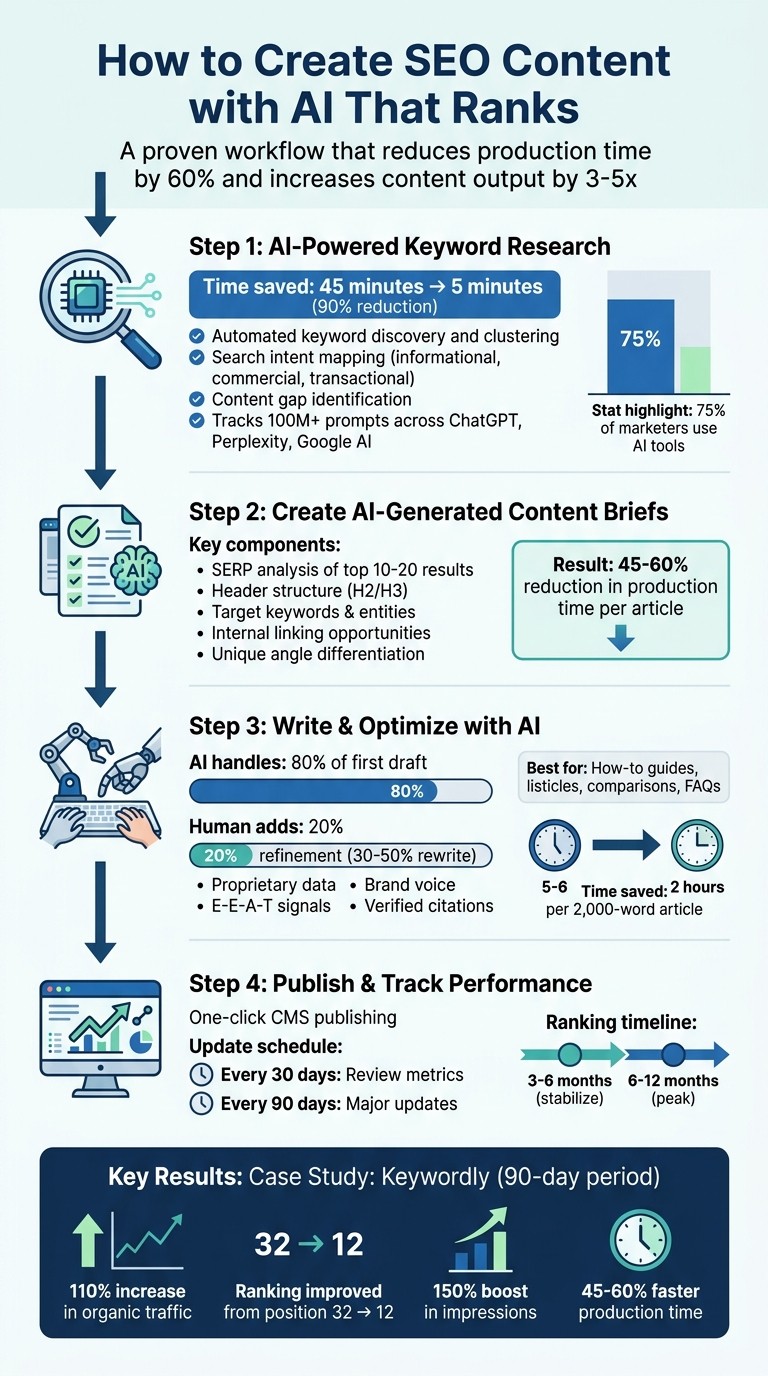
4-Step AI-Powered SEO Content Creation Workflow
How to create an AI SEO Automation to Rank #1 on Google (AI Agent + Autoblogging)
Step 1: Use AI for Keyword Research
Gone are the days when keyword research meant spending hours combing through search engine results and juggling multiple spreadsheets. AI tools have drastically shortened this process, cutting it down from 45 minutes to just 5 minutes by automating tasks like discovery, clustering, and intent mapping - tasks that are nearly impossible to execute at scale manually [8]. Over 75% of marketers now incorporate AI tools into their workflows, with 19% using them specifically for content creation [10]. But this isn't just about saving time - it’s about uncovering opportunities that traditional methods might overlook. This efficient analysis forms the backbone of smarter, data-driven content strategies.
Find Keywords with AI Tools
AI platforms leverage Natural Language Processing (NLP) to examine the top 30–40 search results and build topic models based on rankings. Tools like IBM Watson and Google NLU go a step further, identifying clusters of related keywords that establish topical authority. Some advanced platforms even offer "Personal Keyword Difficulty" metrics, tailored to your domain, to predict your chances of ranking for specific terms.
What sets the best AI tools apart is their ability to map search intent across massive datasets. They classify searches into categories like informational (research-focused), commercial (comparison-driven), or transactional (purchase-ready). These tools don’t stop at identifying keywords - they analyze your site, compare it to competitors, and highlight content gaps - valuable topics you’ve overlooked but should address.
For those looking beyond Google, Semrush One's AI Visibility Toolkit tracks over 100 million prompts across platforms like ChatGPT, Google AI Mode, Perplexity, and AI Overviews [8]. This is crucial as keyword research now extends into Generative Engine Optimization (GEO) - ensuring your content gets cited by AI systems, not just ranked in search engines [11]. Some tools even pull data from unconventional sources like Reddit and Amazon, capturing niche conversational search intent that traditional databases might miss [8].
Tool | Starting Price | Best For |
|---|---|---|
$16/mo | Real-time SEO data & AI agents | |
$14/mo | Keyword clustering & Reddit research | |
$79/mo | Content optimization & AI tracking | |
Semrush One | $165.17/mo | Comprehensive AI visibility & strategy |
$189/mo | Enterprise-grade NLP topic modeling | |
$38/mo | Content briefs & SERP research |
Always verify AI-suggested keyword volumes with Google Search Console. If you notice a 15-20% variance, it’s a red flag that the tool’s estimates might not be accurate enough for major decisions [8]. Use AI to uncover additional long-tail keywords and semantic variations you might miss manually. These insights will lay the groundwork for creating impactful content briefs in the next phase.
Study Competitors and Find Content Gaps
AI can also help you reverse-engineer your competitors' strategies. By analyzing the top 5–10 results for any target keyword, AI tools can extract common headings, questions, and unique angles competitors are using. Even more valuable, they pinpoint what’s missing - subtopics, unanswered questions, or overlooked perspectives that give you an edge.
Platforms like MarketMuse create topic models showing which subtopics high-ranking pages cover and where gaps exist [4]. AI tools can also pull People Also Ask (PAA) questions from search results, clustering them into themes. This reveals exactly what searchers are curious about but competitors haven’t fully addressed. Some tools even send relevance decay alerts, notifying you when your content starts losing its topical authority as new competitors emerge [8].
"LLMs like ChatGPT provide generic advice that doesn't consider what's already on the page. But Chatsonic identified real areas for improvement and concrete suggestions - it felt like collaborating with another SEO expert on the team!" - Evelina Milenova, SEO and Growth Manager, Opinion Stage [9]
Use AI to analyze the top 3 ranking posts for your target keyword and identify angles or questions they miss [2]. This competitive insight informs your strategy, helping you focus on areas where you can stand out. The aim isn’t to replicate what’s already ranking but to find the gaps where you can bring something new to the table. With keywords and competitor insights in hand, you’re ready to move on to crafting precise, targeted content briefs with AI.
Step 2: Create Content Briefs with AI
After pinpointing your target keywords and uncovering competitive gaps, the next move is crafting a content brief that aligns with search intent and incorporates all the critical ranking factors. A well-structured brief includes primary and secondary keywords, target audience details, search intent, ideal word count, header structure, a distinct angle, internal linking opportunities, and calls-to-action (CTAs). By leveraging AI to generate SERP-backed briefs, you can cut content production time nearly in half [7].
"The brief is the most important document in the workflow. It's also where AI saves the most time without sacrificing quality." – Averi [2]
The trick lies in blending AI's analytical prowess with human creativity. AI is excellent at dissecting the top 10–20 search results to identify common headers, subtopics, and entities expected by search engines [7]. Meanwhile, humans contribute the unique perspective, brand-specific context, and differentiation strategy. While AI simplifies data extraction and structure-building, human intervention ensures originality and a consistent brand voice. A robust brief also includes 3–5 internal link targets and CTAs tailored to the content's role in your full-funnel marketing strategy, ensuring it satisfies both search engines and broader business objectives.
Build Outlines from Search Results
AI tools can analyze high-ranking pages to uncover structural patterns that indicate relevance. By feeding an AI tool with the URLs or titles of the top-ranking posts, you can extract common headers, "People Also Ask" (PAA) questions, key entities, and even identify gaps like missing subtopics or unanswered questions. This approach enables your content to stand out.
For example, during a 90-day period ending in September 2025, Keywordly implemented an AI-driven workflow focused on SERP-backed briefs. Their strategy, which included recommended H2/H3 headers and specific entities, led to a 110% increase in organic traffic, improved their average ranking position from 32 to 12, and boosted impressions by 150%. They also slashed production time per article by 45–60% [7].
To differentiate your content, specify in the brief what unique value it will offer - whether it's original research, firsthand experience, or a fresh perspective. A human editor should then review the AI-generated outline to eliminate redundancies and ensure the narrative flow prioritizes reader engagement over algorithmic preferences.
Once your outlines are optimized to include essential ranking signals, automate the scheduling of these briefs to maintain a consistent content pipeline.
Set Up Automated Content Queues
Instead of manually creating briefs, advanced platforms can automate the entire process. Averi AI, for example, continuously monitors your market - tracking trends, analyzing competitor content, identifying high-potential keywords, and uncovering topics that resonate with your target audience. It organizes content ideas into categories like listicles, how-to guides, editorials, and comparisons. Each idea comes with a suggested title, target keywords, and a concise overview, ready for approval. This eliminates the bottleneck of topic selection.
The platform handles research and brief generation in the background, presenting actionable opportunities based on real-time data and competitive insights. Each brief is saved to a library, building a repository of context that allows AI drafts to become increasingly aligned with your brand voice over time.
"Teams that systemize AI content creation don't just publish faster - they compound organic growth month after month." – Keywordly [7]
With your content briefs optimized and automated, the next step is integrating AI-generated drafts with human expertise to produce content that ranks and resonates.
Step 3: Write and Optimize Content with AI
Once your AI-driven briefs are ready, it’s time to turn them into polished SEO content. This step significantly reduces production time while blending the speed of AI with the precision of human expertise using a framework for high-quality output [3][2]. AI is particularly effective for structured formats like how-to guides, listicles, comparison pages, FAQs, and glossary entries, whereas opinion pieces and deeply personal narratives still depend on human creativity.
Think of AI as your drafting partner. Its use has grown from powering 2.27% of top-performing pages in 2019 to an estimated 17% by 2025 [5]. The most effective workflow involves AI generating about 80% of the first draft, with humans fine-tuning the final version [3]. This stage transforms your optimized briefs into refined drafts, ready for publication.
Generate First Drafts with AI
Start by feeding your brief into an AI tool, generating content section by section to maintain focus and alignment. Your brief should include target keywords, audience insights, search intent, unique angles, and brand voice guidelines. Without these specifics, AI may produce generic content, so clarity in prompts is essential.
Break the process into manageable chunks. Begin with the introduction, followed by individual H2 sections, ensuring each aligns with your brief before moving on. Avoid filler phrases and prioritize actionable elements like checklists, troubleshooting steps, and concrete examples. AI drafts often run 20–30% longer than needed, so precise prompts can help streamline the editing process.
Tools like Averi AI simplify this workflow by incorporating your brand context and automatically applying an SEO- and GEO-optimized structure. It can generate drafts complete with FAQ sections and TL;DR summaries that include hyperlinked sources for easy verification, reducing the chances of AI hallucinations. Look for AI tools that support collaborative editing and built-in SEO optimization to make revisions more efficient. Once each section meets your brief’s criteria, move on to refining and optimizing the content.
Edit and Improve for Search Rankings
Refining the AI draft is where the magic happens. Focus on improving the introduction, incorporating proprietary data, and adding internal links. Address your audience’s specific problem and present a clear, actionable solution. Strengthen the draft with verified data, visual elements, and unique insights - aspects that AI alone cannot replicate.
Use optimization tools like Surfer SEO or NeuronWriter to ensure your draft covers all relevant terms and concepts Google prioritizes. These tools offer real-time feedback to help you achieve comprehensive coverage. During this editing phase, add 3–5 internal links to connect the new article to related posts, reinforcing your site’s topical authority.
Double-check all data and citations, as AI can sometimes introduce errors in dates, figures, and sources. Enrich your content with E-E-A-T signals (Experience, Expertise, Authoritativeness, Trustworthiness) by including firsthand testing results or expert quotes. Remember, search rankings often improve with regular updates rather than relying solely on a strong first draft. Plan to update your content every 30–90 days to maintain its relevance and visibility.
Once your content is polished and optimized, publish it directly to your CMS and track its performance over time.
Step 4: Publish and Track Performance
The final step in your AI-powered SEO workflow is ensuring your content goes live smoothly and keeping a close eye on how it performs. With your content polished and ready, the focus shifts to efficient publishing and ongoing performance monitoring.
Publish Directly to Your CMS
Thanks to AI-assisted drafting, publishing has never been easier. Integrating directly with your CMS streamlines the process, turning publishing into a simple, one-click task. Instead of manually transferring content from your AI tool to your CMS, unified systems handle everything in one place. For instance, Averi simplifies the entire workflow - drafting, formatting, and publishing seamlessly. Once you approve the draft, it publishes with the correct formatting, links, and metadata intact. Additionally, every published piece is automatically archived, helping future AI drafts better align with your brand's tone and style.
Monitor Results and Optimize Regularly
After publishing, it’s time to track how your content performs. AI analytics provide valuable insights into metrics like organic impressions, clicks, and keyword rankings, often via tools like Google Search Console. Beyond these, AI-specific metrics such as Production Velocity (time saved per article) and Edit Ratio (the percentage of AI-generated text used in the final version) offer deeper performance insights. A low edit ratio, for example, might signal the need to refine your prompts or content briefs.
Averi goes a step further, delivering actionable recommendations - whether it’s identifying content that needs updates, suggesting new keywords to target, or flagging competitor activity that requires a response. To maintain performance, set a regular refresh schedule:
Every 30 days: Review metrics to spot pages losing traction.
Every 90 days: Make significant updates, like adding FAQs or expanding subtopics.
AI analytics can also help detect content decay and identify opportunities for quick optimizations. For instance, prioritize pages ranking between positions 8–30, as these often present fast wins. If a piece doesn’t gain momentum within 4–8 weeks, troubleshoot for potential issues like intent mismatch - writing a guide when search results favor product pages - or weak internal links. Quarterly audits can also catch problems like keyword cannibalization.
Keep in mind that SEO content often takes time to reach its full potential. New posts typically stabilize in rankings after 3–6 months and may take 6–12 months to achieve their peak performance [6]. By committing to regular, data-driven updates, your content will remain competitive and visible, ensuring long-term success in your optimization strategy.
Conclusion
Using AI to create SEO content introduces a structured workflow that simplifies the technical aspects, allowing you to concentrate on strategic elements. The process is straightforward: start with AI-driven keyword research and competitor analysis, develop comprehensive content briefs, and let AI generate initial drafts. From there, refine the drafts by adding your unique insights, data, and proof points. Once polished, publish directly to your CMS and commit to ongoing performance tracking and updates.
This approach significantly reduces production time. For example, crafting a 2,000-word article can drop from 5–6 hours to roughly 2 hours [3]. A compelling case study comes from Keywordly, which adopted a full AI workflow in September 2025. By shifting to a cluster-based content strategy, they increased their posting frequency from 6–8 articles per month and achieved impressive results over 90 days: a 110% boost in organic traffic, a leap in their median ranking from position 32 to 12, and a 45–60% reduction in production time per article [7].
"AI content becomes a competitive advantage when paired with performance tracking, optimization insights, and repeatable systems." - Keywordly [7]
The key takeaway? AI can handle 80% of the heavy lifting - tasks like research, outlining, and drafting. However, the remaining 20% requires human expertise to inject originality, proprietary insights, and a strong brand voice [1][2]. Publishing raw AI-generated content is never advisable; instead, plan to rewrite 30–50% of the drafts to ensure they reflect your unique perspective and maintain quality standards [1][2].
This streamlined method highlights the power of blending AI with expert oversight. Interested in building your own AI-driven content system? Averi offers a solution that automates everything from strategy and keyword research to drafting, optimization, and direct CMS publishing. With a 14-day free trial, it’s a great way to get started [1]. The most successful teams don’t use AI to replace writing; they use it to eliminate repetitive tasks, freeing up time to focus on what truly drives performance - insightful, impactful content.
FAQs
How do I prevent AI content from sounding generic or “AI-written”?
To make AI-generated content feel distinct and engaging, blend AI capabilities with human creativity. Use AI for foundational tasks like gathering information and drafting initial ideas. Then, enhance the output by incorporating personal insights, specific examples, and thoughtful editing. Ensure the final content aligns with your brand's tone and undergoes thorough quality checks. This collaborative approach balances efficiency with originality, steering clear of the monotonous tendencies often found in unrefined AI text.
What should I verify before trusting AI keyword volume and difficulty?
To make informed decisions using AI keyword metrics, it's crucial to examine the accuracy and reliability of the data sources behind them. Confirm that the tool you're using provides current data that reflects actual search behavior and competition trends. Outdated or misaligned data can lead to misguided strategies.
Go beyond just looking at high search volume or low competition numbers. These metrics alone don’t tell the full story. Pay attention to search intent and how it aligns with your goals. For example, a keyword with high volume but vague intent might not drive the right kind of traffic. Similarly, low difficulty doesn’t always translate to easy wins if the context around the keyword is misunderstood.
By understanding the why behind these metrics - whether it’s user behavior, market trends, or competitive dynamics - you can make smarter, more effective decisions.
How often should I update AI-assisted SEO content to keep rankings?
To keep your rankings intact, it's essential to refresh high-priority AI-driven SEO content every 3–6 months. For product pages, monthly updates might be necessary, whereas blog posts can typically be reviewed and updated on a quarterly basis. At the very least, make it a point to evaluate all content annually to confirm it's still relevant and up-to-date. Consistent updates cater to AI systems' preference for fresh material, boosting both visibility and rankings in search results.
Related Blog Posts

Zach Chmael
CMO, Averi
"We built Averi around the exact workflow we've used to scale our web traffic over 6000% in the last 6 months."
Your content should be working harder.
Averi's content engine builds Google entity authority, drives AI citations, and scales your visibility so you can get more customers.