

In This Article
Find competitor content gaps, prioritize high-value opportunities, use AI and structured data to create authoritative content and improve SEO.
Updated:
Trusted by 1,000+ teams
Startups use Averi to build
content engines that rank.
Your competitors are ranking for keywords you're missing, dominating AI-generated summaries, and capturing traffic from topics you haven't covered. These content gaps - whether in keyword rankings, AI visibility, or SERP features - represent lost opportunities for your brand. Closing these gaps can significantly improve your SEO performance and authority.
Here’s how to address them:
Identify gaps: Use tools like Semrush or Ahrefs to spot missing, weak, or untapped keywords. Track where competitors appear in AI-generated summaries or dominate SERP features like Featured Snippets.
Prioritize opportunities: Focus on gaps with high commercial or transactional intent, outdated competitor content, or areas where you can provide unique insights or data.
Leverage AI tools: Platforms like Averi AI automate competitor analysis, suggest content ideas, and streamline content creation for faster results.
Enhance content: Add depth, clear intent coverage, and SEO features like FAQ schema, structured data, and expert bylines to stand out in search and AI summaries.
Monitor and update: Regularly track performance, refresh older content, and refine your strategy based on data.
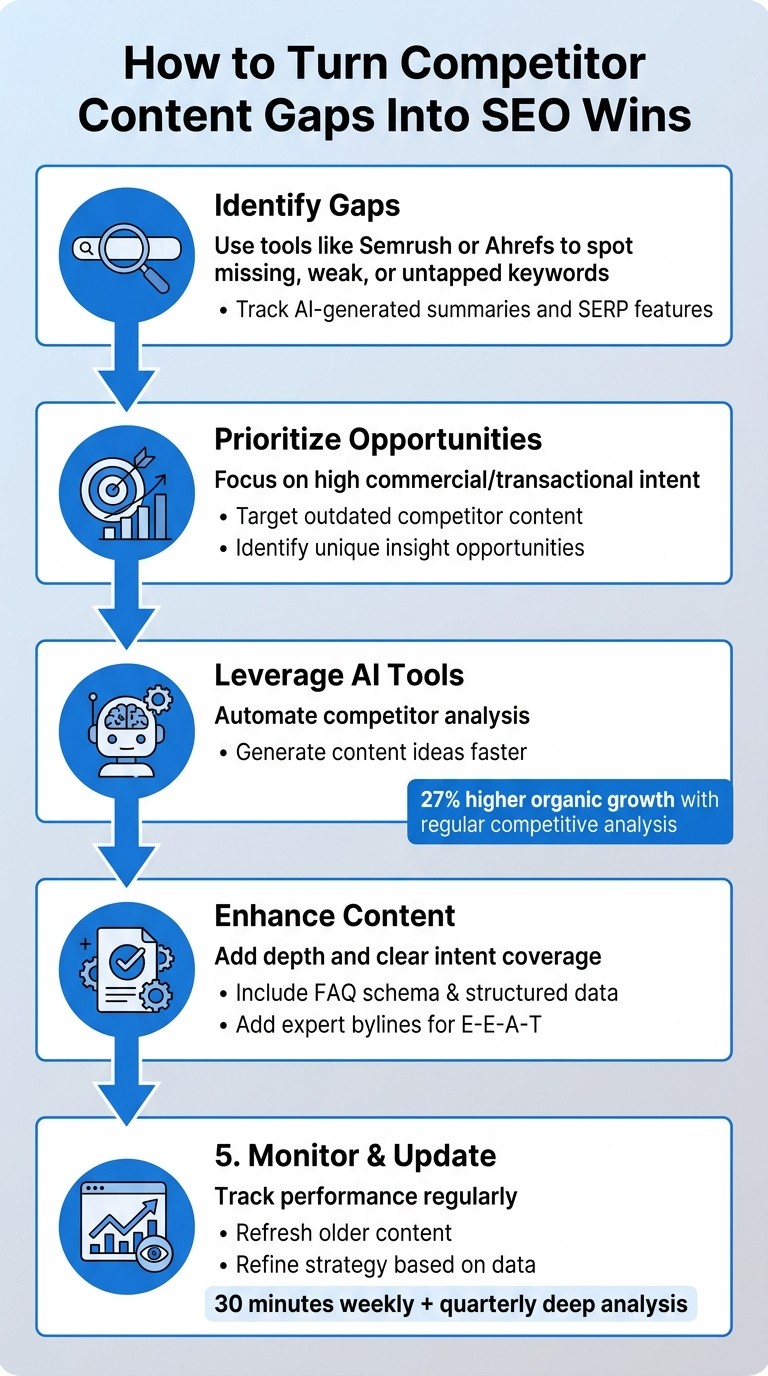
5-Step Process to Turn Competitor Content Gaps Into SEO Wins
Outrank Any Competitor With This FREE Content Gap Tool
How to Find Competitor Content Gaps with AI Tools
The first step to addressing content gaps is figuring out where they exist. Traditional SEO tools like Semrush's Keyword Gap and Ahrefs' Content Gap help by sorting opportunities into three categories: "Missing" (keywords where competitors rank but you don’t), "Weak" (keywords where your ranking lags behind competitors), and "Untapped" (keywords where at least one competitor ranks, and you don’t show up at all) [1]. These tools are a great foundation, but combining their insights with AI analysis can uncover patterns you might otherwise miss.
Using Competitor Analysis Tools
Start by identifying your top 3–5 competitors in the rankings. Use a keyword gap tool to compare their domains with your own site. Pay close attention to the "Missing" category, as it highlights the most critical gaps where competitors have visibility, and your site is absent [1].
Modern tools now go a step further by tracking AI visibility gaps. These are instances where competitors are mentioned in AI platforms like ChatGPT, Perplexity, or Google's AI Overviews, but your content is overlooked. Such gaps could mean you're losing traffic even before users reach traditional search engines.
Exporting and Analyzing Reports
Once you’ve identified the gaps, export the keyword data and group it by search intent - informational (guides and tutorials), commercial (comparisons and reviews), or transactional (product pages and pricing). This breakdown helps prioritize which gaps to address based on where your audience is in their buying journey [1].
Another key step is analyzing the SERP features your competitors dominate. Tools like Google’s Rich Results Test can show if competitor pages include structured data elements like FAQ schema, HowTo markup, or Product structured data - features that may give them an edge [1]. Additionally, review their H2/H3 tags to uncover subtopics or questions you might have missed.
"If your content doesn't cover the complete set of related questions, variations, and supporting ideas around a topic (semantic coverage), Google sees the coverage as incomplete."
Laiba Siddiqui, Semrush [1]
Report Type | What to Analyze | Strategic Action |
|---|---|---|
Keyword Gap | Missing, Untapped, and Weak keywords | Develop new content or refine existing pages |
AI Visibility | Prompts where competitors appear in AI summaries | Add structured data and craft comprehensive answers |
SERP Features | Featured Snippets, People Also Ask, video results | Format content to capture these positions |
Backlink Gap | Domains linking to 2+ competitors but not your site | Identify outreach opportunities |
Using Averi AI for Automated Analysis
While manual analysis is effective, it can be time-consuming. This is where automation tools like Averi AI come in. Averi simplifies the process by continuously monitoring competitor content, tracking updates, and identifying gaps in real time. Once connected, the platform learns about your brand, products, and positioning, using this knowledge to spot missing topics or underserved audience needs.
Averi generates a content queue organized by opportunity type - whether it’s listicles, how-to guides, comparisons, or editorials. This queue includes target keywords, estimated search volume, and content outlines. By approving AI-generated ideas, you save hours of manual work. Brands that regularly conduct competitive analysis see 27% higher organic growth, and automating this process ensures you stay ahead of competitor activity [3].
Additionally, Averi tracks E-E-A-T gaps (Experience, Expertise, Authoritativeness, and Trustworthiness). If competitors lack strong author signals or original data, these become prime opportunities for you to establish authority quickly [3].
How to Prioritize Content Gaps for SEO Results
Once you've identified competitor content gaps, the next challenge is deciding which ones to tackle first. Not every gap will be worth your time, so focus on those that align with your business goals and have the potential to drive revenue.
Types of Content Gaps
Content gaps generally fall into five categories, each influencing SEO differently:
Topic gaps: Entire subject areas your competitors cover but you don't. For instance, a SaaS company might lack an "integrations" section while competitors dominate searches in that space.
Quality gaps: Your content exists but lacks depth, original data, or expert insights that search engines prioritize.
Intent gaps: Missing content for specific buyer journey stages, such as comparison guides or troubleshooting resources.
Weak gaps: You rank on page two while competitors claim top spots.
Format gaps: Competitors excel with formats like video tutorials or interactive tools, while you only offer plain text [5].
Each type requires a specific approach. For example, create new content to address topic gaps and refresh outdated pages to close weak gaps.
Ranking Opportunities by Intent and Volume
Prioritize gaps based on search intent - whether the query is informational, commercial, or transactional. Commercial and transactional queries, even with lower search volumes, often provide more qualified leads. By late 2025, AI Overviews appeared in 18.57% of commercial searches compared to 13.94% of transactional ones, offering higher visibility for commercial content [5]. For instance, a "Slack vs. Microsoft Teams" comparison guide typically attracts more leads than a general how-to post.
Look for gaps where competitors rely on outdated content from 2023 or earlier, or where forum threads from Reddit or Quora dominate search results. These are often easier to outperform with fresh, authoritative articles, as shown by Averi AI insights. Additionally, assess E-E-A-T (Experience, Expertise, Authoritativeness, Trustworthiness) gaps. If competitors lack expert bylines or first-hand data, you can establish credibility quickly. Research indicates that strong author signals improve rankings by 40% in YMYL (Your Money Your Life) categories [3].
Finally, evaluate the Information Gain potential - whether you can add something genuinely new to the conversation. Incorporating proprietary data, expert quotes, or unique perspectives can set your content apart. If your contribution would merely echo existing top-ranking results, it's better to skip that gap and save resources [5].
Building a Prioritization Framework
Use an Impact vs. Effort matrix to organize content gaps into actionable categories:
Quick Wins: High impact, low effort tasks like adding FAQ schema or updating older posts with fresh data.
Major Projects: High impact, high effort initiatives such as creating a new topic cluster with multiple supporting articles.
Fill-ins: Low impact, low effort gaps that can be addressed over time.
Thankless Tasks: Low impact, high effort projects that are unlikely to yield significant results [1][6].
Priority Level | Gap Type | Criteria | Action |
|---|---|---|---|
High | Commercial/Transactional | High CPC, high intent, AI Overview present | Create or optimize product/solution pages |
Medium | Weak/Outdated | Competitor content is 2+ years old or forum-based | Refresh existing content with new data |
Medium | Semantic/Topic | Missing subtopics in a core cluster | Build supporting articles for pillar pages |
Low | Informational (General) | High volume but low conversion potential | Add to long-term content calendar |
Start with revenue-generating pages like your homepage and core product pages. Next, focus on the top 10–15% of blog posts that already drive traffic before creating entirely new content [4]. This ensures you're building on existing success before expanding.
Employ the 10x Rule: aim for content that's 10 times better in depth, recency, citations, or usability [3]. For example, in late 2025, an Australian meal delivery service identified gaps like "Dietary Trust" and "Urgency" instead of just chasing keywords. They created hybrid category pages featuring medically verified content and real-time delivery countdowns, driving monthly revenue from $77,000 to $968,000 within eight months - a 2,327% ROI [5].
"A one-size-fits-all suggestion is a one-size-fits-none experience. The secret is matching the technique to the shopper's intent."
Ben Salomon, E-commerce Expert [5]
For those using Averi AI, the platform automates much of this prioritization. It monitors competitor activity and market trends, suggesting content ideas ranked by opportunity type, target keywords, and search volume. You simply approve the ideas that align with your goals - whether that's boosting revenue for a specific product or building authority in a new market. Over time, the system learns from your choices, refining its recommendations to match your priorities [6]. This dynamic workflow ensures you're always targeting the most impactful opportunities.
Creating Content to Fill the Gaps
Once you've identified content gaps, the next step is to create material that stands out from what's already available. Use AI-driven insights to produce content that not only addresses these gaps but also boosts your brand's credibility. This involves more than just basic keyword strategies - it’s about crafting pieces that search engines and AI systems are eager to cite and recommend.
Conducting Content Audits
Before diving into new content creation, take stock of what you already have. Organize your existing articles by topic, date, word count, and format to spot areas where your coverage falls short [3]. Look for content that skips over key details or examples [1]. For instance, if your "email marketing best practices" guide doesn’t touch on segmentation or A/B testing, you’ve identified a clear opportunity to add depth.
Evaluate your E-E-A-T signals (Experience, Expertise, Authoritativeness, Trustworthiness). Does your content include personal insights, author credentials, proper citations, and fact-checking? Also, check for outdated references, pricing, or tools that no longer align with current trends [2]. If competitors are succeeding with formats you lack - like interactive tools, comparison tables, or video summaries - note these format gaps as well [3][2].
Don’t forget to assess your AI visibility. Are your articles being cited in AI Overviews on Google or answer engines like Perplexity? If your competitors are showing up in these results and you’re not, you’re missing out on a valuable avenue for traffic [1][2]. Regular competitive content analysis can make a big difference - brands that engage in this practice see 27% higher organic growth compared to those that don’t [3].
With these insights in hand, you can move forward with creating content that addresses these gaps effectively.
Drafting Content with Averi AI
Averi AI simplifies content creation while ensuring your brand’s voice remains consistent. Start by training Averi AI with your brand guidelines, tone definitions, and 10–15 examples of your top-performing content. This ensures every draft aligns with your style. To guide the AI, provide a detailed SEO brief that includes primary and secondary keywords, intended search intent (e.g., informational or transactional), and a clear outline of H2/H3 headings.
Averi AI uses real-time research, statistics, and expert quotes to build an optimized outline before drafting. It structures content for Generative Engine Optimization (GEO) by incorporating elements like FAQ sections, TL;DR summaries, and clear definitions of key terms - features that AI systems can easily reference. You’ll receive a detailed outline for review before the full draft is generated, ensuring logical flow and comprehensive coverage.
The process is human-in-the-loop: while Averi AI tackles research and drafting, you retain control at key points to add unique insights and finalize quality. This approach is yielding results - 52% of SEO professionals report improved performance from using AI for on-page SEO [7]. Additionally, marketers leveraging AI see a 70% boost in ROI and 84% report faster delivery of high-quality content [7].
Once your draft is complete, refine it further with targeted SEO enhancements.
Adding SEO Features to Content
To improve search performance, focus on features that help your content land in AI Overviews and featured snippets. Include concise definitions, step-by-step instructions, and TL;DR summaries [1]. Add an FAQ section at the end to address "People Also Ask" queries and provide material AI systems can use. Keep FAQ answers between 40–60 words - this is the optimal length for AI extraction.
Shift your focus from keywords to entities and relationships. Google prioritizes content with clear context, including a central idea supported by relevant details and related concepts [1]. Enhance your content with structured data (e.g., FAQ, HowTo, Product, or Article schemas) and strong internal linking to improve AI recognition and site structure [1].
Include author bios with credentials to build trust, especially for YMYL (Your Money or Your Life) topics. Add comparison tables to improve usability and make your content more likely to be cited. These features not only improve rankings but also make your content more practical and engaging.
"A page that's only optimized for keywords can struggle because if it skips key subtopics or supporting entities, the system has less material to work with."
Search Engine Land [1]
Apply the 10x Rule: aim to make your content 10 times better than existing options in at least one key area - whether it’s depth, timeliness, credibility, or usability [3]. This might mean incorporating original research, exclusive data, or unique tools that competitors can’t easily replicate.
Tracking Performance and Scaling Your SEO
Publishing content is just the beginning. To truly succeed, you need to track performance, learn from the data, and establish a system that keeps improving over time. The aim isn’t to score occasional wins - it’s to create a process that builds momentum and delivers lasting results.
Monitoring Performance Metrics
Start by using Google Search Console to track keyword rankings, impressions, and clicks. For deeper insights, monitor AI citations and engagement metrics through tools like Google Analytics.
To specifically track traffic coming from AI platforms, set up a regex filter in Google Analytics 4. For example, a filter like chat\.openai\.com|perplexity\.ai|claude\.ai can help identify which pages are being referenced by AI systems [9].
Additionally, keep an eye on SERP feature ownership - such as whether your pages are earning featured snippets or appearing in "People Also Ask" results. Don’t forget to measure authority signals, like the number of new referring domains and their Authority Scores. Here's a quick breakdown of key metrics and tools to use:
Metric Category | What to Track | Tool Example |
|---|---|---|
Visibility | Keyword rankings, impressions, AI citations | Google Search Console, Semrush |
Engagement | Bounce rate, time on page, scroll depth | Google Analytics 4 |
Technical | Core Web Vitals (LCP, INP, CLS) | |
Authority | Referring domains, Authority Score | Semrush, Ahrefs |
Conversion | Goal completions, click-through rate (CTR) | Google Analytics 4, Google Search Console |
Use these insights to guide your content updates and future strategy.
Updating Content Based on Data
Once you’ve gathered performance data, use it to refine and update your content. AI tools can take the guesswork out of content gap analysis by identifying outdated references, mismatched intent, or missing features that need attention [2]. They can also perform "Information Gain" audits to highlight areas where your content blends into the crowd and suggest ways to make it stand out - like adding proprietary data or expert quotes [5].
Set aside 30 minutes each week to review competitor SERPs, identify gaps in your content, and update underperforming pieces. For example, if a page is stuck at #8 in the rankings, check if competitors have added new features like comparison tables, FAQs, or structured data. Use AI to flag unsupported claims on your pages and replace them with solid, verifiable evidence [8].
"I'm not using AI to write…I'm using it to try to make me smarter and see things I wouldn't have seen."
Andy Crestodina, Co-founder, Orbit Media[8]
Building a Repeatable SEO Workflow
To scale your SEO efforts, you need a system that runs on its own. A sprint-based workflow with a "minimal viable cluster" approach can help you maintain momentum [10]. Break tasks into categories based on impact and effort: quick wins, major projects, and low-priority items. Conduct in-depth competitive analyses quarterly and monitor ranking changes monthly [3].
Brands that consistently analyze competitors achieve 27% higher organic growth than those that don’t [3]. AI tools can help here too, cutting manual audit time from 12 hours to just 45 minutes - giving you more room to focus on strategy [10]. Prioritize creating content that’s backed by original research and exclusive data [3].
Tools like Averi AI can automate much of this process, continuously monitoring competitors and suggesting high-opportunity content ideas. Each week, it analyzes performance data, generates recommendations, and alerts you when updates or approvals are needed. The more content you produce, the smarter the system becomes, building a library of resources that improves over time. This approach not only scales your SEO but also positions you to stay ahead of the competition.
Conclusion
Turning competitor content gaps into SEO opportunities starts with a clear plan: pinpoint weaknesses, focus on high-impact areas, create AI-optimized content, and track your progress. Consistent competitive analysis has been shown to boost organic growth by 27% compared to occasional efforts [3].
Manually analyzing gaps can be both time-consuming and quickly outdated. That’s where AI tools like Averi AI step in. These tools handle the heavy lifting by scanning competitor sites, identifying keyword gaps, and spotting visibility opportunities in AI Overviews and featured snippets [1].
Averi AI goes beyond analysis by transforming insights into actionable results. It keeps tabs on competitors, suggests content ideas based on up-to-date data, and prioritizes topics that align with your goals. Once you approve, the system tackles everything - from research and drafting to optimization and publishing. Each piece of optimized content builds on the last, creating a cycle of continuous SEO growth.
This streamlined approach helps maintain steady momentum. Shifting from occasional audits to a repeatable workflow is what separates short-term wins from long-term success. Dedicate just 30 minutes each week to review and adjust your strategy [2], and conduct deeper analyses every quarter to stay ahead of market trends [3]. This routine keeps you competitive without overwhelming your team.
With the right tools and consistent effort, you can turn competitor gaps into your strengths and build an SEO system that works while you focus on scaling your business.
FAQs
Which content gaps should I fix first to drive revenue?
To gain an edge in search rankings and content strategy, it’s essential to pinpoint areas your competitors are overlooking or where their content falls short. Start by using tools like SEMrush or Ahrefs to uncover keywords and topics where your competitors rank, but you don’t. These tools can reveal gaps in search demand that remain unaddressed.
By creating content that fills these gaps - whether it’s updating outdated information or diving deeper into neglected topics - you not only meet the needs of your audience but also establish your authority in the field. This approach doesn’t just improve visibility; it drives meaningful traffic and, ultimately, revenue by delivering content that resonates with your target audience.
How do I measure if AI summaries are citing my content?
To keep tabs on whether AI-generated summaries reference your content, leverage AI citation tracking tools. These tools can monitor mentions across platforms such as ChatGPT and Perplexity, offering a clear picture of how often your content is being cited. Beyond tracking, they can reveal where your website shows up in AI-driven conversations and highlight which pages are earning the most citations. This data helps you spot trends and refine your content to improve its visibility in AI summaries.
Should I update existing pages or create new ones to close gaps?
When competitor analysis reveals major content gaps, creating new material is often the best way to seize untapped opportunities. This strategy helps you directly address areas your competitors may have overlooked.
That said, updating existing pages can also deliver strong results. Enhancing coverage or incorporating fresh insights can boost the performance of these pages significantly. A thorough gap analysis will help you determine whether crafting new content or refining what you already have is the smarter move for your goals.
Related Blog Posts

Zach Chmael
CMO, Averi
"We built Averi around the exact workflow we've used to scale our web traffic over 6000% in the last 6 months."
Your content should be working harder.
Averi's content engine builds Google entity authority, drives AI citations, and scales your visibility so you can get more customers.