How to Build an SEO Strategy That Updates Itself Over Time

Averi Academy
Averi Team
8 minutes

In This Article
Create an AI-driven SEO system that automates keyword research, content creation, audits, and real-time updates.
Updated:
Trusted by 1,000+ teams
Startups use Averi to build
content engines that rank.
Your SEO strategy needs to evolve. Manual updates can't keep up with Google's algorithm changes, rising competition, and the shift toward AI-driven search results. Automation is the solution, enabling faster content production, real-time updates, and data-driven decisions.
Key takeaways:
Organic click-through rates dropped 61% since mid-2024 due to AI Overviews dominating search results.
Businesses using automation saw massive growth, like Visit Atlantic City (661% traffic increase) and DreamBox (733% growth in 3 months).
AI tools can automate keyword research, content creation, and performance tracking, saving time and reducing costs.
Steps to create a dynamic SEO strategy:
Audit your site: Identify declining content and gaps using tools like Google Search Console.
Set measurable goals: Monitor KPIs like content decay rates and keyword rankings.
Leverage AI tools: Automate keyword tracking, content planning, and performance updates.
Optimize content production: Use AI for SEO drafts, human review for quality, and direct publishing to your CMS.
Automate updates: AI flags underperforming pages and suggests improvements, ensuring your strategy stays effective.
Automation transforms SEO from a manual process to a self-improving system, cutting costs and boosting scalability. With AI, you can focus on strategy while your tools handle the heavy lifting.
How I built an AI SEO Automation to Rank #1 on Google and ChatGPT (AI Agent + Autoblogging)
Building the Foundation for Automated SEO
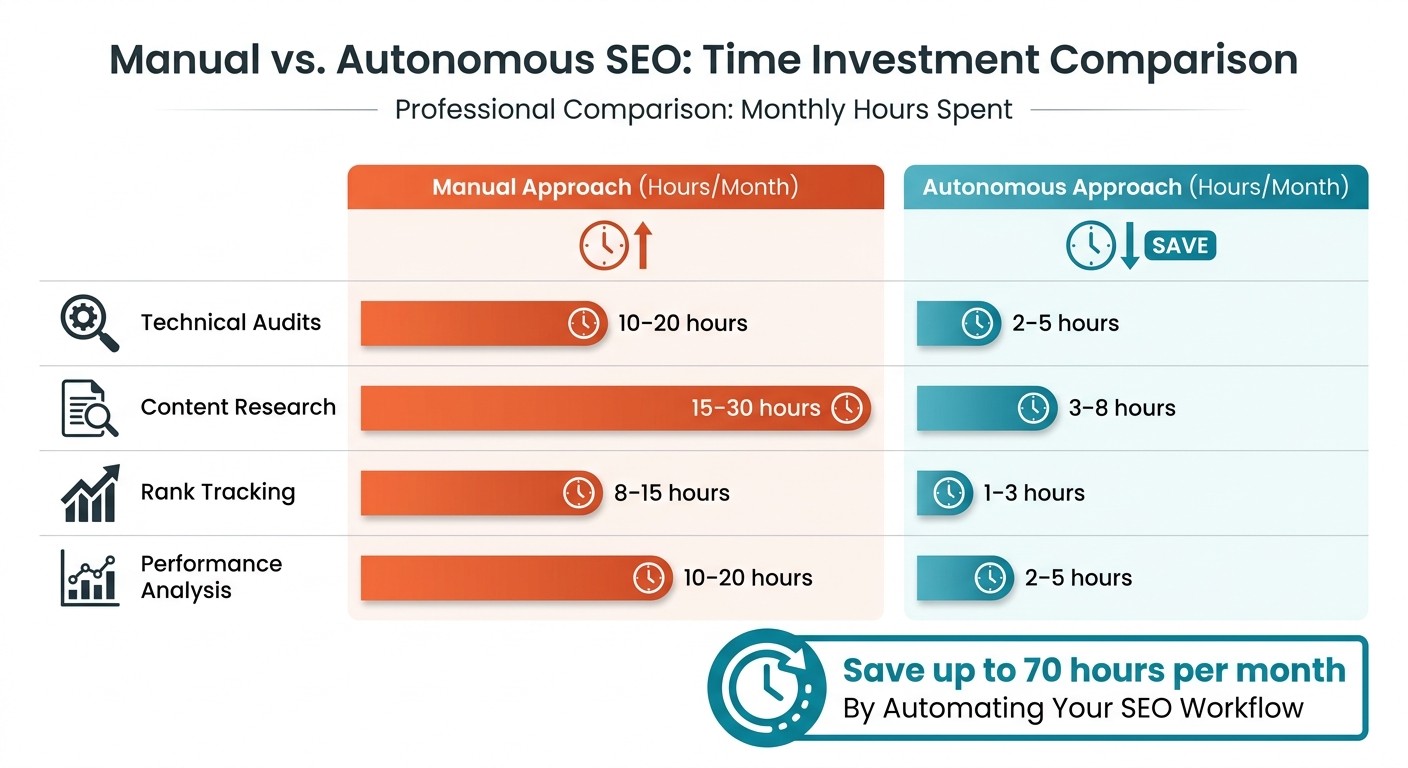
Manual vs Automated SEO: Time Savings Comparison
Automation thrives on accurate baseline data to guide AI-driven decisions effectively.
Review Your Current SEO Performance
Begin by identifying content decay - those pages that once ranked well but have since dropped - and content gaps where competitors dominate topics you haven't covered yet [5][6][7]. These findings will help you prioritize which pages need immediate updates and which new topics to target.
Leverage tools like Google Search Console and Google Analytics 4 to establish a clear baseline. Pay particular attention to keywords where your ranking has slipped from position 4 to 8, as this shift alone can reduce your traffic by 40% [7]. To build momentum, focus on low-competition keywords with a Difficulty (KD) score between 15-40 and search volumes exceeding 100 [7].
Next, conduct a schema audit. 62% of brands are invisible to generative AI models because they lack proper structured data [4]. Ensure that JSON-LD Structured Data is implemented on key pages, as missing schema often forces AI to "guess", leading to poor visibility [4].
SEO Activity | Manual Approach (Hours/Month) | Autonomous Approach (Hours/Month) |
|---|---|---|
Technical Audits | 10–20 | 2–5 |
Content Research | 15–30 | 3–8 |
Rank Tracking | 8–15 | 1–3 |
Performance Analysis | 10–20 | 2–5 |
With your baseline in place, you can set clear, measurable goals for improvement.
Set Measurable Goals and KPIs
Align your targets with your business objectives. For example, track your content decay rate to determine when older pages need updates to retain rankings [1]. Use automated audits to monitor Core Web Vitals (LCP, INP, CLS), crawl budget, and site speed [4][1].
Establish decision triggers - predefined conditions that automatically flag issues for human review. For instance, configure alerts to notify you if a high-value keyword experiences a 10% drop [4]. Group SEO efforts by their purpose, such as creating demand, accelerating evaluation, or enabling business expansion [6].
The cost advantage of automation becomes clear here. AI-powered SEO campaigns typically cost $40 to $120 per month in API fees (DataForSEO, Claude API), compared to the $3,000–$5,000 monthly expense of hiring an agency [7].
Once your goals are defined, it's time to integrate AI tools to streamline these processes.
Connect AI Tools to Your Website
Link technical monitoring tools like DebugBear or Screaming Frog to automate weekly site audits and validate structured data [4]. For strategy and insights, platforms like Averi AI can analyze your website, understand your business and products, and even generate a complete content marketing plan tailored to your needs.
Deploy AI agents to monitor rankings and flag any significant drops for immediate updates [7][6]. Many modern websites rely on a "swarm" of specialized AI agents - such as Auditor, Content, Optimization, and Adaptation agents - that work together to maintain site performance [1].
Streamline internal linking by integrating automated systems into your publishing workflow. These systems can automatically insert links to related content, helping to establish topical authority [3]. Use tools like Zapier or Make to connect your CMS (Webflow, WordPress, Framer) for direct publishing, eliminating the need for manual copy-pasting.
"The problem isn't AI. It's how we're using it. If you can describe the work, you can automate it." - Ameya Deshmukh, Head of Marketing, Everworker [9]
Automating Keyword Research and Content Planning
With a solid SEO foundation in place, integrating AI into keyword research and content planning can supercharge your strategy. Manual keyword research often eats up time that could be better spent on refining your product or service. By leveraging AI, you can uncover new opportunities and shift your focus to strategic priorities.
Configure Automated Keyword Tracking
Set up automation tools like Make or Zapier to interact with SEO APIs on a regular schedule. For example, DataForSEO offers keyword analysis at about $0.10 per 100 queries, helping you identify gaps where competitors rank in the top 10 while your site is missing [7]. Additionally, configure Google Search Console to send you alerts about impression gaps - situations where your site appears in search results but lacks a strong-ranking page.
AI agents can keep tabs on high-intent keywords and monitor competitor content effortlessly. By connecting tools like Google Trends or Exploding Topics, you can filter emerging queries relevant to your target audience and automatically add them to your content pipeline. Large language models (LLMs) like Claude or ChatGPT can then group these keywords by intent into hub-and-spoke clusters, establishing topical authority. For programmatic SEO, create a keyword matrix that combines head terms with modifiers such as industry, use case, or company size. This approach allows AI to generate numerous long-tail keyword variations [3].
Once you've gathered these insights, you can seamlessly transition into building a dynamic content pipeline.
Create a Self-Updating Content Queue
Trade in your static topic lists for a system that organizes content into hub-and-spoke clusters. This not only prevents content cannibalization but also strengthens your topical authority. Regularly crawl your site to identify gaps or outdated pages, triggering automated content refreshes where necessary.
Tools like Averi AI can simplify this process. They track industry trends, analyze competitors' content, and suggest keyword-driven content ideas such as listicles, how-to guides, and comparisons. Each suggestion includes proposed titles, target keywords, and content outlines, ready for your review. At a cost of roughly $100 per month, Averi AI offers a more budget-friendly option compared to agency retainers, which can range from $3,000 to $5,000 monthly [7][8]. You can also automate internal linking, ensuring that new posts connect back to their hub pages and link to two to four related spoke posts, reinforcing the overall content structure.
AI Keyword Tools: Averi AI vs. Alternatives
As your automated processes evolve, selecting the right tools becomes essential for smooth execution. Different tools cater to different needs:
Averi AI: An all-in-one platform that covers keyword research, strategy, drafting, and publishing. It automates keyword discovery, content queuing, and integrates directly with CMS platforms like Webflow, Framer, or WordPress [8].
Jasper and Copy.ai: These tools focus on content generation but leave keyword research, strategy, and publishing to the user.
Ahrefs (starting at $108/month) and Semrush (starting at $139.95/month): Traditional SEO platforms that provide in-depth keyword data but do not automate content creation or publishing [4].
The best choice depends on your workflow. If you're looking for end-to-end automation with minimal coordination, Averi AI can streamline your efforts by eliminating the need for multiple tools. If your team handles strategy and distribution in-house, platforms like Ahrefs or Semrush are excellent for detailed keyword data. Meanwhile, tools like Jasper or Copy.ai are ideal for teams that want AI-assisted drafting while managing other aspects independently.
"Speed of iteration is a competitive advantage in SEO, and automation is the only way to iterate fast enough." - AutopilotRank [3]
Setting Up AI-Powered Content Production
Once your automated keyword research and content planning are in motion, the next step is to streamline content creation with AI. This approach not only speeds up production but also ensures your content keeps up with evolving SEO requirements.
### Create AI-Optimized Content That Ranks
AI tools can create structured drafts that are SEO-ready, complete with essential elements like FAQ sections, internal links, and meta descriptions. For instance, Averi AI conducts in-depth research using hyperlinked sources for verification, then produces a first draft optimized for both Google and AI citation engines like ChatGPT and Perplexity.
A two-step drafting process works best for efficiency. The first pass involves an AI-generated outline with key points and structure. The second pass is where you refine the draft, cutting out redundancies and adding expert insights. This method can reduce the time spent on drafting a single piece of content from over 10 hours to just about 1.5 hours [5][7].
Add Human Review and Editing
AI might draft the content, but human input is crucial for maintaining accuracy, tone, and originality. With 89% of marketers now using AI for content creation [4], your unique voice and expertise are what set your content apart.
Focus your editing efforts on three key areas: refining tone, validating claims, and adding a personal touch. Double-check any statistics or claims included by the AI - if you can't confirm a figure, rewrite it to be more general and truthful. Then, bring in your unique perspective. Share what you’ve learned, experienced, or found surprising about the topic. This "experience layer" adds depth and helps your content stand out among other AI-generated material [5].
Platforms like Averi AI make this process easier by offering collaborative editing tools. You can highlight sections and ask the AI to rewrite, expand, or adjust the tone, all within the same platform.
Publish Directly to Your CMS
Avoid the hassle of manual copy-pasting, which often leads to formatting errors. Instead, integrate AI tools directly with your CMS for smooth, error-free publishing. Averi AI, for example, can publish directly to platforms like WordPress, Webflow, or Framer, ensuring that formatting, internal links, and metadata are correctly applied without manual intervention.
Before automating the publishing process, establish quality checks to prevent low-value content from slipping through. Automated scoring for SEO optimization, readability, and E-E-A-T signals (Experience, Expertise, Authoritativeness, Trustworthiness) ensures your content meets high standards. As Google's Danny Sullivan explains:
"Google doesn't care whether content is AI, automated, or human-created; it's going to be an issue if it's low-value at scale" [4].
Streamline your workflow further by automating internal link insertion during the upload process. Configure your CMS to link each new post to a hub page and two to four related articles. This step alone can cut manual publishing time by 94% [3][5][7]. Additionally, save each published piece to your content library - this builds a resource that helps AI tools create smarter drafts aligned with your brand’s identity.
With this process in place, you're ready to track performance and update content seamlessly over time.
Tracking Performance and Automating Updates
Publishing content is just the beginning. To maintain strong SEO performance, ongoing monitoring and optimization are essential.
Monitor Key SEO Metrics
To effectively track performance, integrate Google Search Console and your analytics platform with an AI-powered monitoring tool. Pay close attention to four key signals: impressions (how often your content appears in search results), click-through rates (CTR), keyword rankings, and traffic trends. Set up automated alerts to flag significant changes, such as a ranking drop that leads to a 40% decline in organic traffic [7].
AI tools can monitor these metrics in real time, identifying patterns and anomalies. For example, if a page has high impressions but a low CTR, it may benefit from updated title tags or meta descriptions [1]. Likewise, content stuck between positions 11–20 in search rankings (commonly referred to as "page 2") might only need small adjustments - like adding an FAQ section or refreshing outdated statistics - to push it onto the first page [3][7]. These insights feed directly into AI-driven suggestions for content updates.
Leverage AI for Content Updates
AI tools don't just track performance - they also recommend specific actions based on real-time search data. If rankings drop, these systems can analyze the top three search results to uncover new angles or subtopics [7]. This process, known as SERP drift analysis, helps identify gaps in your existing content.
The AI then prioritizes updates using opportunity scores, which factor in search volume, keyword difficulty, and how close your content is to climbing higher in rankings [10][7]. Monthly audits also highlight pages losing impressions over the past 30 days, automatically queuing them for updates. These updates could include refreshing introductions, adding recent statistics, or expanding sections to signal relevance and freshness to search engines [5][6].
Establish Weekly Optimization Cycles
Create a consistent schedule where AI handles routine tasks, allowing you to focus on strategy. A typical weekly workflow might look like this: conduct site scans and review opportunities on Monday, work on content updates mid-week, and finalize internal linking and publishing by Friday [5]. Set daily automated audits - perhaps at 2:00 AM - to check rankings and generate content briefs [7].
These automated workflows are surprisingly cost-effective, ranging from $40 to $120 per month [7]. For example, tools like DataForSEO (at $0.10 per 100 queries) and Claude API (at $15–$20 per million tokens) can replace traditional agency retainers, which often cost $3,000 to $5,000 monthly. As your content library expands, AI tools become even more precise, delivering better results with each optimization cycle.
Conclusion
Automated SEO isn’t about working harder - it’s about working smarter. By integrating AI tools with your website, automating keyword tracking, and setting up workflows that handle content creation and optimization, you’ve built a system that operates with minimal intervention. Real-time monitoring now flags underperforming pages and queues them for updates automatically, ensuring your strategy stays agile.
This approach offers a cost-effective alternative to hefty agency retainers. But beyond cost, the true edge lies in its speed and scalability. While traditional SEO can take weeks or months to show results, automated systems respond in minutes [1]. Your role shifts from executing manual tasks to becoming the "Strategy Architect" who defines priorities and ensures the brand voice remains consistent [1].
The benefits don’t stop there. Organizations leveraging AI-powered marketing automation report revenue increases of 10–20% [2]. Automated workflows not only reduce manual tasks by 30% but also slash time-to-publish in half [2]. Real-world examples like Visit Atlantic City and DreamBox underscore the potential: the former achieved a 661% year-over-year boost in organic traffic, while the latter saw a staggering 733% growth in just three months - all by embracing automated systems [4].
"The era of the static, human-maintained website is ending, giving way to a living, breathing, self-improving digital organism." – Single Grain [1]
With your automated SEO engine in place, performance analysis, topic recommendations, and content updates happen weekly. Each new piece of content feeds into the system, sharpening its intelligence and amplifying results. This creates a flywheel effect: more content leads to more rankings, which drives more traffic and provides data for further optimizations [3]. It’s a dynamic, self-sustaining approach that adapts to search trends while freeing you to focus on strategy and innovation. Instead of juggling endless manual tasks, you’ve built a system that works for you.
FAQs
How do I start automating SEO without breaking what already works?
To streamline SEO efforts without compromising what already works, consider setting up a workflow that leverages AI tools for repetitive tasks while keeping a close eye on quality. Begin by analyzing your website to pinpoint its strengths and evaluate its current performance. From there, gradually incorporate AI for tasks like keyword research, updating content, and drafting briefs. This step-by-step approach allows you to refine processes over time. Keep a close watch on results and make small, thoughtful adjustments to complement - rather than overhaul - your existing strategy.
What data should trigger an automatic content refresh?
To keep your content performing at its best, it's crucial to refresh it whenever you notice signs of underperformance or spot chances for improvement. Look out for key signals such as slipping rankings, decreasing organic traffic, poor click-through rates, outdated information, or changes in keyword trends. By keeping a close eye on these metrics, you can ensure your content remains current and optimized for your audience.
How do I keep AI-written SEO content accurate and on-brand?
To keep AI-generated SEO content accurate and aligned with your brand, it’s essential to establish strong quality controls. Start by creating clear brand voice guidelines to ensure consistency in tone and messaging. Regular reviews and internal checks are key to catching any errors or misalignments early on. For technical or sensitive topics, always include human oversight to maintain precision and credibility.
AI can streamline content creation, but it works best when paired with ongoing efforts like periodic audits, refreshing outdated material, and tracking performance metrics. These steps help keep your content relevant and in sync with your brand’s goals while maximizing the efficiency AI offers.
Related Blog Posts

Zach Chmael
CMO, Averi
"We built Averi around the exact workflow we've used to scale our web traffic over 6000% in the last 6 months."
Your content should be working harder.
Averi's content engine builds Google entity authority, drives AI citations, and scales your visibility so you can get more customers.