

In This Article
Automate content workflows with AI to generate leads, boost SEO, and scale marketing for pre-seed startups with minimal time.
Updated:
Trusted by 1,000+ teams
Startups use Averi to build
content engines that rank.
Hook: Most pre-seed startups fail because they can't balance product development, customer engagement, and marketing. Content marketing, when automated, can solve this problem.
Value Summary: Content marketing generates 3x more leads at 62% less cost than traditional methods. Pre-seed startups can save time and resources by automating their content workflows, focusing on lead generation, SEO visibility, and thought leadership. Tools like Averi AI streamline the process, allowing founders to focus on their product while building a scalable content engine.
Quick Overview:
Why Content Matters: 29% of startups fail due to marketing issues. Consistent content drives leads and builds authority.
Key Steps: Set goals, audit resources, identify your audience, and automate workflows.
Tools: AI platforms like Averi AI handle strategy, drafting, and publishing for $100/month.
Metrics to Track: Focus on lead generation, keyword rankings, and content performance to refine your system.
Bridge: Below, we’ll explore how to build an automated content engine in four steps, using AI to save time and drive growth.
How I Built a Fully Automated Marketing Machine (no code)
Assess Your Content Needs and Goals
Before diving into content creation, take a step back and evaluate what you have and build your marketing plan. Skipping this step often leads to wasted effort - it's no surprise that 90% of content gets fewer than 10 organic visits [2]. The issue isn't about working harder; it's about aligning your resources, goals, and audience needs effectively. This step sets the stage for content that genuinely delivers results.
Define Your Content Goals
For pre-seed startups, it's crucial to focus on just 1–2 objectives that align with your current stage, rather than aiming for goals suited to more established companies.
The most impactful goals at this stage are lead generation (capturing qualified prospects), SEO visibility (building organic reach), and thought leadership (establishing the founder’s credibility before the product can fully speak for itself) [4][5]. Use the SMART framework to make these goals actionable. For example, instead of saying "improve SEO", set a target like "rank in the top 10 for 5 high-intent keywords within 6 months" or "generate 50 qualified leads per month through gated content" [4][5].
Your priorities should reflect your immediate needs. If you're bootstrapped and need customers quickly, allocate 40% of your content efforts to bottom-of-funnel materials, such as comparison pages or pricing guides that appeal to buyers ready to make a decision [1]. On the other hand, if you're aiming to attract investors or early adopters, focus on thought leadership content that showcases your expertise [3].
Content Goal | Why It Matters for Pre-Seed | Example SMART Metric |
|---|---|---|
Lead Generation | Validates your ideal customer profile (ICP) and builds a pipeline | 20 email signups/month via ebooks (5% conversion rate) |
SEO Visibility | Creates a sustainable organic growth channel | 10 keyword rankings in 3 months, 30% traffic increase |
Thought Leadership | Establishes credibility before your product is fully mature | 5 founder guest posts with 2,000 LinkedIn impressions each |
Audit Your Current Resources
Pre-seed founders face tight constraints: 47% manage all marketing themselves, and 56% have just an hour or less per day to dedicate to it [1]. Your content strategy must align with these limitations, not work against them.
Conduct a content audit by categorizing your materials into Keep (high-performing evergreen pieces), Improve (outdated posts that need refreshing), and Remove (irrelevant content to redirect via 301s). Additionally, log your available weekly hours, team strengths, and monthly budget for tools or freelancers [4][5].
Identify Your Target Audience
At the pre-seed stage, you're not aiming for a massive audience. Instead, you're looking to connect with your first 50–100 customers who can validate your product [3]. Start by defining 2–3 Ideal Customer Profiles (ICPs). Document key details such as demographics (age, location, job title), firmographics (company size, industry), and psychographics (pain points, goals), as well as their position in the buying journey [4][5].
To understand their needs, conduct 10 customer interviews or surveys. Ask questions like "What content influences your purchasing decisions?" and "How do you currently solve this problem?" [4][5]. Rate their pain points on a scale of 1–10 to prioritize which messages to address first.
Then, tailor your content to match their stage in the funnel. For example, educational blog posts work well for awareness-stage prospects, while decision-stage buyers need comparison guides or pricing details. Use tools like Google Analytics to identify which pages resonate with your audience, and leverage platforms like AnswerThePublic to find the exact questions they're asking [4][5]. This ensures your content strategy is laser-focused on meeting real needs, not just guessing what might work.
Build Your Content Engine in 4 Steps
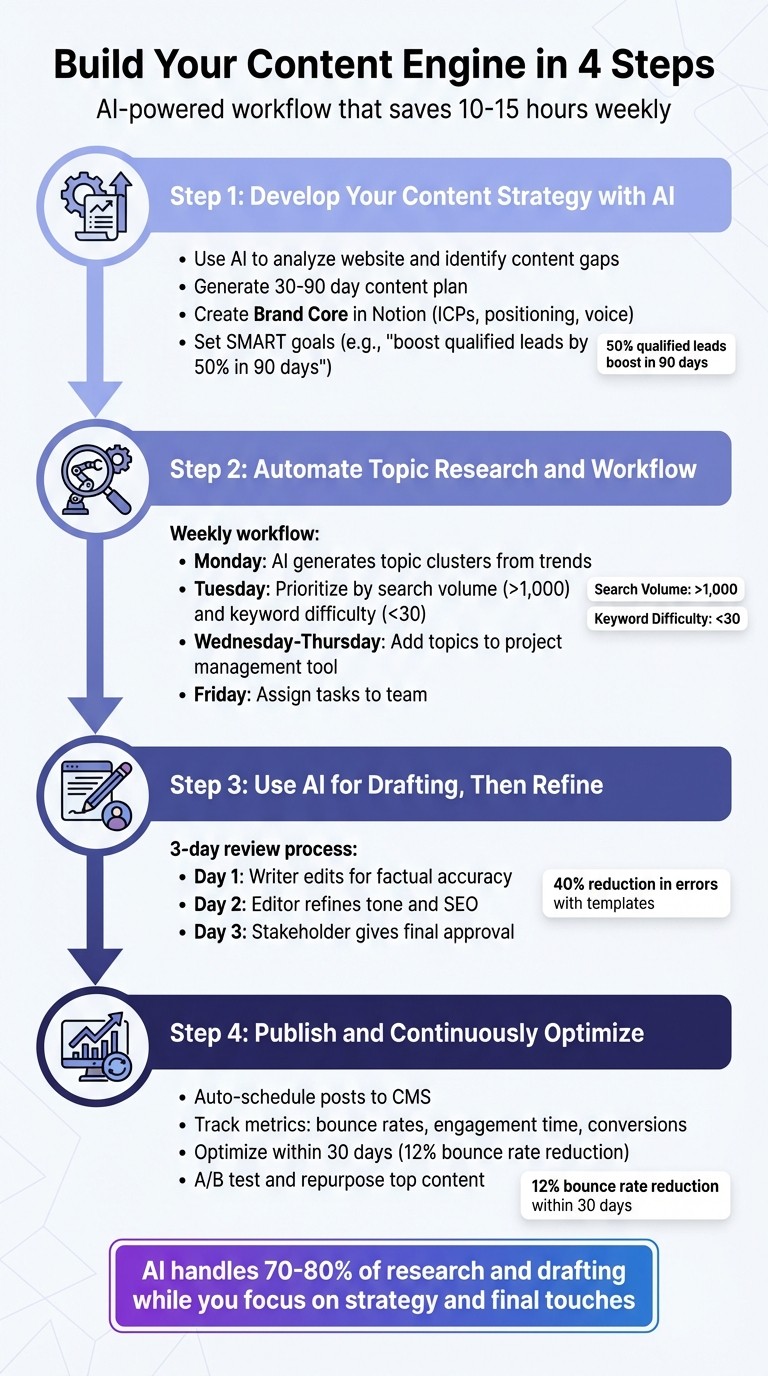
4-Step Content Engine Framework for Pre-Seed Startups
With clear goals and a deep understanding of your audience, these four steps combine AI tools and human input to create an efficient, evolving content engine. By letting AI handle 70–80% of the research and drafting, while you focus on strategy and final touches, you can save 10–15 hours weekly compared to traditional workflows [4][7].
Step 1: Develop Your Content Strategy with AI
Start by using tools like Averi AI to analyze your website, identify content gaps, and evaluate competitors. This generates a 30–90 day content plan tailored to your brand's objectives. The plan includes key content themes, suggested formats (like tutorials or comparison pages), and SMART goals, such as increasing organic traffic by 20% within six months [4][10].
Document this plan in a centralized workspace, such as Notion, to establish a "Brand Core" - a repository for your ideal customer profiles (ICPs), brand positioning, and voice guidelines. This ensures every AI-generated piece aligns with your brand identity over time. For instance, set a measurable goal like "boost qualified leads by 50% in 90 days" and tie each content piece to specific KPIs such as engagement, traffic, or conversions [4][10].
Step 2: Automate Topic Research and Workflow
Automating topic research is key to staying ahead. Averi AI can track Google Trends, competitor rankings, and social media signals to queue up high-potential topics. For example, it might suggest targeting "pre-seed funding tips" if the keyword shows high search volume and low competition [4][6].
A simple weekly workflow might look like this:
Monday: Averi AI generates topic clusters from trends and competitor analysis.
Tuesday: Review and prioritize ideas based on metrics like search volume (over 1,000) and keyword difficulty (below 30).
Wednesday–Thursday: Add top topics and briefs to a project management tool like Asana.
This system ensures your team focuses on impactful content while minimizing manual effort [4][7]. With research automated, you can shift attention to content creation and refinement.
Step 3: Use AI for Drafting, Then Refine with Your Team
Drafting content becomes faster with tools like AGM-2, which can create SEO-optimized posts in your brand voice. For instance, it might produce a 1,500-word guide on "bootstrapping content" based on your brief [4][9]. From there, follow a structured review process:
Day 1: A writer edits for factual accuracy.
Day 2: An editor refines tone and SEO.
Using templates and checklists during this stage can reduce errors by 40% [4][9]. One pre-seed SaaS startup applied this approach to produce 12 blog posts per month with just two team members. They achieved a 25% increase in traffic by focusing on topics like "AI for early validation" and tailoring content to address founder-specific concerns, such as budget constraints [9][10].
"The goal isn't to become a full-time content marketer. The goal is to build the minimal infrastructure that produces results while you focus on product and customers." – Zach Chmael, CMO, Averi [1]
Step 4: Publish and Continuously Optimize
Once content is finalized, export it as HTML or Markdown for seamless upload to platforms like Webflow or WordPress. Averi AI can even auto-schedule posts to save time [4][7]. After publishing, use Google Analytics to track metrics like bounce rates, engagement time, and drop-off points. Within 30 days, optimize top-performing content by adding clearer calls-to-action (CTAs), which can lower bounce rates by 12% [4][7].
Keep an eye on KPIs such as organic traffic growth (aim for a 20% increase), conversions, and engagement time [4][6]. Use this data to refine your strategy: A/B test headlines, repurpose high-performing posts using AI content repurposing techniques (e.g., turn a blog post into a LinkedIn carousel), and feed insights back into your content planning process. This creates a self-improving system that evolves with every new piece of content, building a strong foundation for future growth [2].
Choose the Right Tools for Your Content Engine
Selecting the right tool can simplify your workflow and make the most of the limited time and resources that pre-seed startups often face.
Comparing Options: Averi AI, Marketplaces, and Point Tools
Pre-seed startups typically choose between three main approaches for their content needs:
AI-Powered Workspaces: Tools like Averi AI automate everything from strategy to analytics.
Freelance Marketplaces: Platforms like Fiverr and Upwork connect you with freelancers but require hands-on management.
AI Point Tools: Solutions like Jasper and Copy.ai generate drafts quickly but lack integration with strategy or analytics.
Marketplaces give you access to freelancers, but you'll need to handle the vetting, briefing, and editing yourself. Point tools, while fast and subscription-based, rely heavily on your input and don’t cover the entire content process. On the other hand, AI workspaces like Averi AI offer an end-to-end solution, including content planning, topic generation, drafting in your brand voice, and analytics - all for a flat $100/month.
The major difference lies in how these approaches deliver results. Marketplaces require you to coordinate every step, point tools demand constant prompting and manual edits, while AI workspaces handle everything from research and SEO structuring to CMS publishing and analytics. For early-stage founders - 56% of whom report having only an hour a day for marketing - this kind of automation can be a game-changer [1][2][8].
Here’s a quick breakdown of the differences:
Feature | Averi AI (Workspace) | Marketplaces (Upwork/Fiverr) | AI Point Tools (Jasper/Copy.ai) |
|---|---|---|---|
Pricing | $100/month | Variable pricing per project | Typically subscription-based |
Workflow | Strategy → research → drafting → publishing → analytics | You brief, manage, and coordinate freelancers | You prompt, edit, and publish manually |
Quality Control | Maintains brand voice through a collaborative editing canvas | Varies by freelancer; you handle all QA | Dependent on prompts; lacks built-in review |
Best For | Founders needing a full system without hiring | Teams able to manage contractor workflows | One-off drafts when a broader strategy is in place |
With these distinctions in mind, it’s essential to focus on the key features that will maximize your content engine's efficiency. This includes building a multi-channel content engine that moves from idea to publication rapidly.
Key Features to Prioritize in a Content Tool
When choosing a content tool, consider features that go beyond simple text generation. Look for tools that streamline your workflow, optimize performance, and support scalable growth.
Closed-Loop Analytics: Tools with actionable analytics can help you refine your content. For example, if an article ranks #8 for a keyword, the tool might suggest adding structured elements like answer blocks or FAQs to improve its position.
SEO and GEO Optimization: The best tools optimize for traditional SEO while also addressing Generative Engine Optimization, ensuring your content performs well across platforms.
Human-AI Collaboration: Effective tools balance automation with your input. AI can handle tasks like research, outlining, and drafting, while you refine the content to reflect your brand's unique voice[8].
CMS Integrations: Seamless integration with platforms like Webflow, WordPress, or Framer can save hours of manual work.
Content Clustering: Tools that organize related content into clusters build topical authority. This strategy can boost rankings significantly - mature clusters provide a 2.7× ranking advantage, and companies publishing 16+ posts monthly see 3.5× more inbound traffic compared to those publishing fewer than four [1][2][8].
Measure Success and Scale Over Time
A well-designed content engine thrives on performance data, using it to refine workflows and boost conversions. This stage ensures that every automated process contributes to a smarter, more efficient strategy.
Track Key Performance Metrics
Now that your content engine is automated, measuring its impact becomes the priority. Focus on bottom-of-funnel (BOFU) metrics like qualified leads, conversion rates, and rankings for high-intent keywords such as "product vs. competitor" or "best tools for X" [1][2].
Consistency is essential. Publishing 11 or more posts monthly generates four times as many leads compared to publishing fewer than four [1]. Keep an eye on your publishing frequency alongside conversion data to maintain momentum rather than producing isolated content bursts.
To gain early insights, ask new customers how they discovered your business. This simple attribution method can pinpoint which content pieces influenced their decisions [3]. Also, monitor growth in newsletter subscribers and inbound messages - these are strong indicators of how well your content resonates [3].
Improve Content Based on Performance Data
Once your key metrics are clear, use them to refine your approach. Analytics must translate into action. Shift from creating standalone posts to developing data-driven content cycles, where each cycle builds on the insights from the previous one [2]. For example, identify "Page 2" opportunities - articles sitting on the second page of search results - and refresh them to push them to the first page [2].
Evaluate which keywords are driving both traffic and conversions to ensure your content aligns with market demand [2]. Tools like Averi AI can simplify this process, saving up to 2 hours weekly by automating performance reviews. These tools might suggest, "This topic is trending in your industry - here’s a content angle", or "This piece is ranking #8 - here’s how to push it to page 1" [2]. This level of automation can significantly reduce the time spent manually analyzing data from platforms like Google Search Console and GA4, cutting your review time from 15–20+ hours to just 2 hours per week [2].
"Analytics without action is just observation." - Averi [2]
Build a Self-Running Engine for Long-Term Growth
As you refine your strategy based on performance data, your content engine transforms into a system that drives compounding growth. Mature topic clusters offer a 2.7× ranking advantage, while weekly publishing can increase conversions by 3.5× [1][2]. For B2B SaaS companies, SEO can deliver an impressive 702% ROI within seven months [1].
Your content engine should integrate six core layers: Strategy, Intelligence, Creation, Distribution, Analytics, and Compounding [2]. This interconnected approach prevents fragmented efforts and ensures your content builds sustainable momentum over time. Automation turns your content library into a dynamic asset that continuously improves rankings and sharpens recommendations - each new piece strengthens the next.
Conclusion
Building a content engine as a pre-seed startup doesn’t require a massive marketing team or a hefty agency budget. Instead, success boils down to four core steps: crafting an AI-driven strategy, automating topic research and workflows, leveraging AI for drafting while refining with human oversight, and publishing content that creates a lasting, cumulative impact. This method turns content creation from an occasional task into a streamlined system where performance data continuously guides your next steps[2].
The magic lies in blending automation with human input. AI takes care of the heavy lifting - handling research, drafting, and basic SEO - while your team ensures the final product reflects your brand’s voice and strategic objectives[4][10]. This hybrid approach doesn’t just save time; it can slash content creation efforts by up to 50%[4]. Tools like Averi AI simplify the process further, consolidating workflows and cutting weekly management time from 15–20+ hours to just about 2 hours[2].
What sets scalable engines apart is their reliance on data-driven iteration. By focusing on bottom-of-funnel metrics like qualified leads and conversion rates, you can identify underperforming content to refresh and double down on strategies that work[4][6][7]. Consistent publishing builds momentum, driving exponential growth and establishing topical authority over time[1][2].
FAQs
What should my first content goals be at pre-seed?
At the pre-seed stage, your primary goal is to build trust, gain visibility, and get a clear understanding of your market - all while working with limited resources. Create a straightforward content plan that allows you to produce 8–12 posts each month without overextending yourself. Affordable AI tools can help streamline tasks like research, drafting, and SEO, saving both time and money. Focus on connecting with your first customers, fostering relationships, and setting specific, measurable objectives - like boosting organic traffic or capturing early leads - to create a solid base for future growth.
How much time per week do I need to run a content engine?
Running a content engine for a startup usually requires just 1–2 hours each week. For bootstrapped businesses, dedicating about 2 hours can streamline tasks such as research, drafting, SEO, and publishing. This setup, powered by AI tools, allows founders to generate 8–12 posts monthly with minimal effort, creating a system that’s both efficient and manageable for startups in their early stages.
When will content start generating qualified leads?
Content efforts usually start delivering qualified leads within 4 to 7 months once a steady content strategy is in place. The exact timeline can vary based on the level of effort and how quickly visibility and SEO authority are developed. Staying consistent and patient is crucial for seeing meaningful results.
Related Blog Posts

Zach Chmael
CMO, Averi
"We built Averi around the exact workflow we've used to scale our web traffic over 6000% in the last 6 months."
Your content should be working harder.
Averi's content engine builds Google entity authority, drives AI citations, and scales your visibility so you can get more customers.