

In This Article
Step-by-step templates, metadata blocks, and examples to build B2B case studies that show measurable results.
Updated:
Trusted by 1,000+ teams
Startups use Averi to build
content engines that rank.
Case studies are one of the most persuasive tools in B2B marketing, especially for driving conversions. They showcase how a product or service solved real problems, offering measurable results and clear proof of value. This guide explains how to create case studies that resonate with buyers and outlines four templates for different scenarios.
Key Takeaways:
Why Case Studies Work: 41% of B2B buyers value case studies more than blog posts or white papers. They answer the critical buyer question: "Will this work for me?"
Core Structure: Every case study follows a simple formula: Challenge → Solution → Results.
Templates for Every Need: Use tailored formats for single-customer success, data-driven results, operational workflows, or enterprise rollouts.
Best Practices: Start with a draft using internal data, validate with the client, and focus on specific, measurable outcomes.
Quick Overview:
Metadata Block: Summarize industry, company size, product used, timeline, and key results upfront.
Executive Summary: Highlight 3–5 bullet points on the challenge, solution, and results.
Problem & Solution: Use precise details and step-by-step implementation steps.
Results: Prioritize metrics like percentages, absolute figures, and before-and-after comparisons.
Case studies help businesses close deals faster and reduce objections by offering evidence-backed success stories. Use this guide to craft impactful case studies that drive trust and conversions.
Master Class on Building B2B Case Studies That Convert (Full Webinar)
Core Elements of High-Converting Case Studies
Case studies that influence decisions share a consistent structure. These essential components serve as the foundation for crafting stories that resonate, whether you're showcasing a single customer's success or a large-scale enterprise transformation.
The Metadata Block
Positioned at the very top, the metadata block acts as a quick reference for busy decision-makers. It includes key details like industry, company size, product used, timeline, and headline metrics. This snapshot allows readers to instantly gauge if the story applies to their own situation.
For example: "B2B SaaS | 45-person team | Product used: Marketing Automation Suite | Timeline: 90 days | Result: 2x lead volume, 60% reduction in ad spend." This concise summary can immediately grab attention, prompting a reader to think, "This could be us."
Once the metadata sets the stage, the executive summary follows to deliver the key takeaways.
The Executive Summary
This section distills the case study into 3–5 bullet points, highlighting the challenge, solution, and top results. It’s where you front-load the most impactful metrics to capture interest right away. For instance, if the standout result is a 68% increase in conversion rate, lead with it.
"A well-written case study is the most persuasive piece of content a B2B company can publish." - Averi, Content Strategy Resource [1]
The executive summary serves two critical audiences: decision-makers who may not read further and internal advocates who need a quick, shareable overview. With over 80% of B2B purchases involving four or more stakeholders [5], a concise summary can make all the difference.
Problem, Context, and Constraints
To connect with readers, specificity is key. Avoid vague descriptions like "hiring was slow." Instead, use precise details such as, "10-week hiring cycles and two top candidates lost to competitors in Q3 2023" [6]. This level of clarity helps prospects see themselves in the story.
Establishing the baseline with hard numbers makes the challenge relatable. Even if the client remains anonymous, descriptors like "Series A HR-tech startup, 20-person team in Austin" ensure the story feels grounded and relevant.
Solution and Implementation Steps
This section is where you explain the how. Go beyond describing the outcome by detailing the process. Highlight the tools, features, and workflows used, along with the roles involved in executing the solution. By showcasing a systematic, repeatable approach, you demonstrate the value of your methods.
Be clear about which tasks were automated and which required human input. Including a step-by-step outline - whether through bullet points or a numbered list - helps readers visualize how they could replicate the process.
Once the approach is outlined, the results section ties it all together with measurable outcomes.
Results and Customer Impact
Start with the most compelling numbers. Pairing percentages with absolute figures provides a concrete sense of scale. For instance, Fuji Xerox Australia achieved a 68% increase in conversion rates while doubling qualified inquiries - all without increasing ad spend [3].
A before-and-after comparison table is a powerful way to showcase these results:
Metric | Before | After | Change |
|---|---|---|---|
Monthly inbound leads | 60 MQLs | 130+ MQLs | +117% |
Ad spend | $8,000/month | $3,200/month | −60% |
Conversion rate | 1.2% | 4.9% | +68% |
To reinforce the data, include a customer quote. Paul Strahl, National e-Business Manager at Fuji Xerox Australia, summed it up:
"We doubled monthly lead flow via our website and generated triple the leads from Google for 60% less marketing spend." [3]
This direct testimonial not only adds credibility but also assures readers that the results are both real and achievable.
Case Study Templates for Different Use Cases
Crafting case studies tailored to specific scenarios can make all the difference. A startup celebrating its first major client success will require a different approach than a large organization documenting a complex, multi-departmental rollout. Below are four templates designed to fit various needs. Whether your focus is on a compelling customer story, data-driven results, operational workflows, or a detailed enterprise rollout, there's a format here to help you get started.
Single Customer Success Story Template
This template is ideal for showcasing a single customer's success. It follows a clear structure: introduce the customer, outline their challenge, explain the solution, and highlight the results.
Start with an attention-grabbing, results-focused headline like: "[Company] achieved [Result] in [Timeframe] using [Product]." Include a quick snapshot of 3–4 key metrics near the top. In the solution section, explain which features were used and how they were integrated into the customer’s workflow. Wrap up with results that combine percentages and raw numbers, a quote from the customer, and a compelling call to action.
"The ROI case became undeniable really fast. We were spending $15,000/month on paid ads for 60 MQLs. Now content is delivering more at almost zero marginal cost." - Head of Marketing, Averi Client [1]
Keep the format modular so the story can be repurposed easily into social media snippets, sales decks, or one-pagers without extra effort [5].
If your focus is more on measurable outcomes than storytelling, consider a data-first approach.
Data-Driven Performance Case Study Template
When your strongest asset is in the numbers, let the data lead. This format is all about highlighting key metrics and showing impact through concrete evidence.
Start with a snapshot box featuring 4–5 key metrics that cover areas like growth, cost savings, efficiency, or speed. Always include a baseline and timeframe to make the results meaningful. For instance, "a 76% increase in coupon send rate from a baseline of X" is far more convincing than a standalone percentage [2][3]. Where possible, translate qualitative improvements into measurable terms - for example, turning "better team communication" into "saved 30 hours per month."
If the process behind the numbers is a key part of the story, the workflow template might be a better choice.
Workflow and Operations Template
This format works well for tools and platforms where the process itself is a major selling point, such as AI tools or automation software.
Break down the manual steps, automation processes, roles involved, and the timeline for implementation. For example, Pure Bookkeeping used an inbound engine driven by SEO and content marketing to generate over 221 qualified leads per month, achieve over 100% annual traffic growth, and build a business with profit margins exceeding 80% [3]. The narrative is compelling because it ties the process directly to the results.
"We've built a million dollar business that is delivering over 80% profit. Over half our business comes directly through our online channels." - Peter Cook, Founder, Pure Bookkeeping [3]
A simple before-and-after comparison of workflows can make the changes tangible. For larger-scale rollouts involving multiple teams, the enterprise rollout template may be more suitable.
Multi-Team or Enterprise Rollout Template
Enterprise case studies must address multiple stakeholders, from executives focused on ROI to technical leads concerned with implementation and managers prioritizing adoption.
Start with an executive summary that highlights 3–4 key points. Then, break the case study into sections tailored to each audience: a business impact summary for leadership, a detailed implementation and onboarding section for technical teams, and a team-level outcomes section for managers. For instance, in September 2023, a San Francisco-based AI company with 45 employees used Fonzi AI's Match Day to hire a Head of ML and two senior backend engineers in just 19 days. Meanwhile, the VP of Engineering saved over 12 hours per week that had previously been spent on manual hiring tasks [6]. This layered approach ensures every audience finds relevant information.
For larger rollouts, include details about scaling and governance - how the solution was expanded across teams or regions and what measures were taken to ensure consistency. This is especially important for buying committees, which now involve four or more decision-makers in over 80% of B2B purchases [5].
Best Practices for Writing Case Studies
Case Study Audience Targeting: Key Metrics by Business Size
Draft First, Validate Later
One of the biggest hurdles in creating case studies is waiting for customer input. Many marketers delay the process, expecting the client to provide the initial content. Flip this approach on its head.
Start by drafting the entire case study yourself using internal data, CRM notes, and onboarding records. Once you have a polished draft, send it to the customer for a single review. As Marketing Results advises:
"Write the case study yourself based on the results you already have, then ask the client to approve it. Most clients will review a draft rather than writing from scratch." [3]
Be specific in your writing - replace vague phrases with clear, measurable outcomes. For instance, instead of saying "improved hiring process", say "reduced time-to-hire from 63 days to 18 days." Use exact numbers and defined timeframes to strengthen credibility. If you’re conducting customer interviews, always record them (with permission) to ensure accuracy when quoting.
After completing the draft, focus on gathering precise metrics to back up your claims.
Data Collection Checklist
Once your draft is ready, thorough data collection is essential to make your case study compelling and trustworthy. A common pitfall is starting without a clear "before" scenario - without this baseline, the "after" results lack impact.
Here’s what you need:
Baseline KPIs to establish the starting point
Details on the specific solution implemented
The timeframe of the results
2–3 quantifiable outcomes, such as revenue growth, cost savings, or time saved
If a customer is hesitant to share exact revenue figures, ask for percentage ranges instead. For example, asking, "Was it more or less than 2x?" often yields a response.
"A case study without numbers is just a testimonial. Require at least 2–3 specific metrics before committing to write the case study." – Averi [4]
Keep customer interviews concise - 30 to 45 minutes is plenty - and focus on gathering specific, actionable data.
Tailoring Case Studies for Different Audiences
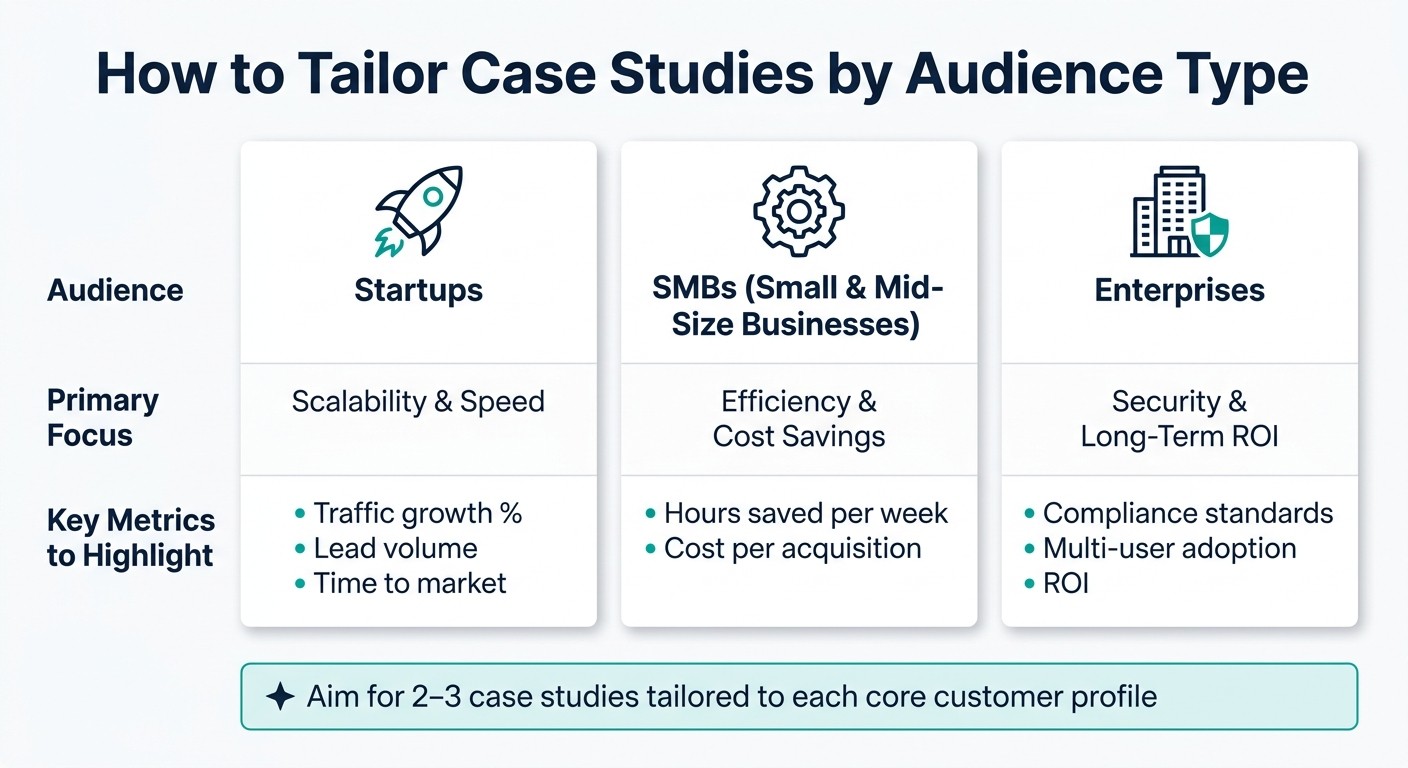
Once your draft is backed by data, customize it to align with your B2B SaaS marketing strategy and the needs of your target audience. A case study that resonates with a small startup won’t necessarily hit the mark with a large enterprise team. The key is to feature companies that reflect your audience’s industry, size, and challenges as closely as possible. Ideally, you should have 2–3 case studies tailored for each of your core customer profiles.
Adjust the language, focus, and metrics of the case study to suit the audience. For example:
Audience | Primary Focus | Key Metrics to Highlight |
|---|---|---|
Startups | Scalability & speed | Traffic growth %, lead volume, time to market |
SMBs | Efficiency & cost savings | Hours saved per week, cost per acquisition |
Enterprises | Security & long-term ROI | Compliance standards, multi-user adoption, ROI |
If a customer prefers to remain anonymous, you can still create a strong case study by using specific descriptors. For example, "a Series A B2B SaaS company in HR tech with 45 employees" is far more effective than a generic, vague testimonial. Specificity builds trust, not just the presence of a recognizable logo.
Conclusion: Writing Case Studies That Drive Results
Key Takeaways
To boost sales, start with the basics. Highlight the results upfront. Use your most compelling metric in the headline and summary box to grab attention and showcase the value immediately. Craft a before-and-after story that demonstrates the transformation, and back it up with specifics - such as names, figures, and timelines - to establish trust.
Remember, where you place your case studies matters as much as how you write them. A case study hidden on an obscure page won’t make an impact. Position it strategically: near calls-to-action, within sales proposals, or as part of your email campaigns.
"A well-written case study is a sales asset disguised as a content piece. It answers the question every prospect has before buying: 'Has this worked for someone like me?'" – Averi [4]
With these strategies in mind, you can confidently refine your approach to creating case studies that deliver measurable results.
Next Steps for Marketers
Use the templates provided earlier to simplify your process. Start with a customer who closely resembles your target audience - same industry, similar business size, and comparable challenges. Draft the case study using the outlined templates, get it approved, and then publish it. Maximize its impact by repurposing it into different formats: a slide deck for sales presentations, email snippets, or pull-quote visuals for landing pages.
"The businesses that invest in strong case studies close deals faster, face fewer objections, and command higher prices. The ones without them compete on promises - and promises are cheap." – Marketing Results [3]
Before starting your next project, establish a baseline, gather 2–3 solid metrics, and finish every case study with a specific call-to-action. These steps ensure your data and storytelling translate into powerful marketing tools that drive conversions.
FAQs
How do I choose the right case study template for my situation?
When creating a case study, choose a template that aligns with your objectives, the complexity of your story, and the needs of your audience. Tailor the structure to resonate with your buyer persona and address their specific concerns.
If your goal is quick lead conversion, opt for a format that highlights a concise results summary right at the top.
For technical solutions, focus on templates that emphasize detailed methodologies and processes.
No matter the approach, always include quantifiable metrics to back up your claims, client quotes to add credibility, and a clear call to action to guide the reader toward the next step. These elements ensure your case study delivers maximum impact.
What metrics should I include if a customer won’t share exact numbers?
When precise figures aren’t an option, lean on alternative data points to demonstrate impact. Highlight aspects like time saved, streamlined workflows, or key milestones reached. Use tools such as percentage changes, before-and-after analyses, or timelines to make results tangible. Bolster credibility by including customer testimonials, visual evidence like dashboards, or detailed examples of operational enhancements. If confidentiality agreements prevent sharing specifics, frame outcomes by referencing the industry or type of company rather than naming the client.
Where should I place case studies to increase conversions?
To increase conversions, weave case studies into every stage of your marketing and sales efforts. On your website, create a dedicated results page showcasing success stories, display key metrics and client logos prominently on your homepage, and ensure case studies align with relevant service pages. Add credibility by placing proof points near call-to-action buttons.
For sales, integrate case studies into proposals, use them in follow-up communications, and kick off presentations with compelling success stories. Additionally, repurpose standout statistics for social media posts and retargeting ads to reinforce your message across platforms.
Related Blog Posts

Zach Chmael
CMO, Averi
"We built Averi around the exact workflow we've used to scale our web traffic over 6000% in the last 6 months."
Your content should be working harder.
Averi's content engine builds Google entity authority, drives AI citations, and scales your visibility so you can get more customers.