

In This Article
Most SaaS blog posts fail from poor strategy; use eight proven templates to align content with the buyer journey and drive conversions.
Updated:
Trusted by 1,000+ teams
Startups use Averi to build
content engines that rank.
For B2B SaaS teams, blogging is more than just creating content - it’s about delivering value that aligns with a B2B marketing strategy that drives results. This guide outlines 8 practical blog post templates designed to increase efficiency, engage readers, and drive conversions. Here's what you'll find:
Product Announcements: Highlight user benefits first, not technical details.
Feature Deep Dives: Solve problems with detailed walkthroughs.
Customer Case Studies: Use the Problem → Solution → Result framework.
Thought Leadership Pieces: Challenge norms with data-backed arguments.
How-To Guides: Focus on actionable steps to solve specific problems.
Comparisons: Help buyers decide with clear, honest feature breakdowns.
List Posts: Showcase use cases with ready-to-use templates.
Playbooks: Share step-by-step workflows for consistent results.
Key Insight: 96.5% of web pages get zero search traffic. To stand out, focus on structure, clear calls-to-action, and aligning content with the buyer’s journey. Start by auditing your existing content for gaps and refreshing outdated posts.
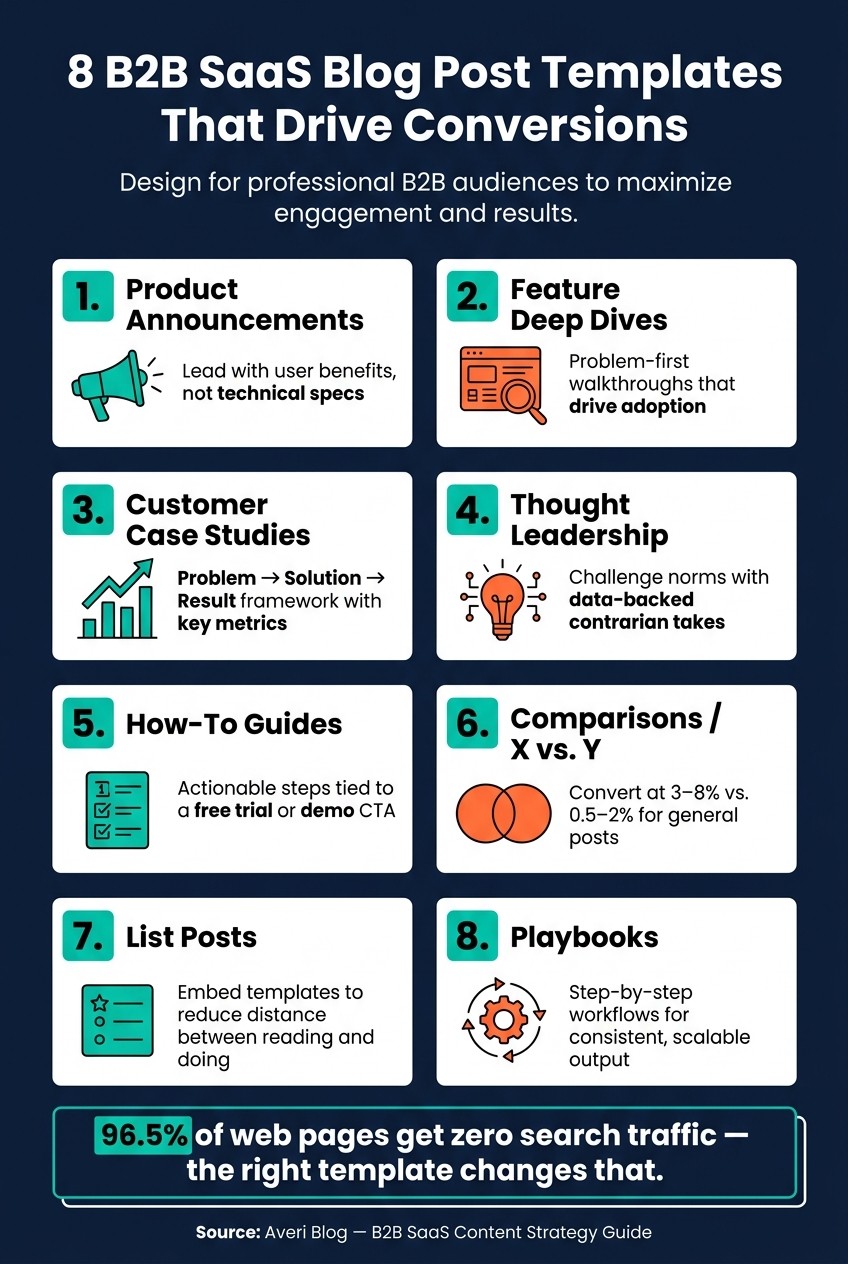
8 B2B SaaS Blog Post Templates That Drive Conversions
How to Write Blog Posts That Get You Clients (B2B & SaaS)
1. Product Announcements
Template: The Benefit-First Feature Launch Post
Product announcements often miss the mark when they focus on internal achievements rather than the value delivered to users. Instead of saying, "We rebuilt our API" or "Introducing v2.0 of our dashboard", shift the focus to how it benefits the user.
"Frame it around the user benefit, not the technical achievement. 'We rebuilt our API' means nothing. 'You can now integrate in 5 minutes instead of 5 hours' means everything." - John Fawkes, Veteran Copywriter [2]
An effective product announcement follows a straightforward structure. Start by identifying the problem it addresses, then explain the update in simple terms. Include a visual walkthrough - screenshots or a short demo work well - and highlight how the feature can be applied to different roles or team sizes. Wrap it up with clear instructions on how to access the feature, specifying which plan tier it’s available on and where to find it in the interface. End with a direct call-to-action like "Try it now." Skipping these steps creates unnecessary hurdles for users, such as needing to contact support or search for answers, which can lead to frustration [2].
Since product-led content typically makes up about 10% of a high-performing B2B SaaS blog [4], every announcement should cater to both current users and potential buyers still evaluating options.
For headlines, consider formulas like: "Introducing [Feature]: Now You Can [Specific Capability]" or "New: [Feature Name] Makes [Task] Easier" [2].
2. Feature Deep Dives
Template: The Problem-First Walkthrough
A feature deep dive takes product announcements to the next level by diving into how a feature works and why it matters. This approach shifts the focus from simple awareness to encouraging action, helping readers see the value in using the feature.
Start by highlighting the pain point rather than jumping straight to the feature. Once readers identify with the problem, present the feature as the solution. Use screenshots or a demo to guide them through each step. Ahrefs excels at this - its deep-dive posts use the tool itself as the tutorial, complete with interface screenshots. For example, their keyword research post, which includes original analysis of 1.9 billion keywords, generates an estimated 200,000+ monthly organic sessions and has maintained the #1 spot for "keyword research", a highly competitive term, as of February 2026 [7].
"If your product is the solution to the problem you're writing about, show it working - don't tell the reader it works." - Averi [7]
After the walkthrough, expand with two or three role-specific examples to show how the feature applies in different contexts. Wrap up with a quick "how to access" section - outline which plan includes the feature, where users can find it in the app, and finish with a direct call-to-action. Skipping this final step risks creating unnecessary friction that could discourage adoption.
Well-crafted deep dives typically run between 1,500 and 2,500 words [1], striking a balance between depth and clarity. Including a customer quote or early user result adds credibility, reinforcing the feature's impact.
3. Customer Case Studies
Template: The Problem-Solution-Result Story
Customer case studies are incredibly effective tools for building trust. In fact, 97% of B2B buyers consider well-crafted business-case content to be critical when making decisions [3]. The key to success lies in delivering detailed and specific narratives.
A proven structure to follow is the Problem → Solution → Result framework. Begin with a Snapshot Box that highlights 3–4 key metrics, such as percentage growth, time saved, or revenue impact. This gives busy readers a quick way to grasp the story’s value. Afterward, dive into the customer’s initial challenges, focusing on measurable pain points. This not only builds empathy but also makes the eventual outcomes more impactful.
Take Notion as an example. Over six months, they executed a strategic content initiative that skyrocketed their organic traffic from 800 to 12,400 monthly sessions - a staggering 1,450% growth. The project also resulted in 87 content-attributed MQLs (Marketing Qualified Leads) per month and slashed their content production timeline from three weeks to just four days per piece [3]. This example demonstrates how a well-constructed case study can effectively address buyer concerns.
"The ROI case became undeniable really fast. We were spending $15,000/month on paid ads for 60 MQLs. Now content is delivering more at almost zero marginal cost." - Head of Marketing, Notion [3]
Including a brief section on migration and onboarding can further ease prospects’ concerns about switching from competitors [8]. Finally, make sure these case studies are ungated - buyers in the evaluation phase need quick access to proof points, and requiring forms can disrupt their momentum [3].
4. Thought Leadership Pieces
Template: The Contrarian Take
Thought leadership pieces are a great way to position your brand as a game-changer in the B2B SaaS space. The key is to challenge established norms. Start by identifying a widely accepted industry practice, highlight its flaws with solid data, and back up your argument with well-researched, specific examples.
"The more granular and opinionated you are, the more interesting your content becomes." – Averi Blog [1]
One effective strategy in thought leadership is creating a new category - introducing a term or methodology that naturally ties into your product. A standout example is Drift’s introduction of "Conversational Marketing." They argued that traditional lead forms don’t meet buyers' needs and positioned their chatbot as the must-have solution [7].
"The most powerful SaaS content isn't about your product - it's about the new category your product creates or champions." – Averi Blog [7]
Idea: "Why [Common Industry Belief] Is Holding Your Team Back"
Develop a post that takes a critical look at a standard industry practice. Use your own data to expose its limitations and conclude with a fresh framework your brand promotes.
This bold, contrarian approach sets the tone for delivering actionable strategies in future content.
5. How-To Guides
How-to guides are a magnet for readers who are actively looking for solutions, making them some of the most effective types of B2B SaaS content. The trick is to focus on specific, actionable steps rather than vague descriptions.
Example: "How to [Achieve a Specific Outcome] [With a Qualifier]"
A well-crafted how-to guide has a clear structure: a headline focused on the desired result, a brief overview of what’s needed to get started, detailed numbered steps with practical actions, and a call-to-action (CTA) that ties directly to what the reader just learned.
"If your product is the solution to the problem you're writing about, show it working - don't tell the reader it works." – Averi [7]
Take HubSpot's "How to Write a Marketing Plan" as a standout example. By early 2026, this guide was pulling in over 85,000 organic sessions per month. Its success lies in its exhaustive 4,000-word format, addressing every possible question, and a gated downloadable template as the main CTA - turning informational traffic into CRM leads [7].
For B2B SaaS teams, the strategy is the same: create a guide that solves a problem your audience faces as part of your B2B SaaS marketing strategy right before they’d consider your product. Show your software in action within the steps, demonstrating how it addresses the issue. Wrap up with a CTA leading to a free trial, template, or demo - this smooth progression turns engaged readers into potential customers.
6. Comparisons and 'X vs. Y' Posts
Comparison posts are a powerful tool for helping potential buyers finalize their decisions by highlighting the key differences between options.
Example: "[Your Product] vs. [Competitor]: Which One Is Right for Your Team?"
These posts are tailored for buyers who are no longer just exploring - they’re actively evaluating their choices. Because of this, they tend to convert at much higher rates. Visitors to comparison pages typically convert at 3% to 8%, compared to just 0.5% to 2% for general blog posts [6]. For instance, Teamwork, a project management SaaS, experienced a 54% boost in organic traffic conversions after incorporating competitor comparison pages into its content strategy [9].
The most effective format for these posts is simple yet impactful. Start with a TL;DR summary table that provides readers with an immediate overview. Follow this with a detailed, feature-by-feature breakdown, but focus only on the aspects that truly influence purchase decisions - such as pricing, setup simplicity, integrations, and migration options. Skip over shared features and zero in on what sets the products apart.
"The goal isn't to win every dimension; it's to help the right reader self-identify and choose your product." - Averi [5]
This approach not only informs but also builds trust. Being upfront about trade-offs is crucial. For example, HubSpot acknowledges on its comparison pages that Salesforce may be a better fit for enterprises requiring highly customized workflows [6]. Such transparency doesn’t deter conversions - it strengthens them by attracting the right audience. Conclude the post with a clear "Choose X if… / Choose Y if…" section, helping readers make a confident decision based on their specific needs, such as team size or use case.
When creating comparison tables, use HTML or Markdown rather than images. Structured text is easier for search engines and AI tools to process, which can improve your content’s visibility and likelihood of being cited [8]. By following this structure, B2B SaaS marketers can craft precise, actionable content that resonates with decision-makers and drives meaningful results.
7. List Posts for Use Cases and Ideas
Idea: "10 Ways [Your Product Category] Teams Are Using [Tool] in 2026"
This approach is perfect for reaching buyers who recognize a problem but haven’t yet connected it to your product. It highlights related use cases where your tool can provide solutions, even if the reader isn’t initially aware of its potential. A great example of this is Calendly's "Meeting Request Email Templates", which, as of February 2026, attracts over 120,000 monthly organic sessions [7]. It addresses a scheduling challenge without making the product itself the focal point.
The real magic lies in offering actionable resources. Embedding ready-to-use templates - like email drafts, project briefs, or workflow checklists - directly into your post encourages immediate engagement. For instance, Monday.com's template pages rank for hundreds of industry-specific queries and generate over 50,000 monthly organic sessions. These templates allow users to replicate resources instantly [7]. As Averi explains:
"Templates convert at dramatically higher rates than how-to posts because they reduce the distance between reading and doing." - Averi [7]
When crafting your headline, stick to the Number Formula: [Number] [Content Type] to [Desired Outcome]. For example, "12 SaaS Onboarding Emails You Can Steal Right Now" sets clear expectations [1]. This structure is also highly effective for surfacing in AI-driven search results - 8 of the top 10 most-cited URLs across AI platforms are "Best X" listicles [4].
8. Playbooks and Repeatable Workflows
Idea: "The [Your Content Type] Playbook: Our Exact Process for Publishing [X] Posts Per Month"
A playbook post lays out your team's detailed, step-by-step content creation process, providing a behind-the-scenes look at how you consistently produce high-quality results. For B2B SaaS teams, this approach stands out because it focuses on real, actionable workflows rather than vague suggestions.
An effective playbook follows a predictable cycle: start with a well-defined brief, proceed through thorough research, drafting, and multiple review stages, and finish with a final quality check. Each brief should outline the essentials - target audience, keywords, search intent, brand voice, and call to action - before any writing begins [1]. This structure reduces unnecessary revisions and keeps the process efficient. The pre-publish quality check ensures every piece meets set standards, such as including keywords early in the content and keeping paragraphs concise (under four sentences) [1][5]. By sticking to this framework, teams can streamline their efforts and align content production with broader strategic goals.
A final quality checklist is particularly valuable for maintaining consistency, even when onboarding new team members.
Averi's content team is a prime example of how this approach pays off. Between October 2025 and April 2026, they boosted organic web traffic by over 6,000%, climbing from 2.85 million to 2.91 million monthly Google impressions. They achieved this by implementing an automated content machine built on this exact workflow [4][10]. Their success wasn’t limited to blog posts - product announcements and case studies also saw similar results. CMO Zach Chmael highlighted the importance of their process:
"We built Averi around the exact workflow we've used to scale our web traffic over 6000% in the last 6 months." - Zach Chmael, CMO, Averi [4][10]
For B2B SaaS teams, the takeaway is clear: a well-documented playbook not only optimizes content production but can also double as a powerful sales tool. Content like comparison articles and case studies, created through this structured process, is particularly effective when shared with prospects considering competitors [8]. This approach reinforces your blog as a key part of your sales strategy.
Conclusion
The eight templates - product announcements, feature deep dives, case studies, thought leadership pieces, how-to guides, comparisons, list posts, and playbooks - serve as essential tools for guiding buyers from initial awareness to final conversion.
Research highlights their effectiveness: BOFU (bottom-of-funnel) posts can deliver 10–25x more conversions, while maintaining a consistent weekly blog schedule can increase organic traffic by as much as 200% [4]. As Zach Chmael, CMO at Averi, aptly points out:
"96.5% of published pages get zero search traffic from Google. That's not a content quality problem. It's a content strategy problem." - Zach Chmael, CMO, Averi [4]
These templates address those strategic gaps by focusing on key elements like identifying the ideal customer profile (ICP), targeting the right keywords, and defining clear calls-to-action (CTAs) from the outset [1]. They’re not rigid formulas but adaptable frameworks - tailor them to your audience, whether it’s a startup founder or an enterprise CTO, and align each post with the appropriate stage of the buyer’s journey. Enhance them further with your own data, customer testimonials, and product-specific insights.
Now is the time to turn this strategy into action with an AI content engine. Audit your current content library through this lens: pinpoint which funnel stages are underrepresented, identify missing BOFU posts, and refresh older content with updated data. Posts published within the last three months are three times more likely to be referenced by AI models, and AI Overviews are now surfacing in about 50% of search queries [4]. These templates make it easier to produce consistent, high-impact content without reinventing the wheel each time.
FAQs
Which template should I use for each funnel stage?
To make your content resonate with the B2B SaaS buyer journey, consider these approaches:
Top-of-Funnel (Problem-Aware): Create How-To guides or Problem-Agitate-Solution posts that highlight common challenges and offer educational insights. These formats help address initial pain points and draw in potential buyers.
Middle-of-Funnel (Solution-Aware): Dive deeper with detailed Use Case analyses or Industry Reports. These resources enable buyers to better understand and evaluate potential solutions tailored to their needs.
Bottom-of-Funnel (Decision-Ready): Focus on content like Comparison articles, Alternatives pages, Migration guides, or Case Studies. These formats are geared toward building trust and assisting high-intent buyers in making confident decisions.
What CTA should I include for each blog post type?
A call-to-action (CTA) should seamlessly encourage readers to take the next step, aligning with the content's purpose. Whether it's a free trial, product demo, or a resource that solves a highlighted issue, the CTA should feel like a natural progression.
For different content types:
Comparison posts: Suggest a customized trial or demo to help readers make an informed decision.
Case studies or templates: Offer gated downloads or tools that provide instant practical benefits.
Feature announcements: Invite readers to test the new feature, explore further details, or share their feedback.
The key is to match the CTA to the reader's intent and the content's focus.
How do I audit my blog to find content gaps?
To identify content gaps in your blog, start by analyzing your existing content library to spot missing high-intent formats, such as comparison posts. Evaluate how effectively your content aligns with the stages of your ideal customer's journey and addresses common questions - these could stem from sales calls, customer feedback, or reviews on platforms like G2 and Capterra. Additionally, conduct a SERP audit for your target keywords. This will help you uncover competitor content, understand their structure, and identify any areas where your site may lack depth or specific criteria.
Related Blog Posts

Zach Chmael
CMO, Averi
"We built Averi around the exact workflow we've used to scale our web traffic over 6000% in the last 6 months."
Your content should be working harder.
Averi's content engine builds Google entity authority, drives AI citations, and scales your visibility so you can get more customers.