Content Marketing for B2B SaaS Startups: The 2026 Playbook

Averi Academy
Averi Team
8 minutes

In This Article
Treat content as a growth system: follow a 5‑phase AI‑human workflow to scale B2B SaaS content, cut costs, and generate predictable pipeline.
Updated:
Trusted by 1,000+ teams
Startups use Averi to build
content engines that rank.
Content marketing remains the go-to strategy for B2B SaaS startups in 2026, driving growth by addressing buyer needs long before sales conversations begin. With 70% of buyers completing their research independently, content like blogs, guides, and comparison pages influence decisions more effectively than paid ads. AI tools are now central to scaling content production, cutting costs and time while maintaining quality. However, startups face challenges like tighter budgets, intense competition for search visibility, and the need for faster decision-making.
Key Takeaways:
AI's Impact:AI-assisted workflows reduce blog costs by 78% and boost productivity, enabling teams to publish 8–12 posts monthly with minimal effort.
Challenges: 93% of Google AI Mode searches end without a click, pushing startups to rethink SEO strategies.
5-Phase System: A structured B2B SaaS marketing strategy — covering strategy, topic selection, AI-assisted creation, publishing, and performance tracking — ensures consistent results.
Tools: Platforms like Averi AI streamline the entire content lifecycle, from strategy to analytics, for as little as $100/month.
Startups that treat content as a growth system, not a one-off task, achieve sustainable results. The 70/30 AI-human balance ensures both scalability and engagement while addressing buyers' evolving expectations.
If I Started SaaS in 2026, Here’s My B2B Content Strategy for $1M ARR
The 5-Phase Content Marketing System
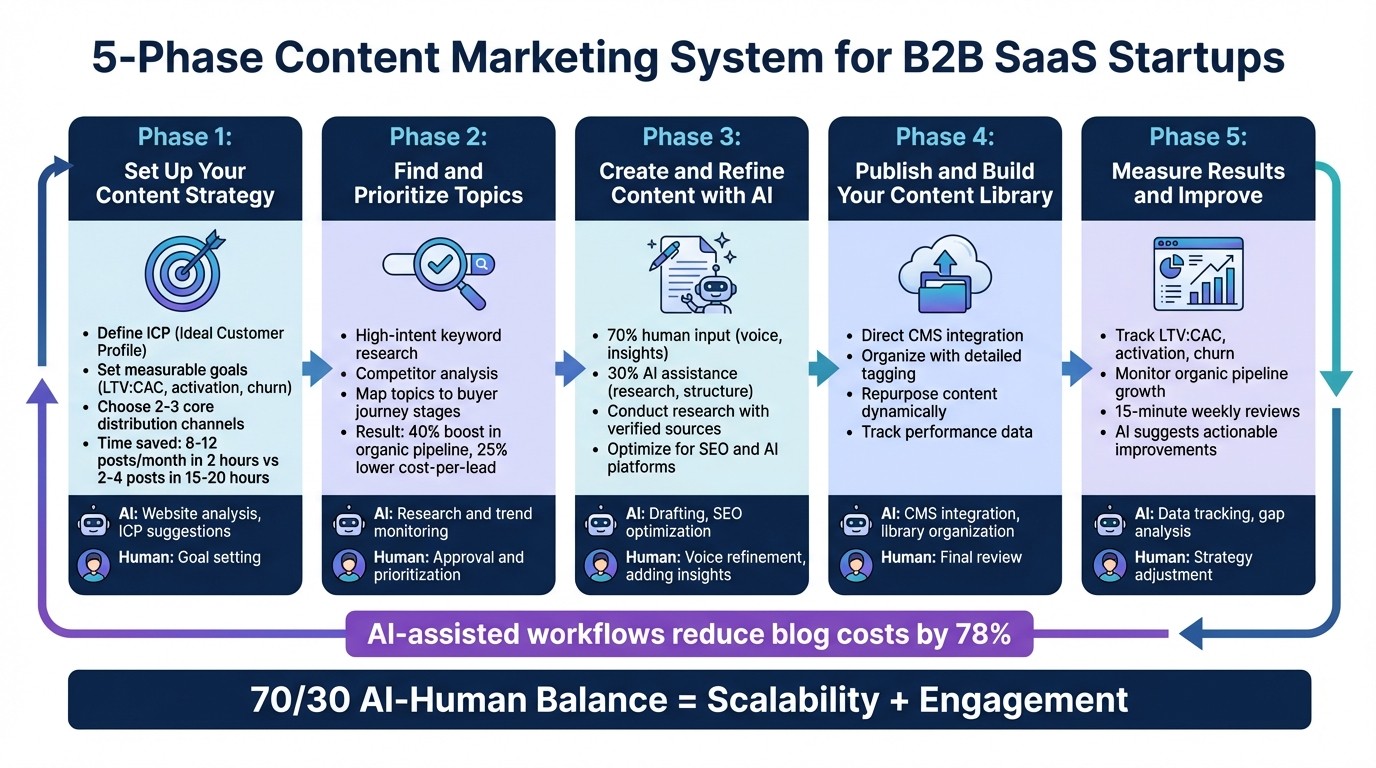
5-Phase B2B SaaS Content Marketing System with AI-Human Workflow
For many B2B SaaS startups, content marketing often feels like a sporadic effort - publishing only when there’s time or inspiration. But companies that see measurable success approach it as a structured, repeatable process. By treating content as an infrastructure, they create a system that becomes smarter and more effective with every piece published.
This five-phase AI content engine transforms content marketing into a scalable system, aligning seamlessly with AI-powered workflows to deliver consistent results.
Phase 1: Set Up Your Content Strategy
Start by defining your ideal customer profile (ICP), measurable goals, and competitive positioning [6]. Skip the lengthy strategy documents and focus on creating a clear framework that guides every piece of content. This approach can drastically improve efficiency - allowing teams to produce 8–12 posts per month in just 2 hours a week, compared to the 15–20 hours needed for 2–4 posts using traditional methods [2].
Identify your target audience by job title, company size, and industry, then match their pain points to specific content themes. For example, if your ICP includes VPs of Sales at mid-sized companies struggling with pipeline visibility, focus on topics like CRM adoption, forecasting accuracy, and deal velocity.
Set goals tied to meaningful metrics such as LTV:CAC ratio, activation rates, or churn. Early-stage companies should prioritize high-intent, bottom-funnel content - like comparison pages or problem-specific solutions - that drives quick conversions.
Choose 2–3 core distribution channels based on where your audience spends their time. For many startups, this often includes organic search for high-intent keywords, LinkedIn content led by founders, and targeted paid search.
AI tools like Averi AI can streamline this process by analyzing your website, brand voice, and competitor gaps in just minutes [2]. What used to take days now happens in a fraction of the time, creating a strong foundation for all future content.
Phase 2: Find and Prioritize Topics
With your strategy in place, the next step is identifying topics that yield the best results. Use a mix of keyword research, competitor analysis, and buyer intent mapping [6][8].
Focus on high-intent keywords that signal readiness to buy, such as “best [category] for [use case]” or “[competitor] vs [another competitor].” These terms often convert faster than general educational queries.
Map each topic to a specific stage in the buyer’s journey. For instance:
Problem-focused blogs address pain points.
Product comparison pages target high-intent buyers.
Integration guides appeal to those with specific tech stack needs [6].
AI tools simplify this by continuously analyzing trends, search volumes, and competitor gaps, presenting you with a curated list of opportunities [2]. Instead of manually combing through keyword tools, you can focus on approving the most relevant topics.
One Series B company structured its content strategy around quarterly themes - such as buyer’s guides or ROI calculators - and saw a 40% boost in organic pipeline while cutting cost-per-lead by 25% [9].
Phase 3: Create and Refine Content with AI
In this phase, AI takes over much of the heavy lifting, but human expertise remains critical. The ideal balance involves 70% human input for voice and insights, with AI handling the remaining 30% for research and structure [5]. Content relying too heavily on AI often fails to engage effectively.
Once topics are selected, AI tools assist by:
Conducting in-depth research with verified sources.
Drafting initial content using proven frameworks like AIDA or PAS.
Each piece is formatted to perform well on both traditional search engines and AI platforms like ChatGPT. This includes concise, 40–60 word answers at the start of major sections to ensure easy extraction by AI systems [4].
After the draft is complete, human editors refine the content by adding unique insights, customer anecdotes, and ensuring accuracy. This step is crucial because generic AI-generated content rarely converts, while enriched content can drive engagement [11].
Tools like Averi AI maintain consistency by pulling from your Phase 1 strategy and existing content library, minimizing the need for repeated briefings [2]. Features like collaborative editing allow for real-time adjustments to tone or structure. For specialized needs, you can also hire vetted experts to help refine your high-stakes assets.
To optimize for AI-driven search, ensure your site allows AI crawlers and includes an llms.txt file to guide them. Adding schema markup and metadata further improves visibility [8].
Phase 4: Publish and Build Your Content Library
Publishing isn’t just about hitting “post.” In this phase, each piece becomes part of a growing content library - a resource that compounds in value over time. Use direct integrations with CMS platforms like WordPress or Webflow to streamline the publishing process [2].
Organize your library with detailed tagging and metadata, categorizing content by industry, persona, use case, and buyer stage [8]. This structure allows AI tools to dynamically repurpose content - turning a single webinar into blog posts, LinkedIn articles, and email campaigns with minimal effort [12].
Track performance data within the library. Identify which topics generate pipeline, formats with higher engagement, and channels with the best ROI. This data informs future content decisions and helps AI recommend opportunities aligned with your goals.
Phase 5: Measure Results and Improve
The final phase focuses on metrics that directly impact business outcomes. Track key indicators like LTV:CAC ratio, activation rates, churn, and organic pipeline growth [6][9]. Attribution tools can help pinpoint which content drives revenue, moving beyond surface-level metrics like page views [6].
Advanced AI tools don’t just report data - they offer actionable insights. For instance, they might suggest new angles for trending topics, recommend ways to improve rankings, or highlight opportunities to counter competitors’ content [2].
Set aside 15 minutes weekly to review analytics. Look at which pieces improved rankings, drove conversions, or revealed new trends. Use this feedback to refine your topic queue and overall strategy.
This ongoing analysis ensures your content marketing system evolves and compounds over time, delivering consistent growth with minimal manual effort.
Phase | AI Responsibility | Human Responsibility |
|---|---|---|
1. Strategy | Website analysis, ICP suggestions | Goal setting |
2. Topics | Research and trend monitoring | Approval and prioritization |
3. Creation | Drafting, SEO optimization | Voice refinement, adding insights |
4. Publish | CMS integration, library organization | Final review |
5. Measure | Data tracking, gap analysis | Strategy adjustment |
Using AI and Automation to Scale Content Production
The challenge with AI isn't just about using it - it's about integrating it as a core part of your workflow. Instead of asking, "Can AI write this?" shift the focus to, "What tasks can we fully automate?" Research indicates that AI-assisted workflows can cut content creation time from 8 hours to just 2.5 hours per article while maintaining quality [5]. The real advantage, however, isn't just speed - it's consistency. When a system operates the same way week after week, output grows without the need to expand your team.
How to Pick Content Tools for Your Startup
Once your workflow is streamlined, choosing the right content strategy tools becomes critical. The right tool depends on the kind of solution you need: a workspace that manages the entire content process, a point tool for specific tasks, or a marketplace to outsource work.
Averi AI provides an all-in-one content engine that handles strategy, research, drafting, publishing, and analytics. It adapts to your brand voice using your website, maintains context across all content, and integrates directly with platforms like Webflow, WordPress, or Framer. At $100/month for the Plus Plan, it's ideal for founder-led startups looking to approve content without micromanaging [2].
Jasper (priced at $49–$75/month) is great for producing high-volume, short-form content while ensuring brand voice consistency, making it a good fit for mid-sized teams scaling their content efforts.
Copy.ai (starting at $49/month) links content creation with go-to-market workflows, making it particularly useful for teams that need their content to align with sales strategies.
Writesonic (ranging from $49 to $249/month) focuses on Generative Engine Optimization (GEO), ensuring that content is optimized to be referenced by tools like ChatGPT and Perplexity[1].
For startups with fewer than five people, a full-service workspace that covers the entire content lifecycle is often the best choice. On the other hand, teams with specialized content roles may benefit from using point tools for specific stages. The key is to avoid juggling too many platforms when a single integrated system can streamline the process.
Combining AI Speed with Human Judgment
AI works best when used for tasks like research and formatting, leaving humans to handle the creative and strategic elements. Studies show that content with over 50% AI involvement tends to have lower engagement and higher bounce rates [5]. The focus shouldn't be on whether to use AI, but rather on where human input adds the most value.
A 70/30 balance works well: let AI handle foundational tasks like research, structuring, and SEO while humans focus on refining the narrative and strategy. A three-step quality check ensures this balance:
Automated tools catch grammar and spelling issues.
AI systems verify brand voice and SEO alignment.
Human experts validate strategic accuracy and competitive positioning.
"AI isn't here to replace writers. It's here to eliminate everything that isn't writing." – Averi Team [5]
In practice, AI can generate a first draft complete with verified sources and structured frameworks. Humans then step in to refine the tone, add anecdotes, and sharpen the overall message. This approach can save around $480 per blog post compared to traditional methods [2].
Automating Repetitive Content Tasks
Automation is key to freeing up human talent for strategic decision-making. Start by identifying repetitive tasks that occur weekly and require little to no strategic thinking.
Tasks like topic research, SEO optimization, and publishing can be significantly streamlined:
Topic research, which traditionally takes 3–5 hours per week, can now be fully automated. AI tools monitor competitor content, identify keyword gaps, and queue up high-potential topics, cutting manual effort to zero [2].
SEO optimization, usually a 1–2 hour task per piece, becomes automatic when platforms apply headers, metadata, and internal linking during the drafting phase.
Publishing, which often involves 30 minutes of manual formatting and uploading, can be reduced to just 2 minutes with direct CMS integrations.
By automating these routine steps, teams can consolidate workflows and scale their efforts. This division of labor allows small teams to match the output of much larger ones, ensuring that human input focuses on high-value tasks like tone refinement and strategic decisions.
Activity | Traditional Workflow | AI Content Engine Workflow |
|---|---|---|
Topic/Keyword Research | 3–5 hours | 0 (Automated) |
Writing (per piece) | 4–6 hours | 20–30 minutes (Review/Edit) |
SEO/GEO Optimization | 1–2 hours | 0 (Automated) |
Publishing | 30 minutes | 2 minutes |
Weekly Total | 15–20+ hours | 2 hours |
This kind of automation doesn't just save time - it creates a system where small teams can achieve consistent, scalable results. By automating low-value tasks, you ensure that your team focuses on what truly matters: creating content that resonates.
Step-by-Step Playbook for Small SaaS Teams
Consistency is the secret weapon of successful teams. When content creation becomes a predictable weekly habit, it’s easier to maintain quality while keeping the workload manageable. The goal? Produce impactful content in just two hours a week.
Your Weekly Content Workflow
By leveraging AI for efficiency, small SaaS teams can streamline their content process. Here’s a breakdown of how to structure your week:
Monday (15 minutes): Start the week by reviewing your content queue. Your AI system has already analyzed competitors, identified keyword gaps, and suggested topics. All you need to do is approve what moves forward. This eliminates the dreaded back-and-forth over topic selection and keeps things moving.
Tuesday–Thursday (45–60 minutes): Dedicate time to refining AI-generated drafts. Each draft should take about 20–30 minutes to adjust for tone, accuracy, and perspective. The AI handles the heavy lifting - research, structure, and SEO formatting - while you fine-tune the human touch.
Friday (15–20 minutes): Wrap up the week by reviewing your analytics dashboard. Check what’s ranking and where traffic is coming from. Based on this data, your AI system will suggest next steps - whether it’s updating old content, targeting new keywords, or prioritizing specific topics. Approve these recommendations, and the cycle continues.
Setting Up Approval Processes
For small teams, simplicity is key. A lightweight review system ensures quality without slowing progress. Focus on three major decision points: initial setup, weekly topic approval, and final draft review [2]. Everything else should be automated or handled by your content system.
Take a page from Redlist, a cloud-based operational management company. In March 2025, they integrated Pipedrive's Smart Docs to centralize document creation and approvals. By combining drafting and e-signatures in one platform, each sales rep saved an entire workday every week, leading to a 200% boost in annual sales [13]. The takeaway for content teams? Centralize feedback to one platform where edits, comments, and approvals happen seamlessly.
Set clear timelines for reviews. Routine blog posts should move through approvals in 24–48 hours. For more complex pieces like whitepapers or rebranding content, allow 3–5 days. Anything beyond that signals inefficiencies in the process [14]. Limit review cycles to two or three rounds. If decisions aren’t made by the third round, the issue likely lies in unclear strategy, not the content itself.
This streamlined approach aligns perfectly with the weekly workflow described above.
Increasing Output Without Adding Headcount
Scaling your content output doesn’t mean hiring more people - it means automating repetitive tasks. Research, SEO, and publishing can all be automated, freeing up time to focus on high-value work.
Disconnected tools are often the culprit behind wasted time, with small teams losing up to 40% of their productivity managing multiple platforms [3]. The fix? Consolidate your tools. A unified system that handles keyword research, drafting, optimization, and publishing eliminates inefficiencies. For example, if a tool like Averi costs $100/month and replaces several subscriptions, it’s a no-brainer - less overhead, more time for creativity.
Batching is another game-changer. Approve five topics on Monday, refine five drafts mid-week, and publish five pieces by Friday. This rhythm keeps your workflow predictable and avoids the stop-start cycle that kills momentum. The payoff is substantial: teams that publish consistently see 3.5 times more conversions compared to those that publish sporadically [2]. In content creation, consistency always wins over perfection.
Building a Content System That Runs Itself
An effective content system doesn’t just churn out material - it evolves. It learns from performance metrics, adjusts to market trends, and becomes more efficient over time. For lean SaaS teams, this kind of system isn’t just helpful - it’s essential.
Here’s a roadmap to creating a content system that operates with minimal manual intervention while delivering maximum results.
What SaaS Founders Should Keep in Mind
To build a system that scales rather than stalls, focus on these three key principles:
Start with strategy, not tactics.
Every piece of content should address a real problem faced by your Ideal Customer Profile (ICP). For instance, one Series B SaaS company aligned their quarterly content themes with the buyer journey: Q1 centered on category education, Q2 on buyer's guides, Q3 on implementation playbooks, and Q4 on ROI calculators. The payoff? A 40% boost in organic pipeline and a 25% drop in cost per lead[9].
Automate the repetitive, refine the strategic.
Efficiency compounds when you repurpose content. Take LCN, a content agency that, in 2026, built a system to transform webinars into blog posts, videos, and other assets. This approach scaled their authority and conversions without increasing headcount[12]. The formula is clear: let AI handle 95% of repetitive tasks while your team focuses on tone, accuracy, and strategic adjustments[7].
Let performance data lead the way.
Rather than relying on guesswork, track meaningful metrics like net revenue retention, customer acquisition cost (CAC) payback, and pipeline coverage. With 70% of B2B buyers completing their research independently before reaching out to sales[7], your content must educate, demonstrate value, and convert - all without constant human intervention.
By adhering to these principles, you can build a content system that not only runs smoothly but evolves alongside your business.
How to Get Started Today
To set up your content system, begin with a full-funnel marketing strategy. Use customer feedback to identify your ICP’s biggest challenges and establish goals tied to pipeline growth, reduced CAC, and shorter sales cycles. Map content types to different funnel stages - think problem-focused blog posts or product comparison guides for high-intent prospects. This approach enables early-stage teams to drive faster conversions[6][10].
Next, invest in tools that blend AI efficiency with human oversight. Look for platforms that streamline content creation, distribution, and analytics while fitting seamlessly into your existing tech stack. Tools like Averi AI, for example, manage strategy, drafting, optimization, and publishing in a single workflow, saving an average of $480 per blog post compared to manual processes[2]. These tools not only accelerate production but also adapt to your brand’s voice, improving over time.
Finally, establish workflows that keep productivity consistent. Develop a weekly content calendar that includes repurposing - turn webinars into blog posts, videos, or infographics. Automate approvals and distribution across SEO-optimized channels, and set up triggers for retention-focused content, such as upgrade emails or renewal reminders[6][12]. By publishing regularly, tracking meaningful metrics, and allowing your system to adapt, you’ll ensure your content engine keeps delivering results.
FAQs
What content should we publish first to generate pipeline fast?
To build a strong pipeline in 2026, concentrate on creating content that delivers impact and scales effectively, all while aligning with your audience's buying journey. Aim to produce 8–12 posts each month using a mix of AI tools and human insight. This approach ensures you can maintain high-quality output without overspending. Early on, focus on content that boosts SEO and attracts AI citations. Well-structured formats like FAQs are particularly effective, generating 2.8 times more AI recommendations. This can significantly enhance visibility and lead generation in the highly competitive SaaS landscape.
How do we keep AI-written content from sounding generic or inaccurate?
To sidestep the pitfalls of generic or off-base AI-generated content, it's essential to pair AI's efficiency with careful human oversight. Start by structuring your content with clear, concise answer blocks to improve accuracy and readability. Consistency across platforms is equally important to maintain credibility and brand alignment.
Adhering to E-E-A-T principles - Experience, Expertise, Authority, and Trustworthiness - is non-negotiable. This means thoroughly vetting your sources, ensuring they are reliable, and maintaining proper citations to bolster authority. Human involvement plays a critical role here, ensuring the content reflects your brand's voice, stays relevant, and resonates with the audience. This combination of AI speed and human precision results in material that is not only accurate but also engaging and dependable.
What metrics show content is driving revenue, not just traffic?
Content has a measurable impact on revenue, with data showing it can generate leads at three times the rate of traditional advertising while cutting costs by 62%. Even more compelling, content shapes 70% of the buyer's journey before any sales interaction, underscoring its key role in influencing purchasing decisions and driving revenue.
Related Blog Posts

Zach Chmael
CMO, Averi
"We built Averi around the exact workflow we've used to scale our web traffic over 6000% in the last 6 months."
Your content should be working harder.
Averi's content engine builds Google entity authority, drives AI citations, and scales your visibility so you can get more customers.