

In This Article
Build sustainable D2C growth with SEO, email flows, UGC and AI-powered content systems that lower CAC and boost retention.
Updated:
Trusted by 1,000+ teams
Startups use Averi to build
content engines that rank.
Content marketing is a game-changer for Direct-to-Consumer (D2C) brands, helping reduce reliance on costly paid ads and build long-term customer relationships. With customer acquisition costs rising 60–80% since 2021, brands need a sustainable approach to growth. Content strategies like blogs, email sequences, and user-generated content (UGC) create organic visibility and improve customer retention.
Key takeaways:
Why it matters: Paid ads are expensive and unsustainable. Content drives traffic, lowers costs, and builds loyalty.
Challenges: Small teams face limited resources and inconsistent messaging.
Solutions: AI tools like Averi streamline content creation, scaling efforts without sacrificing quality.
Content goals: Tailor strategies for acquisition, retention, and increasing order value.
Customer journey: Align content types - blogs, videos, emails - with each stage, from awareness to advocacy.
Creating a Winning Content Strategy for D2C Brands | Pepper Spotlight | S2E06
Aligning Content Strategy with D2C Growth Goals
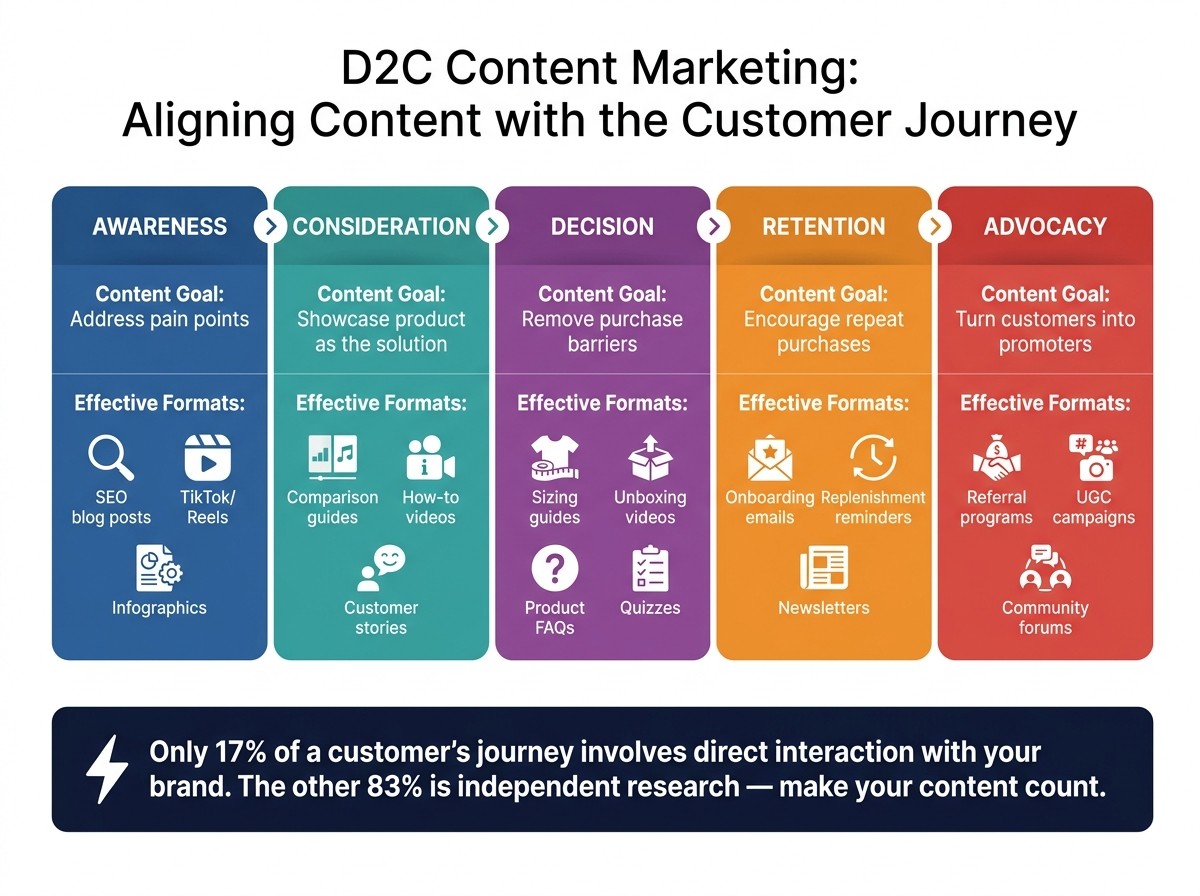
D2C Content Marketing: Customer Journey Stages & Content Types
When it comes to direct-to-consumer (D2C) success, your content strategy isn’t just about producing more - it’s about making sure each piece of content serves your growth goals. By aligning your efforts with clear objectives, you can create content that actively drives results.
Setting Clear Growth Objectives
Before diving into content creation, it’s crucial to define what you’re trying to achieve. For D2C brands, the main goals usually fall into four categories: driving first-time purchases, boosting repeat sales, building subscription revenue, and increasing average order value (AOV). Each of these requires a distinct approach.
For acquisition, focus on top-of-funnel content that answers questions potential customers are already asking - before they even know your brand exists.
For retention, prioritize post-purchase content like educational guides or replenishment reminders to increase customer lifetime value (CLV).
To grow AOV, highlight offers like tiered bundles or "Buy 2 Get 1 Free" deals to encourage larger purchases without increasing ad spend [4].
By tailoring your strategy to these goals, you’ll naturally segment your audience and deliver more impactful messaging.
Segmenting Your Audience for Targeted Content
One-size-fits-all content rarely resonates. To be effective, D2C brands must use the wealth of data at their disposal to segment their audience and craft personalized messages.
Leverage tools like Shopify, email engagement metrics, and CRM systems to understand customer behavior. For example:
High-LTV customers respond well to perks like exclusive content or early access to new products.
Lapsed buyers are more likely to return with a personalized win-back campaign.
New prospects need trust-building content, such as buying guides or educational resources, to feel confident before making a purchase [5][7].
An often-overlooked approach is using zero-party data - information customers willingly share through tools like quizzes. For example, interactive experiences like “Find your perfect fit” quizzes provide explicit, actionable data for personalization. Unlike passive tracking, this method ensures accuracy and scales well. Harry’s, the D2C shaving brand, offers a great example: they collected 100,000 email addresses in just one week through a referral-based pre-launch campaign, with 65,000 of those sign-ups coming directly from referrals [6]. When you give customers a reason to engage, they’ll often provide the data you need to refine your segmentation.
With clear audience segments, the next step is matching content types to where customers are in their journey.
Matching Content Types to the Customer Journey
The type of content you produce should align with the customer’s stage in their journey with your brand. A first-time visitor needs educational content, while a loyal customer values content that reinforces their connection to your brand.
Journey Stage | Content Goal | Effective Formats |
|---|---|---|
Awareness | Address pain points | |
Consideration | Showcase your product as the solution | |
Decision | Remove purchase barriers | Sizing guides, unboxing videos, product FAQs, quizzes [9][1] |
Retention | Encourage repeat purchases | Onboarding emails, replenishment reminders, newsletters [3][9] |
Advocacy | Turn customers into promoters |
Here’s a key insight: only 17% of a customer’s journey involves direct interaction with your brand. The other 83% is spent doing independent research [8]. That means your content - whether on your blog, social media, or product pages - needs to work hard to inform, engage, and persuade long before a customer reaches your checkout page. By mapping content to each stage, you ensure your brand stays influential throughout the buying process.
Next, we’ll explore how AI can help scale your content production and execution.
Building an AI-Powered Content Engine for D2C Brands
With your growth strategy in place, integrating AI into your content creation process can save time and improve efficiency.
Building a Data-Driven Content Strategy
A strong content strategy begins with understanding your customers' needs and identifying where competitors fall short. Tools like Averi analyze your website to capture your brand's tone and reveal content gaps, creating a detailed roadmap aligned with your goals - reducing hours of manual research to just 10 minutes.
The most effective strategies for D2C brands revolve around topical clusters. This approach involves a central pillar page - typically a comprehensive guide of 2,000+ words - accompanied by 8–12 shorter, related articles. This structure helps establish authority with search engines more effectively than random, standalone posts. For example, a skincare brand might create a pillar page on "How to Build a Skincare Routine", supported by related articles like "Best Moisturizers for Dry Skin" or "Retinol vs. Bakuchiol: What's the Difference?"
When targeting keywords, focus on these four types of content, which consistently drive revenue for D2C brands:
Keyword Type | Example Format | Buyer Intent |
|---|---|---|
Buying Guide | "Best [product category] 2026" | High - actively researching |
Comparison | "[Brand A] vs. [Brand B]" | Medium - evaluating options |
Tutorial | "How to use [product]" | Low - post-purchase or educational |
Niche Guide | "[Product] for [specific use case]" | High - specific need |
This structured, data-focused approach ensures every piece of content contributes meaningfully to your brand’s growth.
Creating and Managing a Content Queue
Many D2C brands struggle to maintain momentum when content ideas run out or rely too heavily on intuition. Averi addresses this by monitoring trends, competitor activities, and keyword opportunities to create a ready-to-use content queue. Each idea comes complete with a title, target keyword, and content overview, ensuring your team always has a clear starting point.
Aligning your content queue with your product launch calendar is especially critical. For instance, when preparing for a new product release, plan a cluster of supporting content - like buying guides, comparison posts, and FAQ pages - well in advance of the launch. This ensures your content generates interest and supports sales from day one.
Standardizing Your Content Production Workflow
Consistency in content production doesn’t necessarily mean working harder - it’s about building a repeatable system. The most efficient workflows leverage AI for research and drafting, with human reviewers refining the output for tone and accuracy.
Here’s how it works in practice: AI drafts content based on your brand’s guidelines, while human reviewers add the finishing touches, ensuring it aligns with your strategy and maintains quality. Features like automatic metadata generation, internal linking, and FAQ creation streamline the process further, allowing direct publication to your CMS. Tools like Averi’s Brand Core help scale this system, ensuring a consistent voice across everything from product descriptions to blog posts [2].
"You need to leverage AI as a sidekick to maximize your content processes... you can't just publish lightly edited AI-generated content." - Conor Baker, Content Marketing Manager, Conductor [11]
One often-overlooked tip for efficiency: create a shared prompt library. Save your best-performing AI prompts as reusable templates, so your team doesn’t have to start from scratch for tasks like social media copy or product descriptions. Research shows that generative AI can save marketers an average of 3 hours per content piece and 2.5 hours per day [10]. This frees up time for more strategic work, like building customer relationships or refining your overall content strategy.
Automating Content Distribution Across Channels
Once you've streamlined your AI-powered content production workflow, the next step is ensuring that your content reaches the right audience consistently across all channels. Relying on manual distribution is not only time-consuming but also limits scalability. Automating this process becomes essential to maintain momentum and achieve maximum impact.
Publishing SEO-Friendly Website and Blog Content
Focusing on your owned channels is a smart investment, especially as customer acquisition costs in e-commerce have surged by 60% between 2019 and 2024 [7]. Unlike paid advertising, which becomes more expensive over time, SEO-driven blog content continues to generate traffic long after it's published.
Platforms like Averi streamline the entire process - from keyword research to live publication on platforms like WordPress, Webflow, or Shopify - eliminating the need for manual intervention [2]. For product pages, including at least 300 words of unique content, FAQ schema markup, and customer Q&A sections can significantly improve search rankings [1].
To capture high-intent traffic, prioritize creating comparison pages. Content such as "Brand X vs. Brand Y" targets buyers actively evaluating their options, making it a valuable tool for driving organic conversions [1]. Beyond search, email campaigns can help extend your content's reach even further.
Running Email Campaigns and Lifecycle Sequences
Email remains one of the most effective channels for e-commerce, delivering an average ROI of $36 for every $1 spent [7]. The most successful brands leverage automated lifecycle sequences rather than one-off email blasts, tailoring their messaging to customer behavior.
A well-rounded email strategy should include at least four automated flows: welcome, abandoned cart, post-purchase, and win-back sequences. Here's a quick breakdown of each:
Email Sequence | Recommended Length | Primary Goal |
|---|---|---|
Welcome Series | 5 emails | Share brand story, highlight products, educate [1] |
Abandoned Cart | 3 emails | Recover lost sales, address objections [2] |
Post-Purchase | 3–5 emails | Provide usage tips, care instructions, collect UGC [7] |
Win-Back | 3 emails | Re-engage lapsed customers with offers [2] |
AI tools can handle everything from content creation to managing these flows, but success hinges on using behavior-based triggers. For example, a customer who completes a purchase should immediately exit the abandoned cart sequence and transition into the post-purchase flow [12]. With these automations in place, you can focus on repurposing content across social channels.
Repurposing Content for Social Media and UGC
A robust blog post or buying guide shouldn't be confined to your website. Long-form content can be repurposed into email snippets, social media captions, short-form video scripts, and more. Tools like Missinglettr and Opus Clip can transform a single piece of content into a year-long social media campaign or short-form video clips. This approach caters to the 69% of consumers who prefer videos for learning about products rather than reading text [7][13].
When it comes to user-generated content (UGC), relying on customers to post organically is often inconsistent. Instead, set up a system to collect UGC systematically. For example, post-purchase emails can automatically invite customers to share their experiences in exchange for a small incentive. This creates a steady pipeline of authentic content without requiring constant manual effort [7].
"The brands that build content-driven audiences before they need them spend less on ads, convert better, and keep customers longer." - Averi [1]
Tracking Performance and Scaling D2C Content Marketing
Key Metrics to Track Content Performance
For D2C brands, it’s crucial to focus on metrics that directly impact revenue rather than getting distracted by vanity numbers. Organizing these metrics into three categories - Acquisition, Conversion, and Retention - helps connect your content performance to real business results.
Metric Category | What to Track | Why It Matters |
|---|---|---|
Acquisition | Organic sessions, CAC, CTR, impressions | Measures how well your content attracts new customers [14][16] |
Conversion | Conversion rate, ROAS, AOV, content-assisted conversions | |
Retention | LTV, repeat purchase rate, churn rate | Tracks customer loyalty and long-term profitability [14][15] |
One particularly insightful metric is Content-Assisted Conversions. This measures how your content - whether a blog post, guide, or video - contributes to a customer’s journey, even if they didn’t convert on their first visit. To calculate its ROI, use the formula:
(Revenue from content-assisted orders) ÷ (Content production cost) [1].
For context, a repeat purchase rate above 25% indicates strong brand loyalty [14]. On the other hand, if your cart abandonment exceeds 70%, it’s likely a checkout issue rather than a problem with your content [14]. Regularly reviewing these metrics - weekly for tactical decisions, monthly for strategic adjustments, and quarterly for major shifts - keeps your strategy aligned with business goals [14].
"Data is no longer just a way to measure marketing; it is marketing." - TZS Digital [14]
Using AI to Improve Content Over Time
Metrics are only valuable when they guide your next move. This is where AI tools like Averi shine, transforming from simple analytics providers to strategic advisors. Instead of just reporting traffic, Averi pinpoints actionable insights: which content is close to ranking on page one, which competitor has published on a topic you’ve overlooked, or which keywords combine low competition with high audience relevance.
This approach, known as closed-loop optimization, ensures your content strategy evolves based on performance data. Brands leveraging this method are more likely to achieve continuous growth rather than hitting a plateau. For instance, tools like Agentic can now complete SEO audits in just 72 hours, identifying content gaps and opportunities without the need for a dedicated analyst [3].
As your content library expands, AI tools become even more effective, learning from your brand’s voice, top-performing formats, and audience behavior. This creates a feedback loop, enabling you to refine and scale your content operations systematically.
Scaling Content Operations Across Products and Markets
Scaling your content efforts doesn’t mean hiring more writers; it’s about building efficient systems. One proven approach is the topical cluster model: create a central, comprehensive pillar page on a broad topic and support it with related articles. This signals expertise to search engines far better than publishing unrelated posts [1].
Your team structure should adapt as your revenue grows. At the $0–$1M ARR stage, the founder often handles content and brand positioning. By $1–$5M, a Head of Marketing becomes essential to oversee acquisition channels and email campaigns. Once you reach $5–$20M, dedicated teams for performance marketing and content are necessary, especially if you’re expanding into new product lines or international markets [3]. At this stage, content must be tailored not just for language but also for local search intent and purchasing habits.
One advantage D2C brands hold over wholesale competitors is full control of first-party data. Every customer interaction - from purchases to email clicks - feeds into your content strategy. This data becomes even more valuable as privacy regulations increase and third-party cookies phase out, enabling more precise targeting and reducing CAC over time [3][14].
"The brands that scale aren't the ones with the highest ROAS screenshots - they're the ones that keep learning, week after week, until growth becomes predictable." - Razorpay Rize [16]
Conclusion: How D2C Brands Can Build a Content Marketing System That Works
Successful D2C brands focus on building systems rather than relying solely on ads. With customer acquisition costs climbing by 60%–80% since 2021 [7][3], content marketing has emerged as a more efficient solution, delivering three times the leads at 62% less expense [7].
To thrive, brands must own their audience. This means prioritizing email lists and SEO-driven content over social platforms that can change algorithms overnight. Unlike paid ads, which stop producing results the moment you stop spending, content has a long shelf life - a blog post created today can continue to generate conversions even a year later.
Scaling content marketing requires a strategic approach. The fastest-growing brands align their content with every stage of the buyer journey. At the top, educational posts attract new visitors; in the middle, buying guides and product comparisons help prospects evaluate options; and at the bottom, optimized product pages drive purchases. Building topical clusters not only signals expertise to search engines but also enhances discoverability. Post-purchase email sequences further strengthen relationships, turning one-time buyers into repeat customers. Brands using subscription models often achieve two to three times the lifetime value compared to those relying solely on one-off transactions [3].
For lean teams, tools like Averi make this process manageable. Averi simplifies the entire content workflow, from strategy and drafting to SEO optimization and publishing on platforms like Shopify, Webflow, or WordPress. Teams using Averi have reported traffic growth as high as 6,000% within just six months [1][2]. This streamlined approach not only saves time but also builds the foundation for sustained growth.
Over time, a well-executed content system sharpens your brand's voice, boosts keyword authority, and provides actionable data to refine your strategy. In today’s fast-evolving D2C market, integrating AI-powered tools isn't just helpful - it’s essential. Start with the basics: optimized product pages, a strong welcome email sequence, and a few focused blog posts. Brands that consistently track results and let AI handle repetitive tasks position themselves for steady, predictable growth.
FAQs
How do I choose content topics that actually drive sales?
To create content that drives sales, concentrate on meeting your audience's needs throughout their buying journey. Focus on topics that show clear purchase intent - think product guides, comparisons, or educational articles. Use tools like SEO software or customer feedback to uncover common questions and high-intent keywords. Strengthen trust by crafting content such as detailed product descriptions, instructional videos, or user-generated material. This approach not only boosts conversions but also encourages repeat interactions and supports sustained growth.
What’s the fastest content to create with a small team?
Creating content quickly doesn't have to be overwhelming, even for small teams. Focusing on product storytelling, user-generated content (UGC), and SEO-driven blog posts can deliver results without stretching resources too thin. By tapping into existing assets, such as product stories or customer-generated material, teams can craft engaging pieces that resonate with audiences. These formats are not only easy to produce but also scalable, offering a way to build your brand and drive organic growth with minimal effort.
How can I prove content marketing ROI in my store data?
To show the return on investment (ROI) of content marketing, focus on tracking metrics that clearly connect your content efforts to business results. Key indicators include organic traffic, conversion rates, and customer lifetime value tied directly to your content. Dive into data to see how content influences first-touch conversions and helps reduce customer acquisition costs - especially through SEO strategies and user-generated content. By concentrating on measurable results, you can clearly demonstrate how content drives your store's overall performance.
Related Blog Posts

Zach Chmael
CMO, Averi
"We built Averi around the exact workflow we've used to scale our web traffic over 6000% in the last 6 months."
Your content should be working harder.
Averi's content engine builds Google entity authority, drives AI citations, and scales your visibility so you can get more customers.