

In This Article
Lean, founder-led content system for seed-stage startups using AI to prioritize BOFU content, save time, and prove ROI.
Updated:
Trusted by 1,000+ teams
Startups use Averi to build
content engines that rank.
Seed-stage startups often struggle with limited time and resources, but content marketing can drive early growth, attract investors, and build trust. Here's how to make it work:
Focus on Goals: Every piece of content should support a full-funnel marketing strategy to generate leads, grow your waitlist, or secure investor interest.
Leverage AI Tools: AI solutions like Averi can cut content creation time by 60-70%, allowing you to produce 4-6 posts monthly with minimal effort.
Prioritize High-Impact Content: Dedicate 40% of your efforts to bottom-of-funnel topics like pricing guides and comparison pages for faster results.
Streamline Workflows: Use a simple content stack (e.g., Averi, WordPress, Google Analytics) to centralize and optimize your processes.
Measure Results: Track metrics like organic traffic, keyword rankings, and conversions to refine your strategy.
Mucker Growth Series: How to Kickstart Content Marketing at Early-Stage Companies
Defining a Content Marketing Strategy
A solid content marketing strategy is essential for turning ideas into actionable steps. Without a clear audience in mind, your efforts risk becoming directionless. Before creating any content, it’s crucial to understand exactly who you’re addressing, the challenges they face, and where they are in their buying journey.
Identifying Ideal Customer Profiles (ICPs) and Use Cases
Your Ideal Customer Profile (ICP) isn’t just a job title - it’s a detailed representation of the person most likely to benefit from your product or service. This includes specifics like their role, company size, industry, and the challenges they’re trying to overcome [1]. Conversations with current customers and prospects can help clarify these details. Sales calls, in particular, often reveal recurring questions and concerns that highlight key content needs [4]. Pay attention to the exact language customers use to describe their issues - mirroring their words in your content helps it connect immediately [1].
Once your ICP is defined, align your content with the three stages of their buying journey:
Awareness: They’re identifying their problem.
Consideration: They’re exploring potential solutions.
Decision: They’re ready to make a purchase [7].
This alignment ensures your content targets the right audience at the right time, avoiding the trap of creating material that either misses key prospects or fails to engage those on the verge of deciding.
Establishing Core Content Pillars
Customer insights should guide the creation of focused content themes. Choose two or three core themes based on the challenges your audience faces, your product’s strengths, and gaps in your competitors’ content [8][1]. Concentrating on these themes allows your content to build momentum over time.
For early-stage startups, a helpful framework is the Topic Prioritization Score, which evaluates topics using three factors: Search Demand (30%), Buyer Intent (40%), and Competition (30%) [1]. Buyer intent is the most critical factor because content aimed at ready-to-buy visitors delivers quicker, measurable results. This is why startups should dedicate 40% of their content to bottom-of-funnel (BOFU) topics - such as comparison pages, pricing guides, and “best X for Y” articles - before expanding into broader topics [1][9].
Content Type | % of Output | Examples |
|---|---|---|
BOFU | 40% | Comparison pages, pricing guides, "Best X for Y" |
MOFU | 35% | How-to guides, tutorials, case studies |
TOFU | 25% | Industry trends, thought leadership, definitions |
Use content strategy software to organize your content pillars and maintain a running list of topic ideas [1][9]. The key isn’t the tool itself but the habit of consistently capturing ideas from customer feedback, competitor activity, and product updates [4].
Setting Clear Goals and Metrics
With your audience and themes in place, it’s time to establish measurable goals. Instead of vague objectives like “grow our blog,” aim for specific targets, such as generating 20 qualified leads per quarter or increasing email subscribers by 15% within 90 days [6]. Tie each goal to a specific type of content and a publishing schedule.
Publishing frequency matters - a weekly schedule can boost conversions by 3.5x compared to monthly output [1]. For most early-stage teams, a realistic goal is 2 to 4 high-quality pieces per month, sustained over a year [1][9]. Consistent publishing delivers compounding benefits.
Implement a 90-day review cycle to assess progress [9]. Track metrics like organic traffic, email subscriber growth, and keyword rankings. Don’t overlook qualitative insights - ask new customers how they found you. Analytics tools often miss the subtle content interactions that influence decisions [2].
"The goal isn't to become a full-time content marketer. The goal is to build the minimal infrastructure that produces results while you focus on product and customers." - Zach Chmael, CMO, Averi [1]
Building a Lean Content Engine with AI
Centralizing Workflows in an AI Workspace
For small content teams, the real productivity drain isn't a shortage of ideas - it’s the constant tool-switching. When your strategy lives in Notion, drafts sit in Google Docs, keywords are managed in Ahrefs, and your CMS is a completely separate system, inefficiency creeps into every handoff.
This is where an AI workspace like Averi steps in, acting as a unified hub for every stage of the content process. During setup, Averi spends just 10 minutes scraping your website to learn about your product positioning, brand voice, and ideal customer profiles[1]. From there, it creates a content plan tailored to your target keywords and audience, organizes ideas by funnel stage, which is essential for full-funnel marketing campaigns, and even sends approved drafts directly to platforms like WordPress, Webflow, or Framer - cutting out the need for manual copy-pasting[1][3].
By centralizing your workflow, you eliminate the chaos of juggling tools. This lets you concentrate on higher-value tasks, like injecting founder insights, customer anecdotes, or unique perspectives into AI-generated drafts[4].
Once your workflow is streamlined, the next step is building a lean content stack that integrates all the essentials.
Creating a Minimum Viable Content Stack
An effective content operation doesn’t require a mountain of tools. For seed-stage startups, a simple stack covering five critical areas is enough to take you from brainstorming to publishing and performance tracking:
Component | Tool(s) | Purpose |
|---|---|---|
AI Content Engine | Averi | Strategy, drafting, SEO/GEO optimization, publishing |
CMS | WordPress, Webflow, Framer | Hosting and content presentation |
Analytics | Google Analytics 4, Search Console | Tracking traffic, conversions, and rankings |
Collaboration | Notion, Slack | Content calendar management, team communication |
Email/Newsletter | Capturing audiences and nurturing leads |
This setup costs around $140–$165/month for entry-level plans, with Averi’s Plus plan at $100/month as the cornerstone[3]. While a manual approach may cost $0/month, it often requires 10–15 hours of work per month. In contrast, an AI-assisted stack can reduce that to 4–8 hours while increasing output from 2–3 posts to 4–6 posts monthly[3].
The magic lies in centralization: brief content in AI → generate drafts → publish via your CMS → track performance in analytics → use insights to refine future content. For startups, this approach ensures agility without breaking the bank.
Next, let’s look at how automation can simplify content research and topic generation.
Automating Content Research and Topic Generation
Keyword research is one of the most time-intensive parts of content marketing, but it’s also one of the easiest to automate. Pairing a strong SEO tool with AI can cut hours of research down to just 30–60 minutes per cycle[3].
Start with 3–5 seed keywords that align with your product (e.g., “B2B SaaS onboarding” or “developer productivity tools”) using tools like Ahrefs or Semrush. Export the data, including search volume and keyword difficulty, and load it into Averi. It will cluster the keywords into themes, assign each one a funnel stage, and highlight the top 10 high-intent, low-competition topics to prioritize[3]. On top of that, Averi continuously monitors competitor content to uncover gaps they haven’t addressed yet[1].
This process creates a dynamic, data-driven content queue. All you need to do is approve the topics, and Averi takes care of the research, structure, and first draft. Your role? Adding that personal touch to ensure the final piece reflects your brand's authentic voice.
Operationalizing Content: From Ideas to Publishing
Standardizing a Weekly Publishing Workflow
Once your content tools are in place, setting up a reliable weekly routine ensures consistent output while keeping your time commitment minimal.
Here’s a simple weekly schedule:
Monday (30 minutes): Approve 1–2 topics from Averi's content queue.
Wednesday (30–45 minutes): Add 200–400 words of personal insights, a customer example, or a fresh perspective during the "Founder Edit."
Thursday (5 minutes): Conduct a final review and publish directly to your CMS.
Friday (10 minutes): Check Search Console data and refine next week’s topics accordingly [4].
This system keeps your total time investment under two hours per week while maintaining a steady publishing rhythm. It also creates a clear framework for assigning roles and integrating automation into your workflow.
Defining Roles for Small Teams
With a consistent schedule in place, clearly defining roles helps streamline operations. At the seed stage, founders often juggle multiple responsibilities. The key isn't to add more work but to split tasks effectively between you and AI.
AI takes care of execution, while you focus on decision-making. Averi handles keyword research, first-draft structuring, SEO and GEO optimization, internal linking suggestions, meta descriptions, and even CMS publishing. Your role is to shape opinions, incorporate customer stories, and give the final green light [4]. This approach allows you to focus on strategy and voice, leaving repetitive tasks to AI.
As Zach Chmael, CMO of Averi, explains:
"The founder doesn't write content. The founder makes content sound like a founder wrote it." [4]
This division is crucial because founder-led content generates 8x more engagement than generic brand content [4]. AI delivers a polished, research-backed draft, but your input - whether it’s a customer story, a bold opinion, or a personal experience - makes it resonate and convert [4].
As your team grows, this setup can scale effortlessly. For example, a freelance editor could handle the Wednesday editing session, cutting the founder’s weekly involvement to just 2–3 hours while maintaining the same output [1].
Using Automation for Repetitive Tasks
Automating repetitive processes like internal linking, meta tag creation, and CMS formatting can save hours otherwise spent on manual tasks.
One automation to prioritize is GEO structuring. This involves formatting content with FAQ sections, concise 40–60 word answer blocks, and schema markup. GEO structuring increases the likelihood of AI platforms citing your content, which is critical since 65% of searches now end without a click [1]. Incorporating this into every draft from the start - rather than retrofitting later - helps improve visibility over time, supporting your startup’s growth by building credibility in AI-driven search results.
Another high-impact automation is a content repurposing loop. After publishing a long-form article, you can systematically break it into 3–5 LinkedIn or X posts and an email newsletter excerpt. This approach amplifies your content’s reach without adding extra effort [6][4].
Measuring Impact and Optimizing Content Performance
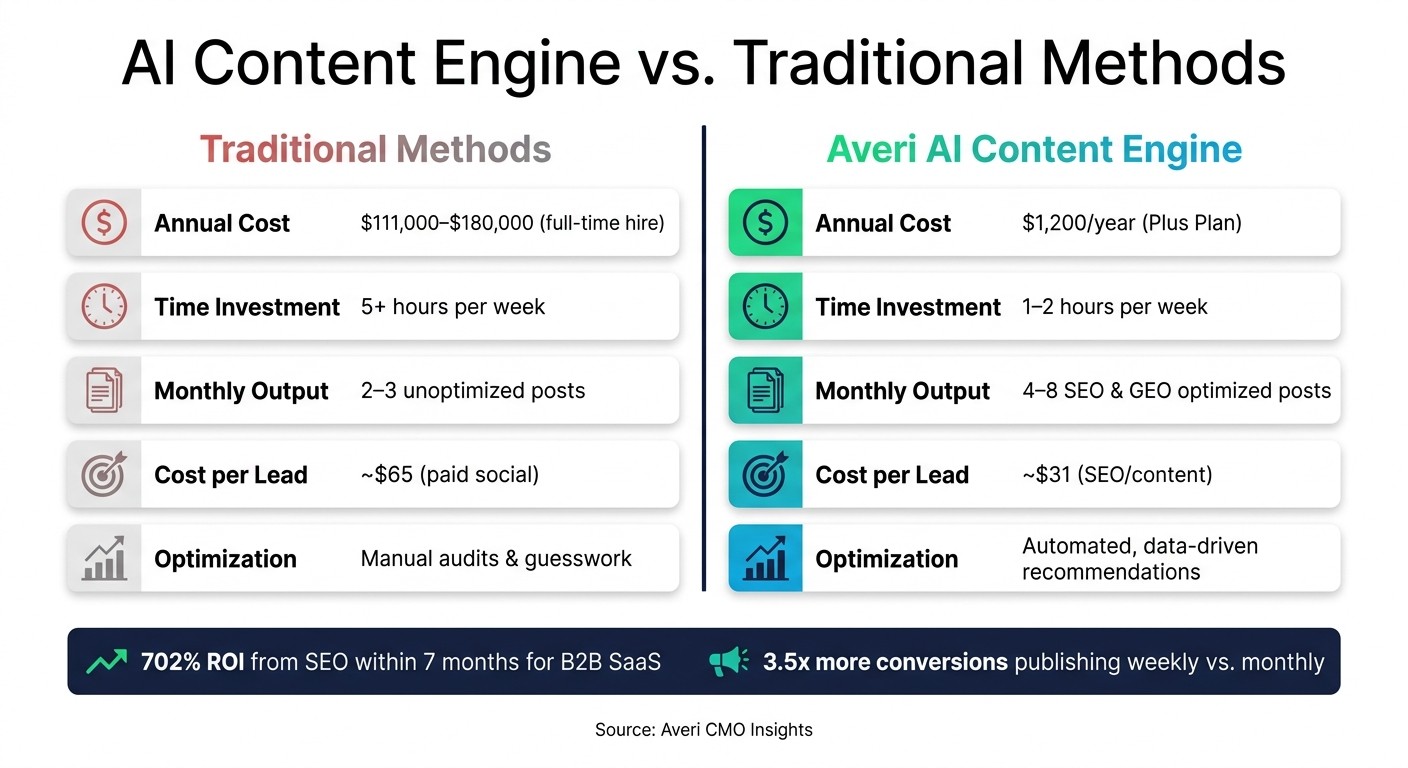
AI Content Engine vs. Traditional Methods: Cost, Time & Output for Seed-Stage Startups
Making sure your content performs well is just as important as creating it, especially when you're working with limited resources. These steps build on the lean strategies discussed earlier, ensuring your efforts deliver measurable results.
Tracking Key Metrics for Early-Stage Startups
For seed-stage startups, the focus isn't on racking up huge traffic numbers. Instead, it's about identifying early signs that your content is driving meaningful growth. Pay attention to metrics that connect directly to full-funnel business outcomes, like organic traffic increases, rankings for high-intent keywords, and content-driven conversions (e.g., demo requests or sign-ups).
To start, integrate tools like GA4 and GSC right away. Track month-over-month (MoM) organic growth and monitor around 20–30 high-intent keywords weekly. Keep a close eye on bottom-of-funnel conversions and top-of-funnel impressions and rankings. One practical approach: ask every new customer how they found you. If a specific blog post keeps coming up, that's a strong indicator of its ROI [2]. Use these insights to fine-tune your content strategy.
Improving Content with AI Feedback Loops
Publishing content regularly is only part of the equation. The real challenge lies in figuring out which pieces to optimize and which topics to tackle next - without spending hours buried in spreadsheets.
Averi simplifies this process by tracking metrics like impressions, clicks, and keyword rankings across your content. For instance, if a post is stuck at position #8 in search results, Averi flags it and suggests specific actions to improve its ranking [1]. It also keeps tabs on competitors and identifies keyword gaps, automatically queuing up new content ideas based on emerging trends. Every published piece is added to your content library, helping the AI refine its understanding of your brand voice over time. This kind of ongoing, data-driven improvement is essential for maximizing the impact of your content.
"Content marketing delivers 3x more leads at 62% lower cost than traditional marketing - but only if you build a system, not just create random posts." - Zach Chmael, CMO, Averi [1]
Comparing Investment Versus Output
Factor | Traditional Methods | Averi AI Content Engine |
|---|---|---|
Annual Cost | $111,000–$180,000 (full-time hire) [4] | $1,200/year (Plus Plan) [3] |
Time Investment | 5+ hours per week [1] | 1–2 hours per week [1] |
Monthly Output | 2–3 unoptimized posts [3] | 4–8 SEO & GEO optimized posts [3] |
Cost per Lead | ~$65 (paid social) [1] | ~$31 (SEO/content) [1] |
Optimization | Manual audits and guesswork [1] | Automated, data-driven recommendations [1] |
For B2B SaaS companies, consistent content efforts can yield a 702% ROI from SEO within just seven months [1]. Publishing weekly instead of monthly can also result in a 3.5x boost in conversions [1]. For startups, the real cost of traditional methods isn't just the salary - it’s also the lost time founders spend on execution instead of focusing on strategic growth.
Conclusion: From Founder-Led to Scalable Content Marketing
Seed-stage startups often begin with sporadic bursts of content - think LinkedIn posts or newsletters - leading to unpredictable results. But the goal isn't to simply create more content. It's about building a system where high-quality, consistent output happens no matter how hectic things get.
Making the leap from ad-hoc efforts to a scalable content strategy is simpler than it seems. Start by documenting your Ideal Customer Profile (ICP) and defining your content pillars. From there, establish a straightforward weekly rhythm: one core piece of content and a few repurposing it into social posts. Over time, shift the founder's role from being the primary writer to acting as an editor. Tools like Averi can handle most of the heavy lifting - research, drafting, SEO structuring, and even publishing - so founders can focus on what only they can contribute: their unique perspective, customer insights, and lessons learned. As Zach Chmael, CMO at Averi, aptly puts it: "The founder doesn't write content. The founder makes content sound like a founder wrote it." [4] These changes aren't just theoretical - they deliver measurable results.
The numbers speak for themselves. Content marketing can generate up to three times as many leads while reducing costs by 62%. Moreover, 64% of the most successful content marketers have a documented strategy, compared to just 19% of their less effective peers [5]. This gap is entirely within reach for seed-stage teams. Set aside 2–3 hours to outline your ICP, positioning, and brand voice. Then, implement a lightweight workflow powered by AI tools like Averi - covering ideation, outlining, drafting, reviewing, publishing, repurposing, and measuring. Assign clear responsibilities for each step, even if it's just you and one generalist for now. This system becomes the backbone of your content efforts, scaling naturally as your team grows.
"Content marketing compounds. Delayed starts don't catch up; they fall further behind." - Zach Chmael, CMO, Averi [4]
The startups that reach Series A with a strong content foundation aren't the ones that churned out the most posts - they're the ones that built a scalable system early on. Start designing for scale today, even if you're the sole content creator. That solid foundation will grow with your team, ensuring you're ready for the next stage.
FAQs
What should my first 3 content pillars be?
Your initial content strategy should revolve around three essential pillars: credibility, market understanding, and audience value. Here's how to approach each:
Thought Leadership: Share your expertise and unique perspectives to establish authority and build trust. This positions your startup as a knowledgeable voice in the industry.
Market Research: Create content that delves into customer needs and industry trends. This not only helps refine your strategy but also demonstrates your understanding of the market.
Educational Content: Focus on delivering practical advice, how-to guides, or solutions that address your audience's challenges. This positions your brand as a go-to resource.
These foundational pillars are crucial for driving growth in the early stages of your startup.
Which BOFU pages should I publish first to get leads fast?
To generate leads quickly using BOFU (Bottom of Funnel) pages, focus on creating content that speaks directly to potential buyers at the decision-making stage. Key elements to prioritize include:
Case studies: Provide real-world examples that demonstrate the value of your product or service, helping to build trust.
Comparison pages: Clearly outline how your solution outperforms competitors, making it easier for buyers to see your advantage.
Pricing or demo pages: Offer clear calls to action, such as signing up for a trial or scheduling a demo, to encourage immediate engagement.
These types of pages are designed to address the final considerations of the purchasing process, leading to faster conversions with minimal effort.
How do I prove content ROI in the first 90 days?
To demonstrate content ROI within the first 90 days, focus on tracking clear, measurable outcomes that align with your specific goals. Key metrics to monitor include website traffic, lead generation, and engagement indicators like time spent on a page or bounce rate. Leverage AI tools to experiment with different content variations and assess their performance. Pay special attention to organic search visibility and inbound inquiries, as these provide valuable insights into credibility and growth potential. At this stage, the emphasis is on establishing trust and creating a strong foundation for sustained success.
Related Blog Posts

Zach Chmael
CMO, Averi
"We built Averi around the exact workflow we've used to scale our web traffic over 6000% in the last 6 months."
Your content should be working harder.
Averi's content engine builds Google entity authority, drives AI citations, and scales your visibility so you can get more customers.