

In This Article
Trust-first, compliant content strategies for LegalTech: problem-led content, AI-assisted workflows, and data-driven optimization.
Updated:
Trusted by 1,000+ teams
Startups use Averi to build
content engines that rank.
Content marketing is essential for LegalTech startups targeting a $29.8 billion market. Legal professionals prioritize trust and thorough evaluation over flashy ads. To stand out, your content must address specific pain points, align with sales goals, and build trust with actionable, accurate information.
Key takeaways:
Understand your audience: Tailor content for Managing Partners (ROI-focused), IT Leaders (security/integration), and Practice Group Leaders (efficiency).
Focus on problem-solving: Offer tools like templates or technical guides to address real concerns.
Leverage data: Use metrics to refine and optimize content performance over time.
Streamline workflows: AI tools can save time on research, drafting, and publishing while maintaining human oversight for quality.
How to Define a Content Marketing Strategy for LegalTech
Identifying Your Target Audience and Their Pain Points
LegalTech buyers come with diverse priorities depending on their roles. A Managing Partner is focused on ROI and minimizing risk. An IT Leader prioritizes security certifications and seamless integration with existing systems. A Practice Group Leader, on the other hand, is primarily concerned with saving their team time and improving efficiency. Each of these stakeholders has the power to approve - or block - a purchase, so your content needs to address their specific concerns, but not all at once.
Here’s how to tailor content to their needs:
Stakeholder | Primary Concerns | Content Focus |
|---|---|---|
Managing Partners | ROI, competitive advantage, risk | Case studies with financial metrics, industry analysis |
IT Leaders | Security, data protection, integration | Security whitepapers, implementation guides, technical docs |
Practice Group Leaders | Workflow, staff efficiency | How-to tutorials, feature walkthroughs, time-saving tips |
Legal professionals often search for solutions to their daily challenges. High-intent queries like "how to reduce office action drafting time" or "how to speed up prior art search" reveal specific problems they’re eager to solve [2]. Listening to feedback from your sales team and clients can help you identify these concerns even before keyword trends emerge [1].
Once you understand their pain points, you can align your B2B SaaS marketing strategy and compliance guidelines to address them effectively.
Setting Editorial Priorities and Compliance Rules
Your editorial strategy should focus on solving problems and delivering measurable outcomes, rather than diving into AI education or technical jargon. Start by addressing the problem your audience is facing, then introduce your product as the solution - don’t lead with a list of features.
Compliance is non-negotiable in LegalTech. Every piece of content you publish reflects on your brand’s credibility, and legal professionals will quickly spot inaccuracies. To maintain trust, establish clear Policies, Processes, and Procedures (the "Three Ps") [4]. If you’re using AI-generated content, ensure it’s reviewed by a human legal expert before publication to meet ethical and factual standards [5].
"Stories resonate more strongly than facts alone. Frame your content around real-world scenarios that legal professionals encounter daily." - Cathy Kenton, Legal Tech Marketing Group [1]
By grounding your content in relatable scenarios and ensuring accuracy, you’ll build trust and authority within your audience.
Connecting Content Strategy to Product and Sales Goals
Many early-stage LegalTech startups make the mistake of focusing too heavily on awareness content, neglecting buyers who are ready to evaluate solutions. A smarter approach is to prioritize bottom-of-funnel (BoFu) content - like comparison pages, pricing guides, and use-case breakdowns - that directly targets those actively researching a purchase. A good rule of thumb is to allocate 40% of your efforts to BoFu, 35% to mid-funnel content, and 25% to top-of-funnel awareness content [3].
A great example comes from IPToolworks, which launched a "Know Your Examiner" campaign. They created SEO-optimized pages for individual USPTO examiners, offering insights like rejection patterns and argument outcomes. The most valuable data was gated behind a signup, turning organic traffic into qualified leads at the exact moment patent attorneys were conducting research [2]. This highlights an important takeaway: your product’s internal data can be a goldmine for content. Structuring and optimizing this data for search can attract high-intent visitors without needing a massive content team.
"The goal isn't to become a full-time content marketer. The goal is to build the minimal infrastructure that produces results while you focus on product and customers." - Zach Chmael, Head of Marketing, Averi [3]
How to Build a Scalable Content Workflow
Using AI and Automation to Save Time
LegalTech founders often find themselves with just an hour a day to dedicate to marketing [3]. That’s barely enough time to brainstorm topics, write drafts, optimize for SEO, and publish regularly. This is where AI-powered tools step in, automating the tedious parts of content creation and freeing up valuable time.
Take platforms like Averi, for example. These tools scrape your website to understand your brand voice, positioning, and product details. From there, they generate an Ideal Customer Profile, track competitor strategies, and organize a content queue complete with keywords and topic angles. All you have to do is review the queue and approve what gets created. The AI takes care of research, drafts the initial content, and can even publish directly to platforms like Webflow, Framer, or WordPress - no need for manual copy-pasting.
Consistent publishing has been shown to boost traffic by 74% and ROI by 68% [3]. For lean LegalTech teams, this level of output, achieved without expanding the team, can mean the difference between gaining visibility and remaining overlooked.
While AI speeds up the process, human expertise ensures the final product meets high standards of accuracy and reliability.
Keeping Human Oversight in the Review Process
Human involvement is key to maintaining compliance and meeting EEAT standards [2].
"Averi is built on a core principle: AI handles the work that slows you down. Humans add the judgment that makes it work." - Zach Chmael, CMO, Averi [3]
In practice, humans remain in charge of the critical decisions: verifying sources, adding unique insights, tailoring the tone for the audience, and ensuring compliance. A collaborative editing platform allows team members to tag subject-matter experts, comment on specific legal claims, or even ask AI to revise sections. This setup ensures the review process is efficient without sacrificing quality.
A Step-by-Step Content Workflow for LegalTech
Establishing a repeatable weekly process helps maintain consistency, even when time is limited. Here's how the responsibilities are divided between AI and humans at each phase:
Workflow Phase | AI/Automation Role | Human Role |
|---|---|---|
Strategy | Scrapes website data | Refines core goals |
Ideation | Tracks trends, identifies keywords, and queues topics | Approves or rejects specific topics |
Execution | Conducts research, drafts initial versions, and adds internal links | Refines tone, adds unique insights, and ensures compliance |
Publishing | Publishes directly via CMS integrations | Performs final quality checks |
Optimization | Tracks performance metrics and suggests updates | Makes strategic adjustments based on data |
A suggested schedule might look like this: dedicate Monday to strategy, Tuesday and Wednesday to AI-generated drafts, Thursday to human review, and Friday to publishing. With just five hours a week, this workflow can ensure consistent, high-quality content production [3]. By adopting this streamlined process, LegalTech startups can produce content that aligns with their broader goals while staying efficient and focused.
What Types of Content Work Best for LegalTech
Thought Leadership and Industry Insights
Legal professionals expect content that matches their expertise and curiosity. With 89% of lawyers aware of AI capabilities - compared to just 61% of the general public [1] - simplistic content won't make the cut. Instead, what resonates is well-researched analysis, proprietary data, and forward-thinking ideas about the future of the legal industry.
The most impactful thought leadership focuses on industry trends, technology forecasts, original research, and actionable insights for implementation [1]. Publishing in niche legal outlets can further amplify this strategy. For example, Triangle IP built its authority by contributing articles to platforms like IPWatchDog and Entrepreneur. By linking these articles back to valuable content on their own site, they boosted one of their blog posts from Google's seventh page to the first, driving consistent and qualified traffic [2].
"Successful content marketing is iterative - each piece should build on previous learnings and contribute to your overall market position." - Cathy Kenton, LTMG [1]
Beyond thought leadership, content that educates while showcasing solutions is another key piece of the puzzle.
Educational and Product-Focused Content
Educational content works best when it addresses a specific pain point - such as reducing time spent on office action drafting - and then seamlessly introduces your product as the solution [2]. This targeted, problem-solving approach has proven to be far more effective than broad, generic messaging.
Lead magnets, like a downloadable IDF (Invention Disclosure Form) template, are particularly successful in converting interest into actionable leads. By offering practical tools, this type of content not only educates but also positions your product as the go-to answer for pressing legal challenges.
Comparison Content and Trust-Building Assets
Legal buyers are thorough in their research, often diving into reviews, alternatives, and detailed case studies before making decisions. Detailed comparison articles that address real-world use cases tend to outperform generic templates by answering the specific questions buyers care about [2].
Trust-building elements are equally critical. Verified reviews on platforms like G2 or Capterra, security certifications, and clear data privacy policies can significantly reduce buyer hesitation [2]. A great example comes from IPToolworks, which launched its "Know Your Examiner" campaign. By creating dedicated pages for USPTO examiners that included rejection breakdowns and success rates - and gating the most detailed data behind a signup - they attracted patent attorneys precisely when they were researching examiner strategies. This approach demonstrated how well-designed bottom-of-the-funnel content can generate steady, qualified leads [2].
These types of content not only engage your audience but also create a measurable path toward growth and refinement.
AI and Content Marketing Secrets for B2B Legal Tech | Levi Lindsay
How to Measure and Improve Content Marketing Performance
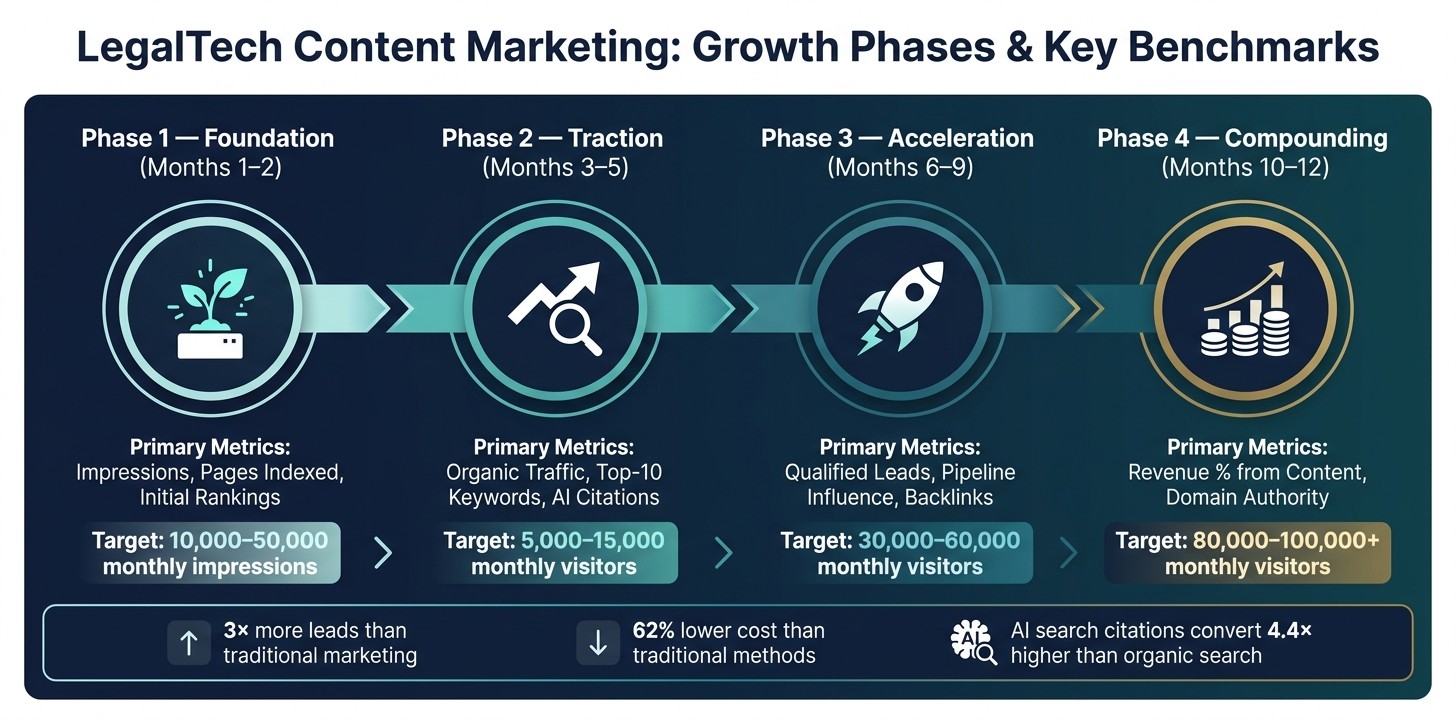
LegalTech Content Marketing: Growth Phases & Benchmarks
Key Metrics for LegalTech Content
In the LegalTech space, quality takes precedence over sheer volume. As Priti Sohal, Content Strategist at Concurate, explains:
"Traffic alone doesn't lead to signups, especially in legaltech marketing. Legal buyers are more cautious than most. They don't buy software on impulse." [2]
This means focusing on metrics that truly reflect performance, like demo requests, qualified leads, pipeline influence, and cost per lead (CPL). For context, the average CPL for SEO-driven content is approximately $31, while paid social averages over $65 [3].
Another area to monitor is "striking distance" keywords - those ranking between positions 10 and 30 on Google. These keywords offer a quick route to page-one rankings with targeted optimization. Additionally, keep an eye on AI search citations, as referrals from tools like ChatGPT, Perplexity, and Google AI Overviews convert at a rate 4.4 times higher than traditional organic search [7].
Here's how your metrics should evolve as your content program matures:
Growth Phase | Primary Metrics | Target Benchmarks |
|---|---|---|
Foundation (Months 1–2) | Impressions, pages indexed, initial rankings | 10,000–50,000 monthly impressions |
Traction (Months 3–5) | Organic traffic, top-10 keywords, AI citations | 5,000–15,000 monthly visitors |
Acceleration (Months 6–9) | Qualified leads, pipeline influence, backlinks | 30,000–60,000 monthly visitors |
Compounding (Months 10–12) | Revenue % from content, domain authority | 80,000–100,000+ monthly visitors |
These benchmarks provide a roadmap for tracking progress and fine-tuning your strategy.
Using Analytics to Guide Content Decisions
Analytics should be at the heart of your AI-powered content strategy. Focus on the top-performing 20% of your content - this small fraction often drives 80% of your results. Tools like Averi can help translate analytics into actionable steps, such as flagging a post ranking at position 8 and recommending updates to push it to the top, or identifying a competitor’s new article and suggesting a counter-strategy. By automating this process, you ensure that your content decisions are grounded in data, not guesswork.
Pair these insights with regular sales feedback for a more dynamic and responsive content plan.
How to Refine Your Content Strategy Over Time
While data highlights trends, sales feedback uncovers the reasons behind them. A simple monthly check-in with your sales team can reveal the most common objections, questions, and concerns prospects have. This gives you a direct line to the topics your content should address next.
To keep your content relevant, adopt a quarterly refresh schedule. Update statistics, incorporate new examples, and reflect any product updates in your existing posts. In LegalTech, where things move quickly, outdated content can harm your credibility. Regular updates not only maintain trust but also boost your rankings. This approach has proven to increase lead generation and page views in the past [2].
The ultimate goal isn’t to churn out endless new content but to create a system where every piece continuously improves over time. By doing so, your content grows smarter and more effective in meeting the needs of your audience.
Conclusion: How to Build a Content Engine That Lasts
Creating a content engine for a LegalTech startup means establishing a reliable system that delivers consistent results. With marketing challenges contributing to 29% of startup failures, and content marketing generating 3× more leads at 62% lower cost than traditional methods [3], the importance of a strong content strategy becomes crystal clear.
This guide outlines a step-by-step approach: identify your audience and their challenges, align content with product and sales objectives, automate repetitive tasks while maintaining a human touch, prioritize trust-building content for cautious legal buyers, and use analytics to refine your efforts. Each phase builds on the previous one, forming a durable framework that supports growth and trust over time.
"The companies that win aren't the ones creating the most content... They're the ones who built a system that produces both quality and quantity - systematically." - Averi [6]
For LegalTech founders, time is often the most limited resource. A well-designed system addresses this directly. A DIY approach might take around 5 hours per week, but leveraging AI tools like Averi can cut that down to just 1–2 hours weekly at $100/month. These tools handle tasks like research, drafting, SEO, and publishing, all while keeping you in control of approvals and final edits [3]. This transforms content marketing from a time-draining chore into a strategic asset.
Start small, stay consistent, and let your system adapt over time. For LegalTech startups operating in a world of strict regulations and high trust requirements, a streamlined content engine isn't just a smart move - it's a necessity. In a market where credibility and consistency are paramount, this approach can set you apart as a trusted leader.
FAQs
What content should I publish first to drive demos?
To engage legal tech buyers effectively, begin by creating educational, high-value content that speaks directly to their challenges. Offer materials like case studies, how-to guides, and industry insights that spotlight the real problems your product addresses. By doing so, you establish trust, illustrate tangible ROI, and connect with key decision-makers such as managing partners and IT leaders. Prioritize showcasing practical applications and benefits that align with their needs, making it easier to inspire interest and drive demo requests.
How do I keep AI-written content legally compliant?
To keep AI-generated content within legal boundaries, it's crucial to involve qualified attorneys for a thorough review. This step ensures the content meets accuracy requirements and adheres to professional standards. Transparency is equally important - clearly disclose when AI tools are part of the content creation process. For solo practitioners and small law firms, staying aligned with ethical rules around AI marketing is essential to maintain trust and avoid potential disciplinary issues. By pairing AI's efficiency with careful human oversight, you can ensure compliance while strengthening credibility.
Which metrics prove content is generating pipeline?
To measure how effectively content drives pipeline growth, focus on metrics that connect audience engagement to business outcomes. Key indicators include multi-touch attribution, which maps out how content interactions contribute from the initial touchpoint all the way to closed-won revenue, and conversions, such as form submissions or demo requests. Additional engagement signals like time on page, session duration, and click-through rates provide further insights into how content supports pipeline expansion.
Related Blog Posts

Zach Chmael
CMO, Averi
"We built Averi around the exact workflow we've used to scale our web traffic over 6000% in the last 6 months."
Your content should be working harder.
Averi's content engine builds Google entity authority, drives AI citations, and scales your visibility so you can get more customers.