

In This Article
Lean, AI-powered content strategies that build predictable pipeline, lower CAC, and accelerate sales for MarTech startups.
Updated:
Trusted by 1,000+ teams
Startups use Averi to build
content engines that rank.
Content marketing is essential for MarTech startups navigating a crowded and complex market. Unlike short-term B2B SaaS marketing strategy components, content marketing builds lasting assets that drive leads for 18–36 months. Organic search already accounts for 44.6% of B2B revenue and costs 40% less per customer than paid acquisition. With buyers consuming 13 pieces of content over a 134-day sales cycle, content marketing helps startups educate, connect, and convert effectively.
Key takeaways:
Focus areas: Pipeline generation, product education, category creation, and shorter sales cycles.
Content mix: Allocate 40% to decision-stage content, 35% to mid-funnel education, and 25% to awareness-level materials.
Efficiency: Use AI tools for workflows, reducing content production time by up to 80%.
Metrics: Prioritize revenue-driven metrics like demo requests and ROI per visitor over pageviews.
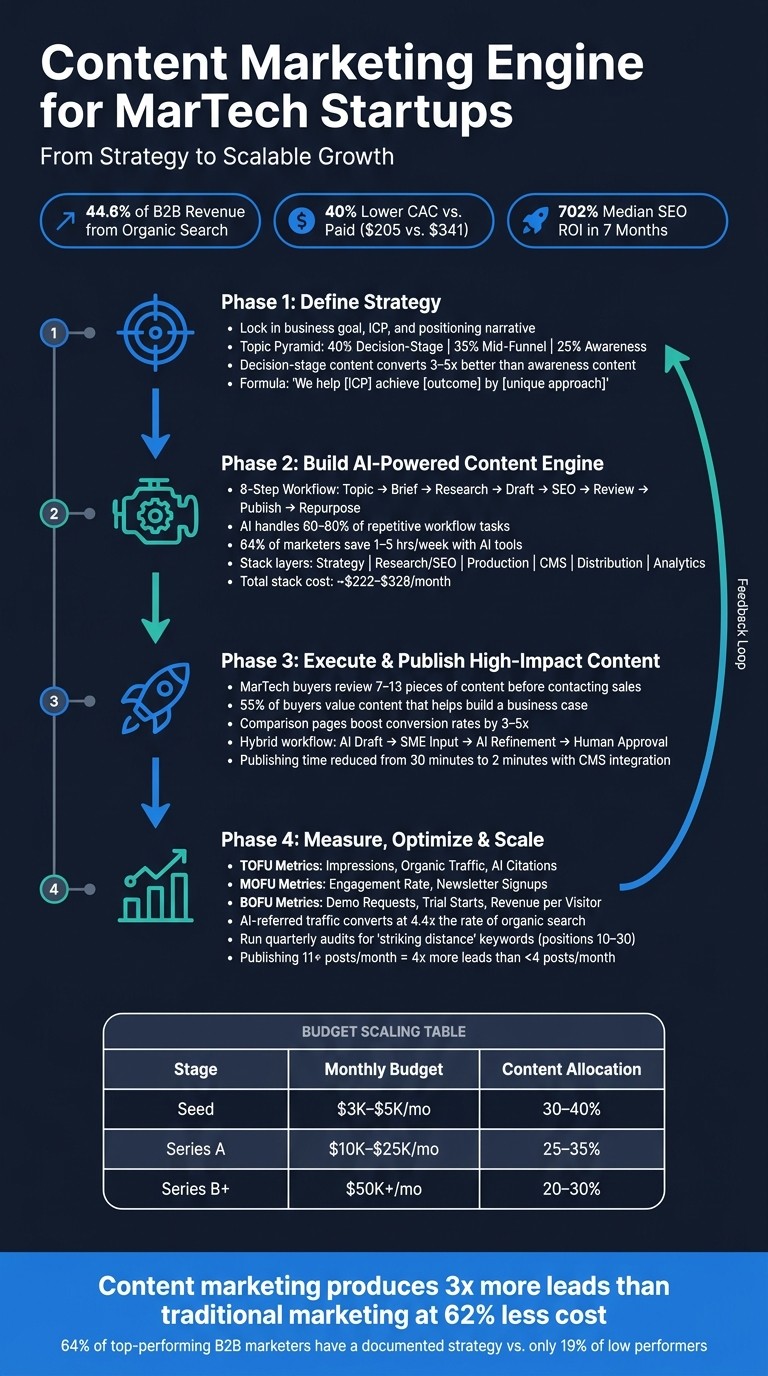
Content Marketing Engine for MarTech Startups: Strategy to Scale
MarTech Club: Anatomy of Marketing Funnel Automation
Defining Strategy, ICPs, and Messaging
Before diving into content creation, three things must be locked in: a clear business goal, a well-defined target audience, and a strong positioning narrative. Without these, your content risks falling flat. Once these are established, align your content goals with your startup's strategic priorities.
Align Content Goals with Business Objectives
A content strategy should directly support your startup's current goals - not just follow trends or mimic competitors. For example, if your focus is on validating product-market fit, your content should spark conversations with potential buyers. If you're aiming to drive free trial sign-ups, prioritize content that attracts high-intent search traffic.
A helpful framework to guide this is the Topic Pyramid: dedicate around 40% of your content to decision-stage pieces (such as comparison articles and pricing guides), 35% to mid-funnel educational content, and 25% to awareness-level materials [5]. This approach is particularly effective for early-stage startups since decision-stage content tends to convert three to five times better than awareness-level content. Plus, it offers quicker feedback on whether your messaging resonates.
"The goal isn't to become a full-time content marketer. The goal is to build the minimal infrastructure that produces results while you focus on product and customers." - Zach Chmael, CMO, Averi [5]
Once your objectives are clear, the next step is to pinpoint exactly who you're creating content for.
Build Ideal Customer Profiles (ICPs)
An ICP is more than just a fictional persona with a name and stock photo. It's a data-driven profile based on your best customers - the ones with the highest lifetime value, lowest churn rates, and quickest time-to-value.
Start by analyzing your CRM data to identify common firmographic traits such as industry, company size, funding stage, and tech stack. For MarTech startups, technographics are especially critical. A prospect already using tools like HubSpot and Segment will have vastly different needs compared to one still managing data in spreadsheets. Tools like Clearbit, which became part of HubSpot after its late 2023 acquisition, make it easier to enrich your CRM with this kind of data automatically [7]. This segmentation not only sharpens your audience focus but also forms the backbone of a targeted messaging strategy.
Divide your ICP into two key groups: end-users (those who will use your product daily) and decision-makers (those who sign off on the purchase). These groups consume very different types of content. End-users gravitate toward how-to guides and workflow tips, while decision-makers are more interested in ROI calculators, security documentation, and case studies.
"Your ICP is your center of gravity for putting data to work." - Kevin Tate, CMO, Clearbit [6]
Write a Clear Content Positioning Narrative
With your ICP in place, the next step is crafting a single, unified narrative that connects your product to the outcomes your buyers care about most. A straightforward formula works well: "We help [ICP] achieve [outcome] by [unique approach]. Unlike [alternative], we [key differentiator]." [5]
For example, a MarTech startup might say: "We help growth-stage B2B SaaS companies improve campaign ROI by automating audience segmentation. Unlike manual CRM workflows, our platform updates segments in real time as buyer behavior changes." This positioning statement should serve as the foundation for all your content. Every blog post, comparison page, and case study should echo this narrative, ensuring consistency and focus.
Building a Lean, AI-Powered Content Engine
With your positioning narrative and Ideal Customer Profile (ICP) established, the next step is execution - turning strategy into consistent, scalable results. Many MarTech startups stumble not because of poor strategy but due to a lack of consistent execution. A lean, AI-powered content engine can transform a small team into a reliable publishing powerhouse.
Create a Repeatable Content Workflow
The key is to design a step-by-step process that simplifies content creation. This workflow should include eight stages: topic selection, brief creation, research, drafting, on-page optimization, review, publishing, and repurposing. AI can handle repetitive tasks, freeing up humans to focus on judgment and quality.
"The engine doesn't replace the human. It replaces the 80% of the workflow that isn't judgment." - Zach Chmael, CMO, Averi [3]
To keep things organized, document the workflow in tools like Notion or ClickUp, assigning each step as either "AI-owned" or "human-owned." With this structure, even a two-person team can maintain consistent publishing by dedicating about three hours of structured work each week [3].
Once the workflow is in place, the next step is building a streamlined tech stack to support it.
Build a Simple, Effective Content Stack
Your content stack doesn't need to be overly complex. It should cover four essential areas: strategy, production, distribution, and analytics. These layers work together to move content smoothly from concept to publication.
Layer | Recommended Tools | Estimated Monthly Cost |
|---|---|---|
Strategy & Planning | Notion, Averi AI | $0–$100 |
Research & SEO | Ahrefs Lite, Google Search Console | ~$99 or free |
Production & Editing | Averi AI, Google Docs | ~$100 |
CMS & Publishing | $23–$29 | |
Distribution | HubSpot, Buffer | Varies |
Analytics | Google Analytics 4, Search Console | Free |
To save time, consider using automation tools like Zapier or Make to connect these systems. For example, you can set up triggers to create a CMS task when a draft is approved or queue a social media post when content is published. Tools like Averi AI can integrate multiple layers of this stack, managing tasks such as research, drafting, SEO optimization, and even direct publishing. This is particularly useful for teams without a dedicated content specialist.
Automate Research, Ideation, and Production
With your tools in place, focus on automating repetitive tasks to maximize efficiency. AI can handle 60–80% of the workflow, including keyword clustering, competitor analysis, first drafts, meta descriptions, internal link suggestions, and content repurposing for social media [10]. A 2024 State of Marketing AI report found that 64% of marketers saved one to five hours per week using AI for content tasks, while 19% saved more than six hours weekly [10].
Start by providing your AI platform with the right inputs: ICP details, your positioning statement, top-performing URLs, and objections from sales conversations. With this information, tools like Averi AI can generate topic clusters tailored to your funnel stages, create detailed content briefs, and produce drafts that align with your brand voice. As Zach Chmael from Averi explains: "We built Averi around the exact workflow we've used to scale our web traffic over 6,000% in the last 6 months." [5][4]
The human role becomes one of refinement - ensuring technical accuracy, capturing MarTech-specific nuances, and confirming strategic alignment before publishing. To maintain focus, create a list of topics to avoid, ensuring AI-generated ideas don’t drift toward irrelevant high-volume keywords that might attract the wrong audience.
Executing and Publishing High-Impact Content
Once your content engine is up and running, the next step is creating materials that truly resonate with buyers. In the MarTech space, this means moving beyond surface-level blog posts and producing formats that align with how decision-makers evaluate and choose solutions.
Create Content That Connects with MarTech Buyers
MarTech buyers typically review 7–13 pieces of content before reaching out to a sales team [8][9]. Notably, 55% of these buyers value content that helps them build a business case during the decision-making process [10]. This means your content should go beyond awareness and address specific evaluation needs.
The most impactful content aligns with the buyer's journey. During the consideration phase, implementation playbooks and vendor comparison pages are especially effective. For example, a resource like "90-Day Rollout Plan for Connecting Your CRM, MAP, and Data Warehouse" gives Marketing Ops and RevOps leaders a clear vision of deployment before they even contact your team. Similarly, comparison pages - highlighting factors like integrations, pricing structures, and usability - help buyers self-qualify and simplify their decision-making process.
When it comes to the decision stage, ROI-driven content takes center stage. Create tools that quantify tangible benefits, such as reducing campaign launch times from three days to three hours or cutting manual tasks by 40%. These tools empower buyers to make a strong case internally. Additionally, comparison pages can boost conversion rates by 3–5x by addressing buyer concerns directly [3].
"Revenue per visitor, not visitors per page, is the metric that matters for BOFU." - Zach Chmael, CMO, Averi [3]
To make your content even more relevant, tailor it to specific audiences like CMOs, Marketing Ops professionals, and IT leaders. This ensures it speaks directly to their unique concerns rather than feeling overly broad.
Use AI to Draft and Refine Content
Once you’ve mapped out your B2B marketing strategy, streamline production with AI tools. The most efficient workflow for MarTech content divides tasks between AI and human contributors: AI provides structure and speed, while humans ensure accuracy and maintain the voice. Start by giving your AI tool (e.g., Averi AI) a detailed brief, including the target persona, funnel stage, key messages, and metrics. While the initial draft will be structurally sound, it will need refinement from a subject-matter expert (SME).
The SME’s role is critical for MarTech content. They replace generic statements with specific data, add stack diagrams, and verify technical details. Once the SME enriches the draft, AI can help refine it further by rewriting sections to include new scenarios or metrics. For example, you might prompt the AI with: "Rewrite this section to incorporate these customer insights while keeping sentences concise." A final human review ensures the content is polished, free of jargon, and engaging. This hybrid process - AI draft → SME input → AI refinement → human approval - ensures your content stands out as credible and authoritative.
For better visibility in AI-driven search tools like ChatGPT and Perplexity (which now appear in 48% of queries [3]), structure key sections with 40–60 word summaries. These concise intros increase the chances of being cited. Additionally, use FAQ schema, clear H2/H3 headers, and CTAs directly tied to the content’s purpose - like "Download the implementation checklist" or "Try the ROI calculator" - instead of generic prompts like "Contact us."
Publish and Manage Content Without the Friction
Once your content is ready, focus on smooth publishing to keep the momentum going. Manual processes, like transferring content from Google Docs or Notion to a CMS, can lead to delays, formatting issues, and broken links. These inefficiencies slow down your entire operation. The solution? Direct CMS integration.
Tools like Averi AI can publish content directly to platforms like Webflow, Framer, or WordPress. This reduces the time from draft approval to live publication from 30 minutes to just 2 minutes [3]. Beyond speed, this approach enriches your centralized content library. By tagging each asset with details like persona, funnel stage, and product, your sales and customer success teams can quickly locate and reuse content without relying on marketing to dig it up. Over time, this library becomes a valuable resource: it sharpens your brand voice, improves AI-generated drafts, and accelerates your content operations - all without scaling your team.
Measuring, Optimizing, and Scaling the Content Engine
Define the Right Metrics for Content Success
Metrics like pageviews might look impressive, but they don’t always tell the full story. To measure content success effectively, focus on metrics tied to revenue and align them with the different stages of your funnel.
Funnel Stage | Primary Metrics | Goal |
|---|---|---|
TOFU (Awareness) | Impressions, Organic Traffic, AI Citations | Build Visibility & Authority |
MOFU (Consideration) | Engagement Rate, Newsletter Signups | Nurture Leads |
BOFU (Conversion) | Demo Requests, Trial Starts, Visitor traffic to comparison pages | Drive Pipeline Growth |
At the bottom of the funnel, revenue per visitor becomes the key indicator of content effectiveness rather than just total visitor numbers. For a broader view, use the Marketing Efficiency Ratio (MER) - total revenue divided by total marketing spend. This approach avoids the pitfalls of trying to attribute every deal to a single blog post, especially when the average B2B SaaS sales cycle involves a lengthy 134 days and multiple touchpoints [3].
An emerging metric for 2026 is AI citation tracking. With AI Overviews now appearing in nearly half (48%) of search queries [3], being referenced in tools like ChatGPT or Perplexity has become as impactful as ranking on Google’s first page. AI-referred traffic also converts at 4.4x the rate of traditional organic search [11]. This makes Generative Engine Optimization (GEO) essential for any content strategy, not a side consideration. Tracking AI citations strengthens SEO efforts while adding long-term value to your content engine.
These metrics provide the foundation for refining your content strategy based on performance data.
Improve Content Based on Performance Data
The quickest wins often come from refining what you already have. Instead of constantly churning out new pieces, run a quarterly audit to identify "striking distance" keywords - content currently ranking between positions 10 and 30 on Google. These pieces are ripe for optimization, as a targeted refresh can push them onto page one without starting from scratch [11].
Common reasons for underperformance include mismatched search intent, lack of depth, or missing data critical for AI citation. Tools like Averi’s analytics layer can flag these issues, offering actionable recommendations such as "This post is ranking #8 - here’s how to move it to page 1." This approach ensures your team focuses on updates that deliver measurable results rather than wasting time on guesswork.
Once existing content is optimized, the next step is scaling production efficiently.
Scale Production with Roles and Automation
Scaling content production doesn’t mean sacrificing quality. By defining clear roles and leveraging automation, you can expand your output while maintaining high standards. A two-track model works well: dedicate about 40% of efforts to consistent, SEO-driven content and the remaining 60% to fewer but higher-impact pieces. These might include original research, bold industry opinions, or in-depth guides designed to attract links and attention [1].
"One article shared by the right industry newsletter does more than fifty perfectly optimized blog posts." - House of MarTech [1]
As your content volume grows, AI-powered workflows can dramatically cut down on time and costs. Tasks like research, structuring for SEO, and publishing that used to take 15–20 hours a week can now be completed in roughly 2 hours [2]. This efficiency allows even a small team to achieve outsized results.
The table below outlines how content budgets typically evolve as startups mature:
Stage | Monthly Marketing Budget | Content Allocation |
|---|---|---|
Seed | $3K–$5K/month | 30–40% |
Series A | $10K–$25K/month | 25–35% |
Series B+ | $50K+/month | 20–30% |
This level of efficiency compounds over time. Companies publishing 11 or more blog posts per month generate 4x more leads than those publishing fewer than four [5]. Additionally, organic customer acquisition costs (CAC) average $205, which is about 40% lower than the typical $341 CAC for paid channels [3]. Ultimately, your content engine becomes a long-term asset, driving results well beyond the current budget cycle.
Conclusion: Building a Content Marketing Engine That Works
Creating a content marketing engine is about persistence and letting efforts build momentum over time. It’s no secret that content marketing produces three times more leads than traditional marketing at 62% less cost [4]. For B2B SaaS companies, the payoff can be massive, with a median 702% ROI from SEO achieved within just seven months [3]. The key is consistency - it builds authority and keeps your pipeline flowing.
At the heart of this process is a simple, repeatable cycle: strategy → execution → measurement → refinement. This loop ties every stage of your content marketing efforts together. Begin by sharpening your Ideal Customer Profile (ICP) and crafting a compelling positioning narrative. With this foundation, each piece of content you create serves a clear purpose. From there, an AI-assisted content engine can help maintain steady production without overwhelming your team. Operating an efficient content engine - producing one major asset weekly with supporting materials - can require as little as 8–12 hours of effort each week.
Tools like Averi’s automation suite make this approach even more manageable. By automating tasks like research, drafting, SEO optimization, and publishing, a founder or small team can cut content creation time from 15–20 hours to just 2 hours of review.
Industry leaders back this approach. As Zach Chmael, Head of Marketing at Averi, explains:
"The goal isn't to become a full-time content marketer. The goal is to build the minimal infrastructure that produces results while you focus on product and customers." [5]
Winning with content doesn’t mean publishing the most - it means publishing consistently, tracking what drives results, and adapting quickly. Interestingly, 64% of top-performing B2B content marketers have a documented strategy, compared to just 19% among the least successful. That gap is your chance to stand out. Build your engine, keep it running, and let its impact grow over time. By following a disciplined, data-driven approach, your startup can achieve sustainable growth and establish itself as a trusted voice in the market.
FAQs
What should I publish first if I have no content?
To establish credibility and connect with your audience, begin by creating content that informs and addresses their needs. Think of blogs, detailed guides, or comparison pages that help potential buyers during the early stages of their research. Use this as an opportunity to showcase your expertise, highlight your key offerings, or share meaningful insights about your industry.
Adding storytelling elements, offering expert perspectives, and using visuals can make your content more engaging and relatable. To make the process more efficient, consider leveraging AI tools to streamline content creation and manage scaling without sacrificing quality.
How do I turn my ICP into actual content topics?
To develop content topics tailored to your Ideal Customer Profile (ICP), start by pinpointing their core needs, questions, and challenges. Dive into the specific pain points they face and design content that directly addresses these issues. The key is to ensure every piece of content resonates with their priorities and offers meaningful solutions.
A helpful approach is to apply the 5 Cs of content marketing:
Clarity: Make your messaging straightforward and easy to understand.
Consistency: Maintain a regular tone, style, and publishing schedule.
Creativity: Present ideas in engaging and unexpected ways to capture attention.
Credibility: Back your claims with reliable data and sources.
Customer-Centricity: Always prioritize the audience’s perspective and needs.
Additionally, take advantage of AI tools and data analytics to uncover trending topics that align with your audience’s interests. This combination of strategy and insight ensures your content remains relevant and impactful.
How can I measure content ROI without perfect attribution?
Measuring the return on investment (ROI) for content without precise attribution means shifting your focus to broader performance metrics. Start by tracking engagement indicators such as website traffic, time spent on pages, and the quality of leads generated. Evaluate long-term value through key performance indicators (KPIs) like organic search rankings, the number of backlinks, and mentions or citations of your content.
To complement these analytics, conduct audience surveys to measure brand awareness and trust levels. By combining qualitative feedback with quantitative data, you can gain a more complete understanding of your content's impact, even when pinpointing exact attribution isn't possible.
Related Blog Posts

Zach Chmael
CMO, Averi
"We built Averi around the exact workflow we've used to scale our web traffic over 6000% in the last 6 months."
Your content should be working harder.
Averi's content engine builds Google entity authority, drives AI citations, and scales your visibility so you can get more customers.