

In This Article
Align content to buyer intent and use AI with human oversight to scale eCommerce growth and cut acquisition costs.
Updated:
Trusted by 1,000+ teams
Startups use Averi to build
content engines that rank.
Content marketing helps eCommerce brands drive sales by creating valuable resources like product guides, videos, and emails. It’s cost-effective, generating 3x more leads than outbound marketing and reducing dependency on rising ad costs, which increased 60% from 2019 to 2024. By tailoring content to each stage of the customer journey, brands can attract new shoppers, guide purchase decisions, and retain loyal customers.
Key takeaways:
Awareness: Use SEO-optimized guides and videos to capture interest.
Consideration: Create detailed product pages, reviews, and comparisons to build trust.
Retention: Send follow-up emails with care tips and reminders to boost repeat purchases.
AI tools like Averi simplify scaling content by automating tasks such as product descriptions, email campaigns, and SEO optimization while maintaining brand consistency. This approach saves time - AI can generate 100 product descriptions in 5–15 minutes, compared to 25–33 hours manually. For success, combine AI efficiency with human oversight to ensure quality and relevance.
Content marketing is a long-term solution to rising customer acquisition costs, helping brands build sustainable growth by aligning content with customer needs and driving consistent engagement.
7 Tips for Great Content Marketing | Ecommerce Webinar
Mapping Content to the eCommerce Customer Journey
Executing a full-funnel marketing campaign by tailoring content to match each stage of the customer journey is essential for driving growth while managing costs effectively. The ability to deliver the right message at the right time can set successful brands apart from those overspending to attract uninterested audiences.
Awareness Stage: Attracting New Customers
At the start of the journey, potential customers are not ready to make a purchase. Instead, they’re exploring solutions to a problem or satisfying a curiosity. For many, this begins with online research, often through search engines, before any brand loyalty is formed.
Content like buying guides, gift guides, how-to articles, and short videos performs well here. For instance, seasonal gift guides - such as "best coffee gifts under $50" - can capture attention on both search engines and visual platforms. Interestingly, 69% of consumers prefer learning about products through short videos rather than reading text [2].
"People may need your product but don't always realize it." - Natallia Slimani, Content Manager, Traqq [6]
AI tools can streamline this process. Platforms like Averi can analyze competitor gaps and generate prioritized ideas for blogs and videos, including optimized buying guides, based on actual search queries from your target audience.
As shoppers move from general research to comparing options, the content strategy must evolve to guide them further.
Consideration Stage: Moving Shoppers Toward Purchase
Once customers know what they’re looking for, they begin comparing products. In fact, 90% of shoppers evaluate multiple options before making a decision [8]. This is where content like product detail pages (PDPs), comparison guides, and customer reviews becomes essential.
Optimizing PDPs involves more than just writing clear descriptions. The tone of the copy plays a key role - precise, straightforward messaging often outperforms emotional appeals by instilling confidence in buyers [8]. For example, in July 2024, Blueair launched an AI-driven interactive ad campaign for its 211i Max air purifier, targeting shoppers in the research phase. The campaign led to a 94% increase in add-to-cart rates and a 45.3% rise in new-to-brand detail page views [7].
"I might be looking at three different dresses from one brand, or three different dresses from three different brands. And if you're not going to give me the information that I need to feel comfortable making the purchase, I'll go somewhere else." - Mary Kate Cash, Head of Growth Marketing, ABTasty [8]
Comparison guides that honestly outline trade-offs - such as "X vs. Y" breakdowns - build trust more effectively than overly promotional content. AI tools can further enhance this stage by testing variations of headlines and copy at scale, helping brands pinpoint what resonates most with their audience.
Once customers make a purchase, the focus should shift to retaining their loyalty and encouraging repeat business.
Retention Stage: Encouraging Repeat Purchases
Retaining a customer is far more cost-effective than acquiring a new one - 5 to 7 times cheaper, in fact [9]. Additionally, repeat buyers tend to spend up to 67% more than first-time customers [9]. Despite this, many eCommerce brands underutilize strategies designed for this phase.
Post-purchase content is key to building loyalty. Examples include onboarding email sequences that educate customers on how to maximize their purchase, care guides that help reduce returns, and replenishment reminders timed to when consumable products might run low. Personalization also plays a critical role. In 2025, the coffee brand Grind used Klaviyo to create personalized win-back campaigns tailored to customers' cancellation reasons. This approach contributed to 71% of the brand’s revenue coming from repeat buyers [10]. Similarly, Compass Coffee encouraged photo reviews through a conditional Okendo flow, resulting in a 3.7x quarter-over-quarter increase in submissions [10].
Retention strategies aren’t just about offering discounts - they’re about creating lasting loyalty and keeping customers engaged.
Building an AI-Powered Content Engine for eCommerce
Tools and Tech Stack for eCommerce Content
An AI content engine is only as effective as the data it can access. Before diving into automation, it’s crucial to connect your AI tools directly to the systems that house your most critical information: your store, customer data, and analytics.
Begin with your eCommerce platform (e.g., Shopify, WooCommerce, BigCommerce) to enable real-time product catalog syncing and conversion tracking. Next, integrate a CRM or CDP (e.g., Klaviyo, Segment) to gather customer behavior and purchase history. Finally, connect analytics tools like GA4 or Triple Whale to evaluate which content is driving revenue.
Tool Category | Core Tools | What It Powers |
|---|---|---|
eCommerce Platform | Shopify, WooCommerce, BigCommerce | Product catalog sync, conversion tracking |
CRM & CDP | Klaviyo, Segment, Omnisend | Lifecycle emails, repeat purchase targeting |
AI Content Engine | Averi, Jasper | SEO content, buying guides, product descriptions |
Analytics | GA4, Triple Whale, Polar Analytics | Content performance, keyword rankings |
These integrations allow AI to create content that connects with your audience and drives revenue.
Automating Content Strategy and Execution
Once these tools are integrated, your AI engine can refine and execute your content strategy on an ongoing basis. Many brands mistakenly treat content strategy as static, but AI transforms it into a dynamic process.
For example, tools like Averi analyze your website to understand your product positioning and brand voice. They also identify gaps in competitor content, generating a prioritized roadmap of content ideas. Instead of guessing what to write, you receive a queue of suggestions - each with a target keyword, content type, and angle - tailored to what your audience is searching for. You approve the ideas, and the AI takes care of the research, drafting, and SEO optimization.
Automation also streamlines workflows. If a customer purchases a product, the AI can automatically send follow-up content, such as care instructions, usage tips, and replenishment reminders, all timed perfectly without manual effort. This efficiency is why 73% of global eCommerce and retail companies are using AI to enhance operations and customer engagement [11]. For perspective, creating 100 product descriptions manually takes 25–33 hours, but AI tools can complete the same task in just 5–15 minutes - saving 88% of the time [13].
Human-AI Collaboration for Content Quality
While automation boosts efficiency, human oversight ensures the content stays engaging and aligned with your brand. Maintaining quality requires a balance between AI-generated drafts and human refinement using a framework for high-quality output.
The most effective teams use a three-pass review process to ensure content meets high standards. This includes reviewing for substance, brand voice, and technical SEO [3]. AI handles the structural groundwork - like outlines, initial drafts, and meta descriptions - leaving humans to focus on creative decisions, emotional impact, and fact-checking. As Averi emphasizes:
"The teams producing excellent content with AI aren't using AI to replace writing. They're using AI to eliminate the parts of the writing process that don't require human judgment." [3]
A well-maintained brand voice document, sometimes called a "Brand Core", is essential for keeping AI outputs consistent. This document should outline specific vocabulary, tone guidelines, and examples of on-brand versus off-brand phrasing. Brands that incorporate generative AI into their marketing operations saw their revenue goals exceed expectations by an average of 22% [14]. However, this success depends on maintaining clear guardrails, not just relying on volume. Interestingly, human-written content is still 20% more likely to inspire high-intent actions, such as purchases or loyalty program sign-ups, compared to AI-only content [14]. This is why a collaborative approach consistently outperforms relying solely on one method.
Running Content Workflows Across eCommerce Channels
Once your AI-powered content engine is up and running, the real challenge lies in applying it effectively across the channels that drive revenue. Each channel - whether product pages, email and SMS, or paid media - requires its own tailored workflow. Mastering these workflows is what sets scalable brands apart from those stuck in sporadic, one-off campaigns.
Product Page Content Optimization
Product pages are where window shoppers turn into buyers, and your AI content engine plays a crucial role in making that happen. Many brands still rely on generic manufacturer descriptions or thin copy, which not only fails to engage customers but also limits SEO performance. High-performing product pages typically include 300–1,000 words of original content, detailed specifications, FAQs, and visuals designed to address the diverse search queries shoppers use [1].
A streamlined five-step workflow can help scale product page optimization:
Start with human-led keyword research focused on commercial-intent queries like "best [product] for [use case]" to attract shoppers ready to buy [1][2].
Use AI tools to conduct competitive analysis and create a structured content brief.
Let the AI draft the product description, FAQs, and meta tags based on the brief.
Have a human editor refine the content to ensure it aligns with your brand voice, is accurate, and meets SEO requirements, such as clean URLs and optimized images for faster load times [15].
Conduct a final quality check to confirm the content answers shoppers' key questions.
For brands with extensive catalogs, this workflow is indispensable. For example, in 2026, Neolait leveraged Salesforce Commerce Cloud’s AI tools to generate and optimize over 1,300 product descriptions, significantly boosting their online visibility [15]. Platforms like Averi and Shopify Flow further simplify the process by automating updates, eliminating the need for manual edits [1][4].
"Search intent is buying intent. An e-commerce buyer who searches 'best running shoes for flat feet' is ready to buy." - Averi Resources [1]
But product pages are just one piece of the puzzle. A robust content strategy also extends to personalized email and SMS campaigns.
Lifecycle Email and SMS Content
Email continues to deliver the highest return on investment in eCommerce, generating $36 for every $1 spent. However, that success hinges on relevance, not sheer volume [2]. Brands that excel here move away from generic mass emails and focus on behavior-triggered sequences. In fact, 23% of consumers report that irrelevant marketing damages their loyalty to a brand [16].
The most effective email strategies revolve around a few key automated flows:
A 5-email welcome series spread over 10 days.
A 3-email abandoned cart recovery sequence.
A 3–5 email post-purchase series centered on education and collecting user-generated content (UGC).
A 3-email win-back campaign aimed at re-engaging inactive customers.
AI tools can draft these emails, expand bullet-point briefs into polished copy, suggest subject line variations, and even optimize send times for different customer segments. Human editors then refine the tone to maintain brand consistency [3][5]. Platforms like Klaviyo and Omnisend integrate with your CRM or CDP, ensuring triggers are based on real-time purchase behavior rather than outdated static lists.
Post-purchase emails, in particular, are often underutilized. Instead of focusing solely on promotions, brands that share care instructions, usage tips, and how-to guides often see reduced return rates and improved customer retention [2][5]. Adding SMS to the mix can further enhance engagement, especially for high-intent customers - 43% of whom rank it as a preferred communication channel [16].
"Volume costs you. Relevance pays." - SAP 2025 Customer Loyalty Index [16]
Paid media channels benefit from similar AI-driven efficiencies, enabling faster and more effective campaign execution.
Paid Media and Marketplace Content
AI has transformed the workflow for paid media and marketplace listings, allowing marketers to iterate quickly and produce high-quality content at scale. On average, marketers report saving an hour per campaign launch by using AI [17].
For ad creatives, tools like AdCreative.ai and Pencil generate multiple versions of static and text-based ads, enabling rapid A/B testing without the need for extensive design resources [18][19]. For video ads, platforms like Arcads.ai create UGC-style videos featuring digital avatars, cutting production times from weeks to mere hours [18]. Meanwhile, tools like Meta Advantage+ and Revealbot handle real-time bidding and creative rotation, ensuring top-performing ads receive more budget automatically [18][20].
Marketplace listings on platforms like Amazon and Walmart follow a similar strategy. Tools such as Photoroom and Flair.ai streamline the creation of lifestyle images and remove backgrounds, while AI-generated listing copy targets specific shopper search terms [12]. These tools also facilitate quick A/B testing and campaign adjustments. For instance, the Boy Scouts of America achieved a 48% improvement in ROAS and cut their CPA by nearly 50% in 2024 by adopting Google Performance Max and Target ROAS bidding strategies [20].
"AI is now woven into every step of campaign management, from initial audience research to final performance analysis." - Digital Marketing Institute [20]
Choosing the Right Content Marketing Platform for eCommerce
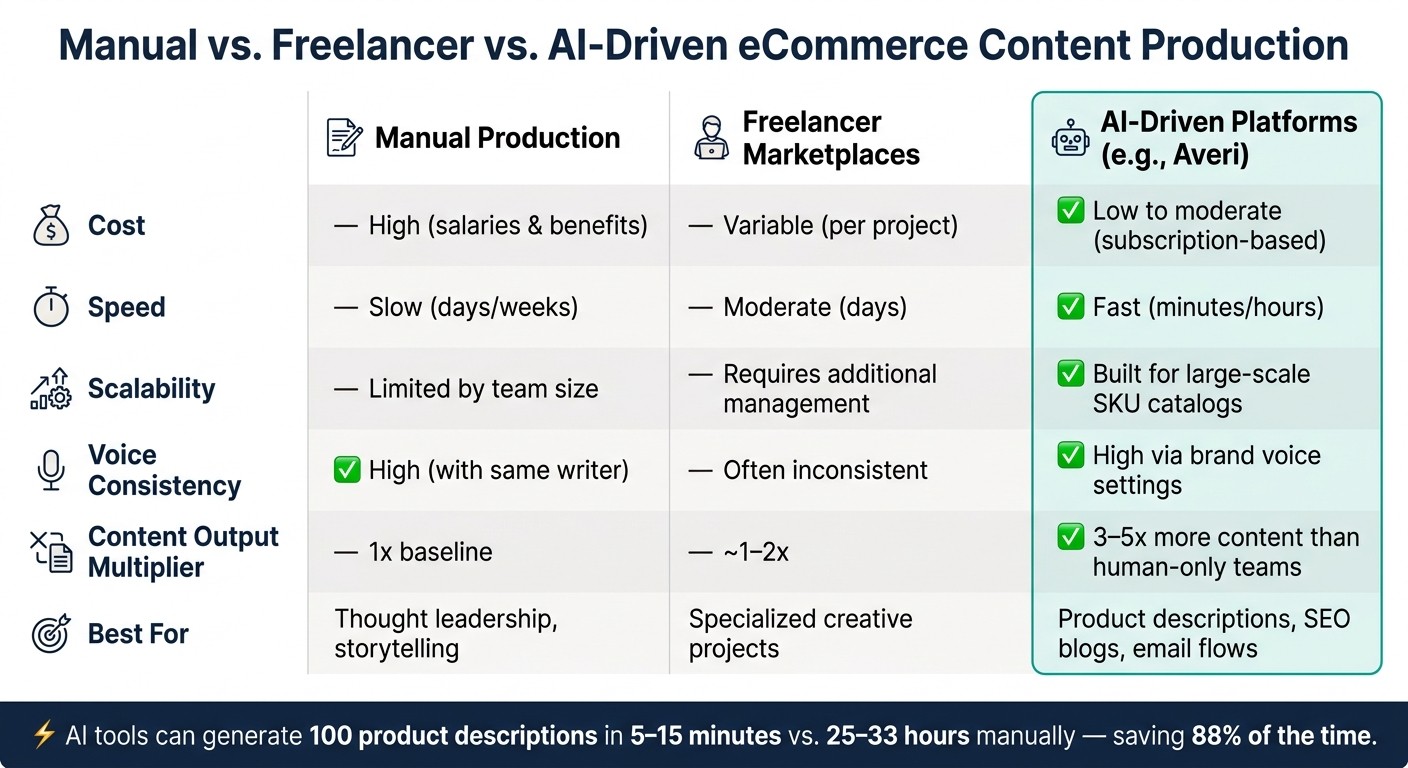
Manual vs. Freelancer vs. AI-Driven eCommerce Content Production
How to Evaluate AI Content Tools for eCommerce
General-purpose AI tools might handle blog drafts, but they fall short when it comes to optimizing product pages, maintaining a consistent brand tone across thousands of SKUs, or triggering abandoned cart emails. When choosing a platform, it’s essential to assess how well it meets the specific demands of your eCommerce marketing strategy.
Seamless eCommerce integrations should be at the top of your checklist. A platform that connects directly with Shopify, BigCommerce, or Magento eliminates the need for manual copy-pasting during content publishing [1]. Equally important is brand voice consistency - the ability to lock in your tone, vocabulary, and customer profile to ensure every piece of content, from product descriptions to promotional emails, feels unified. Additional features to prioritize include:
Multi-channel content repurposing (e.g., transforming a buying guide into emails, social posts, and marketplace listings)
Advanced SEO tools with intent mapping for commercial queries like "best [product] for [use case]"
A human-in-the-loop workflow, ensuring editorial quality with checkpoints [1][2]
Make sure the platform also offers transparent data contracts, complies with GDPR/CCPA regulations, and safeguards your data from being used to train external models [21].
Once you’ve narrowed down your options, it’s helpful to compare manual, marketplace, and AI-driven solutions to determine the best fit for your eCommerce needs.
Manual, Marketplace, and AI-Driven Solutions Compared
There are three main approaches to producing eCommerce content. Manual in-house workflows allow for creative depth but are difficult to scale. For example, writing a single blog post can take 3–4 hours [3]. Freelancer platforms like Upwork or Fiverr offer flexibility, but managing multiple writers can make it hard to maintain a consistent brand voice, and the workload increases with volume [4].
AI-driven platforms strike a balance between speed and quality, excelling in repetitive tasks like product descriptions, meta tags, and email flows. Teams that integrate AI tools can produce 3–5 times more content than teams relying solely on human effort [4].
Feature | Manual Production | Freelancer Marketplaces | AI-Driven Platforms (e.g., Averi) |
|---|---|---|---|
Cost | High (salaries and benefits) | Variable (per project) | Low to moderate (subscription-based) |
Speed | Slow (days/weeks) | Moderate (days) | Fast (minutes/hours) |
Scalability | Limited by team size | Requires additional management | Built for large-scale SKU catalogs |
Voice Consistency | High with the same writer | Often inconsistent | High via brand voice settings |
Best For | Thought leadership, storytelling | Specialized creative projects | Product descriptions, SEO blogs, email flows |
Choosing the right solution isn’t about committing to one method exclusively - it’s about aligning each option with the tasks it’s best suited for. AI tools can handle high-volume tasks, while human input adds strategic depth.
A Phased Approach to Adopting AI Content Tools
To successfully integrate AI tools into your workflow, following a structured AI content creation framework for a phased rollout is key. Many eCommerce brands make the mistake of trying to automate everything at once, which can disrupt existing strategies. Instead, start small and scale gradually to minimize risk and gather performance data before committing fully [4][21].
Begin with a low-stakes use case, such as generating meta descriptions or repurposing social media content. These tasks are high in volume, low in editorial risk, and easy to measure. A short 14-day pilot with a clear KPI can provide valuable insights into the platform’s effectiveness [21]. During this phase, ensure your foundational data - like product feeds, UTM parameters, and event tracking - is accurate. Poor inputs will undermine even the best AI tools [21].
Once you’ve validated the workflow, expand to tasks like product page optimization and email campaigns. These channels offer clear revenue attribution and are ideal for building your "Brand Core" - a guide that defines your vocabulary, sentence structure, and stylistic preferences. This ensures the AI produces consistent, on-brand content. Platforms like Averi can streamline this process by analyzing your website to understand your brand’s tone and applying it across all content [4].
Finally, scale up to full-funnel content production, including blog clusters, lifecycle email sequences, paid ad copy, and marketplace listings. Use analytics to refine your strategy, feeding insights back into your content plan. For major retail campaigns (e.g., Black Friday, Cyber Monday, Christmas), plan your content at least 8–10 weeks in advance to allow time for organic rankings to take effect [2][4].
Conclusion
eCommerce brands relying solely on paid advertising are treading an expensive and increasingly unsustainable path. Between 2019 and 2024, customer acquisition costs surged by an average of 60% [2], and there’s no sign of this trend reversing. In contrast, content marketing offers a more enduring solution, driving organic traffic, building brand loyalty, and creating equity that withstands algorithm changes.
The main takeaway here is straightforward: align your content with customer intent and establish systems to produce it consistently. This means addressing every stage of the buyer journey - from awareness-focused guides to post-purchase retention emails - and doing so at a scale that manual workflows simply can’t support. Over time, these efforts generate momentum, transforming content into a sustainable growth engine rather than a one-off tactic.
By leveraging a human-AI collaboration model, scaling this process becomes attainable. AI takes on repetitive, high-volume tasks like drafting, creating meta descriptions, writing email sequences, and generating product copy. Meanwhile, your team can concentrate on strategy, unique insights, and refining the brand’s voice. This partnership enables even smaller teams to compete with larger operations while staying aligned with the full-funnel content strategy detailed in this guide.
For those ready to implement this approach, Averi offers a solution tailored to this workflow. Averi learns your brand directly from your website, develops a content strategy, schedules SEO-friendly topics, drafts content in your tone, and publishes it seamlessly to your CMS - all for $100/month. No demos or waiting periods. You approve; Averi keeps the engine running. This efficient human-AI system is the key to scaling your eCommerce success.
"Your job will not be taken by AI. It will be taken by a person who knows how to use AI." - Christina Inge, Instructor, Harvard Division of Continuing Education [22]
FAQs
How long does content marketing take to drive sales for an eCommerce brand?
Content marketing for eCommerce brands often starts showing noticeable sales results within 3 to 6 months. The exact timeframe can vary based on factors such as the quality of the strategy, how well it’s executed, and the scale of the efforts. Over time, well-crafted content helps to grow organic traffic, establish trust, and boost customer engagement, leading to measurable outcomes.
What content should I create first for awareness, consideration, and retention?
To draw in visitors, begin with awareness content - think educational blogs, how-to guides, or engaging videos. These not only inform but also establish trust and make your brand recognizable. When moving into the consideration phase, shift focus to resources like product comparisons, in-depth reviews, and detailed descriptions that help potential customers weigh their options. Finally, for retention, develop content that keeps customers engaged, such as compelling customer stories, user-generated content, and personalized emails. This step-by-step approach nurtures loyalty and encourages repeat business, strengthening the bond with your audience.
How can I use AI for eCommerce content without hurting quality or brand voice?
AI offers a powerful way to boost efficiency and scale in eCommerce content production, but keeping quality and brand voice intact demands a structured approach. Use AI for tasks such as research, initial drafts, and content optimization, while relying on human oversight to guide strategy and maintain the right tone. Establish clear prompts for AI tools, implement review processes, and fine-tune AI-generated content to reflect your brand’s identity. This balance allows for scalable content creation without compromising authenticity or consistency.
Related Blog Posts

Zach Chmael
CMO, Averi
"We built Averi around the exact workflow we've used to scale our web traffic over 6000% in the last 6 months."
Your content should be working harder.
Averi's content engine builds Google entity authority, drives AI citations, and scales your visibility so you can get more customers.