

In This Article
Build compliant, role-focused HealthTech content that shortens long enterprise sales cycles, safeguards HIPAA/FDA risk, and tracks ROI.
Updated:
Trusted by 1,000+ teams
Startups use Averi to build
content engines that rank.
HealthTech startups face unique challenges in content marketing. Selling to hospitals, physicians, and healthcare executives often involves long sales cycles (6–18 months) and multiple decision-makers (15+ stakeholders). To succeed, your content must be accurate, compliant with regulations like HIPAA, and tailored to each buyer's role.
Key takeaways:
Content Goals: Align with business objectives (e.g., lead generation, brand awareness) and adapt to the buyer's journey (awareness, evaluation, decision stages).
Know Your Audience: Identify Ideal Customer Profiles (ICPs) and address their specific concerns (e.g., clinical outcomes for CMOs, ROI for CFOs).
Content Audit: Review existing assets for gaps, especially in evaluation and decision-stage content.
AI Tools: Platforms like Averi AI streamline content creation while ensuring compliance and accuracy.
Compliance: Avoid regulatory risks by using cautious language and proper sourcing for clinical claims.
Metrics: Track KPIs like organic traffic, SQLs, and Patient Acquisition Costs (PAC) to measure success.
This guide simplifies the process of creating compliant, effective content that supports HealthTech sales cycles while building trust with your audience.
Setting Goals and Defining Your Ideal Customer Profiles (ICPs)
Aligning Content Goals with Business Objectives
Before diving into content creation, it’s critical to establish goals that align directly with your overarching business objectives. As BRG Communications explains:
"Healthcare content marketing goals should come from overall marketing goals, and marketing goals should come from business goals. Your healthcare content strategy, therefore, should support the business, not just marketing." [7]
A straightforward way to approach this is by working backward from your business objectives. For instance, if revenue growth is the aim, your content should focus on generating leads - tracked through metrics like form completions and sales-qualified leads (SQLs). If building brand presence is the priority, you’ll need to monitor organic traffic and branded search volume. The table below highlights how business objectives translate into content goals and measurable KPIs:
Business Objective | Content Goal | Key Metrics |
|---|---|---|
Growth/Revenue | Lead Generation | Form completions, SQLs, demo bookings |
Market Presence | Brand Awareness | Organic traffic, impressions, branded search volume |
Market Leadership | Thought Leadership | White paper downloads, media coverage, speaking invites |
Customer Success | User Education | Reduced support tickets, email open rates for guides |
Retention | Customer Loyalty | Repeat usage, churn rate, NPS |
In HealthTech, content goals often need to evolve alongside the buyer’s journey, especially during a 6–18 month enterprise sales cycle [3]. Early-stage content should focus on educating prospects about the problem (awareness). Mid-cycle materials should address vendor comparisons and ROI considerations (evaluation). Late-stage content must tackle final concerns, such as compliance or security (decision). A common pitfall for startups is attempting to use the same content across all stages, which rarely works effectively without a dedicated AI content engine to scale production.
Once clear goals are in place, the next step is identifying the key players within your target organizations who influence these decisions.
Identifying and Refining ICPs
After establishing content goals, the focus shifts to defining your Ideal Customer Profiles (ICPs). In HealthTech, an ICP isn’t just about job titles or company size - it’s about understanding the mindset of your buyers. This includes what triggers their search, what challenges keep them awake at night, and what might cause them to abandon a deal.
HealthTech sales often involve multiple stakeholders, making the process far more complex. For example, a hospital system evaluating a clinical tool might bring in 15 or more decision-makers [3], each with their own priorities. A Chief Medical Officer will want proof of clinical outcomes and physician adoption rates. A CIO will focus on interoperability with FHIR/HL7 standards and data security. Meanwhile, a CFO will be looking for ROI calculators and benchmarks for managing denials. To succeed, your content strategy must address all these perspectives.
One effective way to develop these profiles is by conducting what positioning expert April Dunford calls "rage quit" interviews [8]. These involve asking potential customers to describe their worst experiences with current solutions. Their answers will highlight the pain points your content needs to address. Don’t overlook mid-level influencers like head nurses, office managers, or department leads. These individuals often face the most pressing challenges and can act as internal advocates, championing your solution to higher-level decision-makers [9].
"Belkins' expert approach to ICP for clients involves a multi-faceted strategy that emphasizes flexibility, data-driven adjustments, and targeting beyond just high-level decision-makers." - Oleksandra Stepanova, Account Management Team Lead, Belkins [9]
Once you’ve mapped out your stakeholders, tailor your content to their unique concerns and preferred formats. For clinical leaders, this might mean peer-reviewed studies or physician testimonials. IT leaders will need detailed integration guides and security documentation. Finance leaders will look for case studies showcasing measurable cost savings. By aligning content formats with stakeholder needs, you can turn your content calendar into a powerful sales tool, ensuring that your messaging resonates at every stage of the buyer’s journey.
Webinar: Healthcare Content Marketing Best Practices
Auditing Existing Content and Finding Gaps
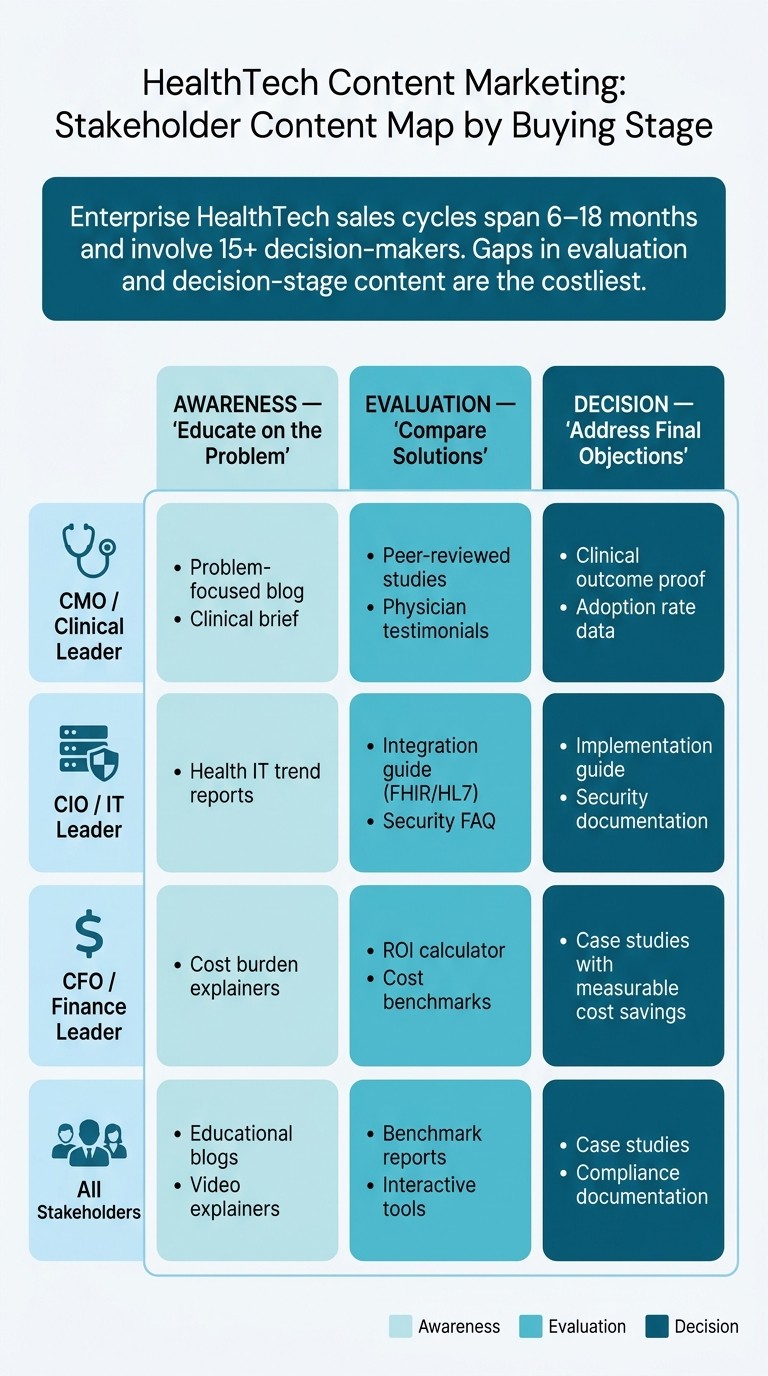
HealthTech Content Marketing: Stakeholder Content Map by Buying Stage
How to Conduct a Content Audit
Creating a scalable content system starts with taking stock of what you already have. Begin by listing all your assets - blog posts, case studies, white papers, landing pages, email campaigns, and sales enablement materials. Then, evaluate each piece for its relevance to your ideal customer profile (ICP), clinical accuracy, regulatory compliance, and performance. For context, the healthcare industry's average website conversion rate is about 3.2% [10]. Flag any content that falls below this benchmark for further review.
A common issue uncovered in HealthTech content audits is the credentialing gap. This happens when content makes clinical or outcome-based claims but fails to provide proper validation, such as a supporting study, methodology, or success story. As Averi explains:
"Clinical buyers are trained to spot methodological flaws and are particularly sensitive to unsubstantiated efficacy claims." [3]
For example, if a piece claims "reduces readmission rates by 23%" but lacks a credible source, it should be flagged for revision or removal. Additionally, ensure HIPAA compliance by verifying that no unapproved Protected Health Information (PHI) is included in case studies or other materials.
Another critical step is aligning your content with the diverse stakeholders involved in HealthTech buying decisions. Enterprise deals often involve multiple personas with differing priorities, yet many startups focus too heavily on just one - typically the CIO or technical buyer. If your audit reveals a lack of content for clinical leaders, finance teams, or compliance officers, this signals where you need to expand your efforts.
Once you’ve assessed your current assets, the next task is identifying what’s missing.
Finding Content Gaps and Opportunities
After completing your audit, the next step is to pinpoint where your content falls short. Start by researching the exact questions your buyers are asking - whether through Google searches or AI tools like Perplexity. High-intent queries such as "FHIR API integration healthcare" or "physician burnout solutions" can highlight areas where your content library is lacking. If you’re not ranking or visible for these topics, that’s a clear gap.
To refine your strategy, map your content to the three stages of the buyer's journey:
Awareness-stage content should educate buyers about the problem, such as high readmission rates or care coordination challenges.
Evaluation-stage content should help stakeholders compare solutions, offering tools like ROI calculators for CFOs or security documentation for CIOs.
Decision-stage content should address final objections with materials like peer testimonials, implementation guides, or compliance documentation.
Use a simple grid to track your progress:
Buying Stage | Stakeholder | Content Type | Status |
|---|---|---|---|
Awareness | CMO / Clinical Leader | Problem-focused blog, clinical brief | Audit existing |
Evaluation | CIO / IT Leader | Integration guide, security FAQ | Gap identified |
Evaluation | CFO / Finance Leader | ROI calculator, cost benchmark | Gap identified |
Decision | All | Case study, implementation guide | Audit existing |
Gaps in the evaluation and decision stages are particularly costly in the 6–18 month enterprise sales cycle [2]. Buyers who can’t find the information they need often turn to competitors who provide it. Prioritize these gaps to keep your pipeline moving and prevent losing potential deals.
Building a Scalable Content Workflow with Averi AI
HealthTech startups often face the challenge of addressing content gaps while maintaining accuracy and compliance. To tackle this, implementing an AI-supported workflow can help ensure consistency and efficiency. With AI marketing automation saving teams over 40 hours per week [12], it's a game-changer for startups juggling limited resources.
Automating Strategy and Research
Averi simplifies the process by analyzing your website to understand your product, positioning, and brand voice, then automatically creating a tailored content strategy. For HealthTech startups dealing with lengthy enterprise sales cycles, the Strategy Map becomes a crucial tool. It aligns content with the needs of various stakeholders - whether it's CMOs, CIOs, or Revenue Cycle leaders - ensuring every role is addressed at the right stage.
The Brand Core is another vital feature, storing clinical accuracy standards, compliance language, and pre-approved disclaimers. By setting this up once, every AI-generated draft starts from a compliant foundation, easing the legal review process:
"AI content tools like Averi don't replace that review process - but they accelerate the drafting stage." [3]
Streamlining Content Creation and Collaboration
Once topics are approved, Averi conducts research and produces structured drafts complete with hyperlinked, verifiable sources. This is especially useful for complex formats like clinical white papers or regulatory explainers, cutting production time by 60–70% [3]. Instead of starting from scratch, clinical editors can focus on refining drafts to meet high standards - an essential advantage for extended sales cycles.
"Think of AI as your fastest first-draft writer, not your clinical editor." [3]
The Content Queue ensures smooth progress by tracking each piece through stages like Draft, Compliance Review, Approved, and Scheduled. This visibility prevents bottlenecks, even during prolonged legal reviews.
Publishing and Measuring Performance
Once content passes all reviews, Averi allows direct publishing to platforms like Webflow, Framer, or WordPress. Each published piece is stored in your Library, creating a reference point that improves the accuracy and consistency of future drafts. Over a 6–18 month sales cycle, this builds a cumulative advantage [3].
On the analytics side, Averi monitors key metrics like impressions, clicks, and keyword rankings. It then suggests actionable next steps, such as optimizing content ranked at #8 to push it to the first page. This feedback loop transforms content creation from isolated tasks into a system that delivers ongoing improvements.
Feature | Function in HealthTech Workflow | Who Benefits |
|---|---|---|
Strategy Map | Aligns content with buying committee roles | Ensures CMOs, CIOs, and Revenue Cycle leaders are covered [3] |
Brand Core | Stores clinical voice and compliance rules | Maintains medical credibility and regulatory safety [2] |
Content Queue | Tracks stages from draft to publication | Provides workflow clarity during lengthy review cycles [2] |
ICP Settings | Calibrates tone and technical depth | Adjusts content for clinical or administrative audiences [2] |
Choosing Content Formats and Distribution Channels
Best Content Formats for HealthTech Startups
Selecting the right content formats depends on understanding your audience's needs and where they are in their decision-making process. For example, a CFO deciding on a $500,000 EHR integration will require different materials than a patient researching a chronic condition. Using mismatched formats can lead to wasted effort and missed opportunities.
Clinical white papers and evidence-based reports are essential when targeting clinical and administrative buyers. These formats demonstrate a strong grasp of healthcare challenges and signal credibility. For early-stage awareness, educational blogs and condition explainers are highly effective, tapping into the 7% of daily Google searches that are health-related[4]. This opens the door to a wide audience, including patients, caregivers, and even clinicians conducting research.
Video content is becoming non-negotiable. With 91% of businesses leveraging video as a marketing tool and 82% of viewers reporting they've been persuaded to make a purchase after watching one[4], formats like procedure explainers, physician introductions, and video testimonials can personalize your brand in ways text simply cannot. Additionally, interactive tools like ROI calculators and implementation roadmaps are invaluable for enterprise buyers, addressing specific financial and operational concerns and helping them move forward in their evaluation process.
"Content marketing humanizes your company and brand; it isn't just blog posts, case studies, or white papers." – SFGate[15]
Here's a breakdown of the most effective content formats and their ideal audiences:
Content Format | Primary Audience | Best Use Case |
|---|---|---|
Clinical White Papers | CMOs, Physicians | |
ROI Calculators | CFOs, Operations Leaders | |
Video Testimonials | Clinical Champions | Building trust and social proof[3] |
Implementation Guides | CIOs, IT Managers | |
Condition Explainers | Patients, Caregivers | |
Benchmark Reports | Executive Leadership | Establishing expertise in specific niches[3] |
Once you've identified the right formats, the next step is to ensure your content reaches the right audience through the most effective channels.
Selecting and Optimizing Distribution Channels
Choosing the right platforms for distribution is just as critical as creating the content itself. For B2B HealthTech, LinkedIn should be your top priority. This is where clinical leaders, health IT executives, and hospital administrators spend much of their professional time. Posts from founders or clinical advisors tend to outperform standard company updates on this platform[2][3].
For patient- or consumer-focused products, organic search (SEO) is the go-to channel. With 73% of Americans seeking health information online[5] and 52% expressing doubts about the credibility of what they find[5], it's crucial to build trust. Meeting Google's E-E-A-T standards - expertise, experience, authoritativeness, and trustworthiness - through credentialed authorship, expert reviews, and authoritative sourcing can set your content apart. Additionally, Generative Engine Optimization (GEO) is becoming increasingly important. Structuring your content to be cited by AI tools like ChatGPT and Google AI Overviews can position your brand as a trusted source for health research[4][3].
One efficient approach is to start with a comprehensive 2,500-word white paper and then repurpose it into multiple formats, such as blog posts, social media updates, and email newsletters[11]. This strategy ensures consistent messaging while minimizing production demands.
"There's no place for jargon in healthcare content - especially when you're writing for a patient or caregiver audience. Accessing reliable health information should be the easiest part of the patient journey." – Ann Key, Content Strategist, Aha Media Group[5]
Compliance, Trust, and Approval Processes
In HealthTech, ensuring compliance and trust is just as critical as creating compelling content and streamlining workflows.
Meeting Regulatory Compliance Requirements
One poorly chosen word can draw regulatory scrutiny and harm your reputation. Two key regulatory bodies set the rules: HIPAA, which governs patient data privacy, and the FDA and FTC, which oversee clinical claims.
Under HIPAA, using Protected Health Information (PHI) for marketing without explicit consent is prohibited. This means no patient-specific stories in ads or targeted campaigns based on health conditions. For products regulated by the FDA, such as Software as a Medical Device (SaMD), content must strictly adhere to approved indications. Promoting off-label use is a serious compliance risk[3][13].
When discussing clinical claims, avoid absolute terms like "cures", "eliminates", or "guarantees." Instead, use more cautious language like "may help," "research suggests," or "consult your doctor." Back up every claim with credible sources, such as peer-reviewed studies, FDA publications, or CDC guidelines. This approach not only ensures legal compliance but also builds credibility with clinical audiences.
"A wrong word in a blog post about medication dosages is dangerous." – Alex Rivera, QuillScout[1]
By prioritizing regulatory care, you lay the groundwork for trust through factual, transparent content.
Building Trust Through Accurate and Transparent Content
Strong compliance practices do more than protect you legally - they elevate the trustworthiness of your content.
With 52% of Americans doubting online health information and 47% believing it’s primarily sales-driven[5], trust becomes the cornerstone of effective content strategy. To earn it, focus on credentialed authorship and evidence-based content. Articles reviewed by healthcare professionals carry far more weight than those that are purely marketing-driven[1][2]. Adding transparent sourcing - citing academic institutions, government agencies, and peer-reviewed journals - reinforces that your content is designed to inform, not just sell.
"In healthcare content, AI is the accelerator, not the driver. Your clinical expertise, compliance knowledge, and editorial judgment are what make the content safe to publish." – Alex Rivera, QuillScout[1]
While AI tools can speed up the drafting process, they also come with risks. Testing has shown that even advanced tools like Jasper AI and Frase.io often introduce 2–3 minor medical inaccuracies per piece[1]. Every claim must be verified by human subject matter experts before publication - no shortcuts.
Setting Up Efficient Approval Workflows
Treating compliance as a final checkpoint often leads to bottlenecks. Late-stage rewrites, stalled campaigns, and frustrated teams are common when legal and clinical reviews only happen at the end of the process.
Instead, efficient approval workflows integrate compliance checks throughout the content creation cycle, ensuring standards are met early and consistently.
"If governance is a final gate instead of a built-in process, you're designing in bottlenecks and late-stage rework. The delays aren't bugs in your system. They're features." – Siteimprove[16]
A tiered review system can streamline this process. Not all content carries the same level of risk, so not all content requires the same level of scrutiny:
Review Tier | Content Type | Who Reviews |
|---|---|---|
Tier 1: Lightweight | Educational blogs, industry trends, company culture | Marketing/Editorial only |
Tier 2: Standard | Product features, implementation guides, technical FAQs | Marketing + SME/Technical |
Tier 3: High-Risk | Clinical outcome claims, patient case studies, regulatory assertions | Full Clinical + Legal/Regulatory |
In addition to tiering, structural habits can improve efficiency. Require reviewers to use "suggesting mode" to clarify edits[17]. Maintain a library of pre-approved legal disclaimers and privacy language for quick insertion[17]. Establish clear Service Level Agreements (SLAs) for review timelines to prevent drafts from sitting idle.
For example, in February 2026, Springfield Clinic reduced its marketing campaign turnaround time by 35% by embedding accessibility and SEO checks into its CMS authoring process with Siteimprove. By handling basic reviews during drafting, experts could focus solely on critical risk assessments[16].
Measuring Results and Refining Your Content Strategy
Once your content is out there, the next step is figuring out if it’s doing its job. For HealthTech companies, success isn’t just about page views - it’s about tracking metrics that align with both awareness and conversion goals.
Key Metrics to Track for HealthTech Content Marketing
Many content teams stop at tracking traffic, but HealthTech startups need to go deeper. The metrics that matter most span the entire buyer journey, from the first click all the way to a closed deal. Interestingly, nearly half of content marketers (about 50%) don’t have clearly defined goals [6], making it tough to improve what isn’t being measured.
Here’s a breakdown of goals and the key performance indicators (KPIs) you should monitor:
Goal | Key Metrics |
|---|---|
Brand Awareness | Organic traffic, search rankings, impressions, social reach |
Engagement | Time on page, bounce rate, social shares, email open rates |
Lead Generation | Form completions, MQL/SQL volume, gated content downloads |
Conversion | Demo requests, webinar registrations, clinical conversion rate |
Retention | Churn rate, Net Promoter Score (NPS), returning user volume |
Financial Health | Customer Acquisition Cost (CAC), Annual Recurring Revenue (ARR), contribution margin |
These metrics do more than measure performance - they’re essential for refining your AI-powered content strategy, especially when paired with tools like Averi AI.
One metric particularly relevant to HealthTech is Patient Acquisition Cost (PAC), which calculates how much you’re spending to turn a lead into an active patient or user. Combining PAC with your payer mix is critical. Reimbursement rates from commercial payers are often 50% to 100% higher than those from Medicare or Medicaid [18], so understanding this dynamic is vital to ensuring your content’s return on investment (ROI) adds up.
Another key area to track is AI Visibility - whether AI tools like ChatGPT, Perplexity, Claude, or Gemini cite your content when users ask health-related questions. Pair this with multi-touch attribution models to credit not just final conversion points but also the early-stage content that influences decisions throughout the buyer journey.
Using Analytics to Improve Content Performance
Data isn’t useful unless it leads to action. A common misstep for HealthTech startups is relying solely on last-touch attribution - giving all the credit to the final touchpoint before a conversion. Instead, multi-touch attribution gives you a fuller picture, showing how early-stage content works alongside later efforts to drive results.
"Track content-to-pipeline attribution with multi-touch modeling rather than last-touch, and invest in building a content library that serves buyers at every stage of a long journey." – Averi [3]
Averi AI doesn’t just streamline content workflows - it also delivers actionable insights. Beyond showing clicks and impressions, it flags specific opportunities: when a piece is stuck on page two and needs a boost, when a competitor covers a topic you’ve overlooked, or when a low-competition keyword aligns well with your ideal customer profiles (ICPs). These insights help you prioritize updates and refine your strategy. Startups using AI-powered content workflows like these have seen traffic skyrocket - some reporting growth of 6,000% within six months [2]. Of course, results depend on maintaining both quality and consistency.
One practical tip: if you’re working on a B2C or direct-to-patient HealthTech product, ask every new user during onboarding, “How did you find us?” Digital analytics often miss offline referrals and word-of-mouth, and this simple question can capture those patterns. Combine these qualitative insights with your quantitative data for a much clearer picture of where to focus your efforts next.
Conclusion: Building a Content Engine for Long-Term Growth
Creating a HealthTech content engine is not a one-and-done task - it’s a system that evolves over time. The most successful startups approach content as a core part of their infrastructure. Every piece is anchored in clinical evidence, tailored to the right audience, and developed with compliance integrated into the process from the very beginning.
These practices are essential for navigating the complexities of HealthTech marketing. Enterprise evaluations often involve multiple decision-makers, extended timelines, and intricate buying committees [3]. Your content engine must support the entire journey, from raising early awareness of a problem to securing final approval.
Thankfully, Ethical AI-powered tools can make this process more efficient. By cutting content production time by 60% to 70% [3], even small HealthTech teams can achieve exceptional results - provided clinical oversight remains a priority. Platforms like Averi AI can manage tasks like research, drafting, and optimization, allowing your team to focus on ensuring accuracy, maintaining the right tone, and making strategic decisions.
Every piece of content adds to your brand’s credibility. Consistently producing well-researched, compliant materials strengthens your authority, sharpens your analytics, and builds trust over time. Remember, consistency outpaces perfection - a regular flow of solid, reliable content will establish authority faster than sporadic bursts of effort.
"The trust bar is extraordinarily high. Healthcare buyers... are making decisions with significant stakes. A purchasing mistake in healthcare has real consequences." – Averi [2]
FAQs
How do I pick the right KPIs for HealthTech content?
When selecting KPIs, make sure they align closely with your business objectives and the specific regulatory demands of the healthcare industry. Prioritize metrics that provide insight into key areas such as patient acquisition costs, content engagement, lead quality, and conversion rates. Additionally, include KPIs that reflect efforts in trust-building, clinical reliability, and compliance - like healthcare provider engagement or adherence to HIPAA standards.
Your KPIs should always be specific, measurable, and directly linked to meaningful outcomes, such as building trust, generating qualified leads, and driving conversions. This approach ensures your tracking efforts remain focused and actionable.
What content should I create for each stakeholder?
To connect effectively with various stakeholders, it's essential to address their unique priorities and concerns:
Clinical decision-makers (such as physicians and administrators): Emphasize aspects like regulatory compliance, improved patient outcomes, and streamlined clinical workflows. These are key areas that resonate with their day-to-day responsibilities and long-term goals.
Executives (like CIOs and CMOs): Focus on areas that demonstrate operational efficiency, return on investment (ROI), and the broader strategic advantages. They are often looking for solutions that align with organizational growth and sustainability.
Patients and consumers: Prioritize building trust by communicating in a clear, compassionate manner. Explain the benefits in a way that offers reassurance and hope, all while adhering to regulatory requirements to maintain credibility.
By tailoring your language, level of technical detail, and messaging to meet the expectations of each group, you'll create more meaningful and impactful engagement.
How can I ensure my content is HIPAA- and FDA-compliant?
To ensure your content aligns with HIPAA and FDA requirements, it's essential to stick to these core practices:
Safeguard patient data: Always rely on de-identified information and prioritize tools designed to protect Protected Health Information (PHI).
Follow regulatory guidelines: Steer clear of misleading statements, real-life patient examples, or unverified health claims.
Implement compliant workflows: Use HIPAA-approved platforms and establish thorough review processes to guarantee accuracy.
By following these measures, you can minimize legal risks while preserving the trust of your audience.
Related Blog Posts

Zach Chmael
CMO, Averi
"We built Averi around the exact workflow we've used to scale our web traffic over 6000% in the last 6 months."
Your content should be working harder.
Averi's content engine builds Google entity authority, drives AI citations, and scales your visibility so you can get more customers.