Content Marketing for Pre-Seed Startups: What Actually Works

Averi Academy
Averi Team
8 minutes

In This Article
Practical, low-cost content tactics for pre-seed startups to validate ideas, build trust, and scale with AI.
Updated:
Trusted by 1,000+ teams
Startups use Averi to build
content engines that rank.
Content marketing is one of the most cost-efficient ways for pre-seed startups to build awareness, validate ideas, and gain early traction. While paid ads can quickly exhaust a tight budget and PR often requires connections, content marketing offers a scalable path to grow your audience and test your messaging without breaking the bank. This approach is the foundation for any startup marketing strategy looking to scale efficiently.
Key takeaways:
Why it matters: Content marketing costs 62% less than traditional methods and generates 3x more leads. It also helps establish expertise and build trust.
Goals to prioritize: Learn from audience feedback, validate your problem/solution, and build credibility.
Effective formats: How-to guides, founder-led thought pieces, and original research are impactful at this stage.
Distribution tips: Start with owned channels, leverage personal networks, and collaborate with partners.
AI tools like Averi: Use AI marketing automation to automate research, drafting, and publishing to save time while maintaining quality.
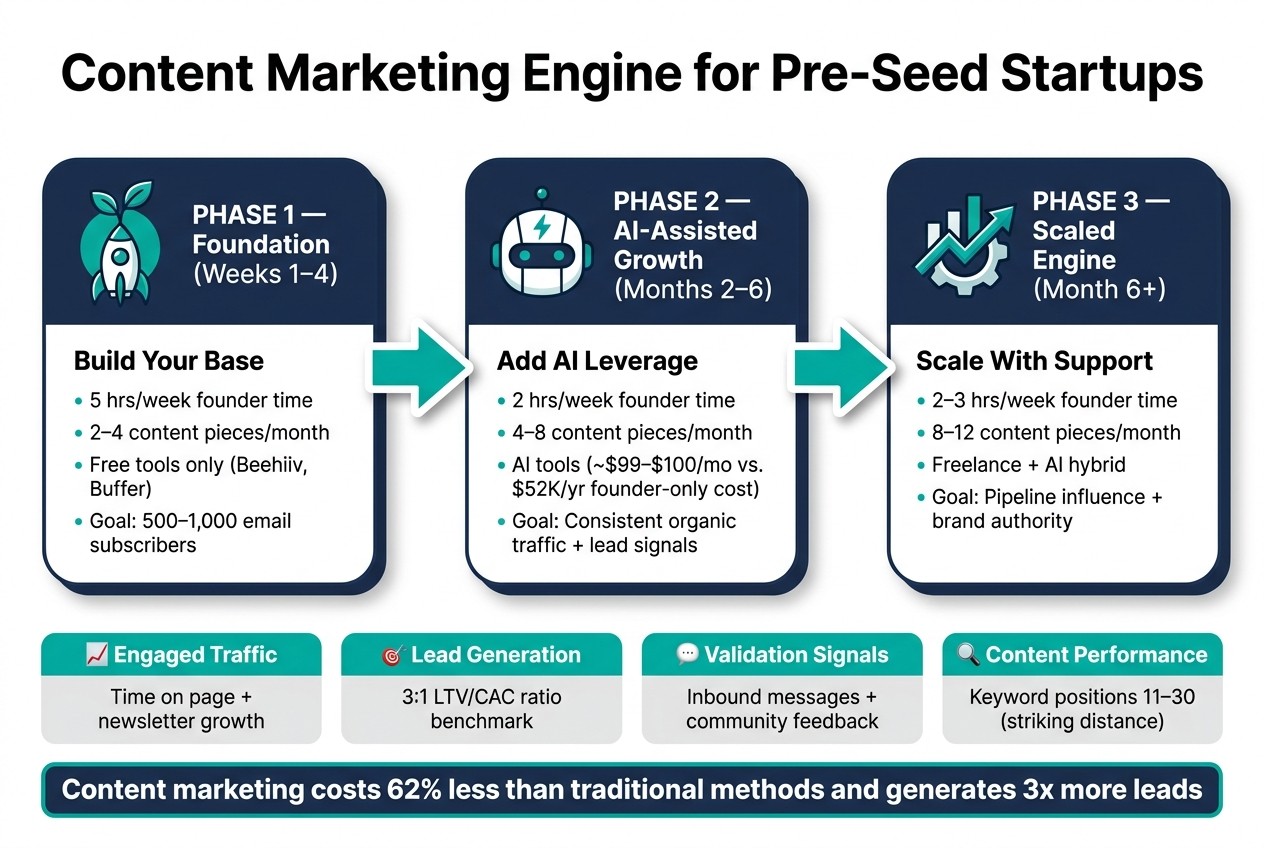
Content Marketing System for Pre-Seed Startups: From Creation to Scale
Mucker Growth Series: How to Kickstart Content Marketing at Early-Stage Companies
Setting Content Marketing Goals for Pre-Seed Startups
At the pre-seed stage, your content strategy needs to focus on learning quickly, building trust, and validating your problem and solution. Forget about traditional marketing funnels - every piece of content should serve at least one of these critical objectives.
Using Content to Validate Your Problem and Solution
When resources are tight, your content needs to multitask. Think of it as a form of public market research. For instance, you can turn customer discovery interviews into short LinkedIn posts or blog articles to test your assumptions in real time. The feedback - comments, shares, and messages - will highlight the pain points that resonate most with your audience. To stay organized, consider implementing an "Idea Capture" system, where you log content ideas from customer calls, product discussions, or even fundraising meetings [1].
Building Early Trust and Credibility
At this stage, you likely lack established social proof, so your content needs to work overtime to demonstrate your expertise. Publishing thoughtful, well-researched pieces can show early adopters and potential investors that you truly understand the problem you're solving. Founder-led content tends to perform better because it feels personal and authentic, offering insights that a generic brand account can't match [4]. A helpful approach is the "Founder Edit" system: use AI tools to handle the heavy lifting - like research and structuring - then spend 30–45 minutes adding your unique perspective, customer anecdotes, and bold opinions [4]. By doing this, you not only build credibility but also set the stage for identifying demand signals. This process is a core part of AI content creation strategies that help small teams compete with established players.
Spotting Demand Signals Through Content
Pay attention to the signals your audience sends through their engagement. Inbound messages, newsletter sign-ups, and direct comments are all forms of validation. A strong early goal is to grow an email list of 500–1,000 engaged subscribers - this gives you a direct channel to your audience, free from algorithm interference [1]. When new leads come in, always ask, "How did you hear about us?" Their answers can help you identify which content is driving interest. Combine this self-reported data with topic-specific engagement metrics to uncover the problems your audience cares about most - often before you’ve even started building a solution. These insights will lay the foundation for scalable growth strategies.
Metric Type | Metrics | Why It Matters |
|---|---|---|
Leading Indicators | Organic traffic, time on page | Shows if people are finding and valuing your content. |
Learning Indicators | Topic engagement, email capture rate | Highlights which problems resonate most with your audience. |
Lagging Indicators | Lead quality, pipeline influence | Measures whether your content is driving tangible business results. |
Content Formats That Work Best for Pre-Seed Startups
When budgets are tight, focusing on content that delivers maximum impact with minimal cost is essential. The formats below consistently stand out for pre-seed startups because they’re affordable to create, simple to share, and can double as a way to gather market insights.
How-To Guides That Address Real Issues
The best how-to guides come directly from customer feedback. If you notice the same question popping up during customer discovery calls - say, 10 or more times - you’ve likely found a high-value topic to cover [4]. These guides are designed for people actively searching for solutions, not casual readers. To decide which topics to tackle first, consider three factors:
Does it solve a real problem for potential buyers? (40%)
Are people actively searching for this information? (30%)
Can you realistically compete with existing content? (30%) [1]
This structured approach ensures your content resonates with your audience and stands out in search results.
Founder-Led Thought Leadership
At this stage, your personal insights as a founder are your most powerful tool. You don’t have a long list of customers or glowing press coverage yet, but your experience can set you apart. In fact, founder-led content generates 8x more engagement than typical brand posts [4].
"At seed stage, the founder IS the brand. The company doesn't have institutional credibility yet. The founder's firsthand experience is the only trust signal that matters." - Zach Chmael, Head of Marketing, Averi [4]
The most impactful topics are those only you can address, such as lessons from recent customer conversations, misconceptions about your market, or why common industry practices fall short [1]. Platforms like LinkedIn and X are ideal for this type of content. Aim for 2–3 posts per week, using a straightforward structure: start with a hook, provide context, share your insight, back it up with proof, and end with a question or link [2].
While thought leadership builds trust, sharing original research can further solidify your credibility by offering unique, data-backed insights.
Market Research and Insight Content
Original research gives you a distinct edge over opinion pieces. By sharing data from customer interviews or industry observations, you provide something readers can’t easily find elsewhere. For example, in September 2025, Finlytics - a fintech compliance startup - created an 8-page guide based on the founder’s consulting experience. They sent it to 40 fintech founders, resulting in six demo requests and two paying customers within three weeks. The guide also became a key asset during their pre-seed fundraising efforts [5].
"A founder with a thoughtful article or report is easier to believe in than one with just a pitch deck." - Founder FAQs [5]
The good news? You don’t need a massive dataset to make an impact. Insights from just 15–20 customer conversations can be distilled into a concise report or post, signaling expertise to both early adopters and potential investors [1].
How to Distribute Content Without a Big Team or Budget
Once you've created content that resonates and built trust with your audience, the next challenge is making sure it reaches the right people. High-quality content that goes unseen is a missed opportunity. For pre-seed startups, the key is to develop a straightforward, repeatable system to distribute content effectively without draining resources.
Start With Owned Channels
Begin with platforms you have full control over - your company blog, email newsletter, and founder’s social profiles. These are cost-efficient tools that can help you build lasting connections.
Use a one-to-many strategy to maximize your efforts. For example, create one in-depth article every two weeks and repurpose it into multiple formats: 3–5 LinkedIn posts, an email digest, and several tweets. Scheduling tools like Buffer can help streamline this process, allowing you to batch your work into just a few hours.
For email, a simple biweekly newsletter using free tools like Beehiiv or Mailchimp works well. Keep it concise and valuable - share one actionable insight each week about the problem your product solves. Even a small but engaged email list of 200 subscribers can outperform a massive but passive social media following.
Tap Into Personal Networks and Communities
Once you've used your owned channels, expand your reach by leveraging personal networks. Your personal connections can be a surprisingly effective distribution channel. Focus on quality over quantity - sending five well-targeted messages to individuals who genuinely face the problem you're addressing can be more impactful than blasting 200 generic emails. Keep your outreach short and specific, explaining why your content is relevant and asking them to share it with one or two colleagues.
For online communities like Slack groups, subreddits, or Discord servers, remember this rule: give before you take. Spend time contributing value - answering questions and sharing insights - before promoting your own content. When you do share, lead with the key takeaway or insight from your content rather than just dropping a link. This approach reduces the risk of being flagged as self-promotional.
"One strong LinkedIn post from a seed-stage founder can reach 10,000+ people in your niche." - Averi Resources [1]
Collaborate Through Partnerships
To amplify your reach further, explore partnerships with other startups that serve a similar audience but aren’t direct competitors. Co-marketing is a powerful way to reach new, relevant audiences without spending extra on ads. Consider creating joint content like an industry report, a webinar, or a LinkedIn post. This allows both companies to tap into each other’s networks.
When creating co-branded content, focus on practical and actionable formats, such as checklists or data guides, which partners can easily share with their audience. Start by identifying two or three founders with complementary products and propose a simple collaboration - this could be a guest blog post, a quote swap, or featuring each other in email newsletters.
AI-Powered Content Marketing with Averi
For pre-seed startups juggling countless priorities, Averi's AI-driven platform simplifies content creation from planning to publishing. Building a product, engaging with customers, and managing fundraising often leave little time for consistent content distribution. That’s where Averi comes in - it takes care of the heavy lifting so founders can focus on everything else. From strategy to a published post, Averi manages the entire process, with your input at key moments.
Automating Research and Content Strategy
Planning content can be a time-consuming task, but Averi integrates research and strategy directly into its workflow. When you sign up, the platform extracts essential information from your website to create a "Brand Core" - a memory bank of your product details, positioning, and voice that informs all future content. It then evaluates competitor content, identifies gaps, and generates a prioritized list of content ideas. Each idea includes a target keyword and angle, requiring just 10 minutes of your time to review and approve. From there, Averi takes over, pulling real-time industry data and compiling credible sources, reducing research time from hours to just minutes [2].
Drafting, Optimizing, and Publishing Content
Once you approve a topic, Averi drafts an SEO-optimized post tailored to your brand. These posts are designed to perform well on Google and to be cited by AI search engines like ChatGPT and Perplexity. They include concise answer blocks (40–60 words) and clearly defined entities [2][4]. After the draft is ready, you can easily add your "Founder Edit" - a personal touch like a unique perspective, a customer story, or a bold opinion. This step integrates seamlessly into the workflow, letting you enhance the content without starting from scratch.
When finalized, Averi publishes directly to platforms like Webflow, Framer, or WordPress, complete with SEO metadata. Each published piece is saved in your brand library, helping Averi refine future drafts to better match your voice [2]. This streamlined process allows founders to produce 4–8 posts per month with just 2 hours of active work per week [4]. With publishing handled, the next focus is on understanding and improving performance.
Tracking Performance and Refining Your Approach
Averi’s dashboard provides insights into traffic and rankings, offering actionable recommendations. It highlights posts ranking at #8 and suggests ways to push them to page one, flags competitor activity you might need to address, and identifies low-competition keywords to add to your content queue [2]. A quick 10-minute check-in each week is all it takes to stay informed.
Between May 2025 and March 2026, Averi used this very system to grow its organic search impressions from 5,800 to 2.91 million per month. This success came from building Google entity authority and driving AI citations through consistent, research-backed publishing [6]. For pre-seed startups, this kind of growth shows why investing in content early can create lasting impact.
Key Metrics Pre-Seed Startups Should Track
Tracking the right metrics is essential for validating your content strategy. For pre-seed startups, it’s not about chasing vanity metrics like page views or social impressions. Instead, focus on data that shows whether your target audience is engaging with your content and taking meaningful action.
Engaged Traffic and Lead Generation
When measuring success, prioritize engagement over sheer volume. Metrics like time on page and newsletter subscriber growth offer a clearer picture of whether your content resonates with visitors. These indicators show if people are not just arriving but staying and connecting with your message.
Additionally, track lead conversions and your LTV/CAC (Lifetime Value to Customer Acquisition Cost) ratio. A good early benchmark is aiming for a 3:1 ratio, which suggests you’re efficiently turning readers into paying customers [7]. To further validate your efforts, ask new leads where they discovered your content. If they mention a specific blog post or newsletter, you’ve got direct proof that your strategy is working [1].
Audience Validation Signals
Pay attention to direct feedback from your audience. Inbound messages, questions, or community responses can reveal which topics and problems resonate most. The tone and urgency of these interactions often provide deeper insights than broad metrics like reach or impressions.
"The content you write and how people respond to it tells you which problems resonate, which framings land, and which angles your ICP cares about. This is market research disguised as content." - Averi Team [1]
Newsletter subscriber growth is another key indicator at this stage. Subscribing signals a deliberate choice to stay connected, which is a strong sign of an engaged and growing audience [1].
Content Performance and Iteration
Once you’ve gathered qualitative feedback, focus on improving your content’s visibility in search. Tools like Google Search Console can help you identify "striking distance" keywords - those ranking between positions 11 and 30. These rankings show that Google already finds your content relevant, but it needs a push to break into page one. A targeted refresh, such as updating data, refining your introduction, or improving your answer block, can make a big difference [3]. Reviewing these opportunities weekly ensures your content stays competitive.
By tracking these metrics, you’ll not only optimize your content but also gain valuable insights into your market.
Metric Category | What to Track | Early Benchmark |
|---|---|---|
Engaged Traffic | Time on page, newsletter subscribers | Consistent weekly growth |
Lead Generation | Inbound inquiries, demo requests, LTV/CAC | 3:1 ratio [7] |
Validation | Direct messages, community feedback | Qualitative market signals [1] |
Content Performance | Keyword positions 11–30 (striking distance) | Progress toward page one [3] |
Conclusion: Building a Lean Content Engine That Grows With You
For pre-seed founders, the real game-changer isn’t about picking the right formats or channels - it’s about creating a repeatable system that delivers consistent results over time. Sporadic bursts of content won’t cut it; a steady, manageable cadence is what drives long-term impact [2].
A practical starting point could be posting three times a week on LinkedIn, publishing one long-form article monthly, and sending out a monthly newsletter [1]. This approach is far more effective than churning out 10 posts in a week and then disappearing for months. Begin with a simple system: dedicate 5 hours per week to create 2–4 pieces of content using free tools. As you grow, incorporate AI assistance to double your output to 4–8 pieces a month without increasing your time commitment. Eventually, with freelance support, you can scale to 8–12 pieces monthly while reducing your own involvement to just 2–3 hours per week [2]. Each step builds on the previous one, making your process scalable and sustainable.
Spend 2–3 hours upfront defining your Ideal Customer Profile (ICP), positioning, and brand voice [2]. This initial investment ensures all content - whether written by you, generated by AI, or created by a freelancer - aligns with your brand. Documenting these elements also enhances AI tools’ ability to produce consistent, on-brand content. Platforms like Averi simplify this process by analyzing your website to learn your voice and positioning, ensuring every piece of content reflects your brand identity from the start.
In terms of cost, a system that relies solely on founder time could run you around $52,000 annually. By integrating AI into your workflow - at roughly $99–$100 per month - you can cut your time commitment to just 2 hours a week [3][4]. For pre-seed startups with tight budgets, tools like Averi offer an efficient way to scale your content engine while keeping everything aligned with your brand. This lean, AI-driven approach ensures your efforts grow with your business, without overwhelming your resources.
FAQs
How do I pick content topics that validate my startup idea fast?
To efficiently validate your startup idea, concentrate on crafting content that gauges market interest while addressing critical, decision-driven questions. Start by clearly defining your ideal customer profile (ICP) - this helps ensure your efforts are targeted. Focus on topics that matter most at the bottom of the sales funnel, such as pricing breakdowns, product comparisons, and solutions to common pain points your audience faces.
Leverage AI tools to streamline the brainstorming and drafting process, saving time while maintaining quality. Aim to produce 2–4 pieces of content per month that not only align with your revenue goals but also offer valuable insights into your audience’s preferences and challenges.
What’s the minimum content cadence I should commit to at pre-seed?
At the pre-seed stage, publishing 2–4 content pieces per month strikes the right balance. This steady rhythm helps your brand gain visibility, build trust, and attract leads, all while being mindful of your limited resources. Prioritize quality over quantity to ensure each piece delivers meaningful results.
Which metrics actually prove content is driving traction (not vanity)?
When evaluating whether content is truly making an impact, focus on metrics that tie directly to engagement and conversions aligned with business goals. Key measures include the number of qualified leads generated through content, such as form submissions or inquiries, and how these leads advance in the sales funnel. It's also important to monitor engagement that leads to meaningful outcomes, like customer interactions, partnerships, or initial sales. Steer clear of vanity metrics like page views or likes, as they don’t provide a clear connection to growth or tangible results.
Related Blog Posts

Zach Chmael
CMO, Averi
"We built Averi around the exact workflow we've used to scale our web traffic over 6000% in the last 6 months."
Your content should be working harder.
Averi's content engine builds Google entity authority, drives AI citations, and scales your visibility so you can get more customers.