

In This Article
Monthly content targets and industry-specific benchmarks to scale startup growth with metrics, AI tools, and workflows.
Updated:
Trusted by 1,000+ teams
Startups use Averi to build
content engines that rank.
High-growth startups often struggle to create consistent, high-impact content. The key is aligning output with your growth stage and industry. Here's what you need to know:
Pre-Seed/Seed Stage: Focus on 4–10 blog posts per month targeting high-intent buyers. Use AI tools to boost production without overloading your team.
Series A: Increase to 9–16 posts monthly. Prioritize long-form articles and topic clusters to establish authority and drive traffic.
Series B: Scale to 16–25+ pieces per month, including diverse formats like blogs, videos, and webinars. Build systems to maintain quality as output grows.
Industry-Specific Guidelines:
SaaS: Publish 9+ posts monthly, focusing on comparison pages and technical guides.
E-Commerce: Aim for 4–5 posts (weekly), such as how-to guides and listicles, to boost repeat visitors.
Enterprise B2B: Create 2–4 gated assets monthly (whitepapers, case studies), aligned with longer sales cycles.
Key Metrics to Track:
Traffic: 1,000+ unique pageviews per post.
Engagement: 2–3 minutes time on page; <40% bounce rate.
Conversions: Target 5% conversion rates for high-intent pages.
ROI: Aim for 300%+ content ROI during growth stages.
AI tools like Averi can help you meet these benchmarks, cutting production time and improving efficiency. Start small, measure results, and scale your content efforts strategically.
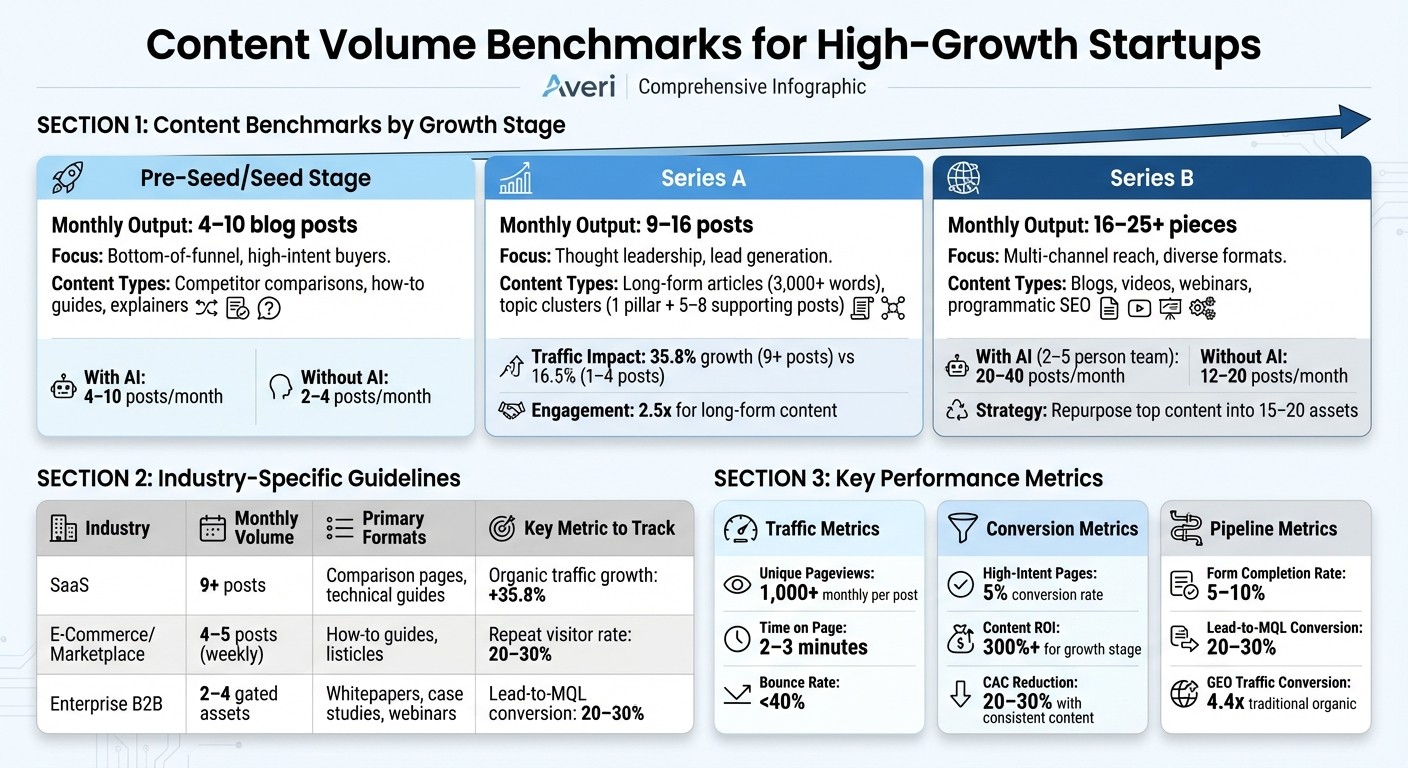
Content Volume Benchmarks by Growth Stage and Industry for Startups
If I Started in 2026, Here’s My B2B SaaS Content Strategy for $1M ARR
Content Benchmarks by Growth Stage
The stage of your funding journey plays a big role in determining how much content you can reasonably produce and what type will yield the best results. Trying to churn out Series B-level content while still in the seed stage can overburden your team and hurt quality. The following benchmarks outline what’s practical at each level, based on typical resources and team sizes.
Pre-Seed and Seed Stage
Set a goal of producing 4–10 blog posts per month, with a focus on bottom-of-funnel content aimed at high-intent buyers. This includes competitor comparisons, how-to guides for core use cases, and straightforward explainers tailored to early customer personas [4]. Leveraging AI tools can significantly boost your output, allowing a lean team to create 4–10 posts monthly, compared to just 2–4 without AI support [2].
At this stage, establishing simple workflows - like templates for briefs and checklists - can help save time and reduce errors as your team grows [5]. These foundational systems not only keep things running smoothly now but also set you up for more sophisticated strategies as you transition to Series A.
Series A and Early Growth
Increase your output to 9–16 posts per month as you focus on building thought leadership and driving lead generation [5]. Research shows that publishing 9 or more posts monthly can result in 35.8% traffic growth, compared to just 16.5% for those publishing 1–4 posts [1]. Long-form articles, especially those over 3,000 words, can deliver 2.5x the engagement of shorter pieces [1].
At this stage, creating topic clusters becomes essential. Start with one pillar page for each major topic and support it with 5–8 related posts to establish topical authority [4][2]. Prioritize hiring a content strategist to guide your roadmap before bringing on writers - many startups make the mistake of hiring writers first, which can lead to content that misses the mark on keyword targeting [2][8]. AI-powered planning tools can also help you streamline briefs and prioritize topics effectively.
Series B and Scaling
Scale your content production to 16–25+ pieces per month, incorporating a mix of formats like videos, webinars, and SEO-driven blogs to reach a broader audience across multiple channels [5]. However, simply increasing your team size won’t automatically lead to a proportional increase in output. Without strong systems in place, scaling can lead to inefficiencies [3].
To maintain quality while scaling, implement standardized briefs, SOPs (standard operating procedures), and hire dedicated editors [3][2]. Programmatic SEO can help you target hundreds of long-tail keyword variations, while repurposing your best-performing posts into 20+ assets can extend their reach across various channels [1][2]. With AI support, a 2–5 person team can produce 20–40 posts monthly, compared to 12–20 posts without AI [2]. Automated workflows further ensure consistency and efficiency.
"Scaling content production successfully requires building systems before adding people, establishing quality standards that survive handoffs, and leveraging technology to multiply human effort." - Averi Team [3]
Content Benchmarks by Industry
The type of content and how often you publish it often depends on your industry. A SaaS startup targeting developers will have different needs compared to an e-commerce brand focused on customer retention or an enterprise B2B firm with lengthy sales cycles. These benchmarks provide tailored strategies for content cadence, building on stage-specific insights.
SaaS Startups
For SaaS startups, publishing 9+ posts monthly can lead to a 35.8% boost in organic traffic, compared to just 16.5% for those posting only 1–4 times [1]. Focus on high-intent formats like detailed comparison pages (e.g., "Tool A vs. Tool B") and technical guides, such as API integration tutorials. These formats are highly effective - HubSpot’s "CRM Software Comparison" pages convert at 2–3 times the rate of regular blog posts, while Notion’s API tutorials increased developer sign-ups by 25% [5][6]. Initially, prioritize 10–15 posts targeting commercial keywords like "[Competitor] alternatives" or "Best [Category] tool" to build traction [4].
Marketplace and E-Commerce
Consistency is key for marketplace and e-commerce brands. Publishing 4–5 pieces per month, or roughly one per week, helps sustain audience engagement. Content like how-to guides and listicles (e.g., "How to Style Your Outfit for Fall" or "Top 10 Gadgets Under $50") drives repeat engagement and encourages social sharing [5]. Aim to improve metrics such as repeat visitor rate (targeting 20–30% of total traffic) and cart conversion rates, which can see a 2–5% lift from content-driven referrals. Shopify merchants using weekly listicles have reported a 15% increase in repeat visits [5][7].
Enterprise B2B
For enterprise B2B companies, prioritize quality over quantity. Focus on creating 2–4 high-value gated assets each month, such as in-depth whitepapers (e.g., "2026 State of Enterprise Security"), case studies with measurable outcomes (e.g., "How Company X Reduced Costs by 40%"), or webinars that position your brand as a thought leader at scale [5][6]. These formats align with longer sales cycles (6–12 months) and help generate leads through email opt-ins. Typical benchmarks include 5–10% form completion rates and 20–30% lead-to-MQL conversion rates [5]. For example, Salesforce’s industry reports generate thousands of leads quarterly, with 15% progressing to sales demos, while Gong’s monthly case studies contribute around $2M in pipeline revenue [5][7].
Industry | Monthly Volume | Primary Formats | Key Metric to Track |
|---|---|---|---|
SaaS | 9+ posts | Comparison pages, technical guides | Organic traffic growth (+35.8%) |
Marketplace/E-Commerce | 4–5 posts (weekly) | How-to guides, listicles | Repeat visitor rate (20–30%) |
Enterprise B2B | 2–4 gated assets | Whitepapers, case studies, webinars | Lead-to-MQL conversion (20–30%) |
These benchmarks should be adjusted based on your growth stage. Early-stage startups may start with smaller goals, while Series B and beyond can scale efforts using AI tools or dedicated editorial teams [5][6]. Aligning your content strategy with your company’s growth phase ensures a scalable and effective approach.
How to Measure Content Volume Impact
Metrics to Track
Measuring the impact of your content is essential for driving growth and refining your strategy. Start with unique pageviews to assess reach - 1,000+ monthly visits per post is a solid benchmark. Use time on page to measure engagement; for educational content, aim for an average of 2–3 minutes. Keep your bounce rate below 40% to ensure visitors explore more than just one page [9][10].
For high-intent pages like comparison guides or technical tutorials, target a 5% conversion rate [11]. To tie these conversions to revenue, track pipeline influence by using UTM parameters to attribute deals to specific content pieces. SaaS startups that consistently produce content often see a 20–30% drop in customer acquisition cost (CAC) [5]. Calculate content ROI with this formula:
Content ROI = (Revenue from Content – Production Costs) / Production Costs
Growth-stage companies should aim for a return of 300% or more [10].
Metric | What It Measures | Startup Benchmark |
|---|---|---|
Unique Pageviews | Traffic volume per piece | 1,000+ monthly per post |
Time on Page | Engagement depth | 2–3 minutes |
Bounce Rate | Single-page sessions | <40% |
Leads Generated | Conversion effectiveness | 5% conversion rate |
Content ROI | Revenue efficiency | 300%+ for scaling stage |
Use these metrics as a foundation to refine and improve your content strategy over time.
Using Data to Improve Content
Once you’ve identified key metrics, use them to make data-driven decisions that enhance content performance. Analyze weekly data to uncover trends. For example, if Series B-focused guides have high bounce rates, revisit your targeting or messaging. Export data from tools like Google Analytics into platforms like Notion or Airtable, and score each piece using this formula:
Engagement Score = (Pageviews × Time on Page) / Bounce Rate
Focus on revising or removing the bottom 20% of underperforming content [5].
Experiment with A/B testing for headlines and calls-to-action (CTAs) to improve mid-tier performance. Tools like Hotjar can provide heatmaps to identify where readers lose interest, while Ahrefs or SEMrush can help you monitor SEO performance [12]. Establish monthly reviews to track each piece from creation to results. For instance, one SaaS company used pipeline influence data to shift focus to mid-funnel topics, resulting in a 15% increase in conversions [5].
With consistent analysis and adjustments, you can maximize the impact of your content efforts.
How Averi Helps Meet Content Benchmarks
Averi is designed to help lean teams consistently hit their content production goals without needing to expand. For high-growth startups, scaling content output can feel like an uphill battle, but Averi simplifies the process. By combining AI automation with human oversight, the platform streamlines workflows from planning to publishing, allowing teams to produce more without compromising quality or brand identity. Here's how Averi makes it happen:
Automated Content Planning
Averi takes the guesswork out of planning by using data to create a content strategy tailored to your needs. It analyzes your website, tracks trends in your industry, and identifies gaps in competitors' content. By understanding your product, positioning, and tone, Averi generates a detailed, 90-day content calendar with prioritized topics and formats. For example, a Series A SaaS startup can skip lengthy brainstorming sessions and jump straight into execution with a pre-built plan.
The platform continuously monitors the market, offering content ideas sorted by type - such as listicles, how-to guides, editorials, and comparisons. Each suggestion comes with titles, target keywords, and detailed overviews that align with your growth objectives. This cuts planning time from weeks to hours, ensuring you maintain the output needed to stay competitive.
AI-Powered Content Production
Averi accelerates content creation by automating tasks like research, drafting, and SEO optimization. The AI pulls data from over 50 sources, producing 2,000-word drafts in minutes while adhering to your brand's voice. It also integrates SEO best practices, including keyword placement, meta tags, and readability improvements. This automation reduces manual effort by 80%, enabling teams to hit ambitious benchmarks, such as producing 6–8 high-quality long-form pieces per month for enterprise-level B2B companies.
Human editors ensure the content meets quality standards, using a collaborative editing canvas to refine tone and add expert insights. With AI handling structure and optimization, teams can focus on what matters most. For instance, a Series B startup using Averi can produce 50–100 pieces per month - far outpacing the 30–60 pieces typically generated by teams of the same size [2].
"We built Averi around the exact workflow we've used to scale our web traffic over 6000% in the last 6 months." – Zach Chmael, CMO, Averi [1]
Performance Tracking and Recommendations
Averi doesn’t stop at production - it also tracks performance metrics like organic traffic, engagement rates, conversion rates, and bounce rates through integrated analytics. But it goes beyond just showing data. The platform provides actionable recommendations, such as identifying "striking distance" keywords (ranking in positions 10–30) and offering steps to push them to page one [1]. It also highlights high-performing content that can be repurposed, like converting a blog post into a LinkedIn thread to boost engagement by 25%.
The recommendations are tailored to your growth stage and industry. For example, seed-stage startups might focus on growing traffic, while Series B companies receive insights on revenue-driving metrics like pipeline influence. Monthly reviews ensure continuous improvement, and startups using Averi’s GEO metrics see AI-driven search visitors convert at 4.4 times the rate of traditional organic traffic [1]. These insights enable teams to refine and optimize their content strategies over time.
Key Takeaways
Content needs vary by growth stage and industry. For pre-seed startups, 4–10 posts monthly can help test messaging and attract early adopters using AI content creation strategies. Series A companies should aim for 8–12 pieces to build momentum, while Series B businesses require 20+ posts to stay competitive. The type of content also depends on your industry - SaaS companies benefit from regular blogs, while e-commerce thrives on a higher volume of social media visuals. Setting clear, measurable goals aligned with your stage and sector is essential.
Metrics are your compass. Tracking key performance indicators like organic traffic (targeting 20–50% quarter-over-quarter growth), engagement rates (above 3%), and lead conversion (5–10%) is crucial. These numbers guide your strategy and highlight areas for improvement. For instance, a Series A startup reviewing metrics monthly could identify top-performing topics and boost traffic by 40% by focusing on those. Data-driven insights eliminate guesswork and drive smarter decisions.
AI tools like Averi break through production limits. Traditional teams typically create 4–8 posts per full-time employee each month. With Averi’s AI-powered planning, drafting, and performance tracking, one team member can generate 12–20 posts monthly, cutting drafting time from 4 hours to just 3 minutes [2][3]. This efficiency not only boosts output but also allows teams to focus on strategy and distribution rather than time-consuming manual tasks.
Start small, measure constantly, and adapt. Build workflows before scaling. If editing slows you down, adding more writers won’t solve the problem [3]. Focus on bottom-of-funnel keywords in early posts to demonstrate ROI within 90 days [4]. Implement scalable systems to integrate AI-driven production while maintaining quality. Regular measurement and quick adjustments ensure your content strategy evolves alongside your startup’s growth.
FAQs
How do I choose the right monthly content volume for my stage?
Finding the right amount of content to produce hinges on your startup's stage, objectives, and available resources. If you're just starting out, aim for 4–8 posts per month - this strikes a balance between maintaining quality and staying consistent. As your operations become more streamlined, you can ramp up to 16 or more posts monthly to boost lead generation. To manage this growth effectively, invest in systems and tools like AI to ensure your content remains both efficient and high-quality. Always align your output with your team's capabilities and what your audience values most.
What should I publish first to prove ROI in 90 days?
To showcase ROI within a 90-day window, prioritize creating and sharing content that delivers immediate engagement and generates leads. Effective choices include keyword-focused blog posts, case studies, or white papers that tackle your audience's pressing challenges while incorporating clear calls-to-action. According to Averi benchmarks, maintaining a steady flow of well-planned content - known as content velocity - directly influences organic traffic and lead generation. This approach is key to achieving noticeable results in a short timeframe.
How can I scale content output without losing quality?
To increase content production without sacrificing quality, begin by mapping out your existing process to pinpoint inefficiencies and areas that need refinement. Develop clear workflows and standard operating procedures (SOPs) to ensure consistency as your output grows. Incorporate AI tools like Averi’s content engine to handle repetitive tasks such as drafting, SEO adjustments, and brand voice alignment. At the same time, leave room for human oversight in strategic and creative areas. Striking the right balance between automation and human input ensures scalable, high-quality content creation.
Related Blog Posts

Zach Chmael
CMO, Averi
"We built Averi around the exact workflow we've used to scale our web traffic over 6000% in the last 6 months."
Your content should be working harder.
Averi's content engine builds Google entity authority, drives AI citations, and scales your visibility so you can get more customers.