The Exact Content Workflow We Use to Rank in Google + LLMs

Averi Academy
Averi Team
8 minutes

In This Article
Use AI for research and drafts, refine with human editors, add FAQ/schema, and publish to improve Google rankings and AI citation rates.
Updated:
Trusted by 1,000+ teams
Startups use Averi to build
content engines that rank.
Want to rank higher on Google and get noticed by AI tools like ChatGPT? Here's the formula.
We combine AI-driven tools with human editing to streamline content creation, improve search rankings, and boost visibility in AI-generated answers. This workflow saves time, reduces costs, and ensures your content stays relevant for both SEO and AI systems.
Key Takeaways:
AI + human collaboration: Use AI for research and drafting, then refine with human expertise for brand alignment and quality.
Structured content: Organize with FAQ schema, clear headings, and internal links to enhance SEO and AI citations.
Focus on authority signals: Build topical clusters, use E-E-A-T principles, and regularly update content for better rankings.
Automate processes: Tools like Averi AI cut production time by 85% and reduce costs to $131 per blog post (vs. $611 for manual methods).
Track performance: Monitor Google rankings and AI citations to refine strategies and maximize impact.
By following this workflow, you can publish 16+ posts monthly, drive 3.5x more traffic, and position your brand as a go-to resource for both search engines and AI systems.
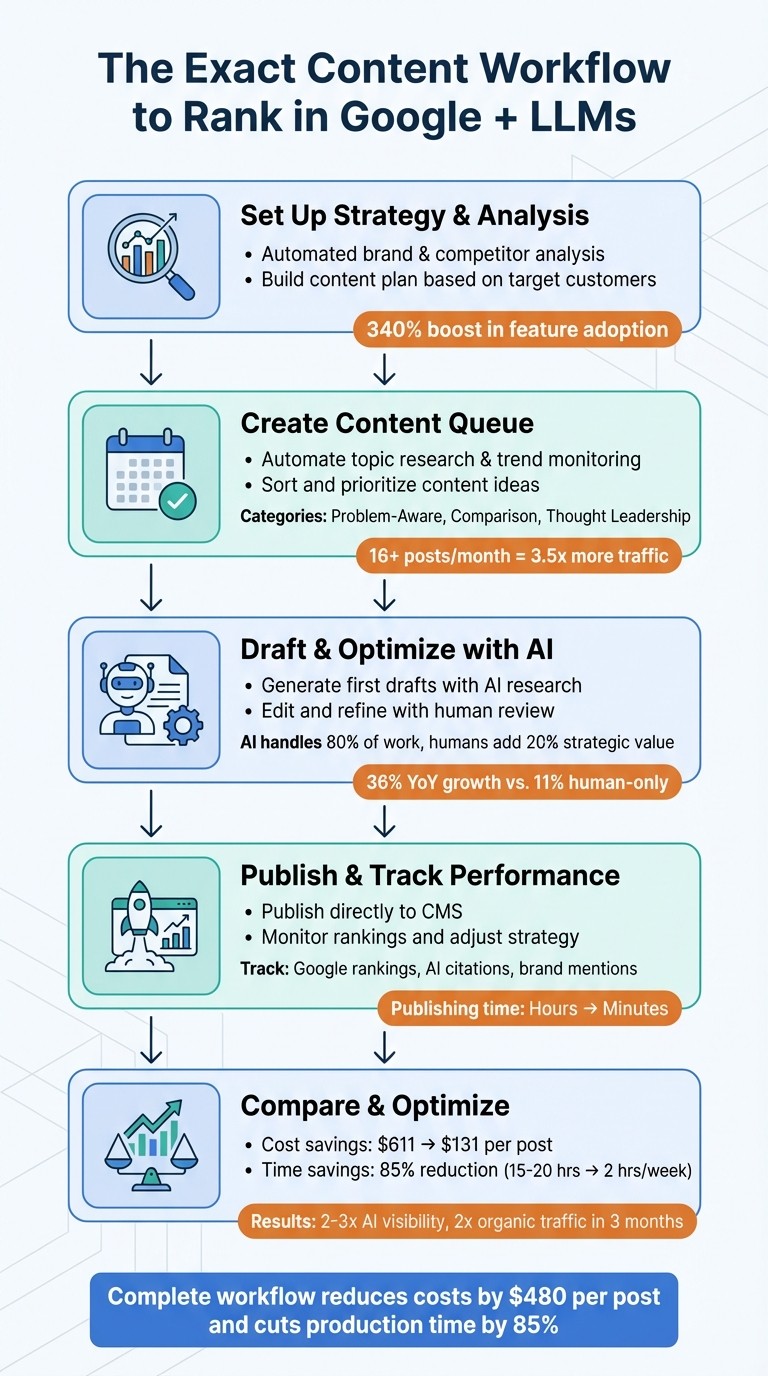
5-Step Content Workflow for Google and AI Rankings
AI SEO in 2025: The Complete Automation Playbook (That Nobody’s Talking About)
Step 1: Set Up Your Content Strategy and Run Initial Analysis
Start with a solid foundation: use real data to shape your content strategy. By analyzing your brand's positioning, competitor performance, and customer search behavior, you can create a data-driven plan that delivers results. Tools like Averi streamline this process, providing insights in minutes instead of weeks, making it easier to establish an effective AI-powered content workflow.
Automated Brand and Competitor Analysis
Begin by entering your website into Averi. The tool scans your site to gather key business details and evaluates competitors to identify content gaps. It also generates Ideal Customer Profiles (ICPs), which reveal customer pain points and search habits. This process goes beyond traditional keyword research by identifying where competitors show up in AI responses and highlighting areas where your brand is missing.
For instance, in August 2025, a B2B SaaS company leveraged Averi to create a strategic brief just six hours after a product launch. This enabled them to produce 94 pieces of content across six platforms, leading to a 340% boost in feature adoption within the first week and cutting their launch timeline by 67% compared to manual methods.
Armed with this analysis, you can fine-tune your content strategy to address your audience's specific needs effectively.
Build a Content Plan Based on Your Target Customers
Once you've mapped out your competitive landscape, focus on creating content that aligns with customer searches. Use ICP data to develop question-based topics that match user intent. Organize your strategy around a pillar page supported by related posts, connected through internal links. This structure signals to both search engines and AI systems that your content provides comprehensive expertise, rather than isolated insights.
Prioritize three key elements:
Authoritative content: Follow E-E-A-T (Experience, Expertise, Authoritativeness, Trustworthiness) standards to demonstrate credibility.
Structured data: Implement formats like FAQ, HowTo, and Article schema to enhance visibility.
AI tracking: Continuously monitor where and how AI tools cite your content[10].
To increase the likelihood of AI citation, structure your content with clear Q&A formats in the opening 40–60 words. Research shows this approach makes content about 40% more likely to be cited by AI systems. Additionally, aim to create 20+ interconnected articles within a specific micro-niche to establish true authority.
Step 2: Create and Manage Your Content Queue
Having a content queue simplifies your weekly workflow. Instead of scrambling for ideas every week, a well-organized system ensures you're consistently working on topics that align with both search intent and your business goals. This method helps you avoid chasing random trends or keywords, keeping your strategy focused and purposeful. A content queue also ensures a steady flow of ideas that support both SEO and AI citation goals.
Automate Topic Research and Trend Monitoring
Using tools powered by large language models (LLMs) can make topic research and trend tracking much easier. Take Averi, for example - it monitors industry trends, identifies gaps in competitor content, and highlights high-opportunity keywords that resonate with your audience. It even categorizes ideas into formats like how-to guides, comparisons, listicles, and thought leadership pieces, complete with suggested titles, target keywords, and summaries.
This level of automation saves a ton of time. While manual research and keyword analysis can take 3–5 hours weekly, automated systems work nonstop. The focus should be on semantic keyword clusters instead of isolated terms. For instance, targeting clusters like "generative engine optimization" better reflects how users naturally phrase their searches[7].
To refine your strategy further, conduct monthly audits of AI-generated responses. Use prompts like "Why didn’t you recommend us?" in tools like ChatGPT, and analyze "People Also Ask" sections on Google or platforms like AnswerThePublic. This helps reveal areas where competitors appear in AI results while your brand does not[1].
Sort and Prioritize Content Ideas
Once your content queue starts filling up, the next step is to sort and prioritize ideas based on their potential impact and format. Break your queue into three main categories:
Problem-Aware Content: How-to guides that address customer pain points.
Comparison Content: Pages that compare alternatives or provide "versus" analyses.
Thought Leadership: Original research or insights into industry trends.
This structure ensures you're covering every stage of the buyer's journey in a systematic way.
When prioritizing, focus on topics with high potential for AI citations and those that build topical authority. For example, FAQ pages and how-to guides should take precedence because they align well with the answer formats AI chatbots favor[1]. Content featuring unique data, expert opinions, or case studies should also rank high, as these elements establish credibility and increase the likelihood of being cited by AI tools[6]. Companies that publish 16 or more blog posts each month see 3.5× more inbound traffic than those with sporadic schedules, emphasizing the need for a consistent content pipeline[4][2].
Dedicate 15 minutes each week to reviewing your queue. Approve ideas that align with your goals, discard those that don’t fit, and refine suggestions to match your brand's tone and voice[2]. This approach blends AI’s efficiency in generating ideas with human oversight to ensure your content remains on-brand and strategically targeted.
Step 3: Draft and Optimize Content with AI
Once your content queue is set, it's time to create drafts that align with your brand's identity and SEO goals. AI takes care of the groundwork - handling research, structuring, and initial writing - while human editors step in to add the strategic elements that make the content stand out. Research shows that AI-assisted content creation drives 36% year-over-year growth, compared to just 11% for content created solely by humans [9].
Generate First Drafts with AI Research
AI tools can craft initial drafts by integrating your brand guidelines, audience insights, and competitive positioning into the process. Platforms like Averi AI offer onboarding tools, custom prompts, and libraries of examples to ensure the draft mirrors your brand's tone and style. These tools also incorporate verified sources, SEO keywords, internal linking strategies, and optimized structures - such as FAQs and content clusters - that improve both Google rankings and citations by language models.
Content designed with clear questions and direct answers has a 40% higher chance of being cited and rephrased by AI tools like ChatGPT [3]. To improve extractability, stick to short paragraphs (3–5 sentences), use subheadings every 300 words, and organize data into tables for clarity. Embedding FAQ, HowTo, and Article schema markup further signals content structure to AI systems.
Additionally, include your primary keyword and brand name within the first 100 words to establish relevance for AI crawlers. Fact-based claims and internal links to core pages help build topical authority, which is valued by both search engines and large language models.
Once the AI draft is complete, the next step is refining it with human expertise to ensure accuracy and depth.
Edit and Refine with Human Review
The human review process is where the draft gets its polish. Start by verifying the AI-generated content - check statistics, quotes, and claims against their original sources. Then, add original research, case studies, or expert commentary to distinguish the content from generic AI outputs. This step ensures the content reflects your brand's unique perspective and expertise.
"Human editors enhance AI content with insights, personality, and strategic nuance." - Zach Chmael, Head of Marketing, Averi [4][2]
This human touch is essential. While AI efficiently handles about 80% of the work - like research, drafting, and SEO structuring - humans provide the remaining 20% of high-value contributions, such as refining voice, incorporating expertise, and adding strategic depth [2]. By focusing on these elements, editors ensure the final piece stands out in both traditional search results and AI-generated answers. Instead of simply reworking AI-generated text, aim to infuse it with personal insights, brand-specific language, and precise technical details to create content that resonates with both audiences and algorithms.
Step 4: Publish Content and Track Performance
This step ties everything together, using live content insights to guide future creation and refinement.
Publish Directly to Your CMS
Manually uploading content can lead to formatting issues and broken links. Tools like Averi AI simplify this process by connecting directly to your CMS through APIs. Content can be exported in HTML or Markdown, with structured data like FAQ, HowTo, and Article schema automatically embedded via plugins like Rank Math or Yoast. This approach cuts publishing time from hours to minutes while ensuring everything is optimized for both Google and AI-generated responses [10][5][7].
Averi AI handles the formatting and optimization, seamlessly delivering your content into your CMS. Once it's live, you can immediately shift focus to performance analysis and planning your next steps.
Monitor Rankings and Adjust Your Strategy
Tracking performance metrics is essential to refining your content strategy. Tools like Google Search Console, Ahrefs, and AI-specific monitors help you measure key indicators such as:
Google Search Console Rankings: Track where your content appears in traditional search results.
AI Answer Inclusion Rate: Measure how often your content is cited in AI-generated answers for relevant queries.
Brand Citation Frequency: Monitor how frequently your brand is mentioned in AI-driven platforms like ChatGPT and Perplexity[3].
Averi AI consolidates real-time data to identify underperforming content clusters and suggests targeted improvements, such as adding bullet points or refining entity sections [10][8]. Weekly performance reviews via dashboards - combining Search Console data with AI insights - help you stay proactive. Set up alerts for significant drops, like impressions falling by over 20% or rankings slipping out of the top 10 [5][11].
Post-publish analysis also highlights opportunities for improvement. For instance, incorporating FAQ schema or expanding topic clusters can yield major gains, such as boosting revenue by 30% and getting 1,479 keywords onto page one [5]. These findings directly fuel your ongoing strategy, ensuring each new piece of content builds on your success in both SEO and AI-driven ecosystems.
Step 5: Compare Workflow Options and Benefits
Comparison Table: Averi vs. Other Content Tools
Many startups rely on a mix of standalone tools like Jasper for writing, Surfer SEO for optimization, and Semrush for research, combined with manual CMS publishing. While this approach may seem practical, it results in a 65% time loss due to constant platform switching [13]. Averi, on the other hand, streamlines the entire process - covering everything from strategy to publishing and analytics - into a single, unified system.
Unlike point tools, which focus on specific tasks like writing or SEO, Averi functions as a complete AI Marketing Workspace. It starts by analyzing your website to understand your positioning and voice, then applies this context consistently across all content you create [4][2].
Feature | Averi | Jasper | Surfer SEO | Semrush | |
|---|---|---|---|---|---|
Primary Focus | Full workflow (strategy → publish) | Content execution | AI writing assistant | SEO optimization | Keyword research |
Strategic Planning | Automated brand analysis & content plan | Limited content planning | None | None | Manual strategy required |
Brand Memory | Permanent "Brand Core" context | Template-based | Starts fresh each time | None | None |
CMS Publishing | Manual copy-paste | Manual copy-paste | Manual copy-paste | Manual copy-paste | |
Performance Tracking | Integrated analytics + recommendations | Content insights only | Basic usage metrics | Rankings only | Comprehensive SEO data |
Human Expert Network | 2,500+ vetted U.S. specialists | None | None | None | None |
Monthly Cost | $100 | Premium tier (higher) | Budget-friendly | ~$89 | ~$129.95 |
This table underscores how Averi's integrated approach eliminates inefficiencies common to fragmented workflows. The following case study illustrates these benefits in real-world use.
In August 2025, a mid-stage B2B SaaS company used Averi's system to launch a new product feature. Within 48 hours of development completion, they published 94 pieces of coordinated content across six platforms. The result? A 340% increase in feature adoption within the first week and a 67% reduction in the launch timeline compared to their previous manual processes [4]. This demonstrates the power of unifying strategy, execution, and publishing into one seamless system.
Why Startups Need an All-in-One Workflow
The financial benefits of integration are compelling. AI-assisted content production reduces the cost of a blog post by $480, dropping from $611 to $131 [2]. However, the real savings go beyond dollars - they include time, a resource most founders lack. Nearly half of small business owners handle their own marketing, yet 56% have only an hour or less each day to dedicate to it [2].
Traditional content creation requires 15–20 hours per week for tasks like research, writing, SEO, publishing, and analytics. Averi reduces this to just 2 hours of review time per week [2]. This 85% time savings allows founders to transition from being hands-on creators to strategic decision-makers, focusing on initiatives that improve Google rankings and AI-driven visibility.
Another standout feature of Averi is its context persistence. Each piece of content saved to Averi's Library enhances its understanding of your brand voice and positioning, resulting in progressively better drafts over time [2]. In contrast, point tools require you to re-enter context and adjust tone for every new piece, making them far less efficient. This continuity is why Averi's content achieves 40% higher conversion rates compared to its competitors [13].
For example, a D2C skincare brand used Averi's multi-channel workflow for a seasonal campaign in August 2025. The system produced 127 assets, including emails and social media copy. The campaign saw a 284% increase in email click-through rates, a 43% reduction in cost-per-acquisition, and launched 89% faster than their traditional manual methods [4]. By maintaining consistent voice and strategy across all assets, the brand achieved results that highlight the advantages of an integrated workflow.
Conclusion: Scale Your Content Marketing with Averi and LLMs
Key Steps to Achieve Better Content Results
Our process delivers measurable growth by combining automated tools with human insight. Begin by leveraging AI for brand and competitor analysis to craft an AI-powered content strategy that prioritizes your audience's needs. Automate your topic pipeline, focusing on ideas informed by current trends. Use AI to draft structured content - complete with FAQ sections, schema markup, and clear headings - then refine these drafts with human editing to ensure expertise and personality shine through. Publish directly to your CMS and monitor results to fine-tune your approach over time.
This workflow is effective because it aligns with both traditional SEO practices and AI-driven citations. Early adopters have seen 2-3x improvements in AI visibility and double their organic traffic within just three months [10][5]. SaaS teams using similar methods have scaled their output from four to 25 posts per month, achieving top Google rankings for 15 of their 20 target keywords. They’ve also gained frequent mentions in ChatGPT responses, leading to a 150% increase in leads [3][12]. Consistency is critical: businesses publishing 16 or more posts each month generate 3.5x more traffic than those publishing fewer than four [2].
This approach not only reduces content production costs but also saves valuable time, allowing teams to focus on higher-level strategies. By shifting from labor-intensive content creation to strategic leadership, SaaS teams can drive sustained growth while scaling their content marketing efforts.
How to Get Started with This Workflow
Take advantage of Averi's free trial to jumpstart your content strategy. Simply input your brand details, competitors, and goals, and the platform will deliver a 30-day content plan in minutes. Review the list of topics, approve drafts, and refine them before publishing directly through your CMS. Integrated analytics will track performance and suggest real-time adjustments [3].
Each piece of content you publish enhances Averi's understanding of your brand, improving the quality of future drafts. As Zach Chmael, Head of Marketing at Averi, puts it:
"The algorithm never sleeps, but you don't have to feed it." [2]
This system allows you to shift from hands-on content creation to strategic management, building a content engine that not only ranks on Google but is also referenced by AI systems. Start now to take full advantage of both AI efficiency and human creativity, scaling your content marketing without sacrificing quality.
FAQs
How can I make my content more likely to be cited by AI tools?
To make your content stand out to AI tools, prioritize creating well-organized, authoritative material. Start each section with clear definitions or concise answers to grab attention immediately. Build credibility by referencing reputable sources and demonstrating your expertise through detailed, accurate information. Focus on addressing common questions within your niche, ensuring the content stays relevant and thorough. Use precise, high-quality language throughout to align with the citation preferences of AI systems.
What should I track to measure Google rankings and AI visibility?
Tracking how your brand appears in AI-generated responses is crucial. Pay attention to brand mentions, share of voice, and the frequency with which your content is cited in AI-driven search results. By monitoring these metrics, you can gauge your visibility and influence across both traditional search engines and AI-powered platforms. This insight helps you better understand your reach and the overall impact of your content.
How many posts should I publish each month to see results?
Publishing content consistently is key to building credibility and improving search rankings. Aim to post 2–4 times per week, but ensure you’re putting out at least one post weekly as a baseline. Regular updates signal authority and reliability, which search engines value over time.
Related Blog Posts

Zach Chmael
CMO, Averi
"We built Averi around the exact workflow we've used to scale our web traffic over 6000% in the last 6 months."
Your content should be working harder.
Averi's content engine builds Google entity authority, drives AI citations, and scales your visibility so you can get more customers.