

In This Article
Pre-seed startups must adopt GEO—answer-first, localized content and automation—to get cited by AI and validate markets fast.
Updated:
Trusted by 1,000+ teams
Startups use Averi to build
content engines that rank.
AI is changing how buyers make decisions, and startups need to adapt fast. With 89% of B2B buyers using AI tools like ChatGPT and Perplexity during their purchasing journey, traditional SEO strategies are losing relevance. Instead, startups must focus on Generative Engine Optimization (GEO) - a method that ensures your content is cited in AI-generated answers. This shift is critical as 93% of AI-driven searches end without a click, meaning your brand's visibility depends on being part of the AI's response.
Key Takeaways:
Why GEO Matters: AI-driven search tools prioritize expertise, clarity, and structured data over traditional SEO metrics like backlinks or domain authority.
Benefits for Startups: GEO content converts 4.4x better than traditional organic traffic, offering a cost-effective way for pre-seed startups to compete with larger players.
Localized Focus: GEO narrows efforts to 2–3 high-potential markets, reducing risk and accelerating market validation.
Actionable Steps:
Identify target markets using AI tools like ChatGPT and Perplexity.
Create "answer-first" GEO content tailored for AI citations.
Automate content creation, publishing, and performance tracking with tools like Averi.
Quick Overview:
Audience Behavior Shift: 50% of B2B buyers now start their research with AI chatbots.
Market Opportunity: AI-cited content levels the playing field, allowing startups to compete directly with industry giants.
Execution Tools: Platforms like Averi streamline GEO strategies, saving time and resources for startups with lean budgets.
GEO isn't just a new tactic - it's a necessity for startups aiming to thrive in the AI-driven era. Start small by focusing on one high-intent topic and testing your visibility in AI tools. From there, refine and scale your strategy.
How GEO Actually Works w/ Bernard Huang
Why Pre-Seed Startups Need GEO Strategy
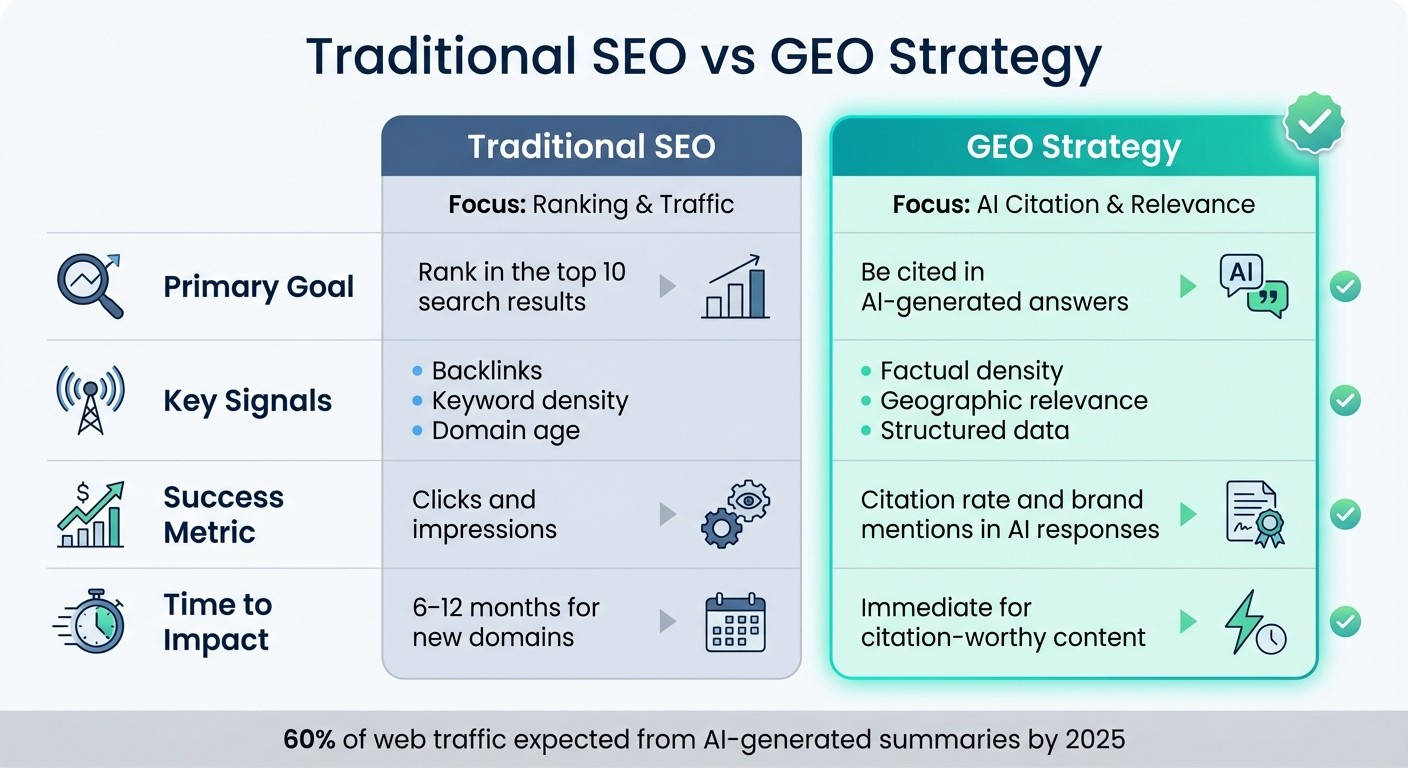
Traditional SEO vs GEO Strategy Comparison for Startups
Pre-seed startups face tough odds: 92% run out of funding within 12–18 months, and 78% fail due to poor product–market fit, often caused by targeting overly broad or mismatched geographic markets. With marketing budgets typically under $50,000 per year and lean teams of 1–5 people, there’s little room for wasted effort. A GEO strategy narrows your focus to 2–3 high-potential markets, reducing risk by 50% and accelerating market validation by three times.
The rise of AI-driven search makes GEO even more essential. Traditional SEO demands months of consistent publishing to overcome barriers like Google's "Sandbox" effect - a timeline most pre-seed startups can’t afford. GEO, on the other hand, leverages factual specificity and structured clarity, allowing even new players to compete immediately by creating content that AI systems are more likely to cite.
How GEO Differs from Traditional SEO
GEO strategy takes a different approach from traditional SEO. While traditional SEO focuses on ranking in the top 10 search results for a keyword, GEO is designed for the AI-driven future, where 60% of web traffic is expected to come from AI-generated summaries by 2025. GEO strategies improve visibility by 50% through tools like schema markup and regional signals.
Feature | Traditional SEO | GEO Strategy |
|---|---|---|
Primary Goal | Rank in the top 10 search results | Be cited in AI-generated answers |
Key Signals | Backlinks, keyword density, domain age | Factual density, geographic relevance, structured data |
Success Metric | Clicks and impressions | Citation rate and brand mentions in AI responses |
Time to Impact | 6–12 months for new domains | Immediate for citation-worthy content |
For pre-seed startups, GEO also emphasizes geographic targeting. This means crafting content tailored to specific regions, using localized examples like U.S. currency ($), date formats (MM/DD/YYYY), and addressing region-specific challenges. For instance, a fintech startup might create content focused on California’s regulatory environment versus Texas’s business climate, rather than relying on a generic national approach.
These unique aspects of GEO not only reshape search strategies but also provide clear, actionable advantages for early-stage startups.
What GEO Delivers for Early-Stage Startups
GEO's localized approach brings measurable benefits. Localized content achieves 2.5x higher engagement rates, and 70% of consumers prefer brands that demonstrate local relevance. This gives emerging startups an edge in niche markets, even when competing against larger, more established players. AI systems prioritize expertise over sheer domain authority, meaning your startup can appear alongside - or even ahead of - industry giants in platforms like ChatGPT, Perplexity, and Google AI Overviews.
With 93% of AI-driven searches ending without a click, your brand’s primary impression often happens within the AI-generated response itself. This makes citations more impactful than traditional click-throughs. For startups working to refine product–market fit, every piece of localized content doubles as a test, helping identify which geographic markets respond best to your messaging. This insight is invaluable for validating demand before scaling further.
Step 1: Find and Prioritize Your Target Markets
The first move in creating a GEO strategy is deciding which geographic markets are worth your limited resources. For pre-seed startups working with tight budgets, trying to tackle too many regions at once can stretch resources too thin. Instead, concentrate on 2–3 markets where your solution directly addresses a pressing problem.
Start by evaluating your brand's presence in AI-driven search tools. Test the top 20 questions your potential buyers might ask using ChatGPT, Perplexity, and Google AI Overviews. Note which competitors are being mentioned and where your brand is missing. This process highlights content gaps that may represent opportunities. Organize these queries in a spreadsheet, noting the platforms where competitors show up and the markets they serve. This roadmap becomes the foundation for deeper market research using free digital tools.
Brand search volume is a strong indicator of AI citations, with a 0.334 correlation[3]. This means that markets where your brand already has some visibility are more likely to show up in AI searches. For example, if your brand is generating interest in California but not in Texas, it makes sense to focus on California first. Platforms like Reddit, which accounts for 46.7% of top citations on Perplexity[3], can help you uncover specific regional pain points. These insights not only help you decide where to focus but also guide how to tailor your content in future steps.
Free and Low-Cost Tools for Market Research
You don’t need pricey enterprise tools to validate your target markets. Free platforms like ChatGPT, Perplexity, and Google AI Overviews can help you audit regional buyer questions and see which brands dominate citations. For more detailed insights, Reddit and YouTube are great for identifying authentic pain points in specific areas.
For further analysis, monitor sources like Wikipedia, G2, and Forbes, as they’re frequently cited by AI systems. Ensuring consistency in your brand information - such as founding date and core products - across platforms like your website, LinkedIn, and G2 builds "entity authority", which AI systems recognize. A standardized Brand Fact Sheet can help you maintain this consistency across all channels.
Tools like Averi can streamline this research by tracking industry trends, monitoring competitor content, and identifying high-impact topics aligned with your Ideal Customer Profiles (ICPs). This saves time compared to manual audits, while community-driven research can also help refine your market map.
Build ICPs and Rank Your Markets
Once you’ve gathered the data, use it to create detailed ICPs and rank your markets. A tiered prioritization framework can help.
Tier 1 markets: These have the strongest alignment between your solution and urgent customer needs.
Tier 2 markets: These show potential but may face higher competition or slightly less alignment.
Tier 3 markets: These should be set aside for now due to unclear fit or significant barriers to entry.
"At the pre-seed stage, I would strategically prioritize the need of the market over its total size, and vertical versus horizontal strategy."
– Olga Maslikhova, Early Stage VC [4]
Consider the example of Victor Lysenko, CEO and co-founder of Osome, who launched an ML-powered administrative and accounting platform for Singapore in 2018–2019. By focusing on solving a specific pain point for local SMBs, the company reached $1 million in Annual Recurring Revenue (ARR) within its first year before expanding elsewhere[4]. This highlights the advantage of addressing a niche vertical need over casting a wide net.
Your ICP should go beyond demographics to include behaviors and pain points tied to specific regions. For instance, a fintech startup might focus on California due to its regulatory environment and high concentration of early adopters, postponing other regions until achieving product-market fit. Use "answer-first" content to tackle these regional pain points - present solutions upfront to increase the chances of being cited by AI search engines. Additionally, create a Definition Library of industry-specific terms, as AI systems often rely on structured glossaries and clear explanations.
Step 2: Create GEO-Optimized Content
After identifying your target markets, the next move is crafting content that performs well in both traditional search engines and AI-driven platforms. GEO content serves as your tool to capture attention in AI-driven contexts. Unlike traditional SEO, which emphasizes keyword usage and backlinks, GEO principles focus on topic authority, structured data, and content tailored for AI citations.
Writing Content with GEO Principles in Mind
GEO-optimized content thrives on an answer-first strategy. Start each major section with a concise, 40–60 word response to the primary question. This format aligns perfectly with AI systems, making it easier for them to extract and synthesize your content. For example, in fintech, you might begin with: "Fintech platforms for small businesses integrate invoicing, payment processing, and cash flow management, reducing administrative tasks by 30–40% while syncing with tools like QuickBooks or Xero."
Using a clear hierarchy - H2 headings, H3 subheadings, and bullet points - can boost your chances of being cited by AI systems by 28–40% [3]. Adding FAQ sections with JSON-LD schema markup on key pages also helps AI crawlers interpret and cite your content effectively [3].
Consistency in presenting brand information across platforms is another critical factor. When your company’s details - such as founding dates, product descriptions, and core claims - are uniform across your website, LinkedIn, and industry directories, it strengthens AI systems' confidence in citing your content [3]. A well-prepared Brand Fact Sheet ensures all your information is accurate and aligned.
To further enhance visibility, focus on factual density. Use precise figures, percentages, and examples to make your content more authoritative. Instead of vague claims like "our platform helps startups save time", aim for specifics: "Our platform reduces onboarding time by 45%, from an average of 8 hours to 4.4 hours, based on feedback from 200 early-stage customers." Tailor these examples to your target regions to make them more relatable.
Automating GEO Content Creation with AI Tools
With these principles in place, you can streamline the content creation process using AI tools. For startups with limited resources, AI can be a game-changer, automating tasks like research, drafting, and optimization. Tools like Averi simplify the process by generating answer-first paragraphs, integrating statistical data, and building FAQ sections with schema markup [3].
Averi AI’s CMO, Zach Chmael, shared how their AI-driven workflow helped scale web traffic by an astounding 6,000%, achieving 2.91 million monthly impressions. Their approach focused on creating content blocks primed for AI citations, positioning the brand as a trusted source in AI-generated responses [5][6].
"We built Averi around the exact workflow we've used to scale our web traffic over 6000% in the last 6 months." – Zach Chmael, CMO, Averi [5]
When choosing an AI tool, prioritize features like automated content creation tailored to your target keywords and regions, TL;DR summaries optimized for AI citations, internal linking suggestions, and metadata enhancements (e.g., title tags, meta descriptions, and schema markup).
For an extra edge, create an llms.txt file - a machine-readable index of your top-performing content for AI crawlers [3]. Developing an "Answer Kit" with interconnected content clusters, such as a 2,500+ word pillar page, a comprehensive FAQ section, and quick-reference materials, helps establish authority in your markets and boosts AI citation potential. This preparation sets the stage for the next step: executing and monitoring your GEO strategy.
Step 3: Automate Execution and Track Results
After producing your GEO content, it's essential to maintain a consistent publishing schedule and focus on metrics that boost AI-driven visibility. For pre-seed startups, automation becomes a lifeline, helping to stretch limited resources while quickly testing GEO strategies. Spending countless hours juggling tools or analyzing superficial metrics isn't feasible. The answer lies in setting up automated systems that handle publishing and track the metrics that matter.
Streamline Content Queues and Workflow Automation
Creating a content engine that runs smoothly requires automating every step - from brainstorming to publishing. Platforms like Averi simplify this process by continuously researching your market. They monitor industry trends, analyze competitor strategies, and identify high-potential topics that align with your Ideal Customer Profiles (ICPs). Content ideas are then categorized into formats like listicles, how-to guides, editorials, and comparisons. All you need to do is approve the ideas, and the system takes care of research, drafting, optimization, and publishing directly to your CMS, whether that’s Webflow, Framer, or WordPress.
This approach keeps the entire content workflow within a single system, eliminating inefficiencies. Once content is live, Averi automatically initiates checklists for promoting it on platforms like LinkedIn and Twitter/X, as well as engaging with relevant communities on Reddit [8]. By automating publishing, you free up time to focus on the next critical step: measuring performance and refining your strategy.
Monitor Performance and Optimize Your Strategy
With content flowing seamlessly, the next priority is tracking the right metrics to ensure ongoing improvement. Traditional SEO metrics alone won’t cut it. Given that 93% of AI Mode searches end without a click, monitoring brand mentions and citations is now essential [2][3]. Use Google Analytics 4 to create custom segments that track referral traffic from sources like "chatgpt.com", "perplexity.ai", and "claude.ai" [3]. Visitors coming from these AI-driven platforms convert 4.4 times better than those from traditional organic search, as they are pre-qualified by AI recommendations [2][3].
In addition to automated analytics, make it a habit to run weekly queries on tools like ChatGPT, Perplexity, and Google AI Overviews. Focus on your top 5–10 strategic questions to see which competitors are being cited and identify where your brand is absent. This "Share of Voice" analysis highlights content gaps that need attention [3][2]. Also, assess the sentiment of AI-generated mentions of your brand and check the freshness of data in your content - AI systems prioritize up-to-date information [1].
A great example comes from ASUS, which in 2025 adopted the Improvado analytics platform to centralize its global marketing data into a managed BigQuery instance. This move saved the company 90 hours per week [7]. For pre-seed startups, the lesson is clear: centralize your data early to avoid operational headaches as your business scales. By starting small but thinking ahead, you set the stage for sustainable growth.
Tools Comparison: Averi vs Alternatives
Once you've mapped out your GEO strategy, picking the right tool becomes a crucial step to keep operations smooth and efficient. For pre-seed startups, the choice often boils down to an AI-powered workspace like Averi or AI writing tools such as Jasper and Copy.ai. Each option brings its own strengths to the table: Averi offers an integrated approach, while Jasper and Copy.ai focus on supporting content drafting. Here's a closer look at their features, pricing, and best-fit scenarios.
Features, Pricing, and Use Cases Compared
AI writing tools, such as Jasper ($39/month per user) and Copy.ai ($49/month for Pro plans), shine when it comes to creating brand-aligned content. These tools are great for teams that already have a clear content strategy in place. However, they come with limitations. You’ll still need separate solutions for SEO, publishing, and analytics, which can lead to what some call a "tool tax" - added costs in both subscription fees and the time spent managing multiple platforms [9].
Averi, on the other hand, is priced at $100/month and serves as a complete content solution. It handles everything from strategy and GEO optimization to CMS publishing (compatible with platforms like Webflow, Framer, or WordPress) and performance tracking. Instead of just speeding up content creation, Averi can essentially replace the need for a full-time content marketing manager - a role that typically costs between $83,488 and $137,417 annually [9]. Zach Chmael, CMO at Averi, sums it up well:
"At the $5K/month tier, every dollar must compound - that means an AI content engine plus SEO tools, zero on agency retainers" [9].
The real game-changer lies in the total cost of ownership. Using a fragmented stack of tools often results in constant context switching and manual coordination, eating up 5–8 hours per week. Averi’s unified workflow eliminates this inefficiency [9]. For startups working with tight budgets, this streamlined approach can be a lifesaver - especially when you consider that SEO offers a 748% ROI with a breakeven point of 7–9 months [9].
If your goal is to have a fully automated content engine, Averi is the clear choice. However, if your team already includes a content strategist, tools like Jasper or Copy.ai can be a good fit. For growth-stage companies with specialized needs, combining these solutions might be the way to go.
Conclusion: Using GEO to Drive Growth
For pre-seed startups working with tight budgets and limited resources, GEO offers a practical way to achieve visibility in today’s AI-driven landscape. With 89% of B2B buyers now relying on AI tools during their purchasing journey [2], GEO focuses on elements startups can control: factual depth, precise answers, and well-structured content [1]. This approach levels the playing field, unlike traditional SEO, which often favors established brands with high domain authority.
To get started, follow this three-step framework: pinpoint and prioritize your target markets, develop GEO-optimized content using answer-first formatting and statistical citations, and automate the process while monitoring AI citation rates. As Zach Chmael, Head of Marketing at Averi, puts it:
"GEO asks: 'How do I become the authoritative source AI confidently cites when synthesizing answers?'" [2]
Content enriched with original statistics achieves 30–40% higher visibility in large language model (LLM) responses [2]. With traditional search engine traffic expected to decline by 25% by 2026 [10], startups that embrace GEO early are positioning themselves for long-term gains.
This streamlined strategy reflects the efficiency of tools like Averi, which consolidate tasks such as research, drafting, optimization, and analytics into one platform - saving users 5–8 hours per week for just $100/month [9]. For pre-seed startups, every dollar must work harder, and an AI content engine that operates in the background while you focus on building your product becomes more than a tool - it’s a critical part of your infrastructure.
Begin with a single high-intent topic. Use answer-first formatting, pack your content with factual depth, and test its visibility in AI tools like Perplexity and ChatGPT. Then, refine and repeat. GEO doesn’t demand a large content team - just the right strategy executed consistently.
FAQs
How do I measure GEO success if AI searches don’t drive clicks?
To gauge the effectiveness of your GEO strategy in an era where AI searches often bypass direct clicks, shift your focus to metrics that track content citation and visibility within AI-generated responses. Pay attention to how frequently systems like ChatGPT or Google AI reference your content. These citations are a clear indicator of your content's relevance and authority. Success in this space is marked by a rise in AI citations and stronger alignment with the factors AI systems prioritize for citing content. This approach ensures your brand remains visible and influential in AI-driven search landscapes.
What’s the fastest way to pick my first 2–3 U.S. markets?
To efficiently select your first 2–3 U.S. markets, start by using geographic data to pinpoint regions with strong potential. Areas such as the Bay Area and New York stand out, particularly for their dominance in seed valuations.
AI tools like Averi AI's GEO Playbook can simplify this process. These tools automate research by analyzing factors like market size, investor activity, and competition. With data-driven insights, you can quickly prioritize regions and streamline your decision-making.
What should I add to a page so AI tools cite it?
To increase the likelihood of AI tools referencing your content, prioritize structured, citation-ready information that aligns with how these systems evaluate sources. Incorporate clear, authoritative elements such as structured data, consistent and reliable references, and explicit mentions of your brand or key entities. Utilizing tools like schema markup, integrating relevant keywords, and focusing on well-defined topics can make your content more visible and trustworthy for AI-driven citations. Always aim for clarity, relevance, and a format that emphasizes authority.
Related Blog Posts

Zach Chmael
CMO, Averi
"We built Averi around the exact workflow we've used to scale our web traffic over 6000% in the last 6 months."
Your content should be working harder.
Averi's content engine builds Google entity authority, drives AI citations, and scales your visibility so you can get more customers.