
In This Article
Learn how AI-powered marketing templates automate workflows, maintain brand consistency, personalize at scale, and speed campaign launches while improving ROI.
Updated:
Trusted by 1,000+ teams
Startups use Averi to build
content engines that rank.
AI-powered marketing templates are changing how businesses create and manage campaigns. Unlike static templates, these systems automate tasks, maintain brand consistency, and adapt content based on performance data. By integrating tools like Averi AI or Copy.ai, teams can save time, reduce costs, and focus on strategy rather than repetitive work. Key benefits include:
Automated workflows: AI generates plans, timelines, and tasks from campaign briefs.
Personalized content: Tailors messaging for specific audiences and channels.
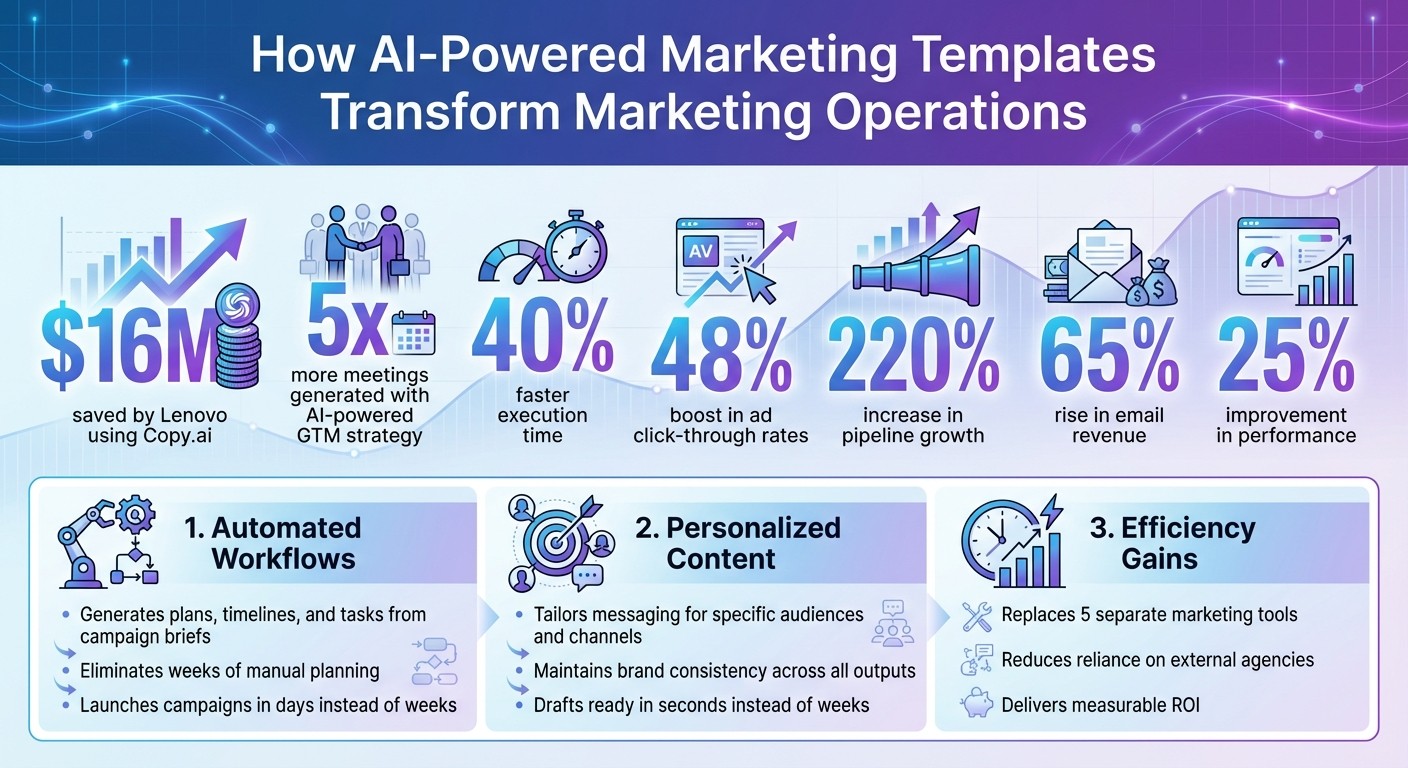
Efficiency gains: Faster campaign launches, less reliance on agencies, and measurable ROI (e.g., $16M saved by Lenovo using Copy.ai).
AI-driven tools not only simplify processes but also improve the effectiveness of marketing efforts by learning from past campaigns and providing actionable insights.
AI-Powered Marketing Templates: Key Benefits and ROI Statistics
I Built an AI Content Agent With N8N and Claude (Step-by-Step)
Main Benefits of AI-Enhanced Marketing Templates
AI-powered templates bring a new level of efficiency to marketing by automating workflows, offering reusable designs, and enabling personalization at scale. These features simplify campaign management and ensure templates are not only effective but also adaptable to a variety of needs.
Automated Workflow Creation
AI platforms can take a campaign brief and turn it into a detailed plan, complete with task lists, timelines, and dependencies, eliminating the need for manual planning. For instance, Averi AI can analyze the performance of a Q3 campaign, identify strong paid social click-through rates but lagging content retention, and then develop a channel-specific improvement plan ready for immediate review [1]. This automation integrates seamlessly with campaign execution, significantly reducing the time it takes to move from strategy to launch. Roman Olney, Head of Global Digital Experience at Lenovo, shared how Copy.ai revolutionized their approach:
"Copy.ai has been phenomenal in transforming the way we develop marketing content. By automating workflows that would typically take weeks and cost thousands of dollars through agencies, they've saved us $16 million dollars this year alone." - Roman Olney, Head of Global Digital Experience @ Lenovo [2]
Flexible and Reusable Template Design
AI-driven templates are designed with modular components, allowing them to adapt instantly to different campaign requirements. Payton from Broadside highlighted the advantage of using Averi AI over generic tools:
"I've been testing it against ChatGPT…I love how it's customized to the information that I have in there in terms of my brand and tone" [1]
This versatility means a single template can be used across various formats, such as SEO content, thought leadership pieces, account-based marketing (ABM) campaigns, and social media, all while maintaining brand consistency.
Personalization at Scale
AI templates take flexibility a step further by leveraging integrated data - such as brand guidelines, analytics, and account insights - to create content tailored for specific audiences and channels. This eliminates the need for manual rewrites while ensuring the output feels personalized rather than generic. Jean English, formerly the Chief Marketing Officer at Juniper Networks, used Copy.ai to craft a personalized go-to-market strategy that resulted in five times more meetings in 2024 [2]. Similarly, Indy from Lucid AI replaced five separate marketing tools with Averi and saw execution times improve by 40%, alongside a 25% boost in performance [1].
The real power lies in the automation: drafts are ready in seconds instead of weeks, and the tailored approach ensures the content resonates deeply with its target audience. This combination of speed and personalization transforms how marketing teams operate, delivering impactful campaigns with minimal effort.
How AI Makes Templates Adapt to Change
Marketing campaigns rarely unfold exactly as planned. Goals shift, audience behavior evolves, and unforeseen challenges arise. AI-powered templates tackle these changes head-on by analyzing real-time performance data and adjusting workflows, content, and strategies on the fly - eliminating the need to start from scratch. Let’s explore how these dynamic tools enhance your marketing efforts through on-the-spot optimization, unwavering brand alignment, and a commitment to continuous improvement.
Real-Time Template Adjustments
AI platforms excel at keeping campaigns on track by actively monitoring performance, identifying potential issues, and proposing solutions before they escalate. Take Averi AI, for instance. During a Q3 campaign review, it detected high click-through rates on paid social ads but noticed a drop in content retention. Instead of merely flagging the problem, Averi AI crafted an actionable plan to address it, leveraging real-time data to suggest practical fixes. This kind of adaptability turns static templates into living, breathing resources that evolve alongside your campaigns.
As David from Thorn put it:
"Averi doesn't just give us insights, it helps us act on them. That's the gap every other platform misses. We're finally turning data into real campaigns." - David, Thorn[1]
AI doesn’t stop at diagnostics - it actively adjusts templates by incorporating optimization tasks and laying out a clear improvement roadmap based on actual metrics[1].
Maintaining Brand Consistency
Quick changes don’t have to come at the expense of your brand identity. AI systems trained on a company’s Brand Core - which includes tone, messaging guidelines, and design principles - ensure every adjustment aligns with your established voice and style[1][2]. Platforms like Copy.ai use a centralized Infobase and defined Brand Voice to make sure AI-generated content reflects your company’s personality[2]. This ensures that even as templates evolve, they remain true to your brand’s identity and standards[1][2].
Context-Aware AI Systems
The most effective AI template systems don’t just react; they learn. By incorporating insights from past campaigns, customer profiles, and proven strategies, these systems become smarter over time. Averi AI, for example, taps into its Library of past performance data to refine templates for maximum impact[1][2]. This context-awareness not only ensures consistency but also drives ongoing improvements. By blending immediate problem-solving with lessons from previous campaigns, Averi AI helps templates grow to address both current needs and future challenges.
Efficiency and Quality Control
In marketing, speed is crucial, but it should never come at the cost of quality or compliance. AI-powered templates simplify workflows by automating tasks while embedding essential review layers, approval processes, and security measures. This combination enables quicker execution while maintaining brand integrity and governance standards. Let’s explore how these systems achieve faster results, ensure oversight, and uphold secure management without cutting corners.
Faster Campaign Launch
AI platforms significantly reduce the time it takes to launch campaigns by automating key tasks like content creation, lead management, and planning. By eliminating delays caused by manual processes and tool-switching, teams can focus on strategy and execution. For instance, users of Averi AI replaced five separate tools and reported a 40% faster execution rate alongside a 25% improvement in performance[1].
Streamlined Approval and Review Processes
AI doesn’t replace human oversight - it optimizes it. Modern platforms incorporate approval workflows directly into the content creation process, ensuring team members are alerted for timely reviews. For example, one user instructed Averi AI to "Build me a plan and notify Anna so she can review it asap", showcasing how AI can generate actionable strategies while seamlessly involving the right stakeholders[1]. This approach eliminates the inefficiencies of email chains and Slack threads. Additionally, centralized brand repositories and clear voice guidelines ensure outputs are aligned with the brand from the outset, reducing the need for revisions. As Kevin from Fieldgrade put it:
"The AI handles what it should, and my team handles what we do best. No confusion about roles, no redundant work. Just better marketing, faster." - Kevin, Fieldgrade[1]
Data Security and Privacy
When dealing with sensitive information like brand guidelines, customer profiles, and revenue data, security is non-negotiable. AI-native platforms like Averi AI are built with secure, centralized repositories to safeguard business-critical data[1][2]. These systems unify data across teams while enforcing governance controls. However, the specific security measures - such as encryption protocols and access controls - differ by platform. For teams working in regulated industries or handling proprietary data, it’s essential to assess a platform’s security features and compliance standards as part of the evaluation process.
How to Evaluate AI-Powered Template Systems
When assessing AI-powered template systems, focus on how well they integrate with your existing tools, automate workflows, support collaboration, and deliver measurable results. These factors are critical to ensuring the platform aligns with your operational goals and drives meaningful outcomes.
What to Look for in a Template System
Start by examining integration capabilities. A good system should connect seamlessly with your revenue, analytics, and advertising platforms without requiring additional tools. For instance, Copy.ai offers over 2,000 integrations, allowing users to consolidate data from various sources into a unified, easily accessible foundation[2].
Next, evaluate workflow automation and scalability. The platform should streamline processes and generate content drafts quickly. Opt for systems that can accommodate a wide range of tasks - such as content creation, lead management, and account-based marketing - without relying on separate tools.
Collaboration features are equally important. A strong platform should enable teams to share assets, incorporate human edits, and invite expert input effortlessly. Payton from Broadside shared their experience:
"I've been testing it against ChatGPT…I love how it's customized to the information that I have in there in terms of my brand and tone."[1]
Additionally, prioritize brand consistency and personalization. The AI should be trained on your brand’s identity and tone, ensuring that every output aligns with your guidelines. Platforms like Averi AI allow users to define their brand voice upfront[1], reducing the need for constant revisions and ensuring cohesive messaging.
With these features in mind, assess the system’s performance through measurable results.
Measuring Results and ROI
To gauge the platform's impact, track efficiency improvements by comparing campaign launch timelines before and after implementation. Faster draft generation often translates to substantial time savings. Sarah from Ghost Note highlighted this benefit, noting that Averi enabled her team to:
"launching campaigns in days instead of weeks."[1]
Monitor revenue-related metrics to evaluate the system’s performance. Averi AI users have reported impressive results, such as a 48% boost in ad click-through rates, a 220% increase in pipeline growth, and a 65% rise in email revenue[1]. Jean English, former Chief Marketing Officer at Juniper Networks, emphasized:
"Thanks to Copy.ai, we're generating 5x more meetings with our personalized, AI-powered GTM strategy."[2]
Roman Olney, Head of Global Digital Experience at Lenovo, shared that Copy.ai saved Lenovo:
"$16 million dollars this year alone" by automating workflows that previously required weeks and incurred high agency costs[2].
Ongoing Template Optimization
After measuring initial results, ongoing optimization is key to maintaining long-term success. Beyond content creation, AI platforms should provide actionable insights into campaign performance. Systems that integrate with analytics tools can deliver valuable data on metrics like paid social click-through rates, content retention, and conversion paths. David from Thorn explained:
"Averi doesn't just give us insights, it helps us act on them. That's the gap every other platform misses. We're finally turning data into real campaigns."[1]
These insights can help refine templates continuously. For example, Alex from AvDerm AI shared how his team achieved a 65% increase in referral traffic within a month by launching a campaign with micro-influencers sourced by an Averi expert[1]. By learning from each campaign, you can make future efforts more effective, reducing the need for extensive manual adjustments.
Conclusion
AI-driven marketing templates are reshaping how teams approach campaigns, offering a level of speed, adaptability, and personalization that was previously out of reach. What once took weeks can now be accomplished in days, all while maintaining consistent branding across every piece of content. Companies are seeing real benefits - streamlined workflows, reduced costs, and a significant decrease in reliance on external agencies. This marks a major shift in how marketing operations function.
But it’s not just about doing things faster. These AI-powered templates allow teams to craft highly targeted, context-rich assets that align perfectly with brand guidelines, all without adding extra manual labor. The results speak for themselves: enhanced personalization leads directly to better business outcomes.
A great example of this transformation is seen in platforms like Averi AI. By combining marketing strategy, content creation, and expert input into a single, seamless system, these tools eliminate the need to juggle multiple platforms. AI takes care of the repetitive tasks, while human teams focus on strategy and creativity. As Kevin from Fieldgrade put it:
"The AI handles what it should, and my team handles what we do best. No confusion about roles, no redundant work. Just better marketing, faster."[1]
For marketers looking to stay ahead, adopting these AI-powered efficiencies isn’t just an option - it’s essential.
FAQs
How does AI help ensure brand consistency in marketing templates?
AI helps maintain brand consistency by creating content that sticks closely to your company’s established guidelines. It ensures your tone, style, and messaging remain uniform across all materials, reducing the risk of mixed signals.
Take tools like Averi, for instance. These platforms examine your brand assets and core values to produce marketing materials that mirror your identity. This not only saves time but also ensures your content remains polished and on-point.
How does AI improve marketing templates?
AI is transforming how marketing templates are created and optimized, making the process both quicker and more efficient. By automating content creation, it enables teams to produce personalized, high-quality materials that stay true to brand guidelines in a fraction of the time.
Another advantage lies in how AI uses performance data to suggest real-time adjustments, helping teams refine their strategies on the fly for better results.
On top of that, AI-powered tools enhance collaboration by seamlessly integrating with human creativity. This synergy strikes a balance between innovation and efficiency, cutting costs, speeding up delivery timelines, and freeing marketing teams to focus on crafting campaigns that truly resonate.
How does AI help marketing templates adjust to campaign changes in real time?
AI brings a new level of flexibility to marketing templates, allowing them to adjust in real time based on campaign performance. By analyzing fresh data and key metrics, it can fine-tune messaging, targeting, and creative elements automatically - eliminating the need for a full manual overhaul.
Take tools like Averi, for instance. They combine advanced features like strategic analysis, memory retention, and smooth collaboration with human input to keep campaigns running at their best. This empowers marketing teams to respond quickly to changes, ensuring their efforts remain relevant and impactful throughout the campaign's duration.
Related Blog Posts

Zach Chmael
CMO, Averi
"We built Averi around the exact workflow we've used to scale our web traffic over 6000% in the last 6 months."
Your content should be working harder.
Averi's content engine builds Google entity authority, drives AI citations, and scales your visibility so you can get more customers.