

In This Article
Use ML and response-curve modeling to reallocate marketing spend, boost ROI, and lower acquisition costs.
Updated:
Trusted by 1,000+ teams
Startups use Averi to build
content engines that rank.
Predictive analytics transforms how marketing budgets are planned and spent by using data-driven models to anticipate future outcomes. Instead of relying on past trends or gut feelings, it identifies when spending delivers diminishing returns and reallocates funds to high-performing areas. Companies implementing these tools report:
25–40% increases in marketing ROI
41% revenue growth
32% reduction in customer acquisition costs
Key benefits include dynamic budget adjustments, improved resource efficiency, and better alignment with revenue goals. By consolidating data, defining KPIs, and leveraging an all-in-one AI marketing platform like Marketing Mix Modeling (MMM) and response curve analysis, businesses can reduce waste and maximize returns. Predictive analytics helps marketers make smarter, real-time decisions that directly impact growth and profitability. For teams needing specialized support, you can also hire vetted growth experts to implement these models.
You Ask, I Answer: How to Set Marketing Budgets With AI?
What Is Predictive Analytics and Why It Matters for Budget Allocation
Predictive analytics combines historical data, statistical models, and machine learning algorithms to forecast future customer behaviors and campaign results [1]. Unlike traditional methods that only analyze past data, this approach focuses on predicting future outcomes, enabling marketers to make proactive and informed investment decisions.
This shift is essential because static annual budgets are becoming less effective in today’s rapidly changing markets [2]. Traditional budget planning often locks teams into spending patterns that may no longer align with current opportunities or challenges. Predictive analytics offers a way to adapt, pinpointing when additional spending begins to lose its effectiveness. This helps marketers avoid waste and allocate resources more efficiently [2][4].
How Predictive Analytics Works
Predictive analytics starts by consolidating first-party data from various sources - such as CRM systems, website analytics, paid media platforms, and email tools - into a unified dataset [1][2]. Machine learning models then analyze this data using techniques like regression analysis, time series forecasting, neural networks, and decision trees to uncover trends and patterns [6].
A key feature of these systems is response curve modeling, which analyzes historical spending to identify the point at which ROI begins to plateau. For example, a paid search campaign might deliver strong returns up to a certain budget, after which additional spending yields diminishing results. The model flags this saturation point and recommends reallocating excess funds to more efficient channels [2][4].
These systems also use advanced forecasting tools, such as:
Propensity-to-buy scoring: Identifies prospects most likely to convert.
Customer Lifetime Value (CLV) prediction: Estimates long-term revenue potential from individual customers.
Marketing Mix Modeling (MMM): Evaluates the impact of each marketing channel on overall revenue, considering factors like seasonality [1].
These techniques allow marketers to make more precise budget decisions, improving both short-term campaign performance and long-term growth.
Benefits for Marketing Budget Allocation
Predictive analytics can increase marketing ROI by 25–40% and enhance forecast accuracy by 15–25% [2]. Businesses also see a 10–15% improvement in blended Customer Acquisition Cost (CAC) by shifting resources toward high-value customer segments rather than focusing solely on low-cost conversions [2].
The real advantage, however, lies in value-based optimization. Predictive models go beyond identifying low-cost acquisition channels; they highlight channels that attract customers with the highest lifetime value - even if the initial acquisition cost is higher [1][5]. For instance, while SEO might require a larger upfront investment, data often shows it delivers higher lifetime value compared to PPC campaigns [3]. Predictive analytics helps justify these long-term investments by forecasting the compounding benefits that typically emerge after an initial 7–9 month ramp-up period.
"Predictive allocation swaps fixed budgets for adaptive systems. Instead of locking spending based on past averages or last year's results, it uses data-driven models to see how investment really works over time."
One of the most powerful features of predictive systems is dynamic reallocation. These systems allow for real-time budget adjustments based on performance data [2][5]. They can flag overspending before a campaign ends and recommend small adjustments (usually under 5%) automatically. Larger reallocations are sent to managers for review and approval [2]. This adaptability ensures that resources are continuously optimized, maximizing returns while minimizing waste.
How to Implement Predictive Analytics for Budget Allocation
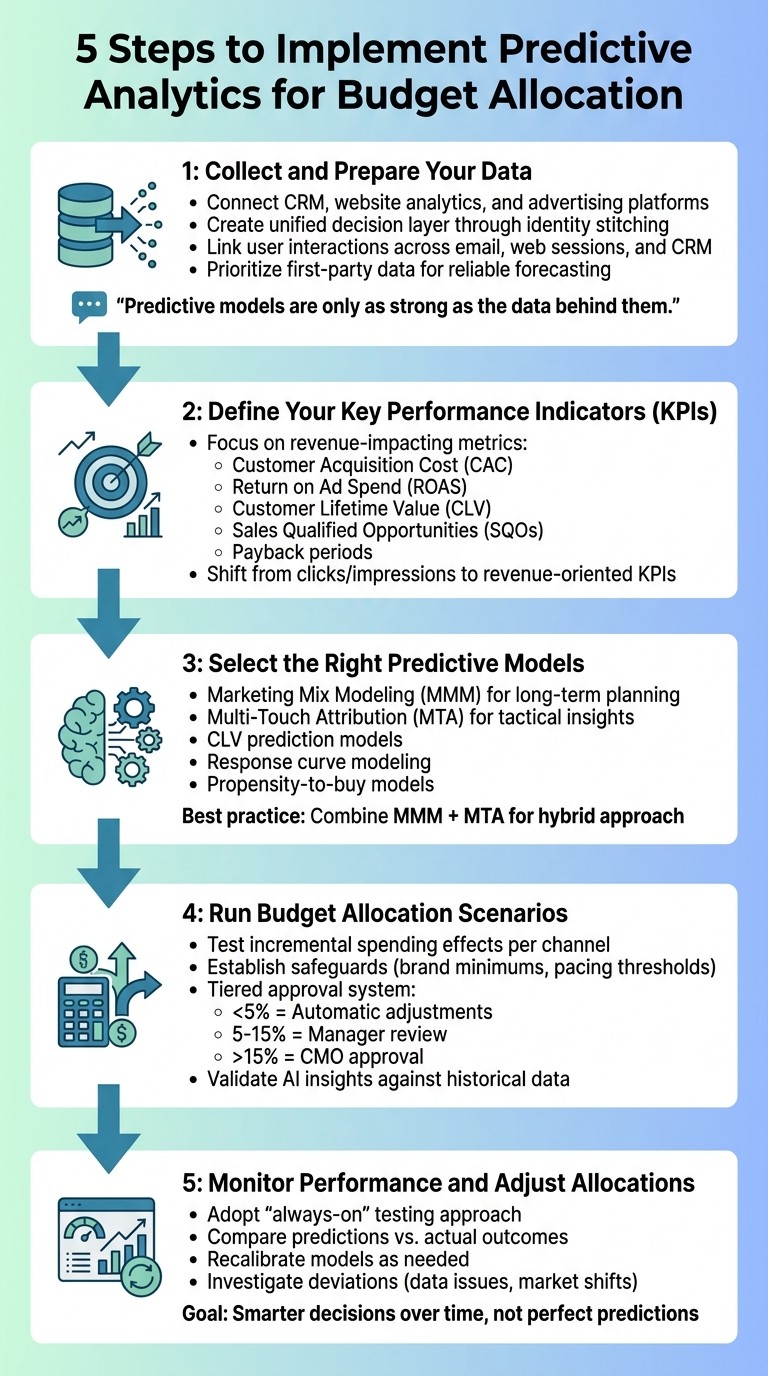
5-Step Process for Implementing Predictive Analytics in Budget Allocation
Taking predictive analytics from concept to execution can transform how budgets are allocated. This process involves a series of structured steps that build upon one another, starting with data consolidation and culminating in ongoing monitoring and refinement. Here's a breakdown of the five key steps to help you move toward data-driven budget decisions.
Step 1: Collect and Prepare Your Data
Begin by connecting all relevant data sources, such as your CRM, website analytics, and advertising platforms, to create a comprehensive historical dataset for training predictive models [7]. This includes data from paid media, email metrics, offline conversions, and more [7][1].
To make this data actionable, create a unified decision layer by linking individual user interactions across email, web sessions, and CRM records - a process known as identity stitching [8][5]. First-party data should take precedence, as it ensures consistent and reliable forecasting, especially as traditional tracking methods become less effective [1].
"Predictive models are only as strong as the data behind them." - Genbe Technologies [1]
Step 2: Define Your Key Performance Indicators (KPIs)
Identify the metrics that directly impact revenue, such as Customer Acquisition Cost (CAC), Return on Ad Spend (ROAS), and Customer Lifetime Value (CLV) [1]. These KPIs should align with broader business outcomes, like Sales Qualified Opportunities (SQOs) and payback periods [5].
Shifting focus from basic metrics like clicks and impressions to revenue-oriented KPIs helps demonstrate marketing's financial impact. This approach also strengthens trust in predictive recommendations among finance teams [8].
Step 3: Select the Right Predictive Models
Choose predictive models based on your objectives. For long-term planning, Marketing Mix Modeling (MMM) evaluates how different channels contribute to overall performance, factoring in historical spending and market conditions [1]. For more detailed, tactical insights, Multi-Touch Attribution (MTA) examines individual user interactions and clickstream data [1].
Other useful models include:
CLV prediction models: Analyze CRM data and engagement metrics to identify high-value customers [1][7].
Response curve modeling: Pinpoint the point of diminishing returns to minimize wasted spending [2].
Propensity-to-buy models: Use website behavior and email engagement to enhance retargeting and lead generation efforts [1].
A hybrid approach often works best - combine MMM for strategic insights with MTA for granular user journey analysis [5]. Tailor your choice of models to match your revenue goals.
Step 4: Run Budget Allocation Scenarios
Experiment with different budget allocations to determine how incremental spending affects each channel [8][5]. Establish safeguards like brand minimums to maintain awareness and pacing thresholds to avoid overspending [5].
When testing scenarios, use a tiered approval system to manage changes:
Automatic adjustments for reallocations under 5%.
Manager review for shifts between 5–15%.
CMO approval for changes exceeding 15% [2].
Initially, validate AI-generated insights by comparing them to historical data. This builds confidence with finance teams before transitioning to full automation [8]. Once validated, continue testing and refining scenarios using live data to optimize performance.
Step 5: Monitor Performance and Adjust Allocations
Adopt an "always-on" testing approach to refine your strategy continuously [5]. Compare actual campaign outcomes to model predictions, recalibrating as needed to improve accuracy [7][1]. If predictions deviate significantly from results, investigate potential causes - such as data inconsistencies or shifts in market conditions - and use these findings to enhance future models.
The objective isn't flawless predictions but making smarter, more informed decisions over time. Regularly monitoring performance ensures that every adjustment contributes to better ROI.
Common Challenges and How to Solve Them
Even with well-designed models and clean data, predictive analytics for budget allocation can still hit roadblocks. Recognizing these challenges and addressing them effectively ensures your strategy stays on course. Below, we break down specific obstacles and practical solutions to fine-tune your approach.
Data Quality and Integration Problems
Fragmented systems can lead to disjointed data, which undermines the accuracy of predictions. Poor integration and inconsistent definitions - like varying interpretations of a "lead" across departments - can confuse your models [2].
To tackle this, start by mapping all your data sources to uncover any gaps [2]. Then, standardize definitions across teams. Though this process may take 4–6 weeks, it saves months of potential errors down the line [2]. Be prepared to invest in this area - experts recommend allocating 30–40% of your AI budget to data engineering [2].
"Allocate 30-40% of your AI implementation budget to data engineering; this is the unglamorous work that determines success or failure." - AI-Ready CMO Editorial Team [2]
For mid-sized companies, setting up the right data infrastructure typically costs $50,000–$200,000 and requires 200–400 hours of implementation work [2].
Misaligned KPIs or Business Goals
Predictive analytics can only succeed if the KPIs it targets align with your broader business objectives. When models focus on operational metrics - like impressions or Marketing Qualified Leads (MQLs) - they may miss the bigger picture, leading to suboptimal recommendations.
Shift your focus to revenue-centric KPIs such as LTV, marginal ROAS, and incremental revenue, which directly connect to business outcomes [2]. Collaborate with your CFO early in the process to ensure that AI-driven recommendations align with cash flow priorities and audit requirements [2]. To maintain balance, apply the 70/20/10 framework: allocate 70% of your budget to proven channels, 20% to experimental efforts, and 10% to measurement infrastructure [3].
"The real problem isn't knowing how much to spend... They need someone to tell them: 'Here's exactly how to spend your $5K this month, and here's what to expect by month six.'" - Zach Chmael, CMO, Averi [3]
Over-Reliance on Predictions
Putting too much trust in analytics can blind you to market dynamics that historical data might not capture, like new competitor launches, economic fluctuations, or seasonal trends. Relying solely on past data risks missing these critical shifts.
Establish safeguards such as minimum brand spend levels and channel caps. Incorporate scenario simulations to blend data-driven insights with real-world considerations [4][5]. Regularly conduct incrementality testing to confirm that AI-optimized channels generate new revenue rather than just capturing conversions that would have happened anyway [1]. Stay vigilant for external factors - like major competitor actions or unexpected events - and adjust your models accordingly [2][4].
"The system doesn't replace leaders' judgment; it supports it with data." - RevSure Team [4]
Tools That Support Predictive Budget Allocation
Modern platforms have redefined how budgets are allocated, turning guesswork into precise, data-driven decisions. These tools consolidate data from multiple sources - your CRM, website analytics (GA4), paid media platforms like Meta and Google Ads, and financial systems such as NetSuite or SAP - into a single, unified view [1][2]. This integration eliminates the hassle of manual exports and disconnected reports, creating a seamless budgeting process.
Core capabilities matter more than flashy features. The most effective tools offer functionality like Customer Lifetime Value (CLV) prediction, propensity-to-buy modeling, churn prediction, and Marketing Mix Modeling (MMM) [1]. Scenario planning is particularly valuable, enabling you to run "what-if" scenarios in seconds to estimate the revenue impact of reallocating funds across channels [2]. Real-time dashboards that refresh daily or weekly are essential for actionable recommendations, complete with confidence scores for suggested budget adjustments [2].
Governance frameworks are critical to maintaining control. The best platforms include tiered approval workflows that define which reallocations can occur automatically (e.g., under 5%), which require manager review (5–15%), and which need CMO approval for larger shifts (above 15%) [2].
These tools not only provide insights but also integrate seamlessly into the entire budgeting and execution process.
Features to Look for in Predictive Analytics Tools
Seamless data integration is a must. Your platform should connect directly to all marketing and financial systems, avoiding the need for manual CSV uploads. It should also identify diminishing returns across channels with precision [4].
Real-time dashboards enhance agility. Go-to-market teams increasingly rely on adaptive systems that adjust spending weekly based on real-time buyer behavior and channel performance [4]. Platforms that refresh data frequently and provide actionable insights - not just static charts - are indispensable [2].
Predictive modeling depth should align with team size.
Small teams with budgets under $10,000/month should focus on tools optimized for channels like SEO and content, along with basic tracking [3].
Mid-sized teams ($10,000–$25,000/month) benefit from multi-channel attribution and lead scoring capabilities [3].
Enterprises, on the other hand, require advanced MMM and hierarchical optimization, often built on robust data warehouses like Snowflake, BigQuery, or Redshift[2][4].
Feature | Traditional Stack | AI-Powered Predictive Tools |
|---|---|---|
Decision Basis | Historical averages & intuition | Forecasted revenue impact & ML models [1] |
Review Cycle | Quarterly or Annually | Real-time, Weekly, or Bi-weekly [2] |
Data Source | Fragmented platform reports |
These capabilities empower teams to adopt predictive analytics, transforming budgeting into a dynamic and efficient process.
How Averi AI Combines Predictive Insights with Marketing Execution
While most tools stop at offering budget allocation advice, Averi AI goes further by integrating strategy with execution, even managing campaigns directly.
The platform operates on Synapse, Averi's proprietary AI architecture, and AGM-2, a marketing-focused foundation model. Unlike traditional martech stacks that require juggling multiple tools and manual data transfers, Averi maintains a unified system. It remembers your brand voice, tracks performance trends, and seamlessly integrates human expertise when needed - without the overhead of agency retainers.
Averi prioritizes high-ROI channels. For example, SEO delivers a 748% ROI for B2B companies, with leads costing $31 compared to $181 for PPC [3]. Averi focuses initial budgets on channels like SEO and content that build long-term authority, using paid ads to amplify successful strategies [3].
"We built Averi around the exact workflow we've used to scale our web traffic over 6000% in the last 6 months." - Zach Chmael, CMO, Averi [3]
The workspace model eliminates inefficiencies. Instead of bouncing between strategy documents, analytics dashboards and KPIs, and project management tools, Averi provides a unified environment. Here, AI-driven strategies connect directly to content creation and campaign planning. Real-time data feeds both predictive models and execution workflows, ensuring continuous improvement. Companies using Averi report a 44% productivity boost compared to traditional fragmented tool stacks [3].
Conclusion
Predictive analytics is reshaping the way businesses approach budgeting, moving from a static, reactive process to a dynamic system that adjusts in real time to market changes. By focusing on future outcomes instead of relying solely on past performance, marketing teams can ensure every dollar is directed toward generating the highest possible return.
This method transforms traditional budgets into flexible strategies designed to maximize revenue. Key advantages include measurable improvements in ROI, better forecasting accuracy, and faster reallocation of resources. Teams can avoid wasting funds by identifying diminishing returns early, channeling investments toward high-value customer segments, and cutting back on underperforming channels.
"The question is no longer whether to adopt predictive analytics, but how quickly you can implement it." – Genbe Technologies [1]
To succeed, a strong foundation is essential. Start with a solid data infrastructure, then roll out predictive models in stages - beginning with response curves, followed by attribution and scenario planning. Implement tiered governance to allow for automated adjustments while reserving major decisions for human oversight.
As marketing budgets approach 7.7% of company revenue in 2024 [5], the need for precise allocation has never been greater. Adopting predictive analytics turns financial constraints into opportunities for competitive growth, enabling teams to make smarter, faster decisions with every dollar they spend.
FAQs
What data is needed to start predictive budget allocation?
To kick off predictive budget allocation, start by gathering historical data on previous marketing efforts. Key metrics to focus on include conversions, spending levels, and audience engagement. This information forms the foundation for predictive models to spot trends and make forecasts that can guide smarter budget distribution. While incorporating real-time performance data and keeping an eye on market trends can refine predictions, having a solid base of historical data is the essential first step.
How do I choose between MMM, MTA, and response curves?
Marketing Mix Modeling (MMM) evaluates how different marketing channels contribute to overall sales or ROI, making it a strong choice for long-term, strategic planning. Multi-Touch Attribution (MTA), on the other hand, focuses on assigning credit to each touchpoint in a customer’s journey, which is particularly helpful for fine-tuning campaigns. Response curves come into play when predicting how budget adjustments might impact outcomes, offering valuable insights for testing and scaling efforts. Your choice depends on your objective - use MMM for strategy, MTA for campaign optimization, or response curves for budget experimentation.
How can I trust predictions before automating budget changes?
To build confidence in predictions, begin with a strong data foundation that brings together marketing metrics, financial records, and external signals. Test your predictive models by comparing their forecasts to real-world outcomes over time to ensure they remain accurate. Tools such as Averi, which blend AI with human oversight, can improve dependability by allowing experts to review and fine-tune predictions. This approach helps minimize costly mistakes before automating decisions about budgets.
Related Blog Posts

Zach Chmael
CMO, Averi
"We built Averi around the exact workflow we've used to scale our web traffic over 6000% in the last 6 months."
Your content should be working harder.
Averi's content engine builds Google entity authority, drives AI citations, and scales your visibility so you can get more customers.