

In This Article
Revenue-focused SEO blueprint for Series A startups: target low-competition keywords, fix technical SEO, scale content with AI, and build backlinks.
Updated:
Trusted by 1,000+ teams
Startups use Averi to build
content engines that rank.
Series A startups can no longer rely solely on paid ads for growth. With rising acquisition costs and board expectations for 2–3x growth, SEO becomes a critical, cost-effective channel to generate leads and reduce customer acquisition costs (CAC). Organic leads cost 60–80% less than paid ones, and a well-executed SEO strategy can deliver a 717% ROI.
Key Takeaways:
Set measurable goals tied to revenue, like demo requests and trial signups.
Focus on high-impact keywords aligned with customer intent, especially bottom-of-funnel queries.
Fix technical SEO (e.g., Core Web Vitals, crawl errors) to ensure content ranks effectively.
Leverage AI tools for content production while maintaining human oversight for tone and quality.
Build backlinks from high-authority sources to boost domain authority.
Track results and refresh underperforming content quarterly.
By targeting 40–60 low-competition keywords and publishing 2–4 optimized pieces weekly, startups can build a scalable SEO system that drives consistent pipeline growth while keeping CAC in check. This guide breaks down actionable steps to help you achieve that.
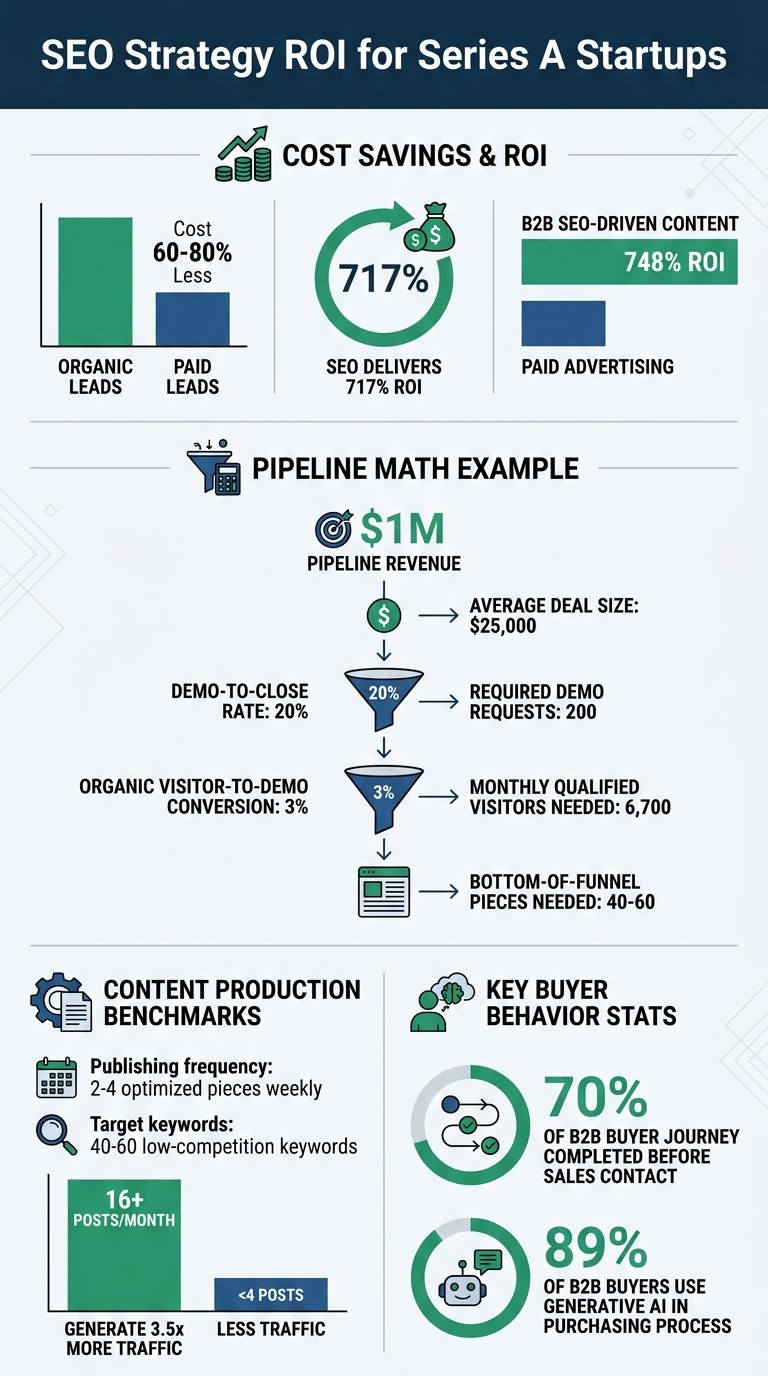
SEO ROI and Key Performance Metrics for Series A Startups
SaaS SEO Strategy - How I make $4,000/day with a SaaS
Step 1: Set SEO Goals That Match Your Business Targets
When your board expects 2–3x growth in a year, "just more traffic" isn't going to cut it. They want results that directly impact the bottom line - how many qualified leads and dollars your SEO strategy is pulling in. Your goals need to align with tangible business outcomes like demo requests, trial signups, and reducing customer acquisition costs. This approach shifts SEO from a brand-building effort to a performance-driven channel with measurable outcomes.
Let’s break it down with some pipeline math: To generate $1 million in pipeline revenue, assuming a $25,000 average deal size and a 20% demo-to-close rate, you’ll need around 200 demo requests. If your organic visitor-to-demo conversion rate is 3%, that means driving about 6,700 qualified organic visitors per month. Setting revenue-linked targets like this transforms SEO into a results-focused engine rather than a vague traffic booster [1].
Create SMART SEO Goals
Your SEO objectives should follow the SMART framework - Specific, Measurable, Achievable, Relevant, and Time-bound. Vague goals like "improve rankings" won’t cut it. Instead, tie your targets to a full-funnel marketing strategy. For example, in the six months following your Series A funding, aim to:
Double your baseline organic traffic.
Secure top 10 rankings for 15 additional keywords.
Ensure content-driven leads make up 15% of your total leads.
By the end of the first year, push for 4x your baseline traffic, over 40 keywords in the top 10, and 25% of leads sourced directly from content [2].
Before scaling your content efforts, make sure your conversion infrastructure is solid. This includes lead magnets, email nurture sequences, and contextual calls-to-action (CTAs) that guide visitors effectively through the funnel [3].
Track the Right Performance Metrics
Metrics like total impressions might look good on paper, but they won’t justify your SEO investment. Instead, focus on key performance indicators and metrics that tie directly to business outcomes - organic conversions, pipeline revenue, and reduced organic customer acquisition costs. Use attribution models, such as first-touch and last-touch, to validate these metrics [1][2].
Set up a monthly dashboard to keep tabs on key indicators like:
Keyword rankings in the top 3 and top 10.
Click-through rates (CTR).
Core Web Vitals performance.
The percentage of revenue sourced from content-driven pipeline [2].
It’s worth noting that visitors coming through AI-driven search tools convert at 4.4x the rate of traditional organic traffic. Also, tracking how often your brand is mentioned in AI-powered search engines like ChatGPT and Perplexity can help you stay ahead of emerging trends [4].
Step 2: Find High-Impact Keywords
Series A startups often lose valuable time chasing high-volume keywords that are nearly impossible to rank for. A smarter approach? Leverage insights from recent sales conversations. By analyzing demo transcripts and sales calls from the past 90 days, you can uncover high-intent queries that are more likely to convert[1]. When optimized effectively, bottom-of-funnel content targeting these queries can achieve an impressive 3% organic visitor-to-demo conversion rate[1]. This strategy lays the groundwork for a B2B SaaS marketing strategy that prioritizes actionable keyword segmentation.
Keep in mind that B2B buyers complete 70% of their journey before engaging with sales teams. Additionally, 89% of buyers now use generative AI tools during their purchasing process[4]. These trends highlight the importance of precise keyword targeting. Your strategy must cater to both traditional search engines like Google and AI platforms such as ChatGPT and Perplexity, where visitors convert at a rate 4.4 times higher than traditional organic traffic[4]. By optimizing for both, you can accelerate revenue generation.
Match Keywords to Customer Intent
Keywords differ in their purpose and value. Informational queries (e.g., "what is marketing automation") attract early-stage researchers. Navigational searches (e.g., "HubSpot login") show brand familiarity, while transactional intent (e.g., "best CRM for startups under $10K") signals a readiness to purchase. For Series A startups, focusing on bottom-of-funnel keywords can drive faster revenue results[1].
To maximize impact, organize keywords into clusters. Create a central pillar page (3,000–6,000 words) that covers a broad topic in depth. Then, support it with 8–12 cluster posts (1,000–2,500 words each) targeting specific long-tail variations[3]. This method not only establishes your expertise but also builds a content ecosystem that grows in effectiveness over time.
Use Keyword Research Tools
Once you’ve aligned keywords with customer intent, use tools to validate and expand your list. Start with Google Search Console to identify quick wins - look for pages already ranking in positions 5–15 for commercial keywords that could benefit from further optimization[1]. For deeper insights, platforms like Ahrefs and Semrush can provide data on search volumes, keyword difficulty, and competitor strategies. While manual research can take 3–4 hours per cluster, these tools can reduce the time to just 30–45 minutes.
Your business model will also influence keyword priorities. Companies with annual contract values under $5,000 should focus on product-led growth keywords that emphasize self-serve content. For those in the $5,000–$30,000 range, a hybrid strategy combining educational SEO and sales enablement works best. Meanwhile, companies with contract values exceeding $30,000 may shift their focus to account-based marketing terms[4].
Target Low-Competition Keywords First
Long-tail keywords (100–1,000 monthly searches) are a quick win for driving qualified traffic and achieving faster rankings. These terms are less competitive and more likely to attract the right audience. For example, a SaaS company aiming for $1 million in pipeline with an average deal size of $25,000 would need around 6,700 qualified organic visitors per month. This goal can typically be met with 40–60 well-optimized bottom-of-funnel pieces[1]. By prioritizing these low-competition terms, startups can efficiently build momentum and generate meaningful results.
Step 3: Fix Technical SEO and On-Page Elements
Once you've nailed down your target keywords, the next priority is making sure search engines can effectively crawl, index, and rank your content. Technical SEO might seem complex, but for Series A startups, it’s about getting the basics right. A solid technical foundation ensures your content investment isn’t wasted and gives every piece you publish a fair shot at ranking. Think of it as the backbone of your keyword strategy and content optimization efforts.
Improve Technical SEO
Start by addressing Google's Core Web Vitals, which directly impact both user satisfaction and rankings. Aim for these benchmarks:
Largest Contentful Paint (LCP): Under 2.5 seconds
Interaction to Next Paint (INP): Below 200 milliseconds
Cumulative Layout Shift (CLS): Under 0.1 [3]
Tools like Google Search Console and PageSpeed Insights can pinpoint pages that don’t meet these standards. Once identified, prioritize fixes based on the traffic potential of each page.
Beyond speed, ensure that 90–95% of your critical pages are indexed, as tracked through Google Search Console [3]. If key pages aren’t showing up, tools like Screaming Frog, Lighthouse, and Google Search Console can help you identify issues like crawl errors, broken links, duplicate content, or misconfigured robots.txt files. For startups with limited engineering resources, focus on addressing these issues in batches, starting with your highest-traffic pages. Once technical performance is in check, shift your attention to optimizing URLs and metadata.
Write SEO-Friendly URLs and Metadata
Your URLs, title tags, and meta descriptions are often the first things users and search engines notice. Keep URLs concise, descriptive, and rich with keywords - avoid generic strings like /page?id=12345. Instead, use clear paths like /seo-strategy-series-a-startups.
Make sure your value proposition is clear within the first 100 words of your content [1][4]. For AI-driven search engines like ChatGPT and Perplexity, consider adding Product schema to solution pages. This structured data helps AI systems accurately interpret your features, pricing, and use cases [1]. With 89% of B2B buyers now using generative AI during their research process [4], schema markup has become essential for staying competitive.
Add Internal Links
Internal linking is key to distributing authority across your site and signaling your expertise to search engines. Build a Topic Authority Map by linking long-tail articles to broader pillar pages [2][3]. For instance, if you’ve created a 4,000-word pillar on "marketing automation", link supporting articles (like "email workflows for SaaS" or "lead scoring best practices") back to that central hub. This structure not only helps search engines understand your content hierarchy but also keeps visitors on your site by guiding them to related resources.
A strong internal linking strategy reinforces your content clusters and strengthens your overall topical authority, aligning perfectly with your keyword and content strategy. Use tools like Ahrefs or Semrush to monitor how link equity flows through your site and to identify orphaned pages that need internal links [2]. This approach ensures no valuable content is left disconnected.
Step 4: Scale Content with AI and Human Review
Once your technical groundwork is set, the next hurdle is maintaining a high output without sacrificing quality. For Series A startups, where growth pace is critical, this means balancing the efficiency of AI tools with the insight and expertise only humans bring. To meet the demand for publishing 2–4+ pieces weekly [4], you’ll need a workflow that blends AI’s speed with human precision. AI can manage the grunt work - research and initial drafts - while humans handle refinement, ensuring the content meets the standards search engines and readers expect.
Use AI for Content Research and Drafts
AI tools can significantly boost productivity without requiring additional team members. Platforms like Averi AI integrate seamlessly into content workflows, enabling teams to triple their monthly output [2]. By configuring brand-specific guidelines upfront, these tools ensure drafts align with your messaging from the start [3]. This setup minimizes repetitive adjustments and guarantees consistency across all content.
Focus your AI on creating content clusters - a strategy that includes one comprehensive pillar page (3,000–6,000 words) supported by 8–12 related posts (1,000–2,500 words each) [3]. This method strengthens your topical authority and reinforces existing content themes. AI tools excel at tasks like keyword clustering, synthesizing research, and maintaining structural cohesion - areas that would otherwise require significant manual effort.
Keep Brand Voice with Human Editing
While AI can generate content quickly, it often lacks the nuance and depth needed to truly connect with readers. That’s why 86% of marketers refine AI drafts to add a human touch [6]. AI content tends to feel generic; human editors bring authenticity, credibility, and a unique voice. A two-pass review process works best: the first pass ensures the tone and expertise match your brand, while the second optimizes for SEO [6]. This hybrid approach delivers results, with 73% of marketers reporting increased website traffic when using AI-assisted content polished by humans [8].
"AI content is good for generating traffic but bad at building trust... it's like reading a Wikipedia page – even if you solve the reader's problem, they won't remember you." - Ryan Law, Director of Content Marketing, Ahrefs [8]
To make AI drafts more engaging, provide your tool with a lexicon of audience-specific terms, banned phrases, and examples of top-performing content [6]. Then, humanize the output by varying sentence length, using contractions, and adding strategic humor. Incorporate unique insights, case studies, and original data to meet Google’s E-E-A-T (Experience, Expertise, Authoritativeness, Trustworthiness) standards [7]. AI may handle the mechanics, but your lived experience is what sets your content apart.
Optimize for Google and AI Search
After refining your content, ensure it performs well across both traditional search engines and emerging AI-driven platforms. With 89% of B2B buyers now using generative AI tools during purchasing decisions [4], your content must cater to both discovery systems. Use clear headings, concise answers, and citable statistics. Adding FAQ sections and TL;DR summaries can boost your chances of appearing in featured snippets and AI-generated responses.
Additionally, maintain consistent information about your company and products across platforms like G2, Capterra, and LinkedIn. This helps AI systems accurately categorize your business [4]. The dual optimization strategy, known as Generative Engine Optimization (GEO), is expected to rival traditional SEO in economic value by 2027 [4]. Position your brand now to stay ahead while competition remains manageable.
Step 5: Build Backlinks and Domain Authority
Once your content is optimized and your technical setup is solid, the next step is to focus on building authority through backlinks. Backlinks are like votes of confidence for your content, signaling to Google that it can be trusted. For Series A startups, this isn’t about quantity - it’s about quality. A single link from a high-authority site like Forbes or TechCrunch (Domain Rating 80+) can outweigh dozens of links from lower-tier directories. The key is to be strategic: aim for backlinks from relevant, high-value sources while steering clear of practices that might lead to penalties.
Secure Links from High-Authority Sources
The best way to attract high-quality backlinks is by creating content that others want to reference. Use the unique data your product generates - insights like customer usage trends, industry benchmarks, or survey findings - to craft research reports that naturally attract citations. These types of resources often become "link magnets", drawing attention from journalists and researchers.
Platforms like HARO (Help a Reporter Out) can connect you with journalists looking for expert opinions. A single quote published in outlets like Business Insider or VentureBeat not only earns you a valuable backlink but also positions your team as industry experts. Additionally, keep an eye out for unlinked brand mentions using tools like Google Alerts or Ahrefs. If you find articles that mention your startup without linking, reach out to the publisher and ask them to add a link. This is a low-effort, high-reward tactic.
Build Backlinks Through Partnerships
Collaborating with complementary businesses can be a goldmine for backlinks. Look for 5–10 non-competing SaaS companies that share your Ideal Customer Profile and propose co-marketing projects, such as co-hosted webinars or integration guides. These efforts naturally create opportunities for mutual linking while exposing your brand to new audiences. Don’t overlook your existing network - investors, advisors, or even customers who contribute to industry blogs can often provide backlinks with a simple ask.
Another effective strategy is creating comparison or "alternative" pages (e.g., "Competitor vs. Your Product"). These pages are highly valuable, as they attract links from users in the research phase and are frequently cited by AI search engines, which account for 32.5% of AI-generated citations [2]. Additionally, consider developing free tools like ROI calculators or APIs tailored to your industry. These resources provide real value, encouraging organic sharing and linking without requiring constant outreach.
Keep an Eye on Bad Links
Once you’ve earned quality backlinks, it’s essential to maintain your authority by monitoring your backlink profile. Not all links are helpful - some can actually hurt your rankings. Use tools like Google Search Console to regularly audit for spammy or irrelevant links from sources like link farms, low-quality directories, or unrelated sites. If you identify harmful links, disavow them using Google’s tool to protect your domain authority.
Track your progress monthly. Set measurable goals, such as increasing your Domain Rating by 5 points within six months and by 10 points within a year. Similarly, aim to boost the number of keywords ranking in the top 10 by at least 15 within six months and by 40 over the course of a year. These benchmarks will help ensure your backlink strategy is driving meaningful results.
Step 6: Track Results and Adjust Your Strategy
Success in SEO isn’t a one-and-done effort - it’s an ongoing process. For Series A startups, the work you put in after content goes live is just as important as the initial setup. Why? Because tracking performance and making adjustments drive long-term results. Your board will want to see metrics like organic traffic growth, keyword rankings in the top 10, the pipeline influenced by content, and the cost per lead from your SEO efforts [3]. These numbers show whether your investment is paying off.
Use Analytics Tools to Track Performance
Start with the basics. Tools like Google Analytics and Google Search Console are essential, and they’re free. Search Console will help you understand which search queries are bringing in traffic, how your pages rank, and whether there are technical issues holding you back. On the other hand, Google Analytics dives deeper into visitor behavior - time spent on the page, bounce rates, and conversion paths.
For Series A startups, focus on the articles ranking in positions 11–30. Why? These are your low-hanging fruit for quick traffic gains [2]. Small tweaks - like adding internal links, updating metadata, or refreshing outdated data - can nudge these pages into the top 10, where the real traffic lives.
Set clear benchmarks to track progress. Keep an eye on how many keywords break into the top 10 each month and measure the pipeline influenced by organic search. If you’re investing $15,000–$40,000 per month on content (a common range for venture-backed startups [3]), it’s vital to calculate your cost per lead and compare it to paid channels. For perspective, B2B companies often see a 748% ROI from SEO-driven content strategies compared to paid advertising [4].
Once you’ve established these benchmarks, remember that regularly refreshing your content is the key to compounding your gains.
Update Old Content
Refreshing what you already have can often deliver better results than creating something entirely new [1]. Conduct a content audit every quarter and sort your URLs into four categories:
Keep and optimize: High-traffic pages that just need minor updates.
Update and expand: Posts with good potential but poor execution.
Consolidate: Merge thin or overlapping content into stronger, unified pieces.
Delete and redirect: Remove outdated or irrelevant pages and redirect them appropriately [2].
When updating, replace outdated screenshots with your latest product UI, add fresh customer examples, and update statistics with the most recent data (think 2025–2026). Include a "Last Updated" date at the top of the post to signal freshness to readers and search engines. Adding proprietary data or recent case studies can also increase credibility and relevance. These updates ensure your content stays competitive as search behaviors shift.
Monitor Competitors and Search Trends
Your competitors won’t sit idle, and neither should you. Tools like Ahrefs and Semrush can help you analyze their organic strategies. Look for bottom-funnel keywords they rank for, such as "{competitor} alternative" or "{category} for {specific use case}" [1]. These types of comparison pages often generate the highest-converting organic traffic for Series A startups [2].
Also, keep an eye out for content gaps that market leaders may have overlooked [3]. Pay attention to the exact questions prospects ask during sales calls, and create comparison pages that directly address competitor shortcomings [1]. Keep in mind that B2B buyers typically complete 70% of their decision-making process before they even engage with your sales team [4]. By addressing these gaps, you position your content to meet buyers where they are in their journey.
Conclusion: Build an SEO System That Runs Itself
For Series A startups aiming to scale SEO effectively, the focus should be on building systems, not relying on short-term efforts. The foundation lies in setting revenue-driven goals, targeting impactful keywords, resolving technical issues, scaling content production with AI, earning backlinks to boost authority, and closely monitoring performance. The ultimate challenge is creating a repeatable process that doesn’t overwhelm your team or drain your budget.
To transition from sporadic efforts to a sustainable SEO engine, you need to move beyond founder-led content creation. A strategic, scalable system is essential. Data shows that companies publishing 16 or more posts each month generate 3.5 times more inbound traffic than those producing fewer than four posts [4]. However, achieving this volume requires a system that handles every aspect - research, drafting, optimization, and publishing - without turning you into a full-time content marketer. For instance, between May 2025 and March 2026, Averi leveraged its AI-driven content engine to grow organic search impressions from 5,800 to a staggering 2.91 million per month - a 6,000% increase [5].
"We built Averi around the exact workflow we've used to scale our web traffic over 6000% in the last 6 months" [5].
Zach Chmael, Head of Marketing at Averi
Key strategies include setting measurable goals, focusing on high-impact keywords, and using a hybrid approach where AI handles repetitive tasks while humans refine the content's tone and strategic direction. This system should optimize for traditional Google rankings as well as AI-driven platforms like ChatGPT, where B2B buyers are converting at rates 4.4 times higher [4]. Establishing topic clusters - where a central pillar page is supported by 8–12 related posts - can help build authority more quickly. AI tools can take on tasks like keyword research and drafting, while your team ensures the content aligns with your brand and messaging.
To measure success, track the metrics that matter most to stakeholders: organic traffic growth, top 10 keyword rankings, content-influenced pipeline, and cost per lead. Regularly refresh underperforming content, set quarterly benchmarks, and keep an eye on competitor gaps to maintain an edge.
The goal isn’t flawless execution - it’s about consistency and smart automation. Build a workflow that automates key stages like research, drafting, editing, publishing, and performance analysis. Tools like Averi AI ($99/month) can save startups around $1,820 monthly compared to traditional tool stacks [5], combining research, content creation, publishing, and analytics into one streamlined process. Let the system handle the heavy lifting, so your team can focus on what truly matters: product development, customer relationships, and scaling your business.
FAQs
How long does it take for SEO to generate pipeline after a Series A?
With the right approach, SEO can deliver tangible results within 12 months following a Series A funding round. During this period, businesses have the potential to generate more than $1 million in qualified pipeline, provided the strategy is well-planned and effectively executed.
How do I pick the first 40–60 keywords to target?
To make an impact, target low-competition, high-intent keywords that resonate with your audience and align with your business goals. Look for search terms your potential customers are actively using - think of phrases tied to solutions, alternatives, or answers they’re seeking. Tools like Google Search Console can help you pinpoint keywords with solid search volume. Focus on those that signal strong purchase intent or a desire to solve a specific problem. Then, create content clusters around these keywords to build credibility and lay the foundation for sustainable growth.
What should I track to prove SEO ROI to my board?
To present the return on investment (ROI) of SEO to your board, focus on tracking key metrics such as revenue from organic search, total SEO expenses, leads or conversions driven by SEO, and growth in organic traffic. A straightforward formula like [(SEO revenue − SEO cost) / SEO cost] × 100 can help quantify the return. Emphasize clear, measurable results to effectively highlight the value of your SEO strategy.
Related Blog Posts

Zach Chmael
CMO, Averi
"We built Averi around the exact workflow we've used to scale our web traffic over 6000% in the last 6 months."
Your content should be working harder.
Averi's content engine builds Google entity authority, drives AI citations, and scales your visibility so you can get more customers.