

In This Article
Build a scalable AI-powered content system for Series A startups: audit workflows, define roles, apply AI tools, enforce reviews, and track KPIs.
Updated:
Trusted by 1,000+ teams
Startups use Averi to build
content engines that rank.
At the Series A stage, content marketing becomes a critical driver of growth. However, producing high-quality content at scale can overwhelm small teams, especially when resources are stretched across product development, sales, and hiring. This guide simplifies how startups can build a scalable AI-powered content strategy without inflating costs or team size. Here's what you'll learn:
Audit Your Current Workflow: Identify bottlenecks like editing delays or inconsistent brand voice before expanding your team.
Leverage AI Tools: Use AI for tasks like topic research, drafting, and SEO optimization to save time and boost efficiency.
Define Clear Roles: Assign responsibilities for strategy, writing, editing, and publishing to avoid chaos as your team grows.
Implement Quality Controls: Use review layers and checklists to maintain brand consistency and SEO standards.
Track Key Metrics: Focus on traffic, keyword rankings, and conversion rates to measure content performance and refine your strategy.
Evaluate Your Current Content Capacity
Series A Content Marketing Challenges
If you're working with a Series A budget of $15,000 to $50,000 per month for content marketing [1], it's important to understand that money alone won't resolve operational inefficiencies. The real hurdles often stem from coordination issues and bottlenecks in your workflow. Adding more writers without addressing these inefficiencies can backfire, as increased management demands can slow productivity [2].
The red flags are easy to spot: you're publishing over 40 posts, but organic traffic isn't growing. Content gets trapped in endless revisions, and your brand voice becomes inconsistent as more contributors join without clear guidelines. Despite 90% of B2B marketers investing in content marketing, only 37% have a documented content strategy. Without one, you're likely reacting to problems as they arise instead of proactively building systems that can scale with your team. Recognizing these challenges is the first step toward conducting a thorough workflow audit.
Audit Your Workflow
Start by mapping out your entire content process, from brainstorming ideas to hitting "publish." Track how much time each step takes to uncover bottlenecks, like delays in briefing or editing [2][3].
Then, conduct a content audit. Review every published URL and classify each piece as "Keep/Optimize", "Update/Expand", "Consolidate", or "Delete" based on performance metrics like traffic and conversions. This exercise helps you focus on refining high-impact content [1]. Additionally, analyze which content formats - blog posts, case studies, or comparison guides - are driving leads through your funnel using first-touch and last-touch attribution.
The key takeaway? Identify your specific bottleneck before scaling your team. If editing is slowing things down, hiring more writers will only increase delays [2]. Solve the issue first, whether that means creating a streamlined briefing template that takes less than 30 minutes to fill out, bringing on a dedicated editor, or upgrading from tools like email and Slack to a more efficient project management platform. Fully document your updated workflow before expanding your team. This clarity will serve as a solid foundation for integrating AI-driven solutions into your processes. This is a core component of AI content strategies for venture-backed startups looking to maintain quality at scale.
Content at Scale: How to Train AI to Create Great Content
Build an AI-Powered Content Workflow
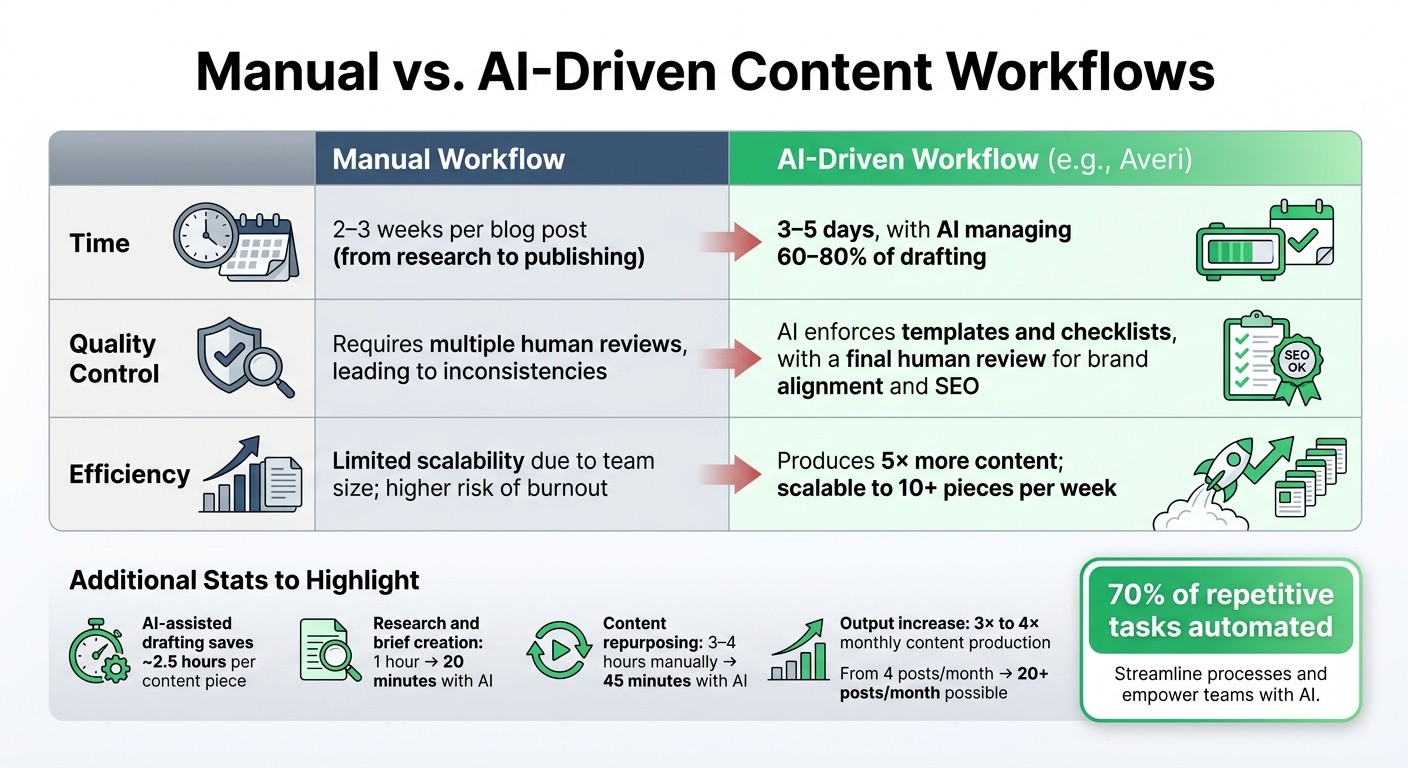
Manual vs AI-Driven Content Workflow Comparison for Series A Startups
Map Your Content Production Process
After completing your workflow audit, the next step is to integrate AI into a structured and well-documented production process. Start by mapping out each stage of content production to identify key roles and pinpoint where AI can make the biggest impact. This process helps uncover potential bottlenecks - like editing delays - that may slow things down. For example, if editing is the issue, simply adding more writers (human or AI-assisted) might worsen the backlog.
Break the workflow into six clear stages: strategy (e.g., setting goals like boosting organic traffic by 20% in six months), ideation (brainstorming topics that resonate with your audience), drafting, editing and reviewing, publishing, and performance tracking. Use tools like Notion or Google Docs to document responsibilities, timelines, and checklists for each stage. This structured approach not only helps new team members get up to speed quickly but also highlights opportunities where AI can save time and effort. With this map in hand, let’s dive into how AI can transform each phase.
Use AI for Automation
AI tools like Averi can take on some of the most time-consuming tasks in content production, freeing up your team to focus on strategy and quality. For instance, AI-assisted drafting can save around 2.5 hours per content piece, while tasks like research and brief creation can shrink from an hour to just 20 minutes [2].
Here’s how AI can make an impact:
Topic Research: AI can analyze audience personas, funnel stages (e.g., awareness-focused blog posts or consideration-stage case studies), and search intent to create topic clusters and pillar pages. This reduces manual research time from days to hours.
Drafting: Using content briefs that include keywords, audience profiles, and brand voice guidelines, AI can generate detailed outlines or full drafts. For example, Averi can produce a 1,500-word blog post on "Series A funding strategies" in just 30–45 minutes, ready for human editors to refine.
SEO Optimization: AI tools can handle tasks like internal linking, targeting featured snippets, and generating meta tags automatically.
Repurposing Content: AI can turn a single blog post into multiple formats, such as social media threads, newsletters, and video scripts, in just 45 minutes - compared to 3–4 hours manually.
"The goal isn't to replace human judgment. It's to stop paying human labor rates for tasks that don't require human judgment." [4]
By applying the 80/20 rule, AI takes care of the initial structured draft, while humans focus on the final 20% - adding unique insights, fact-checking, and aligning content with the brand voice. Teams using AI-powered workflows, like those built with Averi, often see a 3× to 4× increase in monthly content production without needing to expand their team. This efficiency is especially critical for startups or companies in Series A funding stages, where scaling quickly without adding headcount is a top priority.
Manual vs. AI-Driven Workflows
Let’s compare traditional content workflows with AI-powered ones in terms of time, quality, and scalability.
Aspect | Manual Workflow | AI-Driven Workflow (e.g., Averi) |
|---|---|---|
Time | 2–3 weeks per blog post (from research to publishing) | 3–5 days, with AI managing 60–80% of drafting |
Quality Control | Requires multiple human reviews, leading to inconsistencies | AI enforces templates and checklists, with a final human review for brand alignment and SEO |
Efficiency | Limited scalability due to team size; higher risk of burnout | Produces 5× more content; scalable to 10+ pieces per week |
This shift in efficiency is a game-changer for teams with limited resources but high growth demands. By automating roughly 70% of repetitive tasks, small teams can achieve output levels comparable to those of much larger teams. For example, a team that previously managed four posts per month can scale to 20+ posts while maintaining quality through governance measures like quarterly reviews. This streamlined approach ensures that growth doesn’t come at the cost of quality.
Set Up Team Collaboration and Quality Controls
Define Roles and Responsibilities
Once your AI-powered workflow is mapped out, it's time to assign clear roles within your team. As your team grows to five or more members, informal systems often lead to chaos - duplicated tasks, missed deadlines, and lack of accountability can become the norm [3].
To avoid this, document who is responsible for every step of your content process. Assign ownership for tasks like idea generation, brief creation, drafting, editing, SEO checks, publishing, and promotion. A simple table can help clarify these roles:
Role | Responsibilities |
|---|---|
Head of Content | Strategy, editorial calendar, quality standards, team performance [3] |
SEO Content Manager | Keyword research, content briefs, SEO optimization, content audits [3] |
Content Writer | First drafts, research, following briefs [3] |
Content Coordinator | Distribution, scheduling, repurposing, asset management [3] |
Dedicated Editor | Reviewing all output for brand voice, accuracy, and structure [2] |
Think ahead by planning for the team you want to have, not just the one you currently have [3]. If you're expecting to hire more writers or bring in freelancers, integrate those roles into your workflow now. This forward-thinking approach saves you from scrambling to reorganize processes later when content demands increase.
For flexibility, consider maintaining a freelancer output ratio of 30–40%. This helps manage workload spikes while keeping strategy and editing under the control of your core team [3].
A well-structured team is the foundation for maintaining quality as your operations expand.
Add Review Layers and Quality Checklists
As your content scales, implementing formal review layers becomes critical to preserve your brand's voice and SEO standards. A three-gate review process is an effective way to maintain quality [3]:
Gate 1 (Brief Review): Before writing begins, the editor or Head of Content reviews the brief to confirm the keyword target, audience alignment, and unique angle. This step reduces the risk of drafts missing essential goals.
Gate 2 (Draft Review): The editor evaluates the first draft to ensure it aligns with the brief, maintains the brand voice, and meets quality expectations. This is the stage to address any structural or tone issues.
Gate 3 (Pre-Publish Check): A final check ensures all technical elements - like meta tags, internal links, alt text, and CTAs - are in place. This review catches any last-minute oversights before publication.
To ensure consistency across all writers - whether human or AI - provide your tools with a brand voice guide. This guide should include tone attributes, "do/don't" examples, and sample copy. Emily K. Schwartz, Head of Content + Comms at Haus, highlights the importance of this:
"By feeding an AI tool our style guide, voice, tone, and verbiage that is unique to our industry... AI makes it easy for our brand voice to come through clearly and consistently, no matter the writer, context, or medium" [6].
Before publishing, use a standardized checklist to verify critical elements like title tags, meta descriptions, internal links, CTAs, and image alt text. Regular quarterly audits of published content against your brand voice guide can help identify and correct any inconsistencies that may arise over time. This disciplined approach ensures your content remains polished and aligned with your brand as your team grows.
Measure Performance and Improve Content Strategy
Track Key Performance Metrics
Once your AI-powered workflow is up and running, the next step is measuring performance to ensure your content strategy delivers results. The focus should be on metrics that drive growth and impact, rather than simply increasing the volume of published content that doesn’t contribute to business goals [1].
Take a dual approach: monitor SEO content for long-term traffic growth and conversion content for immediate pipeline contributions [1]. For SEO, key metrics include monthly organic traffic, keyword rankings (especially those in the top 10), and domain authority. For conversion-focused content, track demo requests, free trial signups, newsletter subscriptions, and visits to pricing pages as indicators of success [1].
To tie content performance directly to business outcomes, set up conversion events in tools like GA4 and use UTM parameters for every piece of distributed content. This enables precise tracking of how content contributes to your sales pipeline [1]. Additionally, tag leads in your CRM with first-touch and last-touch attribution models to identify which content sparks initial interest and which pieces close the deal [1].
For content audits, evaluate URLs based on three key metrics: monthly traffic, keyword rankings, and conversion rate [1]. Growing teams should also track "Content Velocity", which measures the number of new posts and case studies published each month. This ensures your production keeps pace with your growth goals [1][2]. A 12-month growth framework can help guide your efforts:
Metric | Month 1 | Month 6 Target | Month 12 Target |
|---|---|---|---|
Monthly Organic Traffic | Baseline | 2× baseline | 4× baseline |
Keywords in Top 10 | Baseline | +15 keywords | +40 keywords |
Content-Sourced Leads | Baseline | 15% of total | 25% of total |
Case Studies Published | Baseline | 5 total | 10 total |
Domain Rating / Authority | Baseline | +5 points | +10 points |
Keep in mind, initial results often take 4–6 months to materialize. By investing in attribution systems early, you’ll have the data ready when leadership asks for performance updates [1]. With these metrics in place, you can use analytics to uncover growth opportunities and refine your approach.
Use Analytics to Optimize Content
Analytics are your best ally for refining your content strategy. Conduct a 6-month review to identify the top-performing 10% of content by traffic and conversions. These are the formats and topics to double down on. At the same time, review the bottom 20% of content for potential updates, consolidation, or retirement [1]. Watch for emerging keywords, too - articles ranking in positions 11–30 often offer quick wins to push into the top 10.
Modern AI analytics tools make this process easier. Natural language querying (NLQ) allows users to ask questions like, "What was the conversion rate for blog posts last month?" and receive instant visualizations [8]. Features like anomaly detection can flag unusual trends, such as sudden keyword ranking drops or unexpected traffic spikes, and trigger real-time alerts [7][8].
Platforms like Averi integrate performance tracking into the content creation process, offering actionable insights. For example, they might highlight articles that are just shy of top rankings and suggest tweaks to improve their position or recommend new content ideas based on trending topics. This ensures performance data directly shapes your next steps - whether it’s creating fresh content, updating existing pieces, or retiring underperforming ones.
With 90% of marketers now using AI to make faster decisions [5], the teams that act quickly on insights will stand out. Set up a tiered reporting system: weekly dashboards for day-to-day KPIs, monthly reviews to evaluate top and bottom performers, and annual reports to track long-term growth trends [1][3]. These insights not only validate your current strategy but also help prioritize future content efforts.
Conclusion
scaling your content production doesn’t have to mean scaling your team. By focusing on smarter systems and leveraging tools like Averi, you can significantly boost output without ballooning costs or complexity. For Series A startups, this means shifting from publishing just a handful of posts each month to producing 10 times that amount - all while maintaining quality and focus.
The key lies in understanding how AI can take over repetitive tasks like drafting, keyword research, and repurposing content, freeing your team to concentrate on strategic planning, unique insights, and quality assurance. Tools such as Averi have shown how this balance can lead to remarkable results, with some startups achieving traffic growth as high as 6,000% in just six months, all with the same team size [1].
Start small by auditing your content using the "Keep, Improve, Remove" framework, and test an AI-driven workflow on a single content type, like blog posts. Use a RACI model to define roles clearly, monitor KPIs over the first 30 days, and refine your process based on the data. The focus should be on creating momentum rather than chasing perfection from the outset.
To maintain quality at scale, implement safeguards like documented SOPs, standardized briefs, and layered reviews. As Averi emphasizes:
"Scaling without a quality control step produces more content and worse content simultaneously. That's worse than publishing less."
With the right approach, you can achieve exponential growth in content production while keeping quality firmly intact.
FAQs
How do I know what to fix before hiring more writers?
To begin, take a close look at your current content creation workflow. Map out each step, from selecting topics to drafting briefs, writing content, and managing edits and approvals. Pinpoint any areas where things slow down or where inconsistencies arise - whether it’s unclear guidelines, lengthy approval processes, or uneven quality standards. Addressing these issues, such as by simplifying approval steps or establishing clear benchmarks for quality, can help you work more efficiently. With these improvements, you might be able to boost your content production without needing to expand your team right away.
What content tasks should AI handle versus my team?
AI shines when it comes to tasks that demand efficiency, large-scale processing, and structured outputs. Think of activities like drafting initial content, generating outlines, or producing various content iterations. However, the human touch is crucial for areas that require creativity, subtlety, and critical thinking. This includes polishing drafts, maintaining a consistent brand voice, and infusing emotional resonance into the work. By combining the strengths of AI and human expertise, startups can delegate repetitive tasks to AI while ensuring that the final output retains its originality and quality. This balanced approach allows teams to scale their content efforts without sacrificing the personal touch that resonates with audiences.
How do I prove content is driving pipeline at Series A?
To demonstrate that content is fueling pipeline growth at the Series A stage, it’s essential to track specific metrics such as leads, demo requests, or sign-ups directly linked to your content efforts. Tools like UTM parameters and analytics platforms can help you measure the impact effectively. Consider creating dedicated landing pages for your content to ensure accurate attribution. Regularly analyze the data to establish clear connections between content engagement and pipeline expansion. Additionally, leverage examples or case studies that highlight how your content is converting leads into paying customers.
Related Blog Posts

Zach Chmael
CMO, Averi
"We built Averi around the exact workflow we've used to scale our web traffic over 6000% in the last 6 months."
Your content should be working harder.
Averi's content engine builds Google entity authority, drives AI citations, and scales your visibility so you can get more customers.