How to Build a Creative Strategy for Education Platforms
Averi Academy
Averi Team
8 minutes

In This Article
Define goals, personas, formats, and AI-powered workflows to boost enrollments, completion, and retention on education platforms.
Updated:
Trusted by 1,000+ teams
Startups use Averi to build
content engines that rank.
Education platforms face unique challenges: earning trust, catering to diverse audiences, and delivering measurable results. A clear strategy connects your brand’s message to the needs of learners, educators, and administrators. Start by setting specific goals, defining your audience, and aligning your content to their decision-making journey. Use AI tools to streamline workflows and analyze performance, ensuring every effort drives engagement and enrollment.
Key Steps:
Set Goals: Define measurable outcomes for both business (e.g., enrollments, revenue) and learners (e.g., course completion rates).
Know Your Audience: Build personas for stakeholders like IT directors, CLOs, and learners, addressing their specific concerns.
Tailor Content: Match content formats (videos, webinars, reports) to each stage of the decision journey.
Leverage AI: Use tools to centralize workflows, automate content creation, and integrate with systems like LMS or CRM.
Test & Iterate: Track metrics (e.g., cost-per-lead, retention rates), run A/B tests, and refine based on data.
By focusing on outcomes, aligning messaging, and using AI strategically, education platforms can scale efficiently while meeting user needs.
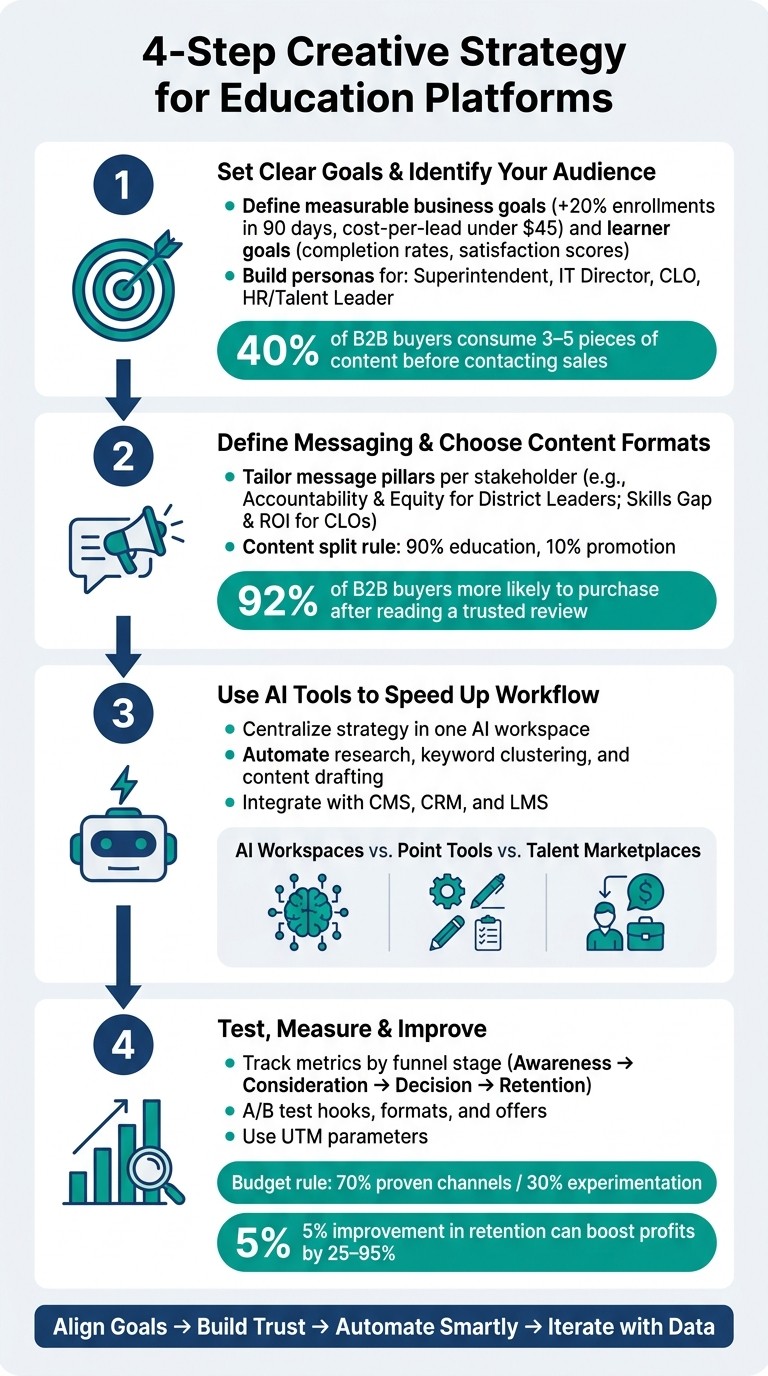
4-Step Creative Strategy Framework for Education Platforms
Staying Ahead in 2025: Top Education Marketing Strategies for Success
Step 1: Set Clear Goals and Identify Your Audience
Before creating any content, it’s crucial to define clear success metrics and understand your audience. Without these, even the most well-thought-out campaigns can fall flat.
Define Measurable Business and Learner Goals
Goals like "increase awareness" or "get more enrollments" are too vague to provide real direction. Instead, every goal should be tied to a specific number and timeline. For example, aim to boost monthly course enrollments by 20% within 90 days or lower the cost-per-lead to under $45 by the end of Q3. These precise targets help guide your strategy and measure success.
Education platforms often juggle two layers of goals: business outcomes (such as revenue growth, enrollment numbers, and cost-per-acquisition) and learner outcomes (like course completion rates, satisfaction levels, and time-to-skill). Both are essential. If your platform attracts plenty of sign-ups but struggles to retain learners beyond the first week, no amount of advertising can compensate for that retention issue.
Once you’ve nailed down your metrics, the next step is tailoring your approach to meet the unique needs of your audience.
Build Learner Personas
Most education platforms cater to a variety of users. A single learning management system (LMS), for instance, might need to address the needs of a K–12 curriculum director, a corporate Chief Learning Officer (CLO), and an IT director - each with distinct priorities. The curriculum director may focus on teaching alignment and professional development, while the CLO prioritizes closing skills gaps and demonstrating ROI. Meanwhile, the IT director needs to ensure compliance with regulations like FERPA and seamless SSO integration.
To avoid creating one-size-fits-all content, develop 1–2 detailed personas for each audience segment. Use real data - like CRM records, support tickets, sales call notes, and search trends - to ground these personas in reality. The table below highlights how different stakeholders have unique concerns and search behaviors:
Persona | Primary Concerns | Key Search Terms |
|---|---|---|
Superintendent | Accountability, equity, budgets | "edtech ROI for school districts", "improving student outcomes" |
IT Director | FERPA compliance, data privacy, SSO | "FERPA-compliant edtech", "edtech data privacy checklist" |
Chief Learning Officer | Engagement, skills gaps, ROI | "enterprise LMS comparison", "skills-based learning platform" |
HR/Talent Leader | Employee retention, onboarding | "onboarding automation platform", "L&D tools for HR" |
Map the Learner Decision Journey
Once you’ve set your goals and defined your audience, the next step is to map out the learner’s journey. This ensures your content aligns with their decision-making process.
Education decisions often involve high levels of consideration. Research shows that 40% of B2B buyers consume three to five pieces of content before ever engaging with a sales representative [5]. This means your content has to do the heavy lifting early on, building trust and answering key questions before any direct interaction.
Break the journey into four stages: awareness, consideration, enrollment, and retention. Then, assign specific content types to each stage. For example:
Use SEO-driven blog posts and short social videos to capture attention during the awareness stage.
Build trust in the consideration phase with outcome studies and webinars.
Provide free trials and demo videos to close the deal at the enrollment stage.
Focus on retention with resources like advanced training and support, as even a 5% improvement in retention can boost profits by 25% to 95% [5].
For K–12 platforms, seasonality plays a major role in shaping this journey. Budget decisions often occur from July to September, product evaluations happen between October and December, and implementation typically takes place from January to June [2]. Align your content strategy with these cycles to ensure you’re reaching decision-makers at the right time.
Laying this groundwork sets the stage for incorporating AI tools to streamline and scale your efforts even further.
Step 2: Define Your Messaging and Choose Content Formats
With your goals outlined and personas in place, it’s time to craft messaging that resonates across channels. By aligning your communication strategy with these foundations, you can ensure your content connects meaningfully with every audience.
Establish Key Message Pillars
Message pillars are the recurring themes that anchor your platform’s communication. For an education-focused platform, these pillars should shift depending on the audience. A district superintendent may be drawn to discussions around accountability and equity, while a corporate CLO (Chief Learning Officer) is more likely to engage with content emphasizing skills gap solutions and measurable ROI. Similarly, learners want to hear how your platform can improve their career prospects.
Here’s a breakdown of stakeholders, their primary concerns, and the best formats to address them:
Stakeholder | Primary Messaging Pillar | Optimal Format |
|---|---|---|
District Leaders | Accountability & Equity | Efficacy/Outcome Reports |
Curriculum Directors | Pedagogical Alignment | Implementation Playbooks |
IT Directors | Security & Compliance | Privacy Checklists/FERPA Guides |
Enterprise CLOs | Skills Gap & ROI | L&D ROI Measurement Reports |
Learners | Career Transformation | Student Spotlights/Success Stories |
Focus on outcomes rather than features. Education buyers, particularly teachers and administrators, are often driven by mission and impact. For example, a message like “Help every student close the reading gap by third grade” is far more compelling than simply highlighting “200+ adaptive modules.” Social proof also plays a critical role - efficacy studies, third-party validations, and case studies from real institutions go a long way in building trust and overcoming doubts [1][2].
Choose the Right Content Formats
Once your core messages are set, the choice of content format becomes crucial. Each format serves a distinct purpose at different stages of the learner’s journey. For example:
Short-form video (e.g., TikTok clips, Instagram Reels) is ideal for the awareness stage, as it meets learners where they are already spending their time [1].
Webinars and comparison guides are more effective during the consideration phase, where trust-building is key. In fact, 92% of B2B buyers report being more likely to purchase after reading a trusted review [4].
For retention, personalized progress emails and advanced training materials help keep learners engaged long after they’ve enrolled.
A helpful guideline is to allocate 90% of your content to educating your audience about real challenges and trends, leaving only 10% for direct promotion of your platform. This approach nurtures trust and builds credibility over time.
Tailor Content for Each Channel
Different channels require different approaches. High-intent channels like search and email work best with clear, informative content. On the other hand, discovery platforms such as TikTok, Instagram, and Pinterest thrive on emotional storytelling paired with bold visuals [1][3].
For owned channels like your website, LMS, or email list, consistency is key. If a learner encounters a student success story on TikTok and then visits your homepage, the messaging should align while being tailored to the platform. A cohesive visual identity - consistent thumbnails, color schemes, and content categories - helps not only with branding but also with discovery algorithms, ensuring your content reaches the right audience [3].
Step 3: Use AI Tools to Speed Up Your Workflow
After finalizing your messaging and content formats, AI in marketing execution often slows down when teams juggle between drafting, asset management, and publishing on separate platforms. AI workspaces can bridge this gap by bringing everything together in one place. This approach simplifies workflows and keeps your efforts aligned.
Centralize Strategy and Content in One AI Workspace
AI workspaces, like Averi, consolidate your brand details, audience profiles, campaign briefs, and content assets into a single platform. By keeping all this context in one place, you eliminate redundant setups and ensure every draft starts with the right foundation. This is especially important when tailoring campaigns - for instance, crafting a message for district superintendents requires a different tone than one aimed at individual learners. A centralized system helps maintain consistency across all campaigns.
"We accomplished more in two weeks with Averi than we did in three months with our previous agency. AI speed paired with expert execution drove our remarkable progress." - Sarah Chen, Founder, TechScale [1]
Automate Research and Content Drafting
AI tools take on the repetitive tasks that often bog down teams. They can handle keyword clustering, create content briefs, and even summarize transcripts from webinars [6]. For education platforms, this means quickly identifying high-priority topics like "best LMS for K–12 districts" or "how to measure corporate training ROI." This allows teams to move swiftly from brainstorming to drafting. Additionally, webinar transcripts can be repurposed into blog posts, email campaigns, or other formats [6].
Once your content is ready, AI tools make it easy to integrate with your distribution channels.
Connect AI Tools to Your CMS, CRM, and LMS
Distribution is the final step, and integrating AI tools directly with your CMS (like WordPress or Webflow), CRM (such as Salesforce), and LMS can eliminate manual hurdles. This ensures seamless publishing and keeps learner data synced across systems. For example, connecting AI with LMS platforms like 360Learning or Docebo allows you to automate tasks like sending re-engagement emails when a user pauses mid-course or recommending new resources upon completing a module [7].
Feature | AI Workspaces (e.g., Averi) | Point Tools (e.g., Jasper) | Talent Marketplaces (e.g., Upwork) |
|---|---|---|---|
Workflow | End-to-end (strategy to publishing) | Drafting only | Manual project management |
Brand Context | Persistent memory | Manual setup per session | No context persistence |
Integration | Direct CMS/LMS connectors | Copy-paste required | Manual delivery |
Quality Control | Built-in expert review layers | Relies on user editing | Varies by freelancer |
Step 4: Test, Measure, and Improve Your Strategy
Once you've set clear goals and streamlined workflows, the next step is refining your approach through testing and measurement. Publishing content is only the beginning - understanding what drives enrollments and what falls flat is where the real learning happens. Unfortunately, many education platforms stop short here, relying on surface-level data without creating a structured feedback loop.
Focus on the Right Metrics
The metrics you track should align with where potential learners are in their journey. At the start of the funnel, prioritize metrics like brand visibility and audience reach. In the middle, look at engagement indicators such as video views, content downloads, and time spent on your site. For the decision stage, zero in on cost per enrollment, free trial sign-ups, and conversion rates by channel.
Beyond these, two additional metrics are vital for education platforms: course completion rates and satisfaction scores. If learners are enrolling but not finishing courses, it could mean your messaging doesn't align with the actual course experience. Workflow efficiency metrics - like time from brief to publication and average editing time per draft - are also worth tracking to ensure your AI tools are genuinely speeding up production [6].
Funnel Stage | Key Metrics | What They Tell You |
|---|---|---|
Awareness | Social reach, search rankings, brand impressions | Audience reach and visibility |
Consideration | Video views, content downloads, time on page | Engagement with your content |
Decision | Cost per enrollment, conversion rates, trial sign-ups | ROI and enrollment efficiency |
Retention | Course completion rates, satisfaction scores | Long-term value and learner success |
These metrics provide a foundation for effective creative testing.
A/B Testing: Fine-Tune Your Creative
When testing your creative, focus on one variable at a time. Platforms like Meta and TikTok, which are essential for education marketing, allow you to experiment with key elements. Start by testing your hook - the first three seconds of a video or the opening line of an ad. Then, compare formats like video versus static images, or test different offers, such as "Start free" versus "Book a demo." Keeping all other elements consistent helps you pinpoint what’s driving performance.
To track ad performance more accurately, use UTM parameters on your links. This ensures you can directly connect ad results to enrollment data in your CRM or LMS, removing any ambiguity about which channels or creatives are delivering the best outcomes.
Once your tests are complete, bring in AI tools to analyze the results and guide your next steps.
Let AI Handle the Analysis
Manually reviewing data can be both time-consuming and prone to errors. AI tools like Averi simplify this process by tracking metrics such as impressions, clicks, and keyword rankings. These tools don’t just present the data - they offer actionable insights. For example, they might highlight a blog post ranking at position #8 and suggest specific updates to push it to the first page. Or they could flag competitor content that fills a gap in your strategy.
This feedback loop ensures that every piece of content ties back to your ultimate goals: improving learner engagement and boosting enrollments. Over time, your strategy becomes more refined. High-performing topics can be expanded, ineffective formats replaced, and your content library becomes more targeted and effective. A helpful rule of thumb is the 70/30 budget split: allocate 70% of your resources to proven approaches and dedicate the remaining 30% to experimenting with new ideas and tools.
Conclusion: How to Build a Scalable Strategy for Education Platforms
Creating an effective strategy for an education platform isn't something you set and forget - it’s an ongoing process. The four steps outlined here - setting clear goals, building trust through messaging, leveraging AI-driven workflows, and using data to iterate - work as a cohesive system. Each part feeds into the next, forming a loop that keeps your strategy aligned, efficient, and continually improving.
The key lies in shifting from full-funnel marketing campaigns to a well-oiled content engine. When your strategy focuses on real learner outcomes - like job placement rates, skill development, or course completion - rather than just platform features, you establish credibility that drives sustainable enrollment growth.
As your platform expands, scaling becomes easier when you tailor messaging for distinct audiences (such as students, administrators, and IT directors) while maintaining a unified brand voice. Allocating your budget wisely - 70% to proven channels and 30% to experimenting with new ones - helps you build a system that grows over time.
Tools like Averi streamline your workflow by handling tasks like research, drafting, and performance tracking. This allows your team to dedicate their energy to high-value efforts, like ensuring academic accuracy and refining your brand voice. The goal isn’t to automate everything but to automate strategically, freeing up time for impactful work.
In the long run, success won’t come from spending the most but from aligning your strategy with learner needs and building systems that deliver consistently.
FAQs
Which goals should I prioritize first: enrollments, completion rates, or retention?
The goals you focus on will vary depending on where you are in your growth journey. In the early stages, the priority should be on boosting enrollments to grow your user base. Once you’ve established a steady stream of enrollments, the attention should turn to enhancing completion rates, ensuring participants find real value in the experience. This naturally leads to better retention, as satisfied learners are more likely to stay engaged. Tailor your efforts to align with these evolving objectives to fuel growth and maintain long-term success.
How many personas do I need for an education platform?
To effectively engage with all key stakeholders, an education platform must cater to a range of personas. These typically include students, educators, administrators, and parents. Each group brings its own set of needs and expectations, so crafting strategies specifically designed for each audience is essential to ensure your messaging and content genuinely connect with them.
What’s the simplest way to connect AI-driven content work to LMS/CRM results?
Integrating AI tools directly with your LMS or CRM can make content creation and automation far more efficient. These tools can handle tasks like drafting or optimizing content, such as briefs or drafts, and then automatically deploy and track them. This approach not only simplifies workflows but also ensures your content aligns with your objectives. The result? Better learner engagement and improved enrollment metrics, all achieved through smooth, automated processes.
Related Blog Posts

Zach Chmael
CMO, Averi
"We built Averi around the exact workflow we've used to scale our web traffic over 6000% in the last 6 months."
Your content should be working harder.
Averi's content engine builds Google entity authority, drives AI citations, and scales your visibility so you can get more customers.