How to Build a Creative Strategy for Healthcare & Wellness

Averi Academy
Averi Team
8 minutes

In This Article
AI plus human oversight is the only safe way to scale compliant, patient-focused healthcare content.
Updated:
Trusted by 1,000+ teams
Startups use Averi to build
content engines that rank.
The healthcare and wellness industry demands marketing strategies that are precise, compliant, and patient-focused.
Here’s how you can create a plan that works:
Define clear, measurable goals: Use SMART goals to align your strategy with business and patient needs, while staying within regulatory boundaries.
Understand your audience: Segment patients based on their concerns and decision-making stages. Address their specific needs with evidence-based and relatable content.
Leverage AI for efficiency: Use an AI content creation framework to handle repetitive tasks like research and drafting, but always rely on human oversight for accuracy and compliance.
Ensure quality and compliance: Train AI to match your brand voice and implement a three-step human review process to maintain accuracy and regulatory adherence.
Track performance: Measure key metrics like visibility, engagement, and conversions to refine your strategy over time. This approach ensures you can repurpose high-performing content across multiple channels without losing its original impact.
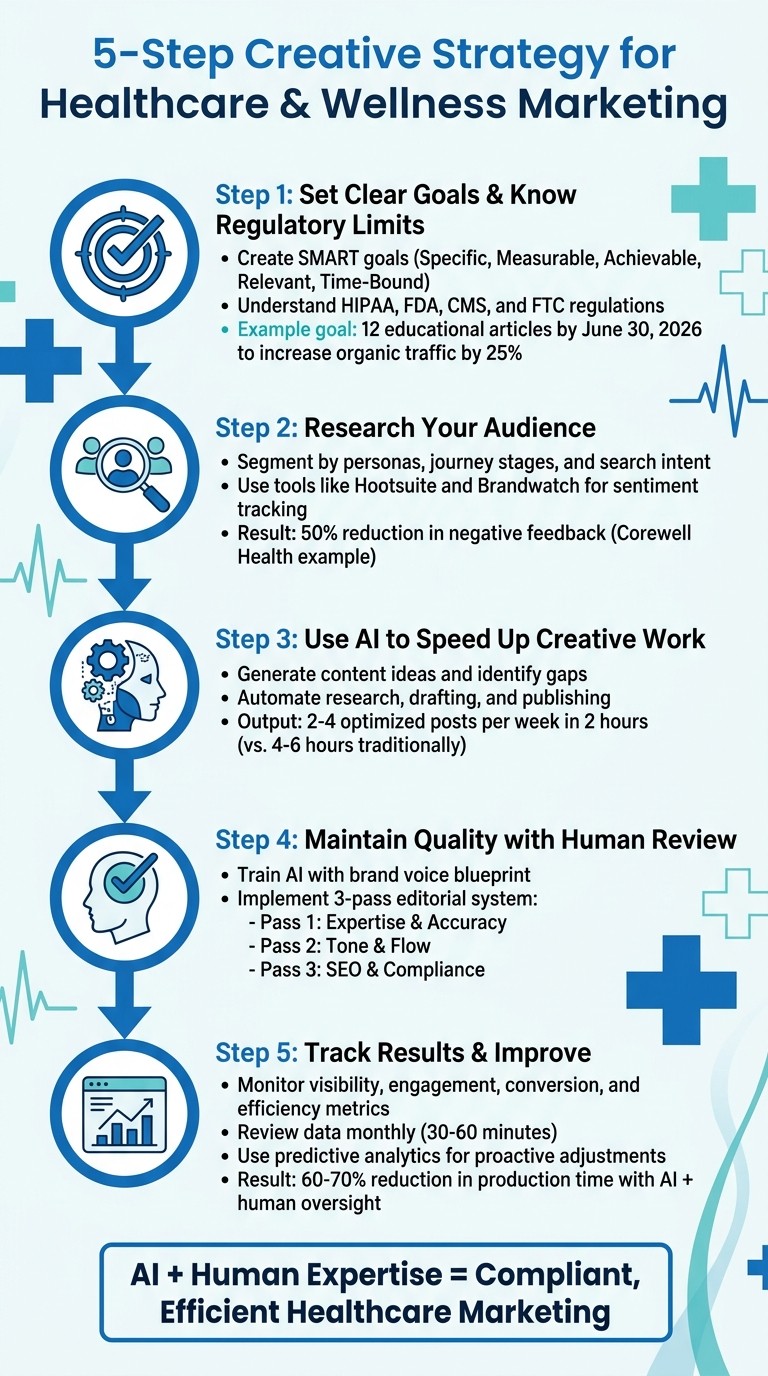
5-Step Healthcare Content Strategy Framework
AI Usage in Healthcare Marketing: Case Study
Step 1: Set Clear Goals and Know Your Regulatory Limits
Before creating content, it's critical to define what success looks like and understand the legal boundaries of your industry. Marketing in healthcare and wellness operates under strict regulations from HIPAA, FDA, CMS, and FTC, all of which shape how you communicate and manage data. A single misstep - like a non-compliant email or social media post - can lead to serious repercussions [2]. These initial decisions lay the groundwork for the rest of your strategy.
Create SMART Goals
Start by setting clear, measurable objectives. SMART goals - Specific, Measurable, Achievable, Relevant, and Time-Bound - align your creative efforts with both business priorities and patient needs. Avoid vague targets like "improve engagement." Instead, aim for something specific: for instance, publishing 12 educational articles on diabetes management by June 30, 2026, to increase organic traffic by 25%. This approach ensures your keyword strategy prioritizes business goals and domain authority over sheer search volume [1].
Focus on goals that enhance patient education, build trust, and foster engagement. For example, a wellness brand might aim to cut patient no-show rates by 42% using AI-based scheduling tools [2]. Whatever the objective, tie it to measurable results and a clear timeline.
Learn the Rules That Apply to Your Industry
Understanding the regulatory framework is non-negotiable. Compliance forms the backbone of effective healthcare marketing. Here are the key regulations to know:
Regulation | Focus Area | Marketing Impact |
|---|---|---|
HIPAA | Patient Data Privacy | Requires secure data handling and BAAs with vendors. |
FDA | Product Promotion | Enforces clinical accuracy and safety disclosures for drugs/devices. |
CMS | Healthcare Services | Regulates marketing for Medicare/Medicaid-related services. |
FTC | Advertising Ethics | Prohibits deceptive or unsubstantiated health claims. |
HIPAA mandates that patient data and Protected Health Information (PHI) are handled securely. This means any platform you use for marketing must have a Business Associate Agreement (BAA) if it processes or stores PHI [2]. FDA guidelines require pharmaceutical and medical device companies to maintain clinical accuracy and include safety information in promotional content [2]. CMS rules oversee how healthcare plans and services are marketed, while FTC regulations ensure that health claims are truthful and backed by evidence [2].
Even with the speed of AI tools, human oversight remains essential to verify accuracy [1]. If you're using AI for patient-facing tasks like scheduling or data intake, ensure the platform complies with HIPAA by securing a BAA [2]. Regularly audit AI tools like ChatGPT and Gemini to confirm they provide factually correct and compliant information [2].
With well-defined goals and a solid understanding of the rules, you'll be ready to dive deeper into understanding your audience in the next step.
Step 2: Research Your Healthcare and Wellness Audience
Understanding your audience is the cornerstone of effective healthcare marketing. Healthcare decisions are deeply personal and often emotionally charged, so your focus should be on providing evidence-based answers that resonate with their concerns. It’s not about flashy slogans - it’s about addressing what truly matters to your audience. To do this, move beyond simple demographics and explore their specific worries, search habits, and decision-making processes.
Divide Your Audience into Groups
The first step is to segment your audience using anonymized and privacy-compliant data that uncovers actionable insights. Break them into groups based on personas, journey stages, and search intent. For instance, someone searching for "early signs of diabetes" needs foundational information, while "best endocrinologist near me" indicates they’re ready to take action.
Tools like Hootsuite and Brandwatch can help track real-time patient concerns. For example, in 2025, Corewell Health used Hootsuite Listening to monitor patient sentiment, which led to a 50% reduction in negative feedback by addressing issues head-on [6][7].
To gain deeper insights, platforms like Indeemo enable you to capture "in-the-moment" patient experiences through mobile diary studies or video feedback [5]. This approach can reveal emotional highs and lows throughout the patient journey, from the onset of symptoms to treatment adherence [5].
Write Messages That Address Real Concerns
Effective messaging centers on the challenges your audience faces rather than promoting your brand. Patients will only trust your expertise if they feel understood. For example, if your target audience includes new parents worried about infant sleep safety, focus directly on that concern instead of offering a generic overview of pediatric care [1].
"How do we align content, SEO, and AI so that the information patients see... is accurate, consistent, and helpful?" - eHealthcare Strategy & Trends [3]
AI can help organize your content and synthesize research, but emotional connection requires human input. Add real-world examples and unique insights that reflect your expertise. For instance, if your clinic specializes in chronic pain management, share anonymized patient stories to illustrate how personalized care improved their lives.
Always verify your claims through human review [1]. Use the "read aloud" test to ensure your tone feels conversational and approachable - your content should sound like advice from a trusted provider, not a dry textbook [1].
With your audience clearly segmented and your messaging refined, you’ll be ready to harness AI tools to streamline creative execution in the next step.
Step 3: Use AI Tools to Speed Up Your Creative Work
Once you’ve mapped out your audience and fine-tuned your messaging, the next step is scaling up your content production. AI tools can help you turn what would normally take weeks into just hours of work - but they work best when treated as collaborators, not replacements for human expertise.
The trick is to let AI handle repetitive, non-specialized tasks like synthesizing research, generating outlines, and formatting for SEO. This frees up your team to focus on critical areas: verifying medical facts, adding unique perspectives, and ensuring compliance. By blending AI’s efficiency with human oversight, you can create high-quality, compliant content faster and more effectively.
Generate Content Ideas with AI
AI tools are excellent at identifying what’s already working in your industry and uncovering gaps in existing content. For example, Averi’s AI engine scans competitor content to pinpoint content gaps - topics or questions that high-ranking articles have overlooked [1]. If you’re a telehealth provider targeting busy professionals, AI might suggest hooks like "5-minute stress relief techniques for remote workers" or "How to fit therapy into a packed schedule", tailored to your audience’s needs [8].
One of the biggest advantages of AI in this stage is maintaining a consistent brand voice. Tools like Averi store your Brand Core, which includes your tone and clinical guidelines, so every suggestion aligns with your established standards [1]. This eliminates the need to constantly re-upload brand guidelines and reduces the risk of off-brand ideas slipping through. Planning your content calendar 4–6 weeks in advance gives your team enough time for editorial and compliance reviews [4]. With AI generating fresh ideas, you can move seamlessly into drafting and publishing.
Automate Research, Drafting, and Publishing
After approving a topic, AI can take over the heavy lifting: analyzing search results, creating detailed outlines, and drafting structured content with hyperlinked sources for easy verification [1]. However, it’s crucial to have human reviewers verify every fact and medical claim before publishing [1]. In healthcare, inaccurate information isn’t just a mistake - it’s a compliance risk.
To ensure quality, adopt a three-layer review process: one for verifying original insights and data, another for maintaining brand voice, and a final check for SEO and technical accuracy [1]. Averi makes this process even smoother by integrating directly with platforms like WordPress, Webflow, and Framer, eliminating the need for manual uploads. With this workflow, you can produce 2–4 optimized, compliant posts per week in just 2 hours of total time, compared to the 4–6 hours typically required per post using traditional methods.
"We accomplished more in two weeks with Averi than we had in an entire quarter. Their platform helped us cut through the noise and actually grow our customer base." - Maya Patel, Founder of Health & Wellness Brand [8]
Step 4: Maintain Quality with Brand Voice and Human Review
In healthcare, speed without precision is just noise. While AI can churn out content at record speed, it can't replicate the nuances of your brand's perspective or spot the subtle compliance pitfalls that come with regulated industries. The key isn't about choosing between AI and humans - it's about creating a workflow that leverages the strengths of both.
Teach AI Your Brand Voice
Think of training AI as you would onboarding a new writer. Start by providing detailed guidelines to minimize the need for revisions. Develop a voice blueprint that outlines your tone (e.g., empathetic or authoritative), preferred sentence style (concise or descriptive), and vocabulary. Pair this with 5–10 examples of your highest-performing content - like social media posts, email openings, or blog excerpts - alongside annotated examples of "off-tone" content to clarify what doesn’t fit (e.g., "too promotional" or using restricted language) [9][10].
This process helps the AI understand where your boundaries lie. Tools like Averi can integrate these rules, ensuring drafts align with your brand’s standards. You can also use persona-driven prompting by assigning the AI specific roles, such as "Act as our knowledgeable Patient Advocate", to fine-tune its tone for healthcare-related content using advanced AI prompting strategies [10]. Once this groundwork is laid, human review becomes critical for catching compliance and quality nuances.
Add Review Steps for Compliance and Quality
AI-generated content should always be treated as a starting point. In healthcare, skipping human review isn’t just risky - it’s outright dangerous. AI can confidently present outdated or incorrect medical information, making it essential for humans to verify every claim before publication [1]. Building on the review process outlined in Step 3, incorporate a three-pass editorial system to ensure brand voice and compliance are intact [1]:
Editorial Pass | Focus Area | Key Tasks |
|---|---|---|
Pass 1: Substantive | Expertise & Accuracy | Verify statistics, add original insights, include real-world examples, and remove unnecessary filler. |
Pass 2: Voice | Tone & Flow | Read the content aloud, eliminate robotic phrasing, and rewrite passive sentences actively. |
Pass 3: Technical | SEO & Compliance | Review headings, meta descriptions, internal links, and alt text for compliance and optimization. |
This layered approach ensures adherence to HIPAA and other regulations while maintaining professional standards [1]. Assign each piece of content to a designated human reviewer who is responsible for its accuracy and tone [4].
"Training AI is like mentoring a junior writer. The more detailed you are, the faster it adapts." - Ryan Acton [9]
The objective isn’t to automate everything - it’s to create better content, faster, while applying human judgment where it’s most crucial [1]. With quality and compliance in place, the next step is to monitor outcomes and refine your approach further.
Step 5: Track Results and Improve Over Time
A strategy without measurement is just guesswork. In healthcare, tracking key metrics is what separates campaigns that attract patients from those that drain resources. The focus should always be on identifying the most impactful performance indicators.
Monitor the Metrics That Matter
Zero in on metrics that directly influence business outcomes. Start with visibility metrics, such as keyword rankings, AI citations (how often your content appears in tools like ChatGPT or Perplexity), and impressions, to measure whether your content is reaching its audience. Then, look at engagement metrics like click-through rates (CTR), time on page, and social shares to assess how well your content resonates. Finally, conversion metrics - such as signups, demo requests, and newsletter opt-ins - reveal whether your visibility is driving tangible actions [4].
Operational efficiency also matters. Track efficiency metrics like content velocity (how much you produce and how quickly) and the time spent creating each post. For instance, drafts stuck in the "In Review" stage point to workflow bottlenecks [4].
"If you can't connect individual posts to traffic and conversions, you can't learn from what works" [4].
Metric Category | Key Performance Indicators (KPIs) | Purpose |
|---|---|---|
Visibility | Keyword Rankings, AI Citations (GEO), Impressions | Gauge reach in search and AI tools |
Engagement | Click-Through Rate (CTR), Time on Page, Social Shares | Assess content quality and relevance |
Conversion | Signups, Demo Requests, Newsletter Opt-ins | Measure direct business outcomes |
Efficiency | Content Velocity, Production Time per Post | Track operational performance |
By focusing on these metrics, you not only measure engagement but also ensure compliance and uncover areas for improvement. This data-driven approach lays the groundwork for refining your strategy.
Use Analytics to Refine Your Approach
Once you’ve established your key performance indicators, it’s time to dive into the data. Set aside 30–60 minutes each month to review your results and adjust your priorities. Compare the performance of AI-generated content with your traditional, human-only benchmarks to see if your workflows are delivering better outcomes [1].
Predictive analytics can take this a step further by forecasting results and helping you adjust strategies proactively. Instead of reacting to last quarter’s data, you can allocate resources based on predicted patient acquisition or potential churn risks [2].
"Predictive models that sit on your team's dashboard aren't going to move the needle. To drive decisions, the output needs to be communicated clearly to the people who control spending" [2].
Tools like Averi streamline this process by tracking performance, identifying trends, and offering recommendations on what to create, update, or prioritize - based on real-time data [4].
A great example of analytics in action comes from Endeavor Health (formerly Northshore-Edward-Elmhurst Health), which used IQVIA's NLP technology in 2026 to analyze unstructured patient notes for social determinants of health. By automating the identification of issues like food insecurity across thousands of records, social workers were able to shift from spending 80% of their time on manual chart reviews to dedicating 80% of their time to direct patient care. This contributed to closing a 22-year life expectancy gap [2]. This shows how analytics, when applied strategically, can go beyond just tracking performance to driving meaningful improvements.
Conclusion
Combining clear objectives, audience understanding, AI-driven execution, and thorough human oversight creates a winning creative strategy for healthcare and wellness. AI can handle tasks like research, drafting, and optimization with remarkable speed, while human expertise ensures strategic alignment and compliance with regulations.
Studies indicate that AI-assisted workflows can reduce production time by 60%–70% when paired with human oversight [4]. As Marc D. Succi, MD, Associate Chair of Innovation at Mass General Brigham, explains:
AI is going to make us the most efficient version of ourselves, in terms of delivering health care more efficiently and managing the administrative side [11].
However, efficiency alone isn’t enough - accuracy and fairness must remain top priorities for clinicians and marketers.
Tools like Averi simplify the process by automating research, drafting, and performance tracking, all while maintaining a consistent brand voice through human review. The aim isn’t to automate everything but to create better content faster, leaving human experts to focus on areas requiring judgment [1].
In healthcare, where errors can endanger patients and regulatory missteps have serious consequences, this balanced approach is non-negotiable. Always verify data and incorporate human review before publishing. This is how you create a strategy that is both compliant and effective.
FAQs
What’s the safest way to use AI without risking compliance?
The best approach to using AI in healthcare responsibly starts with creating a governance framework that ensures compliance with regulations such as HIPAA. This means putting data privacy and security at the forefront. Opt for AI tools that come equipped with compliance features, like automated systems to monitor and enforce regulatory standards. Additionally, adhering to federal guidelines, such as the HHS AI Strategy, can provide a solid foundation for implementing AI in a way that aligns with legal and ethical requirements in healthcare environments.
How do I choose patient segments that actually convert?
To effectively target patient groups that are likely to engage with your healthcare services, focus on identifying segments whose needs align closely with what you offer. Leverage AI tools to sift through demographic and psychographic data, revealing patterns that can help you categorize patients based on factors like age, medical conditions, or lifestyle choices. Once you've identified these segments, craft messaging that speaks directly to their unique concerns. Regularly monitor engagement metrics to fine-tune your strategy, ensuring your campaigns stay relevant and impactful, ultimately boosting conversion rates.
Which KPIs matter most for healthcare content ROI?
When evaluating the return on investment (ROI) for healthcare content, a few key performance indicators (KPIs) stand out. Patient trust and satisfaction is paramount, often gauged through surveys and direct feedback. Equally important are metrics like content reach and accessibility, particularly when AI tools are employed to tailor and distribute educational materials effectively. Lastly, operational efficiency plays a crucial role. This includes streamlined content production processes and improved patient acquisition rates, with AI integration frequently leading to notable gains in both engagement and revenue.
Related Blog Posts

Zach Chmael
CMO, Averi
"We built Averi around the exact workflow we've used to scale our web traffic over 6000% in the last 6 months."
Your content should be working harder.
Averi's content engine builds Google entity authority, drives AI citations, and scales your visibility so you can get more customers.