

In This Article
Step-by-step guide to build a B2B SaaS paid media strategy: define audiences, match offers to funnel stages, pick channels, optimize ads, and track performance.
Updated:
Trusted by 1,000+ teams
Startups use Averi to build
content engines that rank.
Paid media is essential for B2B SaaS businesses to drive growth. With long sales cycles and multiple decision-makers, relying only on organic channels won’t cut it. Paid ads help create touchpoints across the buyer's journey, building trust and familiarity with key stakeholders.
Here’s how to create a winning strategy:
Define your audience: Use CRM data to build Ideal Customer Profiles (ICPs) and buyer personas. Tailor messaging for end users, evaluators, and budget approvers.
Align offers to funnel stages: Provide educational content for top-of-funnel leads, case studies for mid-funnel prospects, and free trials or demos for bottom-of-funnel buyers.
Choose the right platforms:
Google Ads for high-intent searches.
LinkedIn Ads for precise targeting by job title, industry, and seniority.
Meta Ads for cost-effective retargeting.
Organize campaigns: Structure by funnel stage and audience, and use clear naming conventions to simplify management.
Optimize ads and landing pages: Focus on pain points, results, and social proof. Keep landing pages focused on a single call-to-action.
Track and refine: Use tools like UTM parameters and CRM integrations for accurate tracking. Optimize based on metrics like cost-per-click (CPC) and conversion rates.
Leverage AI tools: Automate ad creation, tracking, and adjustments with platforms like Averi AI.
PPC Strategy for B2B SaaS: What Actually Works in 2025
Define Your Audience, Offers, and Success Metrics
Before investing in ads, it’s crucial to have a clear understanding of who you’re targeting, what you’re offering, and how you’ll measure success. Skipping this foundational step can derail your entire campaign. Let’s break down how to identify your ideal customers and align your strategy accordingly.
Build Ideal Customer Profiles and Buyer Personas
Start by defining your target audience through a mix of data analysis and understanding key stakeholder roles. Dive into your CRM data to uncover trends in company size, industry, tech stack, and growth stage. Look at product usage patterns and win-loss reports to identify what drives success for your customers.
With this information, create an Ideal Customer Profile (ICP) to target the right companies, and develop detailed buyer personas for the key decision-makers within those organizations. Most B2B SaaS products involve multiple stakeholders, such as:
End users: Those who will actively use the product.
Evaluators: Individuals tasked with researching and comparing options.
Budget approvers: Decision-makers who sign off on the purchase.
Tailor your messaging to resonate with each group. For example, a product manager might respond well to LinkedIn ads emphasizing workflow efficiency, while a CFO may be more interested in ROI-focused messaging delivered through search ads.
AI-driven GTM platforms can be incredibly helpful here. These tools offer rich insights into target accounts, industries, and personas, making them essential for strategies like Account Based Marketing (ABM)[1]. They enable deeper research into specific accounts and contacts, allowing for more personalized and effective outreach[1].
Match Offers to Each Funnel Stage
Your offers should align with where prospects are in the sales funnel. For top-of-funnel leads, focus on educational resources like reports, webinars, or guides to spark interest. Mid-funnel prospects, who are actively evaluating options, might respond better to comparison pages, case studies, or product demos. Bottom-of-funnel buyers, ready to make a decision, are more likely to engage with free trials, personalized demos, or direct sales conversations.
The right offer also depends on your sales model. For product-led companies, bottom-of-funnel offers like free trials may drive conversions. In contrast, enterprise SaaS businesses often require top-of-funnel content to build awareness and nurture leads over a longer sales cycle.
Set Goals, Budgets, and Performance Metrics
Establish clear goals before launching any campaign. Avoid getting distracted by vanity metrics and instead focus on outcomes that directly impact your pipeline. Key performance indicators might include:
Cost per qualified lead (CPQL)
Customer acquisition cost (CAC)
Revenue attribution from paid channels
When setting budgets, base them on your acquisition economics. Start with a test budget to identify what works, and then scale your efforts on proven channels. By doing so, you’ll ensure your campaigns are both effective and cost-efficient.
Select Channels and Structure Your Campaigns
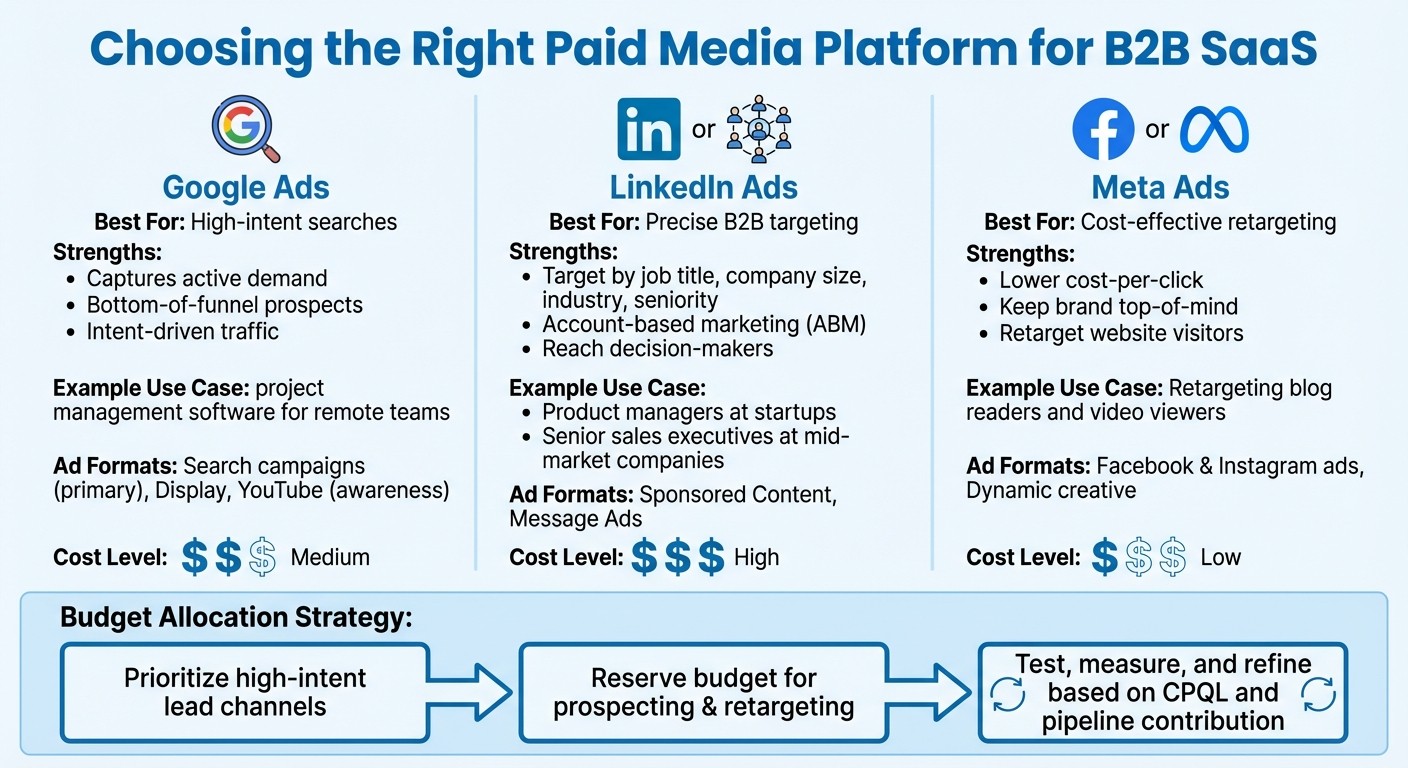
B2B SaaS Paid Media Platform Comparison: Google Ads vs LinkedIn vs Meta
Once you’ve defined your audience and created tailored offers, the next step is deciding where to advertise. Each platform has its strengths for B2B SaaS marketing, and how you structure your campaigns will determine how effectively you can scale.
Pick the Right Channels for B2B SaaS
Google Ads is a powerful tool for capturing demand from buyers actively searching for solutions. For instance, search campaigns perform well for high-intent queries like "project management software for remote teams", making it ideal for prospects at the bottom of the funnel who are ready to evaluate their options. While Google Display and YouTube can help build awareness at the top of the funnel, search campaigns typically deliver the best results for intent-driven traffic.
LinkedIn Ads stands out for its precise targeting capabilities. You can reach decision-makers and influencers based on job title, company size, industry, or seniority, making it especially effective for account-based marketing strategies. Although LinkedIn’s costs tend to be higher, it’s a smart choice for building awareness among niche, high-value audiences. Ad formats like Sponsored Content and Message Ads work particularly well for promoting gated content such as webinars or whitepapers.
Meta Ads (Facebook and Instagram) shines when it comes to retargeting. If someone has already visited your website or interacted with your content, Meta’s relatively lower cost-per-click can help keep your brand top-of-mind. However, for direct prospecting in B2B, LinkedIn often delivers better results than Meta.
When allocating your budget, think about where your buyers spend their time and which stage of the funnel you’re targeting. You might prioritize channels that capture high-intent leads while reserving some budget for prospecting and retargeting. Regularly test, measure, and refine your approach based on metrics like cost per qualified lead (CPQL) and contribution to your pipeline.
The next step is structuring your campaigns to leverage each platform’s strengths effectively.
Organize Campaigns for Scale
Once you’ve chosen your channels, organizing your campaigns becomes critical for testing, optimizing, and scaling efficiently.
For Google Ads, segment campaigns by funnel stage and intent. For example, you could create separate search campaigns for high-intent keywords like "best CRM for startups", broader informational queries like "what is customer relationship management", and branded terms. Within each campaign, group keywords by theme to keep your ad copy relevant and improve your Quality Score, which can help reduce costs. Additionally, set up separate Display or YouTube campaigns to retarget site visitors effectively.
On LinkedIn, structure campaigns around audience segments and offers. For instance, one campaign might target product managers at startups with a webinar, while another could focus on senior sales executives at mid-market companies with a case study. Use LinkedIn’s Matched Audiences to retarget website visitors, email list members, or CRM-based accounts. To ensure LinkedIn’s optimization algorithms perform well, make sure your prospecting audiences are large enough.
For Meta retargeting, divide your audience based on how they’ve engaged with your content. Create campaigns targeting visitors to key pages, blog readers, or video viewers, while excluding those who’ve already converted or are existing customers. Dynamic creative tools can streamline the process of testing multiple ad variations, helping you find what resonates most effectively.
To keep everything organized, adopt a clear naming convention for your campaigns, such as:
[Platform][Funnel Stage][Audience]_[Offer] (e.g., LI_MoF_ProductManagers_CaseStudy or Google_BoF_BrandedSearch_FreeTrial). This approach simplifies filtering and makes performance reporting across campaigns much more manageable.
Create Ads and Conversion Paths That Convert
Design ads and landing pages that guide prospects seamlessly through your funnel, offering clarity, proof, and an effortless path to conversion.
Write Ad Copy and Design Visuals That Work
Your ad copy should address the specific challenges your ideal customers face. Instead of focusing on features, highlight the results they can achieve. Take, for instance, Copy.ai's messaging from December 2025. It tackled "GTM bloat" and the hassle of managing "dozens of disconnected AI copilots and point solutions", positioning itself as a "single platform" that can "codify best practices, unify data, connect teams, and eliminate GTM bloat" [1]. This messaging worked because it identified the problem and offered a clear and compelling solution.
To strengthen your claims, include social proof and testimonials. This consistency ensures your message resonates across all touchpoints, from ads to landing pages.
Build Landing Pages That Drive Conversions
A landing page should focus on one primary goal - whether it’s "Get Demo", "Start Free Trial", or "Download Guide." This call-to-action (CTA) should be strategically repeated throughout the page. Every element - headlines, subheadings, and social proof - needs to reinforce this single objective.
Start with a strong value proposition that directly addresses the visitor's pain point. For example, Copy.ai’s landing pages lead with "AI-Native GTM Platform" and emphasize benefits like "double your pipegen per rep" and "drafts delivered in seconds, not weeks" [1]. This approach immediately communicates the value visitors can expect.
Social proof plays a critical role. Highlight user numbers, recognizable client logos, and testimonials from respected industry figures. Consider this quote from Jean English, Former Chief Marketing Officer at Juniper Networks:
"Thanks to Copy.ai, we're generating 5x more meetings with our personalized, AI-powered GTM strategy" [1].
These endorsements reassure potential customers that others have achieved meaningful results, making them more likely to trust your offering.
Keep the page streamlined, ensuring every element serves the conversion goal. Clearly confirm submissions to reassure users, and if they don’t convert right away, guide them to the next step in your funnel.
Set Up Retargeting and Email Nurture Flows
Retargeting campaigns are essential for staying top-of-mind with prospects who need additional encouragement. Tailor your messaging based on user behavior - someone who viewed your pricing page might need a different approach than someone who only skimmed a blog post. Be sure to exclude those who’ve already converted to make the most of your budget.
Pair retargeting with email nurture flows to keep prospects engaged throughout the funnel. For instance, if someone downloads a guide, follow up with a series of emails offering related resources like case studies, product demos, or webinar invites. These touchpoints help nudge them closer to making a decision.
Tools like Averi AI can simplify the process of creating ad copy, landing page content, and email sequences. By using its /create mode, you can transform a brief into ready-to-deploy assets in one seamless workflow, ensuring consistency across your entire conversion strategy.
Track Performance and Automate with AI
Once your channels are set up and your creative work is live, the next step is to ensure accurate tracking and leverage automation tools to streamline your strategy.
Configure Tracking and Attribution
Start by implementing conversion tracking on platforms like LinkedIn, Google, and Facebook using their native tracking pixels. Link these platforms to your CRM - whether it's Salesforce, HubSpot, or a similar tool - to monitor leads from their first interaction all the way to closed deals. To ensure clarity in your data, apply consistent UTM parameters. A standard example might look like this:
utm_source=linkedin&utm_medium=paid_social&utm_campaign=q1_demo_drive&utm_content=variant_a.
For B2B SaaS companies, attribution can be particularly challenging due to long buying cycles and multiple touchpoints. First-touch attribution helps identify which channel initially brought in the lead, while multi-touch attribution spreads credit across all interactions throughout the customer journey. Configure your CRM to capture both models, allowing you to compare results and gain a clearer picture of performance from initial engagement to final conversion.
Diagnose Issues and Optimize Campaigns
Once tracking is in place, use the performance data to identify and fix potential problems. If your metrics aren't hitting the mark, take a closer look at areas like targeting, creative assets, and landing pages:
High CPC (Cost Per Click): Widen your targeting or experiment with different keyword variations.
Low CTR (Click-Through Rate): Update your ad copy to focus on specific pain points or try new visuals.
Strong CTR but low conversions: Check for message alignment between the ad and landing page, simplify forms, or enhance your value proposition.
Rising CPA (Cost Per Acquisition): Reassess your targeting, funnel alignment, and landing page performance.
Declining impression share: Consider increasing your bids or expanding your audience targeting.
Review these metrics on a weekly basis to make small, strategic adjustments rather than completely overhauling your campaigns.
Use AI Tools to Speed Up Campaign Execution
With performance insights in hand, automate repetitive tasks to improve efficiency and speed up campaign adjustments. AI platforms like Averi AI offer centralized solutions for tracking, optimization, and execution.
Averi's Synapse architecture directs tasks seamlessly between AI-generated solutions and human expertise. When deeper strategy or specialized execution is needed, Averi's Human Cortex taps into a network of vetted marketing professionals who already have access to your brand guidelines, past campaigns, and strategic context via the shared Library. This setup reduces the back-and-forth typical with traditional agencies or freelancers. Over time, Averi's Library evolves with your campaigns, enabling faster and smarter launches.
"Copy.ai has been phenomenal in transforming the way we develop marketing content. By automating workflows that would typically take weeks and cost thousands of dollars through agencies, they've saved us $16 million dollars this year alone."
Roman Olney, Head of Global Digital Experience at Lenovo [1]
Conclusion
Crafting a successful paid media strategy for B2B SaaS hinges on a well-defined audience and deliberate execution. Start by identifying your target audience with precision and aligning your offers to each stage of their buyer journey. Focus on platforms that decision-makers already use - LinkedIn for role-based targeting, Google Ads for intent-driven searches, and retargeting to keep your brand top-of-mind. Build campaigns that are easy to scale and design ads and landing pages that address specific pain points directly. This groundwork sets the stage for every optimization that follows.
Once your campaigns are running, tracking becomes your guiding light. Make sure your tracking framework captures the entire journey, from the first click to the final deal. Regular performance reviews are essential - check metrics like CPC and conversion rates weekly to spot and resolve any issues before they impact your budget. Small, thoughtful tweaks are often more effective than large-scale overhauls.
AI tools can also streamline your efforts. Platforms like Averi AI integrate AI-generated content with marketing experts who already have access to your brand’s guidelines and previous campaigns. This unified workspace eliminates the need to juggle between ChatGPT, Google Docs, design software, and freelancer platforms. Strategy, creation, and execution all come together seamlessly in one place.
The best paid media strategies rest on a solid foundation: accurate targeting, consistent messaging, robust tracking, and continuous refinement. By leveraging AI-driven automation, you gain more time to focus on strategy while your campaigns operate efficiently behind the scenes.
FAQs
How can Averi AI improve a B2B SaaS paid media strategy?
Averi AI reshapes your B2B SaaS paid media efforts by taking the heavy lifting out of tedious processes, sharpening audience targeting, and simplifying ad creation. It combines the speed of AI with the insight of human expertise, ensuring your campaigns are both efficient and effective.
Here’s what Averi AI brings to the table:
Automated Workflows: Get campaigns up and running faster by automating repetitive tasks.
Smarter Targeting: Pinpoint the right decision-makers with refined audience research.
On-Brand Content Creation: Develop compelling, high-quality ads that connect with your audience.
By cutting out inefficiencies and honing in on precision, Averi AI empowers you to boost ROI while reducing the headaches of managing paid media campaigns.
What are the main differences between Google Ads, LinkedIn Ads, and Meta Ads for B2B SaaS marketing?
Google Ads stands out for search-driven campaigns aimed at capturing leads with high intent. Its extensive reach and precise keyword targeting make it a strong option for connecting with users actively searching for B2B SaaS solutions.
LinkedIn Ads excel in account-based marketing, offering unmatched access to professionals in specific industries or roles, including decision-makers and executives. With its advanced targeting capabilities, LinkedIn is a solid choice for reaching niche B2B audiences.
Meta Ads, which include Facebook and Instagram, are less suited for direct B2B SaaS lead generation due to their consumer-focused nature. However, they can play a valuable role in brand awareness and retargeting campaigns, particularly when you want to engage broader audiences or stay on the radar of existing prospects.
How can I align offers with each stage of the sales funnel in a B2B SaaS strategy?
To craft offers that align with each stage of a B2B SaaS sales funnel, consider the following:
Top of Funnel (Awareness): At this stage, the goal is to spark interest. Offer educational materials, downloadable guides, or free trials that give potential customers an introduction to your product without requiring a commitment.
Middle of Funnel (Consideration): Once prospects show interest, nurture them with more targeted content. This could include product demos, case studies that highlight success stories, or tailored consultations to address their specific challenges.
Bottom of Funnel (Decision): When prospects are ready to make a decision, provide tools to help them commit. Free pilots, enticing pricing options, or detailed ROI breakdowns can highlight the value your solution brings and encourage them to close the deal.
By aligning your offers with where prospects are in their journey, you can effectively guide them through the sales funnel and improve the chances of converting them into customers.
Related Blog Posts

Zach Chmael
CMO, Averi
"We built Averi around the exact workflow we've used to scale our web traffic over 6000% in the last 6 months."
Your content should be working harder.
Averi's content engine builds Google entity authority, drives AI citations, and scales your visibility so you can get more customers.