

In This Article
Define emotional triggers, align tone and visuals, and use AI-powered workflows to build a consistent, vibe-driven B2B SaaS brand.
Updated:
Trusted by 1,000+ teams
Startups use Averi to build
content engines that rank.
Hook: Most B2B SaaS brands fail to stand out because they focus on features, not feelings.
Value Summary: A vibe-driven brand connects emotionally with its audience, creating trust and loyalty that outlasts competitors. By crafting a relatable personality and maintaining consistency across all channels, you can boost customer retention by 20% and revenue growth by 60%. This guide explains how to define your brand's "vibe", audit its alignment, and use AI tools to keep your messaging sharp and impactful.
Quick Overview:
Why it matters: Emotional resonance drives trust, with 81% of buyers prioritizing brands they trust.
Key steps:
Define emotional triggers that matter to your audience.
Maintain a consistent tone and personality.
Use AI tools to automate and refine your brand vibe.
Regularly audit your messaging, visuals, and workflows.
Results: Consistent branding can increase revenue by 23–33%, while emotionally connected customers are 70% more valuable.
Bridge: Let’s dive into how to create and sustain a vibe-driven brand that resonates deeply with your audience.
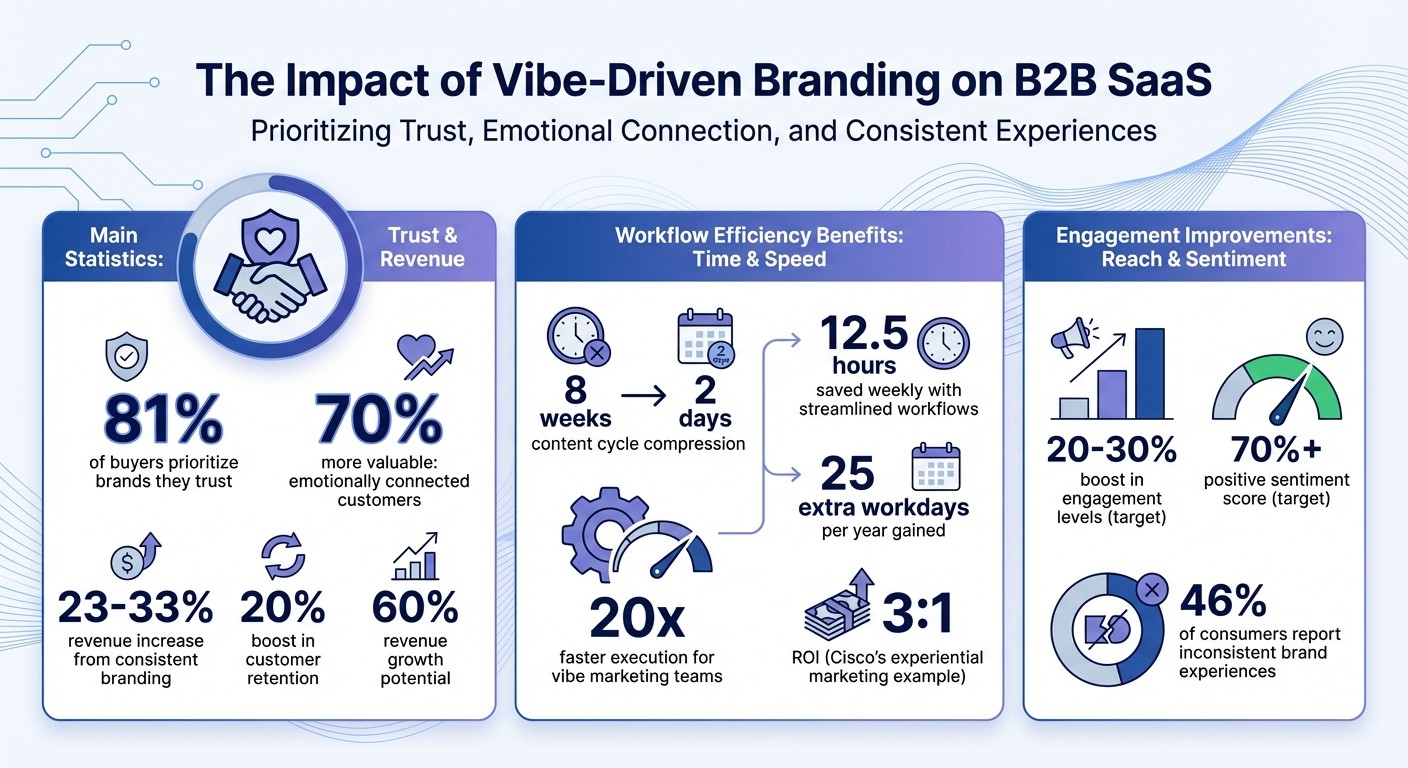
Vibe-Driven Branding Impact: Key Statistics for B2B SaaS Success
B2B Marketing: How To Build A Brand in 2025
Define Your Core Vibe
Your brand's vibe isn't just a collection of buzzwords or generic descriptors. It's about creating a specific emotional experience every time someone interacts with your business - whether they're visiting your homepage, opening a marketing email, or reaching out to customer support. This emotional blueprint becomes the foundation for every customer interaction and begins with understanding how your audience feels when facing the challenges your product addresses.
Find Your Audience's Emotional Triggers
To pinpoint these emotional triggers, start by talking to the people who use your product - especially those in engineering, IT, or product teams. These conversations often reveal deep-seated frustrations and unmet needs. For example, Lucidchart discovered through customer interviews that its users weren’t just looking for diagramming tools; they needed help untangling complex systems and fixing inefficient processes [8].
Another way to align your brand with emotional needs is by using brand archetypes. These archetypes help connect your product's purpose to universal emotional drivers. For instance:
If your product inspires innovation, the Magician archetype (focused on transformation and possibility) might resonate.
If your platform empowers users to make smarter decisions, the Sage archetype (centered on wisdom and insight) could be a natural fit.
Salesforce, for example, embraced the Hero archetype by spotlighting customer success stories that celebrated overcoming obstacles, which built trust and loyalty [6][7]. Similarly, analyzing testimonials and success stories can uncover recurring emotional themes, like empowerment or stress relief - just as LogRhythm highlighted the unsung heroes of cybersecurity [7].
Set a Consistent Tone and Personality
Once you’ve identified the emotional triggers that matter most to your audience, translate them into a consistent tone and personality across all your communications. Define your tone along specific dimensions, such as Friendly ↔ Formal, Cheerful ↔ Serious, or Innovative ↔ Classic. Document these choices thoroughly, including stylistic rules like whether contractions are allowed or if sentences should stay under a certain word count [5].
For example, brands like Dropbox and Mailchimp use Friendly, Cheerful, and Innovative tones to make technical products feel approachable [5]. Salesforce reinforces its identity not just through tone but also through visual consistency, such as its cloud logo, blue color palette, and friendly messaging style [6][7].
"Brand voice isn't a collection of adjectives. It's the accumulation of ten thousand micro-decisions about word choice, sentence rhythm, cultural references, humor tolerance, vulnerability willingness, and opinion strength." - Averi Academy [1]
To keep your tone distinctive, create a "never say" list of overused corporate jargon like "synergy", "best-in-class", or "ecosystem." These choices help your brand avoid blending into the sea of generic business language, often referred to as "corporate beige" [1].
Use AI Tools to Analyze and Suggest Brand Vibes
AI tools can be incredibly helpful in defining and maintaining your brand vibe. For instance:
Averi AI analyzes your website, competitor sites, and audience language to identify tone, visuals, and messaging patterns, while also highlighting areas where emotional triggers might be missing.
SparkToro uncovers demographic and psychographic trends in your audience.
Sentiment analysis platforms like Brandwatch and Mention track shifting moods and conversations to ensure your tone stays relevant.
BuzzSumo identifies which emotional triggers are driving viral content in your industry.
The key is to use these tools to identify patterns and refine your voice - not just to collect adjectives. Feed your AI tools with 10–20 examples of content that perfectly reflect your desired tone, then document the recurring tone elements [1]. Regular audits, conducted quarterly, can help ensure your brand voice remains distinct and aligned with your core vibe.
With these steps in place, you're ready to evaluate your current brand to ensure it aligns with the emotional experience you aim to deliver.
Audit Your Current Brand for Vibe Alignment
Once you've nailed down your core vibe, the next step is to ensure your brand actually delivers on it. This requires a thorough review of all the ways your audience interacts with you - whether it’s your homepage, email campaigns, or social media posts. The goal? Spotting where your messaging, visuals, or tone stray from the emotional connection you're trying to create.
Review Your Brand Messaging
Start by gathering every piece of content your customers see. Then, evaluate it against the tone dimensions you’ve defined - whether that’s friendly vs. formal, cheerful vs. serious, or modern vs. traditional. Look for inconsistencies that might dilute your brand's impact.
Sentiment analysis tools can be a lifesaver here. These platforms assess emotional tone at scale, flagging areas where your language doesn’t match your desired vibe. Key metrics to monitor include sentiment polarity (positive, negative, or neutral), emotional categories (like trust, joy, or frustration), and consistency scores across your content. Why does this matter? Research shows that emotionally connected customers are 70% more valuable, so getting your tone right isn’t just a nice-to-have - it’s critical [9].
Take Lucidchart, for example. In 2024, they audited their messaging after struggling to gain traction in enterprise sales. By interviewing customers across departments like IT and engineering, they discovered their language wasn’t resonating with decision-makers. They restructured their messaging around three key needs - process improvement, system visualization, and Microsoft Visio replacement - and successfully pivoted into enterprise markets [8]. Similarly, BambooHR refined their tone to emphasize "human-centered" messaging, which helped them grow from 30 employees to over 1,000 by focusing on culture-first communication [6][8].
To avoid falling off track, run these audits quarterly. A simple test? Remove your logo from a piece of content and ask if it’s still recognizable as yours. If not, your brand voice might need tightening [1].
Once your messaging is aligned, it’s time to ensure your visuals match the vibe.
Align Visuals and Design
Your visual elements - logos, colors, fonts, imagery, and even animations - should reflect the emotional tone you’re striving for. A playful brand might lean into bold colors and lively animations, while a more professional one might favor muted tones and sleek transitions. Mailchimp is a great example of a brand that nails this balance with visuals that perfectly complement their friendly, approachable tone [5].
To align your visuals, gather all your design assets and ask these questions: Do the colors evoke the right feelings? Does the imagery match your brand’s personality? A/B testing can help you pinpoint which designs resonate most with your audience. And don’t overlook functionality - 46% of consumers say brands fail to deliver a consistent experience because design elements either don’t load properly or feel disconnected [1].
For even deeper insights, consider using AI tools to refine your audit.
Use AI-Powered Feedback Loops
AI can speed up the process by identifying inconsistencies that might be hard to catch on your own. Tools like Averi AI analyze both messaging and visuals in real time, flagging mismatches - like overly formal language in a playful brand - and suggesting alternatives based on your tone guidelines. This "vibe coding" approach lets you iterate quickly and keep your content aligned [9].
Here’s a quick workflow: Input your assets into an AI platform, set vibe parameters (like playfulness or authority), review the feedback and suggested variations, and then test these changes using performance data. This process works especially well for small teams looking to maintain emotional engagement with limited resources [9].
To keep your brand voice sharp, sample both AI-generated and human-written content every three months. Watch out for the dreaded "corporate beige" tone - generic, forgettable language that makes your brand blend into the background. Create a "never say" list of overused jargon (think "synergy" or "best-in-class") and use it to train your AI tools [1]. This ensures your voice stays distinct and recognizable.
"Your brand voice is your competitive moat in an AI-democratized world. The question is whether you'll protect it or accidentally surrender it in the pursuit of efficiency." - Zach Chmael, CMO, Averi [1]
After each audit, track key metrics like engagement rates, emotional resonance scores, conversion rates, and Net Promoter Scores (NPS). Compare these results to pre-audit performance. Since emotionally connected customers drive 70% more value, and consistent branding can boost revenue by 23–33%, the effort is well worth it [9][6][1].
Build Vibe-Driven Workflows Across Channels
Creating a system that consistently delivers the emotional experience your audience expects - whether through a blog post, a LinkedIn update, or an email - is essential. By leveraging insights from your audits, you can ensure every channel reflects your brand's emotional DNA, leaving no room for inconsistency.
Set Up Vibe-Optimized Content Workflows
Marketers lose over an hour daily to context switching, which not only wastes time but also waters down your brand’s identity. When strategy lives in Google Docs, drafts are in Notion, approvals happen in Slack, and publishing requires manual CMS uploads, maintaining a consistent vibe becomes nearly impossible [2]. For B2B SaaS teams, this fragmentation can be a dealbreaker.
The solution? Bring everything into a single workspace. Replace the traditional, sequential workflow - strategy, then creation, then approval - with parallel processes. Here, strategy and creation happen simultaneously, and testing starts while drafts are still being fine-tuned [2]. This shift can save marketers 12.5 hours weekly, which adds up to 25 extra workdays per year [2].
Start by loading your brand’s core elements - tone guidelines, visual standards, and messaging frameworks - into one system. When a new piece of content is required, AI can handle the initial research and drafting, keeping your brand’s vibe intact. Human editors step in at key "quality gates" to refine voice and ensure cultural sensitivity without starting from scratch [1]. This approach enables vibe marketing teams to execute 20x faster, compressing traditional 8-week content cycles into just 2 days [3]. Use tools like Averi AI to automate tone checks throughout the research, drafting, and approval phases.
"Vibe marketing is all about how your brand makes people feel, not just what it says. Marketers are using AI tools to shape that feeling faster, with more emotional nuance and precision." - Flo Crivello, CEO, Lindy [4]
Apply Your Vibe Across All Marketing Channels
Once workflows are streamlined, the next challenge is consistency. It’s not enough to nail the tone on your homepage if your email campaigns or LinkedIn posts feel disconnected. This is where many B2B SaaS brands falter.
Vibe stacking ensures that every piece of content reflects your brand’s emotional DNA, even if the formats vary [2]. For instance, your LinkedIn posts might be short and punchy, while your guides are more detailed, but the underlying personality - whether bold and direct or thoughtful and empathetic - should remain unmistakable. To maintain this consistency, monitor your context-switching ratio (how often team members switch tools) and momentum scores (how long they stay focused on one task) [2].
The benefits are hard to ignore. Research shows that a consistent brand presentation across all channels can boost revenue by 23–33% [1]. To keep everything aligned, conduct quarterly voice audits, sampling content across platforms to ensure your tone hasn’t drifted into something generic [1].
Test and Refine Emotional Triggers
Even with efficient workflows and consistent messaging, your brand’s vibe needs to evolve. What resonates with your audience today may not work six months from now. That’s why ongoing testing is key. Regular feedback ensures your emotional triggers stay relevant.
Use A/B testing to explore different emotional approaches. Does your audience engage more with humor or authority? Urgency or reassurance? Track both quantitative metrics (like engagement rates, conversions, and time on page) and qualitative signals (such as sentiment analysis, customer feedback, and social media comments). When you identify trends - like certain emotional triggers driving higher engagement - focus on those in future content. For underperforming triggers, don’t wait for quarterly reviews; tweak them immediately.
This constant refinement helps your brand stay in tune with your audience’s shifting emotions.
"It's about using machines to systematize the creative intuition behind modern brands - at scale, with speed, and with measurable impact." - Ashley, Content Strategist, Ramp [3]
Measure and Improve Your Brand Vibe's Impact
A vibe-driven brand isn't just about feeling - it’s about measurable results. After completing your brand audit and aligning workflows, the next step is evaluating the impact. To ensure your emotional positioning connects with your audience, start by tracking sentiment scores. These scores reveal how people perceive your brand across platforms like social media, customer reviews, and support channels. Tools like Google Analytics can help you monitor engagement metrics, such as time spent on a page and bounce rates. Aim for over 70% positive sentiment and a 20–30% boost in engagement levels [10]. This data will guide you in fine-tuning your approach across all touchpoints.
Track Key Metrics for Vibe Performance
In addition to sentiment, keep a close eye on engagement rates (e.g., likes, shares, and comments) and conversion rates. For example, Salesforce leverages these metrics to maintain its approachable tone, which has strengthened community loyalty [6][7]. Similarly, BambooHR scaled from 30 employees to over 1,000 by tracking how its human-focused messaging resonated with culture-driven companies [8]. To streamline this process, set up dashboards that aggregate weekly data. Tag content by vibe attributes - like “cheerful” or “authoritative” - to compare performance before and after launching new strategies [5].
Use Performance Data to Refine Your Strategy
Once you start collecting data, use it to guide your next steps. Tools like Averi AI can analyze content performance and audience feedback, offering actionable suggestions. For instance, if sentiment drops, it might recommend shifting from a formal tone to a friendlier one or increasing cheerful elements by 15% to potentially raise engagement by 25% [10]. A/B testing can also help you pinpoint which tone variations resonate most. For example, when Cisco collaborated with the BottleRock music festival in 2023, they tracked brand awareness among IT executives. The result? A 3:1 return on objective (ROO), faster pipeline velocity, and higher deal values compared to conventional leads [10]. Integrating analytics with your CRM further allows you to see how vibe-aligned content shapes the customer journey.
Compare Before and After Metrics
To validate your strategy, compare key metrics before and after implementation. For instance, if engagement rates jump from 2.5% to 4.2%, or monthly leads grow from 150 to 280, the numbers speak for themselves. Cisco’s experiential approach at the BottleRock festival not only boosted brand perception but also sped up deal cycles, showing how vibe-driven strategies can deliver tangible business results [10]. Review these metrics quarterly to identify underperforming content and make immediate adjustments. This ongoing evaluation ensures your brand maintains a consistent and impactful vibe over time.
Conclusion: Maintaining Your Vibe-Driven Brand
Once you've established a vibe-driven brand, the challenge lies in keeping that emotional connection alive as your business grows. This isn't a one-time effort; it's an ongoing process. Successful brands expand their reach by building systems and tools that support their personality, ensuring their core emotional appeal remains intact [1]. To keep your brand consistent, create a style guide that outlines your tone, humor boundaries, and references that resonate with your audience [12]. Regularly review your messaging - quarterly voice audits can help prevent your brand from slipping into a bland, overly corporate tone [1].
Key Takeaways
To refine and sustain your brand's vibe, focus on these essentials:
Define and document your emotional triggers.
Audit your messaging and visuals frequently.
Simplify workflows for efficiency.
Measure engagement consistently to fine-tune your approach.
Research shows that consistent branding can boost revenue by 23–33%, while emotionally connected customers are 70% more valuable to businesses [1][11]. Use tools like the "Logo Test" to ensure your content stands out and remains unmistakably yours [1].
Next Steps
Start by documenting your brand voice with clear, actionable guidelines. For instance, specify whether to use contractions or keep sentences concise - under 25 words, for example [1]. AI tools like Averi AI can help centralize these guidelines and monitor their application in real time, cutting down on the mental fatigue caused by constant context-switching, which can drain up to 20% of focus [2]. Additionally, set up live dashboards to track feedback instantly. This allows you to adapt your strategy on a weekly basis instead of waiting for quarterly reviews [12].
"AI is not a replacement for brand voice - it's an amplifier, and what you choose to amplify matters more than production speed." [1]
While automation can handle routine tasks, storytelling, strategic decisions, and the nuances of your brand voice remain tasks best suited for humans [1][12]. Let technology support your efforts, but keep the heart of your brand firmly in human hands.
FAQs
What’s the fastest way to define my brand’s core vibe?
To shape your brand's core identity quickly, AI tools can be a game-changer. They help pinpoint and articulate the emotional tone and essence that define your brand. Start by delving into your audience's needs and feelings, then use AI to craft storytelling, visuals, and messaging that resonate with the vibe you want to project. This method allows for quick adjustments, sharp communication, and a genuine connection with your audience.
How do I maintain a consistent vibe across all channels?
To maintain a unified presence across all channels, focus on aligning your brand’s visuals, tone, and messaging through a reliable framework. Utilize AI tools like Averi to streamline personalization and automate content delivery effectively. Establish clear guidelines rooted in your brand’s core principles - like the efficiency of AI, the nuance of human creativity, and smooth execution. Ensure every message reflects clarity, confidence, and a relatable, human voice to create a consistent and cohesive brand experience.
How can I prove a vibe-driven brand is working?
To showcase the success of a vibe-driven brand, focus on measurable indicators that reflect emotional resonance and cultural impact. Key metrics include audience engagement, the consistency of storytelling, and overall brand perception. Pay attention to signs of deepening emotional connections and growing relevance within your target audience. Additionally, track metrics like audience reactions and long-term growth to gauge how effectively the brand builds meaningful relationships and aligns with cultural trends.
Related Blog Posts

Zach Chmael
CMO, Averi
"We built Averi around the exact workflow we've used to scale our web traffic over 6000% in the last 6 months."
Your content should be working harder.
Averi's content engine builds Google entity authority, drives AI citations, and scales your visibility so you can get more customers.