

In This Article
Guide to define, audit, and scale a vibe-driven brand using interviews, social listening, vibe sheets, and automation to build emotional loyalty.
Updated:
Trusted by 1,000+ teams
Startups use Averi to build
content engines that rank.
A vibe-driven brand connects with people emotionally, focusing on feelings, tone, and personality instead of just product features. This approach is essential for startups to stand out, especially in competitive markets where products are easily replicated. By prioritizing emotional connection over traditional demographics, brands can build loyalty and trust.
Key takeaways:
Emotional tribes: Target groups with shared values or mindsets, not just demographics.
Examples of success: Liquid Death used a rebellious image to reach a $1.4 billion valuation, and Duolingo’s quirky TikTok content boosted engagement to 4.03%.
Proven impact: 88% of consumers prefer brands they see as genuine, and emotional ads outperform rational ones by driving 31% more profit.
Startups can define their vibe through customer interviews, social listening, and clear emotional positioning. Consistency across tone, visuals, and actions is critical to avoid "vibe-washing." Tools like AI-powered social listening and automation help maintain this consistency while scaling. A concise "vibe sheet" can guide teams in keeping the brand personality intact across all channels.
The key is to create a brand that feels human, resonates emotionally, and builds long-term loyalty.
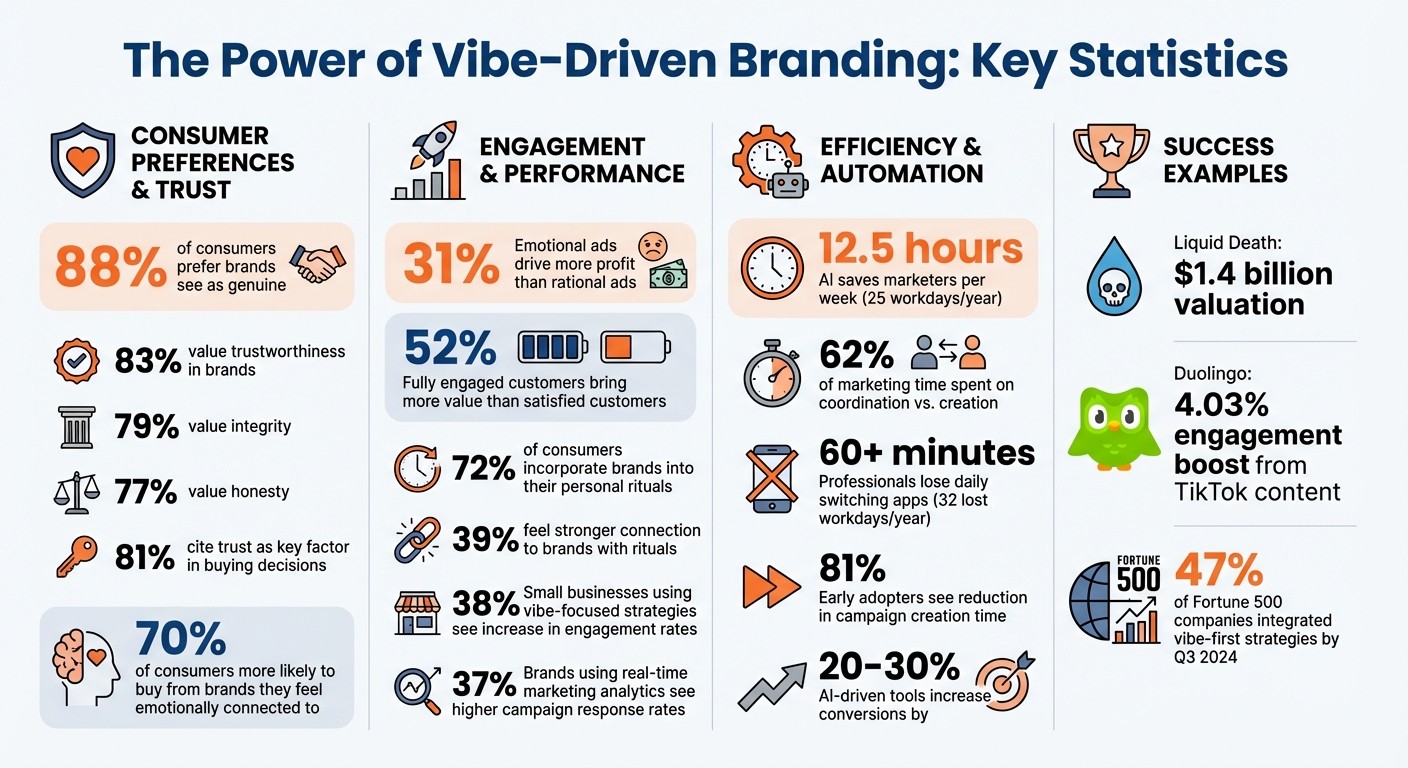
Vibe-Driven Branding: Key Statistics and Impact Metrics for Startups
How to create a brand vibe (real life playbook)
Define Your Brand's Vibe
Your brand's vibe is all about the emotional connection your product creates and the feelings it inspires. It’s less about who your audience is demographically and more about what drives them emotionally - whether that’s confidence, a sense of belonging, or finding deeper meaning in their lives [8][13].
Begin by conducting 10–15 validation interviews to uncover what truly resonates with your customers. Ask questions that dig into the emotional and functional values they associate with your product [9]. Use the Jobs-to-be-Done framework to pinpoint the deeper emotional need: are you helping people “feel like they belong” or “build confidence”? [8][13]. This approach takes you beyond just features and into the emotional core where genuine connections are formed.
To get the most honest insights, focus on where your audience speaks freely. These raw, unfiltered conversations often take place on "dark social" platforms like Discord, niche Reddit threads, or Slack groups [10]. AI-powered social listening tools can help you interpret complex emotional tones, such as “excitement mixed with anxiety” [10]. This deeper understanding sets you apart from surface-level research and helps you tap into the emotional energy that drives your audience.
Understand Your Target Audience
Once you’ve defined your brand’s emotional pull, it’s time to fine-tune your understanding of your audience. People connect most with brands they perceive as trustworthy (83%), having integrity (79%), and being honest (77%) [8]. These aren’t just abstract ideals - they’re the emotional foundation that determines whether someone sticks with your brand or moves on. Fully engaged customers bring 52% more value than those who are simply satisfied, and 81% of consumers cite trust as the key factor in their buying decisions [8][12].
To clarify your place in your audience’s world, use a positioning formula: “For [target customer] who [statement of need], [Product] is a [category] that [key benefit]. Unlike [competitor], [Product] [differentiation]” [11]. This forces you to articulate not just what your product does, but why it matters emotionally. Then, assess the "vibe gap" - compare how you want your brand to be perceived with how your audience actually feels about it by leveraging social listening tools [10][3].
Articulate Your Brand's Core Personality
With a clear sense of your audience, distill your brand’s personality into 3–5 "feeling words" - like grounded, playful, or luminous - that will guide everything from Instagram captions to customer service emails [14]. These words should go beyond generic marketing jargon to create a visceral, emotional connection.
Take it a step further by developing a sensory vocabulary. Imagine your brand as a physical space, a playlist, or even a season. For instance, ask yourself: “If my brand were a room, what would it look like? What textures and colors would it have?” Descriptions like “linen curtains” or “pristine white walls” create a shared visual language that translates abstract ideas into tangible design cues [14]. Think of a brand like Notion, which uses muted colors and soft visuals to convey calm productivity [4].
Structure your brand’s vibe using five key elements: Tone of Voice, Visual Language, Values, Rituals, and Community Cues [1]. Conduct a tone audit to ensure your voice is consistent across all platforms, from social media posts to customer support emails [1]. Look for opportunities to create rituals - small, memorable actions that become part of your audience’s habits, like Oreo’s famous “twist, lick, dunk” routine [1]. When 72% of consumers incorporate brands into their personal rituals, these seemingly small moments can drive lasting loyalty [1].
"A brand is not a logo. A brand is not a corporate identity system. It's a person's gut feeling about a product, service, or company." - Marty Neumeier, Author [11]
Audit Your Current Brand and Research Your Market
Before you can refine your brand's identity, you need a clear understanding of where it stands today, recognizing that brand guidelines are just the beta version of a living system. A thorough audit helps you pinpoint the disconnect between how you want to be seen and how your audience actually experiences your brand. It’s about identifying inconsistencies that weaken emotional ties and spotting opportunities that competitors might be missing.
Start by assessing whether your brand feels cohesive across all the places your audience interacts with it. People today are quick to notice whether a brand feels genuine or manufactured. A candid audit ensures you stay on the side of authenticity.
Audit Your Existing Brand Assets
Dive into your brand's assets with a critical eye. Start with a tone audit across all communication channels - social media, help articles, customer emails, and website copy. Ask yourself: does your brand sound like the same "person" everywhere, or does the voice shift depending on the platform? Consistency in tone builds recognition and trust.[1]
Next, examine your visual coherence. Remove your logo and see if your brand is still recognizable through its colors, typography, and imagery. If it’s not, your visual identity needs refinement.[1]
Don’t overlook values alignment. Review your product features, partnerships, and how you respond to challenges. Do your actions reflect the values your brand claims to champion? This is key to avoiding "vibe-washing" - a term for brands that claim values they don’t genuinely uphold.[1][7]
Finally, conduct a friction audit to identify inefficiencies in your workflows. Are tool switches, approval delays, or coordination hiccups slowing you down? Research shows that 62% of marketing time is spent on coordination rather than actual creation, with professionals losing over 60 minutes daily switching between apps - amounting to around 32 lost workdays each year.[3] Highlighting these bottlenecks can help you reclaim time for creativity.
Audit Component | What to Check | Why It Matters |
|---|---|---|
Tone Audit | Vocabulary, sentence structure, emotional tone across channels | Builds a consistent "personality" that resonates with your audience |
Visual Audit | Colors, typography, imagery - recognizable without the logo | Strengthens brand memory and immediate recognition |
Friction Audit | Tool switching, approval delays, workflow bottlenecks | Frees up time for creative work and improves responsiveness |
Values Audit | Product decisions, partnerships, crisis responses | Keeps your brand genuine and avoids perception issues like "vibe-washing" |
Once you’ve examined your internal assets, it’s time to look outward and see how your brand is perceived in the market.
Use Tools for Audience and Industry Insights
After mapping out your internal brand reality, shift focus to the external world. Set up a social listening system to tap into unfiltered audience conversations. Use platforms like Twitter/X Advanced Search for live updates, TikTok Creative Center for trending content, LinkedIn for professional insights, and Reddit for authentic community discussions. Tools like Brandwatch or Mention can provide sentiment analysis, while SparkToro helps uncover demographic and behavioral trends.
The goal here is to identify your "vibe gap" - the difference between how competitors position themselves and where real audience conversations are happening. Teams using AI-powered analytics adapt to market shifts 5x faster than those relying on traditional methods, and brands leveraging real-time data see 37% higher campaign response rates compared to static data approaches.[3] Keep an eye on micro-influencers (1,000–10,000 followers) for a 3–5 day lead time on emerging trends.
"The competitive edge in 2025 is no longer what you say, but the velocity at which you can respond to culture." - Stormy AI[7]
To stay focused, create a simple Relevance Assessment Matrix for evaluating trends. Score each trend based on three factors: Audience Overlap (does it align with at least 70% of your target demographic?), Brand Alignment (does it fit your brand’s personality?), and Trend Velocity (how quickly is it gaining traction?). This approach ensures you prioritize trends that truly connect with your audience while avoiding distractions from fleeting fads.
Build Your Vibe-Driven Branding Principles
Once your audit and market insights are complete, it's time to transform them into a practical branding framework. This isn't about creating a static document that gathers dust - it’s about crafting a "Vibe Sheet" that serves as a dynamic guide. This sheet should define one dominant mood and two supporting ones, shaping every interaction your brand has with its audience[7].
To bring this to life, focus on five key elements: tone (the personality your words convey), visual language (choices in color and typography that evoke emotion), values (the principles steering your decisions), rituals (patterns of behavior that build loyalty), and community cues (signals that create a sense of belonging)[1]. Avoid vague descriptors like "friendly" or "modern." Instead, lean into sensory imagery - think "linen curtains with dusty rose lighting" - to make your brand identity feel tangible[14].
Create a Vibe Style Guide
Start by answering sensory-driven prompts to make your brand identity specific. For instance, if your brand were a room, how would it look? If it were a playlist, what songs would define it? If it were a season, which one would it be?[14] These exercises turn abstract ideas into actionable creative decisions.
For every customer touchpoint, write a one-sentence description of how your vibe should come across. For example: "The website should feel like stepping into a sunlit studio", or "Customer emails should sound like advice from a savvy, approachable friend."[14] This clarity ensures that all channels feel connected rather than disjointed.
Define your tone of voice with precision, detailing preferred vocabulary, sentence structure, and emotional tone. Whether your brand leans into humor, raw honesty, or aspirational energy, documenting these elements guarantees consistency across all content.
Take inspiration from Liquid Death, which turned canned water into a nine-figure business by embracing a "rebellious punk and metal vibe." CEO Mike Cessario crafted such a distinct identity that superfans have even tattooed the logo on their skin[7][5]. Achieving this level of loyalty requires documenting every detail, from packaging to social media captions to live events.
Your guide should also outline rituals - specific ways customers interact with your product. Oreo’s "twist, lick, dunk" ritual elevated their cookie into an icon. Research shows that 72% of consumers integrate brands into their rituals, and 39% feel a stronger connection to brands that do this well[1]. What ritual could your startup create to deepen customer loyalty?
This detailed, sensory-first guide ensures your brand’s vibe is unmistakable, no matter where or how it appears.
Align Your Vibe Across All Channels
Consistency is essential for reinforcing the emotional connection your brand establishes. This doesn’t mean posting the same content everywhere. Instead, it’s about preserving the emotional essence of your brand while tailoring the format to fit each platform. Your LinkedIn posts may differ from your TikTok videos, but both should unmistakably reflect your brand’s personality.
Operational inefficiencies are the biggest threat to maintaining consistency. Slow workflows can prevent your brand from responding quickly to cultural moments. To stay agile, many startups are adopting Centaur Marketing - a hybrid approach where human strategists guide AI tools to ensure consistent, high-quality output across all channels[7]. Brands that use real-time marketing analytics outperform those relying on static methods, with 37% higher campaign response rates[3].
"The competitive edge in 2025 is no longer what you say, but the velocity at which you can respond to culture."
Be cautious of vibe-washing - adopting a trendy aesthetic that doesn’t align with your actual product or values[7]. For instance, if you claim to be "transparent and human" but your customer support feels slow and impersonal, the disconnect will quickly erode trust. Make sure your internal operations align with the vibrant, fast-paced identity you project.
Implement and Scale Vibe-Driven Strategies
Creating a vibe-driven brand is just the start. The real challenge lies in scaling that vibe without losing its emotional essence. As your startup grows, the focus shifts from defining your brand to embedding it into every process, campaign, and interaction with customers. This involves smart use of automation and aligning your team to work in harmony with your brand's identity.
Your vibe can't just live in a branding document; it needs to be part of the systems that create content, handle customer interactions, and engage with trends in real time. Early adopters have seen campaign creation time drop by 81% through this approach [2]. The startups excelling in this space aren't just producing better content - they're building faster, smarter systems that keep the emotional heart of their brand intact. This operational shift also sets the stage for leveraging automation tools that ensure consistency while scaling.
Use Automation and Tools for Consistency
Manual processes can drain your team's energy and dilute your brand's vibe. Endless spreadsheets, approval chains, and switching between tools slow everything down. On the other hand, AI and automation can save marketers an average of 12.5 hours per week, translating to about 25 workdays a year [3]. That extra time can be redirected toward strategic thinking instead of repetitive tasks.
The goal is to move from hands-on execution to strategic oversight. Instead of crafting every social post or blog by hand, you focus on defining the emotional intent - the vibe - while AI takes care of the details [2]. This eliminates the bottlenecks that prevent your brand from reacting quickly to trends, customer input, or competitor moves.
Voice consistency engines are especially important. Generic AI tools often produce what’s been dubbed "AI slop", which lacks authenticity. Instead, use platforms that learn your specific tone and style from your existing content - like your website, blogs, and social media [6]. Tools such as Averi can analyze your brand's voice and generate optimized drafts that align with your personality. Each new piece of content strengthens the system’s understanding, improving future outputs.
For visual content, tools like Midjourney and DALL-E can create mood boards and concepts that match your brand's aesthetic, while Runway (Gen-3) offers cinematic B-roll for videos [2][7]. If you're repurposing long-form content, platforms like Opus Clip and Descript allow small teams to quickly produce short clips for TikTok or Instagram Reels [2][7]. With these tools, vibe-led campaigns can launch within 24 hours for under $100, compared to traditional campaigns that might cost up to $20,000 [7].
Automating social listening is another game-changer. Tools like Zapier or Make can connect directly to your content workflow, enabling your system to instantly create content when it detects a trending topic or cultural moment [2][6].
"The competitive edge in 2025 is no longer what you say, but the velocity at which you can respond to culture."
Stormy AI [7]
However, internal consistency is key. If your brand promises speed but your internal systems are slow, the disconnect will be obvious. Make sure your internal processes align with the responsiveness your brand projects [4].
Train Your Team on the Brand Vibe
While automation can handle the heavy lifting, your team’s understanding of the brand vibe remains essential. As your team grows, everyone - from sales to support - needs to embody your brand's personality. Forget bulky manuals; instead, provide clear and actionable guidance.
One way to do this is with a Vibe Sheet - a concise, one-page document that outlines your brand’s core and secondary moods (e.g., "Nostalgic" supported by "Dreamy" and "Irreverent") [7]. This makes it easy for team members to adapt your brand's voice to different scenarios. For example, your sales team might use an upbeat, energetic tone, while your support team takes on a more empathetic approach - all while staying true to your brand identity [4].
Introduce the "Pilot" model to your team. Instead of focusing on execution, team members should concentrate on providing strategic direction and creative input while leaving repetitive tasks to AI [2]. This shift allows professionals to be more productive and creative, freeing them from operational distractions [3]. When your team spends less time managing processes and more time on strategy, your brand vibe remains sharp.
For startups, consider organizing vibe marketing pods - agile marketing teams that can work without getting bogged down by approval delays [3]. This setup keeps creativity flowing while avoiding rigid silos.
Finally, conduct regular friction audits to identify and fix inefficiencies. Track how many tools your team uses, how long approvals take, and where bottlenecks occur. By Q3 2024, nearly 47% of Fortune 500 companies had integrated vibe-first strategies into their core marketing [2]. Startups that scale effectively treat their brand vibe as a dynamic, evolving system. By training their teams to act quickly and confidently, they ensure their vibe remains at the heart of everything they do.
Monitor, Iterate, and Evolve Your Brand Vibe
Your brand vibe isn't static - it needs to adapt to shifting audience preferences, new competitors, and emerging trends. To stay emotionally connected and competitive, treat your brand vibe like a living system, one that evolves based on real-world performance data and market feedback.
But here’s the tricky part: knowing what to measure. Traditional metrics like reach and ad value often fall short as reliable indicators [15]. Instead, focus on shareability - how often people actively share your content - and the specific language your audience uses when discussing your brand [15]. These qualitative insights reveal whether your vibe is striking the right chord or just creating surface-level impressions.
Track Branding Performance Metrics
Start by focusing on what truly matters: engagement speed, sentiment, and conversion rates. While conventional marketing often prioritizes reach and awareness, vibe-driven brands pay close attention to how quickly content spreads and how deeply it resonates [16]. For example, small businesses using vibe-focused strategies have seen engagement rates climb by 38% [18], while startups leveraging AI-driven tools report conversion increases between 20% and 30% [17].
In 2025, a fintech startup revamped its email marketing by adopting a "financial empowerment" vibe. They used AI to test emotional tones like "supportive mentor" versus "pragmatic advisor." The result? An 89% boost in qualified leads over six months [16]. This wasn’t about sending more emails - it was about nailing the emotional tone that connected with their audience.
"Vibe marketing is a way of talking about marketing that goes beyond numbers and long approval flows. It tries to be more dynamic and get past flawed metrics." - Jamie Bulman, Senior Solutions Consultant, Brandwatch [15]
Coca-Cola's "Create Real Magic" campaign in 2025 is another great example. By inviting fans to use DALL-E 2 to create branded artwork, they fostered a collaborative vibe that led to over 120,000 submissions and 7 million social impressions [16]. Similarly, Spotify’s "AI DJ" feature, which used voice cloning for conversational commentary, achieved a 40% weekly engagement rate and a 30% increase in user session time [16].
Brands that rely on real-time marketing analytics enjoy a 37% higher campaign response rate compared to those using static data [3]. Tools like Averi can help you analyze performance continuously, enabling quick adjustments. Also, ensure your visual identity is consistent - ask yourself if your audience can recognize your content without seeing your logo [1].
These insights enable you to refine your creative approach as trends evolve.
Adapt to Changing Market Trends
Performance metrics aren’t just numbers; they’re a roadmap for adapting to market shifts. To remain relevant, your brand vibe needs to reflect current audience sentiment and cultural moments. In 2025, the brands that thrive are those that can quickly align their messaging with the mood of the moment.
Take Heinz’s "AI Ketchup" campaign, for instance. By combining a "Brand Authority + Humor" vibe with AI-generated visuals, Heinz created a campaign that generated 15 million organic impressions and boosted sales by 15% [16]. The secret? Staying true to their playful personality while embracing cutting-edge tools.
Vibe compilers can make experimenting with emotional tones easier. These systems allow lean teams to create magnetic campaigns that outperform traditional departments. These platforms take a natural-language brief (e.g., "confident, pragmatic, value-driven") and generate structured ad campaigns with creative variations [16].
"If I have 1,000 customers, I have 1,000 marketing campaigns tailored to each person. There's no way a human team can do that" [16].
While your core vibe should remain consistent, how you express it must adapt. For example, a "supportive mentor" tone might feel more playful during product launches but shift to empathetic during customer support. Monitor how your audience reacts to these adjustments and fine-tune accordingly. With 70% of consumers more likely to buy from brands they feel emotionally connected to [18], staying relevant to their evolving needs is key.
Conclusion
Building a vibe-driven brand goes far beyond chasing trends or crafting clever slogans - it's about creating an emotional connection that sticks with your audience and earns their loyalty. In a world where 88% of consumers value sincerity when deciding which brands to support [2], your brand's vibe isn't just an added bonus - it’s your edge. It’s what turns casual visitors into loyal advocates and simple transactions into meaningful relationships.
The most successful brands leverage their unique vibe to foster deeper engagement, which directly translates into loyalty. With 70% of consumers more likely to purchase from brands they feel emotionally aligned with [2], the rewards are both immediate and impactful.
"A brand is not what you say it is - it's what they say it is." - Marty Neumeier [19]
The best part? You don’t need a massive budget to start. Begin by reviewing your existing brand assets - evaluate whether your tone, visuals, and values align across the board [1][3]. Pinpoint areas where your vibe feels genuine and where it might need some work. Shift your team’s focus from repetitive tasks to overseeing AI marketing automation that handles the groundwork, freeing up time to hone the emotional and strategic aspects of your brand [2].
Your brand vibe is your startup’s secret weapon. By auditing, refining, and scaling it with thoughtful strategies and smart automation, you can transform your business into a brand that lasts. Let your emotional fingerprint guide the way and watch your brand grow into something unforgettable.
FAQs
How do I find my brand’s vibe fast?
To get a clear sense of your brand’s vibe, start by honing in on its emotional tone, core values, and how well it connects with your audience’s mindset. Identify key factors such as the tone of your messaging, the style of your visuals, and the cues you take from your community. AI-powered tools can help you quickly test and adjust your messaging and visuals to ensure they align effectively. By weaving in genuine storytelling and nurturing a sense of community, you can create a deeper emotional connection, setting your brand apart and encouraging loyalty in a crowded marketplace.
How do I avoid vibe-washing?
To steer clear of "vibe-washing", make sure your brand's emotional appeal and connection with its audience are honest and rooted in reality. Avoid superficial or overstated attempts that fail to align with your true values or the identity of your audience. Instead, prioritize transparent storytelling, engage in ways that genuinely matter, and follow through on your commitments. Building trust and forming real connections comes from substance, not just chasing fleeting trends or polished appearances.
How can I tell if the vibe is working?
To truly understand how your brand is connecting with its audience, pay attention to emotional resonance, customer feedback, and how well it aligns with the values and interests of your community. Instead of relying solely on numbers, focus on qualitative signals like the emotional bonds your brand creates, the level of brand loyalty it inspires, and the strength of its engagement with your audience. These insights can reveal whether your brand's message and identity are striking the right chord.
Related Blog Posts

Zach Chmael
CMO, Averi
"We built Averi around the exact workflow we've used to scale our web traffic over 6000% in the last 6 months."
Your content should be working harder.
Averi's content engine builds Google entity authority, drives AI citations, and scales your visibility so you can get more customers.