

In This Article
A practical 6-step framework to identify, monitor, and analyze B2B SaaS competitors—tools, KPIs, and AI workflows to turn insights into action.
Updated:
Trusted by 1,000+ teams
Startups use Averi to build
content engines that rank.
Competitor research is essential for B2B SaaS companies to thrive in a crowded market where customer acquisition costs have risen by over 20% in 2026. By systematically analyzing competitors, you can allocate resources efficiently, improve your product, and refine your market position. Here's what you need to know:
Identify Competitors: Start with direct rivals (same audience, similar features), indirect competitors (different approaches to the same problem), and substitutes (manual processes or basic tools).
Use Tools and Platforms: Leverage G2, Capterra, SEMrush, and LinkedIn to find competitors, track trends, and uncover market gaps.
Organize by Relevance: Categorize competitors into direct, indirect, and replacement tiers to focus your efforts.
Gather Data: Analyze pricing, features, marketing strategies, and customer sentiment manually and with tools like Ahrefs or SpyFu.
Apply Frameworks: Use methods like Porter’s Five Forces or 2x2 positioning maps to uncover opportunities and threats.
Leverage AI: Automate research with tools like Averi AI to save time and monitor competitors in real time.
Key takeaway: Competitor research isn't just about knowing what others are doing - it's about finding untapped opportunities to stand out. Companies that consistently analyze competitors grow 2.5× faster, reduce costs, and improve decision-making.
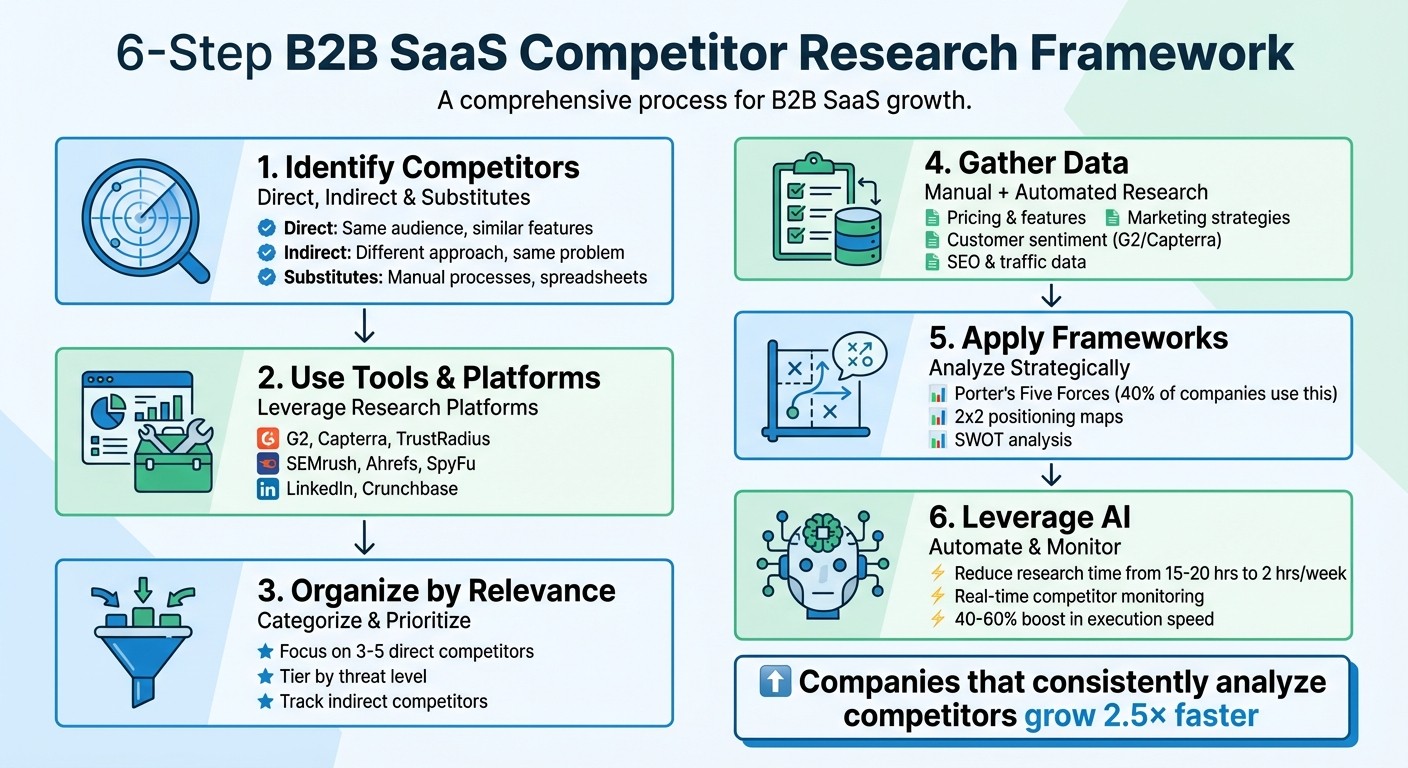
6-Step B2B SaaS Competitor Research Framework
Mastering the art of B2B SaaS competitor research
How to Identify Your B2B SaaS Competitors
Understanding who your competitors are goes beyond just recognizing companies within the same category. Direct competitors address the same problem for the same audience with similar features - imagine Notion versus Coda. Indirect competitors solve the same business need but in different ways, like comparing Notion to Google Docs. Then there are substitutes, which include manual processes, spreadsheets, or even whiteboards that customers rely on before transitioning to a dedicated SaaS solution [7][5].
Not every competitor will equally affect your growth. To pinpoint the real threats, you need a structured approach that identifies who’s vying for your prospects' attention and budget. Once identified, grouping these competitors by their impact and positioning helps lay the groundwork for deeper analysis.
Finding Competitors on Review and Data Platforms
Platforms like G2, Capterra, and TrustRadius are excellent starting points. These tools categorize companies by specific use cases and industries, making it easier to see which products customers are evaluating alongside yours [2][1][3]. You can also use their filters to discover indirect competitors operating in related niches [3][6].
Search engines are another goldmine for competitor insights. Typing "[Your Brand] vs" into Google will often reveal autocomplete suggestions listing competitor names. Similarly, searching "[Competitor Name] alternatives" shows which rivals are being compared in those discussions [12][4][6]. These searches provide a snapshot of the mental shortlist your prospects are building during their decision-making process.
Your sales team and customer interviews are invaluable for uncovering alternatives that prospects consider [4][3]. These conversations often highlight emerging competitors that may not yet have a strong presence on review sites. For a broader perspective, platforms like Crunchbase and CB Insights can help track funding activities, acquisitions, and partnerships - indicators of evolving competitive threats [2][1].
Tools like Ahrefs, SEMRush, or Moz True Competitor can identify websites with overlapping keywords or those ranking for the same high-intent search terms [5][6]. This is especially useful for spotting content competitors who may not offer a similar product but still capture your audience’s attention during research. Don’t overlook social platforms either - searching LinkedIn for hashtags tied to specific industries or problems can reveal up-and-coming players building their presence before appearing on major review platforms [3].
Once you’ve compiled a comprehensive list of competitors from these various channels, the next step is to organize them by relevance and threat level.
How to Categorize Your Competitors
Organizing your competitors into tiers helps prioritize your research. This structured list becomes the foundation for applying frameworks like Porter's Five Forces in later stages. Competitors generally fall into three categories: direct, indirect, and replacement [7][11][5].
Direct competitors are the ones you’ll encounter most often in head-to-head comparisons. These require the most detailed analysis.
Indirect competitors address the same customer needs but with different solutions. While they pose a threat, their weaknesses can also present opportunities for differentiation [6].
Replacement competitors include non-SaaS alternatives like spreadsheets or manual processes. Understanding these helps you craft messaging that highlights the advantages of a purpose-built tool.
Deep analysis should focus on 3–5 direct competitors [7][5].
"A competitive analysis brings all of that information together so you can see your market through the same lens your potential customers use." - Elena Cucu, Socialinsider [3]
Monitoring tools like LinkedIn can provide early warnings of competitive moves. For instance, new roles such as "Enterprise Sales Director" might signal a focus on larger accounts, while expanded engineering teams could indicate significant product investments [8][13]. Automate updates with Google Alerts or Zapier to track brand mentions, pricing changes, and new content from your competitors in real time [1][6]. Additionally, tools like SpyFu can reveal whether competitors are bidding on your brand name or alternative-related keywords in paid search campaigns [6].
How to Collect and Analyze Competitor Data
Once you've categorized your competitors, the next step is gathering data on their pricing, features, marketing strategies, and customer sentiment. A combination of manual research and automated tools works best here. Manual efforts provide a closer look at their messaging and positioning, while automated tools help track metrics like web traffic and keyword performance on a larger scale. Notably, B2B SaaS companies that regularly engage in competitive analysis grow 2.5× faster than those that don't [7].
Manual Research Techniques
Start by auditing competitor websites. Look at their homepage headlines to understand their unique value proposition and target audience - whether they're targeting small businesses or enterprise clients [11][7]. Dive into their pricing and packaging: examine plan names, note if pricing is based on per-user or usage models, and identify which features are reserved for premium tiers. Pay attention to how they encourage upgrades [11].
Customer review platforms like G2, Capterra, and TrustRadius are goldmines for understanding sentiment [13][7]. Read through both positive and negative reviews to spot recurring themes - what customers love, what frustrates them, and where there are gaps in features or service. Complaints about onboarding challenges, hidden fees, or slow support can highlight areas where your product could stand out [11][8][12].
Go through a competitor's signup and onboarding flow yourself. Take note of any friction points, the number of steps involved, how well the mobile experience matches the desktop, and how quickly users are guided to an "aha moment" [11]. Additionally, search for comparison keywords like "[Competitor] vs [Another Competitor]" or "[Competitor] alternatives." These searches reveal how potential customers are evaluating options and what concerns they have [12][9].
To expand these insights, incorporate automated tools that can track data over time and at scale.
Tools for Automated Data Collection
Automated tools complement manual research by providing scalable, real-time data. Tools like SEMrush ($139.95/month) and Ahrefs ($129/month) are invaluable for identifying keyword gaps - terms your competitors rank for but you don't - and analyzing backlink profiles to assess their SEO strength [14]. Similarweb ($125/month) uncovers traffic sources and market share, showing whether competitors rely more on organic search, paid ads, or direct traffic [14].
For real-time monitoring, tools such as Visualping (free tier available; paid plans start at $14/month) alert you to updates on competitor websites, like changes to pricing pages or feature lists [14]. SpyFu ($39/month) focuses on PPC intelligence, revealing the keywords competitors bid on and their historical ad copy [14]. Meanwhile, BuiltWith ($295/month) provides a deep dive into competitors' tech stacks, exposing the marketing tools and analytics platforms they use, which can offer clues about their strategies for lead generation and integration [14].
A great example of leveraging these tools is TestGorilla, which achieved an 80-day CAC payback in early 2026. By using automated tools to identify gaps in pricing transparency among competing HR tech platforms, they secured a $70M Series A funding round [9].
This mix of manual and automated data collection sets the stage for applying analytical frameworks and sharpening your market strategy.
Frameworks for Competitor Comparison
Turn raw data into actionable strategies by using structured frameworks that refine pricing, positioning, and product decisions. For instance, 40% of companies worldwide rely on Porter's Five Forces to evaluate industry dynamics, with B2B SaaS firms leveraging this framework achieving 28% improved market positioning [8].
Applying Porter's 5 Forces to B2B SaaS
Porter's Five Forces provides a systematic way to evaluate competitive pressures in your industry. Here's how it applies to B2B SaaS:
Threat of New Entrants: Assess barriers like extensive integrations, network effects, and high switching costs that deter new competitors.
Buyer Power: Examine how easily customers can switch providers, considering factors like data portability and onboarding challenges.
Supplier Power: Evaluate dependencies on critical resources, such as AWS or other infrastructure providers.
Threat of Substitutes: Look beyond direct software competitors to alternatives like spreadsheets, manual processes, or consulting services.
Rivalry Among Existing Firms: Analyze whether the market is fragmented or dominated by a few key players, and adjust your approach to align with the competitive landscape [8].
"A static analysis tells you where your rivals were. A dynamic framework tells you where they're going." - Big Moves Marketing [8]
Comparing Key Performance Metrics
Organize competitor metrics to identify gaps and opportunities in the market. Key indicators to track include:
Churn Rate: Reflects product stickiness and customer loyalty.
Customer Acquisition Cost (CAC): The median ratio is $2.00 spent for every $1.00 of new ARR.
Revenue Growth: The median growth rate stands at 26%.
Pricing Models: Analyze structures like per-seat, usage-based, or flat-rate pricing [16][17].
Competitive selling is a direct factor in 68% of deals, yet sales teams rate their preparedness at only 3.8 out of 10 - a clear opportunity to strengthen sales strategies [16].
To assess competitors effectively, apply a scoring system. For example, rate attributes on a scale of 1–5 or use symbols (❌ None, ⚠️ Basic, ✅ Good, ⭐ Excellent) to quickly highlight weaknesses. Additionally, use a 2x2 positioning map with axes like "Ease of Use vs. Enterprise Power" or "Price vs. Value" to uncover areas for differentiation [7][8].
Data Category | Key Metrics to Track | Strategic Value |
|---|---|---|
Product & Tech | Core features, pricing tiers, integrations, update frequency | Reveals product strengths and development pace |
Marketing & SEO | Organic traffic, keyword gaps, ad campaigns, messaging | Highlights audience targeting and brand positioning |
Customer Experience | G2/Capterra sentiment, support response times, onboarding speed | Identifies weaknesses in customer interactions |
These metrics serve as the foundation for sales battlecards and strategic reviews. Update battlecards quarterly to keep your sales team equipped with the latest insights. Annually, conduct a deeper analysis to reevaluate your competitive standing [8][16].
Using AI Tools to Automate Competitor Research
Conducting competitor research manually can consume upwards of 15–20 hours each week. AI platforms, however, streamline this process, reducing the time investment to just about 2 hours by automating data collection, monitoring, and analysis tasks [17]. Marketing teams employing AI-driven workflows have reported a 40–60% boost in execution speed, all while maintaining quality [15]. These advancements pave the way for more detailed and continuous monitoring of competitors.
How AI Simplifies Data Collection and Analysis
AI has revolutionized competitor research, turning periodic updates into an ongoing process. With change detection algorithms, businesses can track competitor pricing adjustments, feature rollouts, or shifts in messaging within hours instead of weeks [10]. Tools like Averi AI can scrape competitor websites to uncover keyword strategies, feature lists, and positioning language in mere minutes [5].
AI doesn’t stop at data retrieval - it also sharpens your messaging strategy. Using natural language processing (NLP) models, AI can detect "language saturation" - instances where competitors rely on overused phrases like "comprehensive solution" - and assess AI search engine performance with Retrieval-Augmented Generation. This reveals which brands dominate AI-generated responses, helping refine your messaging to focus on specific, outcome-driven language [10][17]. As 60% of searches now conclude without a click, understanding and leveraging AI-generated recommendations is becoming essential [17].
AI also identifies content gaps by categorizing competitor materials based on target personas and funnel stages. Tools like Averi AI continuously analyze the market, suggesting content ideas backed by strategic reasoning and highlighting areas your competitors have overlooked [17]. Businesses integrating AI into their marketing strategies report a 42% drop in customer acquisition costs (CAC) compared to traditional methods [17].
Incorporating AI Into Your Research Process
Once AI has automated data collection, it can be seamlessly integrated into your research workflow to refine your competitive strategy further. Tools like Averi AI can learn your product, positioning, ideal customer profile (ICP), and brand voice, enabling real-time alerts for changes in competitor pricing or calls to action [17][10]. This allows you to react immediately to aggressive tactics, rather than discovering them weeks later.
Focusing on 3–5 direct competitors ensures data remains clear and actionable [7]. Additionally, creating "Competitor A vs. Competitor B" comparison pages can attract high-intent buyers who are already evaluating larger competitors, positioning your brand as the better choice [12].
To enhance visibility, design comparison tables in clean HTML and include FAQ sections with schema markup. AI search engines are more likely to extract this information for product recommendations [12]. Visitors referred by AI systems convert at an impressive 14.2%, compared to just 2.8% for traditional organic search [12].
"We built Averi around the exact workflow we've used to scale our web traffic over 6000% in the last 6 months." - Zach Chmael, CMO, Averi [12]
How to Apply Research Findings to Your Strategy
Competitor research only makes an impact when it leads to actionable changes. Gathering data is just the first step; the real difference between average and top-performing SaaS companies lies in how effectively they transform insights into decisions that fuel product development, pricing strategies, and marketing campaigns.
Finding Market Gaps and Opportunities
Once you've collected detailed competitor data, it's time to turn those insights into strategic moves. A helpful approach is to organize competitor features into three categories:
"Table Stakes": Essential features like SSO or API access.
"Differentiating": Unique capabilities that set a brand apart.
"Innovative": Advanced features that only a few competitors offer. [7]
This categorization helps prioritize your roadmap by revealing areas where competitors fall short or are entirely absent.
Another effective tactic is analyzing negative reviews on platforms like G2 and Capterra to identify customer pain points your product can resolve. For example, in 2026, Playvox, a CX platform, revamped its demand generation strategy by targeting "complaint keywords" found in competitor reviews, such as "[Competitor] issues" or "[Competitor] alternatives." This approach slashed their cost per lead by 10x and boosted lead volume by 163%. [9][6]
A 2x2 positioning map can also help identify unoccupied market space. By plotting competitors on axes like "Ease of Use vs. Power" or "Generalist vs. Specialist", you can pinpoint areas where no one dominates, giving you a chance to carve out a unique position. For instance, mid-market buyers often go underserved when competitors focus solely on enterprise clients. Aligning your content and features with these overlooked segments can open new opportunities. [7][11][10][5]
"A well-built framework moves beyond simple feature comparisons to uncover deep strategic insights. It answers the questions that truly matter: Where should we play, and how can we win?" - Big Moves Marketing [8]
Refining Your Pricing and Positioning
Once you've identified market gaps, the next step is to refine your pricing and positioning to exploit competitor weaknesses. Don't just look at price points - dig into their pricing architecture, including models like per-user or usage-based pricing, value metrics, and free tier strategies. [7] Look for vulnerabilities like recent price hikes, hidden fees, or overly complex add-on structures, and position your pricing as a simpler, more transparent alternative.
TestGorilla leveraged pricing-focused campaigns to highlight its transparency, achieving an 80-day CAC payback period that played a key role in securing its $70M Series A funding round. [9][6]
Another effective strategy is creating "Your Brand vs. Competitor" comparison pages. These pages, designed to influence buyers during their final evaluation stage, often convert 2-5x higher than general blog content. Use clean HTML tables and FAQ sections to structure the comparison data - AI search engines favor this format when recommending products. Interestingly, visitors referred by AI systems convert at 14.2%, compared to just 2.8% for traditional organic search. [12]
Equip your sales team with "battlecards" - concise, one-page documents that highlight competitor weaknesses. Include strategic "landmine" questions, such as "How does their simplified UI manage complex enterprise workflows?" to expose gaps during sales discussions. Additionally, convert your SWOT analysis into objection-handling guides so your team can address product limitations head-on, rather than defensively.
"Winning isn't just about having one more feature; it's about out-marketing, out-positioning, and out-selling them in the mind of your ideal buyer." - Big Moves Marketing [8]
Conclusion
Competitor research isn’t a one-and-done task - it’s a discipline that demands ongoing attention. With the market poised to grow from $273.55 billion in 2023 to $908.21 billion by 2030[2], staying competitive requires more than static reports. The strategies outlined in this guide - ranging from identifying various types of competitors to using tools like SWOT and Porter's Five Forces - are key to understanding your product's place in the market and spotting new opportunities.
The real edge lies in leveraging automation and continuous monitoring. Automated tools not only reduce manual tracking efforts by 20% but also triple the speed at which companies can respond to market changes[13]. This allows businesses to detect pricing shifts, feature updates, and emerging trends weeks ahead of competitors still relying on manual methods. It’s about turning raw data into actionable insights that drive smarter decisions.
"When companies treat competitive analysis as an ongoing discipline rather than a one-time project, they consistently outperform rivals in both traditional search rankings and AI-powered search results." - Nelson Brassell, Ten Speed[5]
To translate insights into results, focus on creating assets like battlecards, high-conversion comparison pages, and data-driven roadmaps. For instance, comparison pages have been shown to convert 2–5x better than general content[12], proving the value of targeted, research-backed strategies.
In the fast-moving B2B SaaS world, success favors those who actively listen, adapt, and act. With competitors and market trends constantly shifting, the question isn’t whether you’re conducting competitor research - it’s whether you’re doing it often enough to maintain your edge.
FAQs
How do I pick the 3–5 competitors that matter most?
To begin, take a close look at your competitive landscape. Identify both direct competitors - those offering similar products or services - and indirect competitors that cater to related customer needs or nearby market segments. From there, refine your list using practical filters such as market relevance, customer preferences, and brand visibility. Focus on the companies that your target audience frequently compares to your own. By prioritizing competitors that closely align with your niche, offerings, and objectives, you'll ensure your analysis remains sharp and actionable.
What should I track weekly vs. quarterly in competitor research?
When it comes to weekly tracking, the focus should be on data that shifts frequently, such as competitor campaigns, product updates, pricing changes, and the performance of your content. This also includes monitoring your digital presence, like ads and social media activity. These reviews help you stay on top of immediate trends and make quick adjustments as needed.
Quarterly Tracking
Quarterly tracking, on the other hand, is all about the bigger picture. This includes evaluating strategic metrics like pricing or total cost of ownership (TCO) adjustments, product positioning, and feature updates. It’s also the time to assess progress on long-term projects, such as building out comparison pages or enhancing content assets. While weekly reviews keep you agile, quarterly insights ensure your strategies remain aligned with overarching goals.
How can I turn competitor insights into higher conversions fast?
To transform competitor insights into higher conversion rates, focus on creating comparison-driven content that answers buyers' specific questions. Pages like “X vs. Y” often deliver conversion rates 2–5 times higher than standard blog posts. Dive into competitor analysis to uncover areas where they excel or fall short, including pricing, strengths, weaknesses, and overall positioning. Use this information to craft persuasive value propositions that set your brand apart. Tools such as Averi AI can simplify and speed up the research process, helping you refine messaging and content for stronger audience engagement.
Related Blog Posts

Zach Chmael
CMO, Averi
"We built Averi around the exact workflow we've used to scale our web traffic over 6000% in the last 6 months."
Your content should be working harder.
Averi's content engine builds Google entity authority, drives AI citations, and scales your visibility so you can get more customers.