

In This Article
Use content pillars, AI-assisted workflows, and an editorial calendar to turn B2B SaaS content into scalable traffic, signups, and conversions.
Updated:
Trusted by 1,000+ teams
Startups use Averi to build
content engines that rank.
Key Takeaways:
Define Goals and Audience: Align content with specific business objectives like acquisition, retention, or revenue. Research customer pain points and map content to the buyer's journey.
Content Pillars and Clusters: Build 3–5 core themes and group related topics into clusters to improve SEO and address customer needs effectively.
AI for Efficiency: Use AI for research, drafting, and planning, but rely on human review for quality and strategy alignment. AI can cut production time by up to 70%.
Editorial Calendar: Structure content production with quarterly themes, monthly focus areas, and weekly deliverables to maintain consistency.
Measure and Optimize: Track performance metrics like traffic, conversions, and ROI. Refresh outdated content and use data to refine strategies.
Quick Example:
Averi's team used an AI-guided "Content Machine" framework with a weekly production schedule, resulting in a 220% increase in newsletter signups and scalable content output.
Next Steps: Define your content pillars, train AI tools with your best-performing content, and establish a repeatable workflow combining AI efficiency with human oversight.
AI-Powered Content Marketing Statistics and ROI Impact for B2B SaaS
How to Build an Editorial Framework
Define Your Business Goals and Target Audience
To create a successful editorial framework, start by aligning your content strategy with measurable business objectives. Research shows that organizations with documented content strategies are over three times more likely to achieve success [4]. The key is ensuring your content directly supports specific business goals.
Identify the primary growth area you want to focus on:
Acquisition: Attract new leads through SEO-driven content.
Activation: Encourage users to adopt specific features.
Retention: Minimize customer churn by addressing ongoing needs.
Revenue: Boost purchases or conversions.
Referral: Expand organic reach through sharable content.
Next, define your target audience with precision. Go beyond surface-level demographics by documenting their pain points, preferences, and common questions. Use insights from customer interactions, such as sales calls, support tickets, and feedback, to uncover recurring themes. This approach ensures you're addressing the real concerns of your audience, not just assumptions. Additionally, map your content to the buyer's journey, covering stages like problem awareness, solution evaluation, and decision-making.
"AI supports your strategy, it does not set it."
Montana Thomas, Quick Sprout[1]
Consistency is also critical. Develop detailed brand voice guidelines to maintain uniformity across all content. A documented brand voice is a hallmark of success, with 64% of top-performing content marketers having one in place [4].
With your goals and audience defined, organize your content themes to consistently address these needs.
Set Up Content Pillars and Topic Clusters
Content pillars serve as the foundation of your strategy, representing the 3–5 core themes that reflect your expertise, customer needs, and unique perspective. These pillars help establish your brand's identity and focus. For example, a structured five-pillar approach has been shown to drive substantial organic growth [3].
Under each pillar, create 8–12 topic clusters that dive into specific customer questions. Use content strategy software to analyze search queries, group them by related topics, and categorize clusters based on search intent - whether informational, navigational, commercial, or transactional. Notably, 65% of companies leveraging AI-driven content systems report improved SEO performance [6].
Conduct a content gap analysis to identify areas where your competitors are excelling and where your brand can fill unmet needs. AI tools can help pinpoint these opportunities, allowing you to create content that establishes authority in underserved areas.
Once your pillars and clusters are defined, use an editorial calendar to bring structure and consistency to your content production.
Build an Editorial Calendar
An editorial calendar ensures your content aligns with your strategic goals and is produced on a consistent schedule. Structure your calendar into three tiers:
Quarterly Themes: Broad themes tied to your brand pillars and business objectives.
Monthly Focus Areas: Specific topics or campaigns, such as product launches or seasonal initiatives.
Weekly Pieces: Individual content assets aligned with buyer journey stages, from awareness to decision-making.
A balanced approach works best - aim for a 70/30 split, with 70% of your content offering evergreen value and 30% addressing timely, relevant topics. For instance, in May 2025, Averi implemented this approach as part of their "Content Machine" framework, transforming sporadic posting into a systematic production cycle [3]. Their weekly rhythm included planning on Mondays, drafting on Tuesdays and Wednesdays, reviewing on Thursdays, and publishing on Fridays.
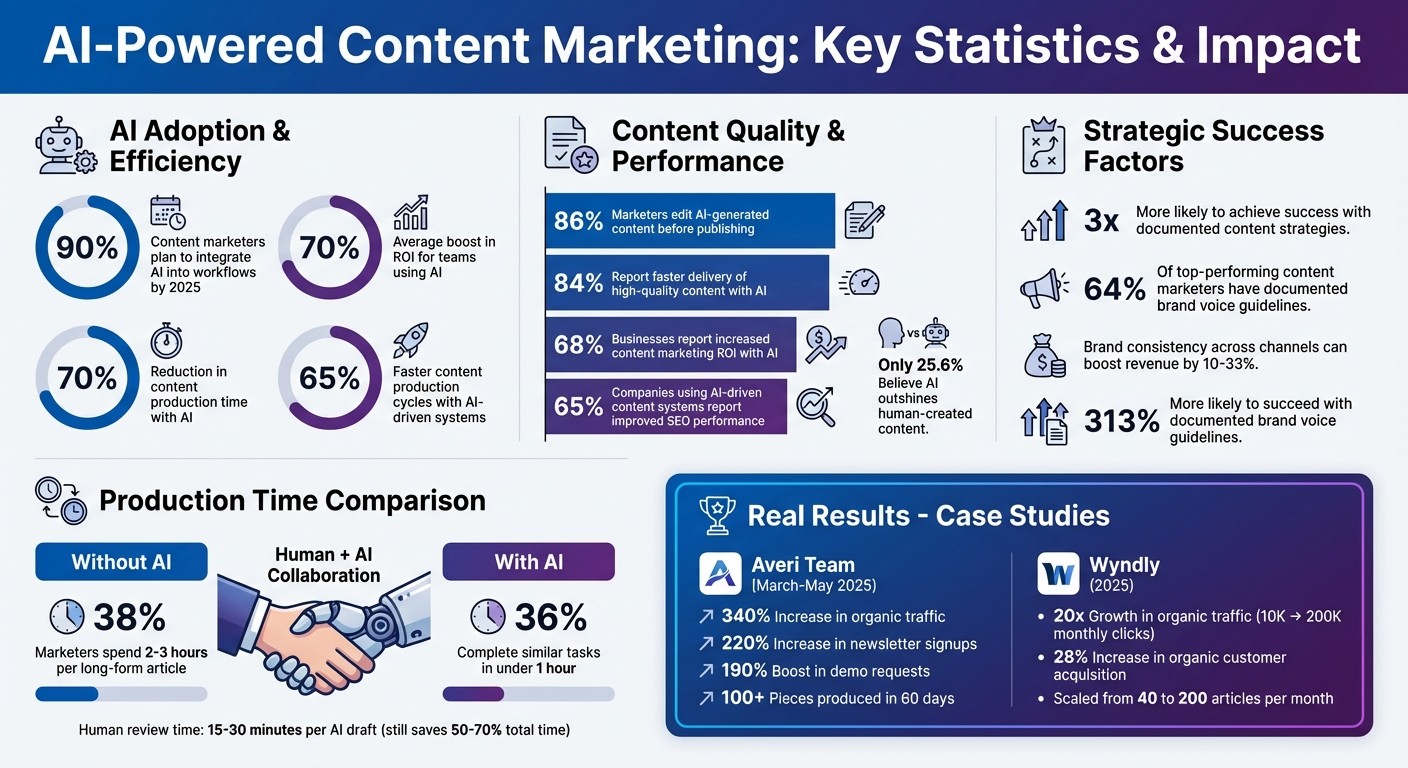
To avoid bottlenecks, monitor each piece of content through key production stages: briefing, drafting, editing, SEO optimization, and quality assurance. This structured workflow keeps teams accountable and ensures a smooth process. For example, 38% of marketers not using AI spend 2–3 hours creating a single long-form article, while 36% of AI-assisted marketers complete similar tasks in under an hour [2]. Despite AI's efficiency, always include human review to maintain authenticity and strategic alignment.
Planning Tier | Purpose | Alignment |
|---|---|---|
Quarterly | Define high-level themes | Core Brand Pillars & Business Goals |
Monthly | Focus on specific campaigns | Marketing Campaigns & Product Launches |
Weekly | Plan individual content pieces | Buyer Journey Stages (Awareness/Decision) |
Daily | Manage social distribution | Channel-Specific Engagement Patterns |
A well-organized editorial calendar not only streamlines your content production but also ensures every piece serves a clear purpose and aligns with your broader strategy.
Using AI Tools for Content Strategy and Execution
Automate Content Research and Planning with AI
AI tools have revolutionized content research and planning by processing vast amounts of data in record time, transforming it into actionable strategies. By analyzing your content library, sales conversations, and support tickets, these tools can pinpoint content gaps, group keywords by search intent, and create topic cluster architectures - all tailored to your growth objectives. It's no surprise that 90% of content marketers plan to integrate AI into their workflows by 2025, with those already using it reporting an average 70% boost in ROI [2].
One key distinction lies between generic AI tools and platforms designed specifically for content marketing. For instance, while tools like ChatGPT require repetitive reintroduction of your brand voice during each session, platforms such as Averi retain and build upon your brand's unique identity. This capability allows for smarter, more personalized content plans with each iteration [4].
By combining AI’s efficiency with human expertise, marketers can elevate content creation to the next level.
Combine AI and Human Work for Content Creation
AI is excellent for generating first drafts, but human input is essential for ensuring quality and alignment with your brand’s voice. In fact, 86% of marketers edit AI-generated content before publishing [2]. The ideal workflow leverages AI for time-intensive tasks like research, outlining, and drafting - cutting writing time by 60% - while humans refine the content by verifying facts, perfecting tone, and aligning it with strategic goals.
To avoid generic results, train your AI using 10–20 of your best-performing articles and voice guidelines. Once trained, AI can seamlessly assist in specific tasks, such as expanding bullet points into full drafts, creating alternative headlines, or tailoring content for different stages of the buyer journey. While 84% of marketers report faster delivery of high-quality content with AI [2], only 25.6% believe it outshines human-created content [4]. This underscores why human review remains indispensable.
To maintain consistency and quality, establish a review checklist for AI drafts. Verify factual accuracy, ensure the tone matches your brand voice, confirm logical flow, and check that terminology aligns with your style guide. Additionally, define scenarios where AI should never work alone - such as fabricating quotes, creating data, or producing regulated content without expert oversight [1]. As the Averi Team aptly puts it:
Success isn't about using AI tools - it's about implementing systematic frameworks that combine AI efficiency with human strategy [2].
This balanced approach naturally extends to optimizing publishing and analytics.
Automate Publishing and Analytics with AI
Once research and creation are streamlined, AI can also simplify publishing and analytics, completing the content cycle. These tools can repurpose long-form content into formats like email newsletters, LinkedIn posts, video scripts, and podcast outlines. They also generate social media captions, meta descriptions, and alternative headlines, while scheduling posts across platforms [1][7].
A great example is the telehealth platform Wyndly, which scaled its content production from 40 to 200 articles per month in 2025 using AI workflows. By automating research, SEO optimization, and publishing, Wyndly achieved a 20x growth in organic traffic (from 10,000 to 200,000 monthly clicks) and a 28% increase in organic customer acquisition [7]. AI played a critical role, handling technical SEO tasks like schema markup, metadata creation, and Core Web Vitals monitoring, as well as flagging outdated content for updates.
The real game-changer is predictive analytics. Beyond just reporting traffic metrics, AI recommends actionable next steps: identifying trending topics, pinpointing articles that need a boost to reach the top of search results, or suggesting counter-angles to competitor content. 68% of businesses report increased content marketing ROI thanks to AI [2], largely because it transforms performance data into strategies that build momentum over time.
Building a B2B SaaS Content Strategy
How to Execute Editorial Strategies Efficiently
Executing an editorial strategy effectively requires a smart blend of human expertise and AI-driven efficiency. Here's how you can make it happen.
Build a Workflow You Can Rely On
A well-defined, repeatable workflow takes the guesswork out of content creation and keeps your team on track. Successful teams often integrate AI into specific stages like research, outlining, drafting, and quality checks, while leaving tasks like strategy, judgment, and final approvals to human oversight [1]. Start by assigning clear roles within your team: an Editor-in-Chief oversees the overall strategy and tone, a Managing Editor handles content briefs and scheduling, an SEO Lead develops topic clusters, and writers or subject matter experts add original insights [1][5].
To keep things organized, use templates for blog posts, content briefs, and newsletters, and establish a weekly production schedule. For example, dedicate Mondays to planning, Tuesday and Wednesday to drafting, Thursday to reviews, and Friday to publishing [5][3]. The Averi marketing team, led by Zach Chmael, showcased the power of this approach between March and May 2025. By combining AI-powered ideation with human-led editorial reviews, they produced over 100 pieces in just 60 days. The results? A 340% spike in organic traffic, a 220% jump in newsletter signups (reaching 3,400 subscribers), and a 190% boost in demo requests [3].
Batching related content can also streamline the process. By creating multiple pieces within a single topic cluster at the same time, you can maintain consistency and maximize the use of shared research [2]. Quality control is essential at every stage - verify facts, align with your brand's voice, and ensure technical SEO is optimized [2][5]. Additionally, set clear boundaries for AI usage, such as prohibiting fabricated quotes, invented data, or content requiring expert review for compliance [1]. This structured approach ensures a smooth transition to the next critical step: maintaining a consistent brand voice.
Keep Brand Voice and Quality Front and Center
A consistent tone and message are key to building trust and recognition. In fact, maintaining brand consistency across channels can boost revenue by 10% to 33% [4]. To achieve this, go beyond generic tone descriptions like "professional" or "friendly." Clearly document specific characteristics, such as tone complexity, perspective (e.g., first-person "we" or third-person), and guidelines on using industry-specific terms and metaphors [4][2]. Train your AI using 10–20 top-performing content samples - blogs, emails, or social posts - so it learns your style. Include "good vs. bad" examples and maintain a terminology library with approved ways to describe your products, features, and competitors [4][2].
Before publishing, have humans review AI-generated drafts for tone, factual accuracy, and strategic alignment [4][6]. While 83% of marketers report faster content creation with AI, only 25.6% believe it outperforms human-created content [4][2]. Allocating 15–30 minutes for human review per AI draft can still save 50–70% of the time compared to starting from scratch [4].
Hold quarterly sessions to evaluate AI outputs, score them for alignment with your brand voice, and update the training data as needed [4]. Since 68% of consumers trust AI-generated content less than human-created material [4], a strong and distinctive brand voice is crucial for credibility.
Scale Your Content Without Overwhelming the Team
Scaling content production doesn’t mean expanding your team or overloading on tools. The secret lies in automating repetitive tasks while focusing human efforts on strategy and refinement. Use AI to create social media posts, email subject lines, and meta descriptions based on your core long-form content [1]. Batching related pieces together also boosts efficiency and keeps your messaging consistent [2]. Teams using AI-driven systems report content production cycles that are up to 65% faster [6].
Many modern marketing teams are consolidating their tools - 88% plan to streamline their tech stacks by 2025 - to reduce complexity [4]. Platforms like Averi, for instance, retain brand-specific knowledge and adapt based on human edits over time, unlike generic AI tools that require re-teaching your brand voice with every session [4][8]. Even at scale, sticking to established review processes ensures quality remains high [4].
AI can also help you identify outdated content or pieces with declining traffic in your archives. Prioritize refreshing these based on performance [1]. Marketers using AI report an average 70% increase in ROI [2], largely because they can produce more content without adding more team members or complexity. AI becomes a tool to amplify your team's capabilities - not a replacement for their strategic thinking.
Measure Performance and Improve Over Time
To understand how your content strategy is performing, track key metrics like conversion rates (e.g., lead generation, demo requests, and revenue attribution), efficiency indicators (content production speed, cost per piece, and editing time), and brand consistency scores. These numbers provide a clear picture of your content’s impact and effectiveness [2][3][1][4].
AI tools can play a pivotal role in maintaining your content library. They can flag pages with reduced engagement [1], compare older posts to newer competitor content to identify gaps, and point out outdated elements like statistics, tool recommendations, or screenshots [1]. This methodical approach ensures your content stays relevant without requiring a complete overhaul. Regular updates based on these insights naturally integrate into your review cycles, keeping your strategy sharp and competitive.
Establish a structured review process to stay on top of performance:
Conduct weekly reviews to track tactical metrics such as traffic patterns and engagement trends.
Dive deeper monthly to assess ROI and benchmark against competitors.
Refresh your overall strategy quarterly to align with evolving goals [2].
High-performing content should also feed back into your AI tools. This helps refine your brand voice guidelines and improve future output [2][4]. Over time, this creates a feedback loop where every piece of content informs and enhances the next.
When it comes to resource allocation, let data guide your decisions. Use channel performance metrics to determine where to focus the majority of your budget and which platforms to experiment with [7]. The most successful teams monitor both leading indicators (like production speed and quality scores) and lagging indicators (such as organic traffic and conversion rates). This dual focus allows you to quickly identify issues and seize new opportunities [7].
Take Wyndly, a telehealth platform, as an example. By leveraging performance data and AI-powered workflows, they transformed video content into SEO-optimized articles, scaling their production from 40 to 200 articles monthly. This shift led to a 20x increase in organic traffic - jumping from 10,000 to 200,000 monthly clicks - and boosted organic customer acquisition by 28%. Their strategy even enabled them to consistently outrank major players like WebMD [7]. This case study highlights how consistent performance tracking and AI-driven processes can supercharge your content strategy within a broader editorial framework.
Conclusion
Summary of Key Strategies
Editorial-led growth for B2B SaaS relies on a well-structured framework that transforms content into a dependable growth engine. It all begins with brand clarity - establishing a unique perspective supported by 3–5 clear content pillars. While AI takes on tasks like research, drafting, and distribution, humans focus on strategy, refinement, and final editorial decisions. This division of responsibilities enables teams to scale their output from 10 to 100 pieces per month without compromising quality or burning out.
The numbers speak for themselves: AI can boost ROI by 70% and positively impact 68% of businesses [2]. However, the key to success lies in consistency, not perfection. Averi's case study highlights the power of systematic workflows, showing a 340% increase in organic traffic, a 220% rise in newsletter signups, and strong engagement metrics - all achieved with minimal resources [3].
Top-performing teams align content with specific growth objectives, such as Acquisition (SEO), Activation (onboarding guides), Retention (case studies), and Revenue (product comparisons). They measure progress through leading indicators like production speed and quality, as well as lagging indicators like traffic and conversions. This dual approach creates a feedback loop where every piece of content builds on the last, combining human creativity with AI efficiency for long-term editorial success.
Next Steps to Get Started
To put these strategies into action, start by building a clear, actionable editorial framework.
Schedule a dedicated session with stakeholders to define your brand's unique perspective and identify 3–5 key content pillars to guide your efforts [3]. Train the best AI content creation tools using your best-performing content to ensure alignment with your brand's voice [4]. Research shows that organizations with documented brand voice guidelines are 313% more likely to succeed, and maintaining consistency across channels can increase revenue by 10% to 33% [4].
Next, adopt a "human-in-the-loop" workflow. Let AI handle the initial draft, while your team reviews for accuracy and ensures the content reflects your brand's voice before publishing. This method can cut production time by 50–70% without sacrificing quality [4]. For those ready to streamline their processes, tools like Averi can automate strategy, research, publishing, and analytics - allowing you to focus on driving product innovation. Take the first step today by signing up for the AI Marketing Workspace and start building your editorial-led growth system.
FAQs
How can AI help B2B SaaS companies create content more efficiently?
AI can transform how B2B SaaS companies approach content creation by taking over labor-intensive tasks such as research, outlining, drafting, and editing. This not only streamlines the workflow but also reduces the potential for errors, making it easier to produce content that is both data-informed and scalable.
When AI tools are integrated into the process, teams can maintain a consistent level of quality while saving valuable time. However, the most effective results come from combining AI capabilities with human oversight. This ensures the content stays aligned with the brand's voice and effectively connects with the intended audience.
What are content pillars, and why are they important for a successful B2B SaaS editorial strategy?
Content pillars serve as the foundation of a brand’s content strategy, acting as overarching themes that shape everything a company creates. These themes - like "SEO", "Content Marketing", or "Tool Reviews" - highlight the company’s expertise, reflect its values, and align with its goals. Whether it’s a blog post, a video, or a social media update, all content ties back to these pillars, ensuring a cohesive and consistent brand identity.
Why are content pillars so important? For starters, they offer a structured approach to content creation, eliminating the guesswork of "what should we create next?" They also play a key role in boosting SEO performance, as they help establish thematic authority - something search engines reward with better visibility. Beyond that, content pillars ensure that all efforts align with business goals, making it easier to track results and drive meaningful growth. Together, these advantages simplify workflows, increase brand recognition, and create a scalable content strategy, particularly for B2B SaaS companies.
How can B2B SaaS companies evaluate the success of their editorial-led growth strategy?
To evaluate the success of an editorial-led growth strategy, it’s essential to focus on metrics that tie content performance directly to business results. Start with content ROI, calculated using this formula: (Content Revenue – Content Spend) ÷ Content Spend × 100. This helps you understand how much revenue each piece - whether a blog, guide, or video - generates through new ARR, qualified leads, or closed deals, compared to its total production cost. Be sure to include expenses like AI tools, team salaries, and expert fees.
Beyond ROI, keep an eye on SaaS-specific indicators such as organic traffic growth, keyword rankings, time spent on pages, and conversion rates (e.g., visitor-to-MQL and MQL-to-SQL ratios). Efficiency metrics like time-to-first-draft, time-to-publish, and cost-per-piece are equally important. These show whether AI-human workflows are speeding up production and cutting costs while maintaining high-quality output.
Lastly, connect content to the buyer’s journey using multi-touch attribution or pipeline-impact models. Analyze how many qualified opportunities or deals stem from specific content hubs and compare this to the total cost of producing and maintaining them. If you’re seeing improvements in traffic, lead quality, pipeline contributions, and ROI while keeping production costs steady - or even lowering them - you can be confident your editorial-led growth strategy is delivering results.
Related Blog Posts

Zach Chmael
CMO, Averi
"We built Averi around the exact workflow we've used to scale our web traffic over 6000% in the last 6 months."
Your content should be working harder.
Averi's content engine builds Google entity authority, drives AI citations, and scales your visibility so you can get more customers.