How to Create Editorial-Led Growth for Education Platforms

Averi Academy
Averi Team
8 minutes

In This Article
Editorial content and AI to grow education platforms: scale research, align content to KPIs, and build repeatable, quality workflows.
Updated:
Trusted by 1,000+ teams
Startups use Averi to build
content engines that rank.
Education platforms can achieve sustainable growth by prioritizing editorial-led strategies over short-term tactics like paid ads. By focusing on high-quality, audience-driven content, platforms can build trust, improve engagement, and create lasting value. Here's how this approach works:
Why It Matters: Editorial content builds credibility and positions platforms as trusted authorities, essential for educators and administrators making key decisions.
Proven Results: For example, Tomorrow Sleep increased organic traffic from 4,000 to 400,000 monthly visitors in a year by addressing topic gaps and optimizing for search intent.
AI's Role: AI tools streamline content creation, research, and optimization, enabling teams to produce tailored, impactful content efficiently.
Key Benefits: Companies using customer education strategies see higher satisfaction (+11.6%), retention (+7.1%), and revenue (+6.2%) while reducing support costs.
This article outlines a step-by-step approach to defining an editorial strategy, leveraging AI for scalability, connecting content to growth metrics, and optimizing workflows for continuous improvement. With the right mix of expertise and automation, education platforms can transform their content into a powerful growth engine.
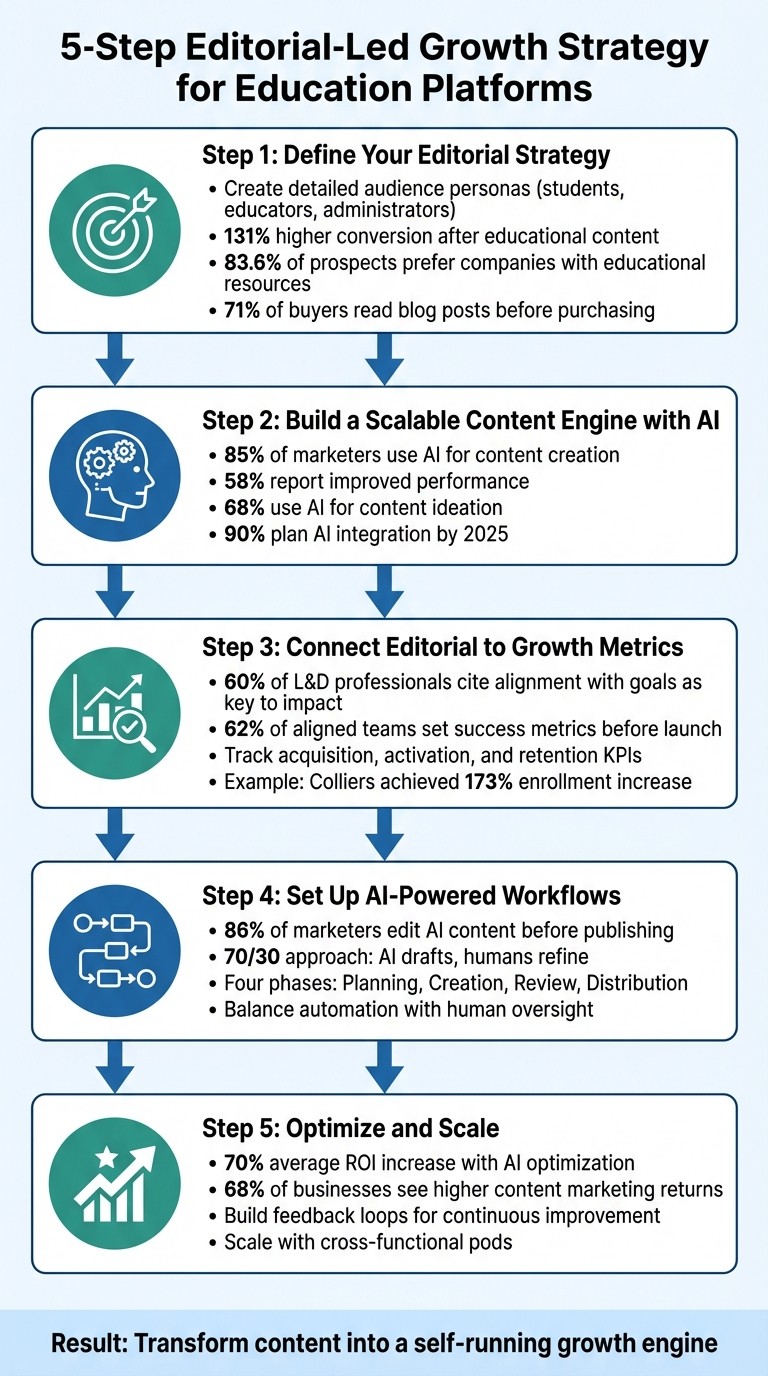
5-Step Editorial-Led Growth Strategy for Education Platforms
Content as a growth engine for your business - John Collins at Inside Intercom Paris
Step 1: Define Your Editorial Strategy for Education Audiences
A strong editorial strategy begins with a deep understanding of your audience. Education platforms cater to distinct groups - students searching for learning resources, educators needing classroom tools, and administrators evaluating platform investments. Each group brings unique challenges, goals, and content preferences. Without a clear strategy, efforts can scatter, wasting valuable resources. This groundwork is essential for effectively incorporating AI tools in later steps.
Identify Your Target Audiences and Their Needs
Start by creating detailed personas for each audience. For example, students may value guides and video tutorials, while administrators are more likely to seek ROI calculators and implementation roadmaps. The key is understanding each segment’s specific challenges and how your platform provides solutions.
Building these personas requires collaboration across departments. Sales teams, for instance, hear objections and questions daily, product teams know which features users find confusing, and business development monitors market trends. Combine these internal insights with external research, such as customer interviews, prospect surveys, web analytics, and social media monitoring to paint a full picture of your audience’s needs [5][6][7].
The data backs this approach. Consumers are 131% more likely to convert immediately after engaging with educational content. Additionally, 83.6% of prospects prefer to buy from companies offering educational resources, and 71% of buyers read blog posts before making a purchase decision [5].
Once you understand your audience, align your content to their journey. During the awareness stage, focus on educational blog posts and infographics. For the evaluation stage, use case studies and product demos. And when it’s time to convert, free trials paired with implementation guides can be highly effective [6]. A great example of this strategy is Moz’s "White Board Fridays" video series, which simplifies complex SEO topics while establishing the brand as an authority [5].
With well-defined audience insights, the next step is to examine your competitive landscape.
Analyze Competitor Content and Industry Trends
To stand out, identify gaps in the market. A three-step content gap analysis can help: evaluate your current content performance, review what competitors are publishing, and analyze search volume versus competition to uncover underserved topics [2].
Categorize search intent by grouping keywords into informational, navigational, commercial, and transactional categories. This method highlights areas where competitors may not be fully addressing the needs of education-focused audiences [2]. For instance, long-tail keywords like "how to implement adaptive learning in high school math" often signal high intent but face less competition.
Anchor your strategy around topic clusters. Start with 3–5 broad pillar topics that align with your business goals, then create 8–12 supporting pieces for each pillar that address specific questions. For an education platform, a pillar topic could be "Remote Learning Best Practices", with clusters covering areas like video conferencing tools, student engagement techniques, and assessment strategies. This approach ensures comprehensive coverage of the learner’s journey - from initial awareness to final decision-making [2].
With a solid editorial strategy in place, you're ready to build a scalable content engine powered by AI tools.
Step 2: Build a Scalable Content Engine with AI Tools
Once your editorial strategy is in place, the next challenge is scaling your output. Education platforms need to consistently produce high-quality content without overwhelming their teams. AI tools are the game-changer here, taking on tasks like research, drafting, and optimization. This allows your team to focus on strategy and fine-tuning. The trend is clear: 85% of marketers already use AI for content creation, with 58% reporting improved performance [2]. This efficiency opens up more time for targeted research and creative ideation.
Use AI for Content Research and Ideation
AI shines when it comes to uncovering content opportunities that might otherwise go unnoticed. It can analyze search intent - whether informational, navigational, commercial, or transactional - ensuring your content matches the needs of your audience at different stages of their journey [2]. For example, a student may seek informational content, while an administrator might be ready for commercial material.
The numbers back this up: 68% of marketers use AI for content ideation, and 90% plan to integrate AI into their strategies by 2025 [2]. Tools like Averi AI track industry trends, identify gaps in competitor content, and suggest high-potential topics tailored to your audience. By categorizing search intent, AI eliminates the need for manual research, keeping your content calendar full without the stress of constant brainstorming.
A step-by-step approach works best. Instead of asking AI to generate a full article in one go, start with detailed outlines or research summaries. This method ensures a logical structure and provides checkpoints for reviewing the direction before diving into full drafts [2]. With a steady pipeline of data-driven ideas, the next focus is streamlining production and optimization.
Automate Content Production and Optimization
While AI can efficiently handle initial drafts, maintaining quality requires careful setup. Train AI tools to align with your brand’s voice, preferred terminology, and high-performing examples. This upfront effort ensures consistency across all content [2]. For education platforms, this means creating materials that meet academic standards while catering to diverse learners. This might involve incorporating specific language about learning outcomes, accessibility, or teaching methods that reflect your brand’s identity.
Adopting a modular content approach can also enhance efficiency. Treat content as reusable components - such as problem statements, key data points, and explanations - that can be repurposed across formats and platforms [1]. For instance, a research piece on student engagement strategies could be transformed into a blog post, a series of LinkedIn updates, an email campaign, and even a downloadable guide. AI simplifies this repurposing, saving both time and effort.
Over time, systematic AI-driven production builds momentum. To maximize results, assign AI tools to tasks that match their strengths. Use one model for summarizing documents, another for synthesizing research, and a third for drafting [3]. Many AI platforms integrate research, context loading, and SEO structuring into a single workflow. For education platforms using specialized LMS systems, tools like 360Learning (starting at $8 per registered user per month) offer features like prompt-based authoring that maintain academic standards while automating lesson plan creation [8][9].
The secret lies in balancing automation with human oversight. AI should speed up production, not replace editorial judgment. Establish workflows where AI handles research and drafts, but human editors review for accuracy, tone, and alignment with your educational goals before publication. This blend of efficiency and quality control creates a reliable and scalable content engine.
Step 3: Connect Editorial Efforts to Growth Metrics
To truly drive growth, content strategies must be tied to measurable outcomes, not just superficial metrics. For education platforms, this means ensuring every editorial piece aligns with specific business goals. The numbers back this up: 60% of L&D professionals cite better alignment with organizational goals as the key to boosting learning impact [13]. Furthermore, 62% of strategically aligned teams establish success metrics before launching a program, compared to just 38% of their non-aligned counterparts [13].
By linking editorial efforts to tangible outcomes, you ensure that every piece of content contributes to growth. Focus on leading indicators - like content completion or engagement rates - that provide immediate feedback, alongside lagging indicators such as revenue growth or customer retention for long-term insights [13].
Track Key Performance Indicators (KPIs)
Start by aligning your content types with specific stages of the growth journey. For example:
Acquisition content: SEO-friendly guides can drive traffic and generate leads.
Activation content: Onboarding tutorials help users adopt features faster and deliver value sooner.
Retention content: Advanced case studies or in-depth guides can deepen engagement and reduce churn.
Each stage requires tailored metrics and tools. AI can play a pivotal role here, from assisting with topic research during acquisition to providing usage-based recommendations for retention.
It’s also critical to connect learning outcomes to business KPIs. For instance:
Product training can be linked to higher sales conversion rates.
Certification programs often correlate with improved NPS or CSAT scores.
Leadership workshops might drive higher promotion rates within teams.
Using tools like Google Analytics, you can assign a "Page Value" to each editorial piece, converting abstract engagement data into concrete revenue insights [12].
Consider the case of Colliers, which partnered with D2L for Business to scale its training initiatives. Between 2022 and 2025, they grew course enrollments from 4,000 to over 10,000 - a 173% increase - while maintaining a quality rating of 4/5 or higher from 85% of learners [13]. This demonstrates the power of tying content efforts to clear, measurable goals.
### Use an AI-Powered Content Strategy to Improve Results
Data becomes meaningful only when it informs action. Once you’ve defined your KPIs, use analytics to identify and address content gaps. Tools like heat maps and scroll depth analysis can reveal how deeply users engage with your material, while time-on-page metrics distinguish between accidental clicks and genuine interest [1].
Modern content measurement goes beyond traditional metrics. For example, tracking "AI Citation Volume" - how often platforms like ChatGPT or Claude reference your content - can provide valuable insights into reach and authority [4]. Regularly audit your content to ensure it’s accurately summarized and appropriately featured in AI-generated responses [10].
Feedback loops are another critical component. Use pulse surveys and manager check-ins to evaluate whether your content is driving behavior changes or improving on-the-job skills [11]. Mark deployment dates in your analytics to monitor the impact on rankings and conversions over 30-, 60-, and 90-day intervals [10]. This data-driven approach transforms content from a sunk cost into a measurable growth engine.
Step 4: Set Up AI-Powered Editorial Workflows
To effectively scale your content production, leverage a combination of AI automation and human expertise. This hybrid approach ensures you can create high-quality, consistent content efficiently - even with smaller teams. By building on your AI-powered content engine, this workflow prioritizes both speed and precision.
86% of marketers edit AI-generated content before publication [2]. This isn’t a shortcoming of AI - it’s an intentional part of a well-designed process. While AI handles repetitive tasks like drafting and formatting, humans step in to perfect areas where machines fall short, such as accuracy, brand voice, and creative nuance.
Build AI-Powered Content Pipelines
Start by mapping out your content workflow - covering planning, creation, review, and distribution - and identify where automation can deliver the most value in your marketing execution. AI can enhance each step, but seamless handoffs between AI and human contributors are key.
During planning, AI tools can perform tasks like gap analysis, identifying trending topics, and conducting keyword research. These insights help pinpoint content opportunities. Humans, on the other hand, define the strategy, prioritize topics, and align content with audience needs. For creation, AI drafts lesson plans, course descriptions, or blog posts based on your brand guidelines. Training the AI with 10–15 high-performing examples ensures consistency [2]. Use prompts rich in context - such as audience personas, company background, or specific quality standards - to minimize editing time [2].
The review phase is where human expertise is essential. AI can handle basic quality checks, like ensuring SEO optimization and brand voice alignment, but subject matter experts are crucial for validating accuracy, especially for high-stakes content like assessments or certifications. Finally, in the distribution phase, AI automates publishing directly to platforms like your CMS or LMS, saving time and preserving metadata across systems.
Tools like Averi AI simplify this entire pipeline by integrating strategy, execution, and publishing into one workflow. Instead of juggling multiple tools for research, drafting, and distribution, Averi allows you to approve topics while it handles the rest - generating SEO-optimized drafts and publishing content directly to platforms like Webflow, WordPress, or Framer. Each piece is stored in a Library, enabling smarter AI drafts over time.
Balance AI and Human Review for Quality Assurance
Once you’ve automated content generation and distribution, shift your focus to maintaining quality. A good rule of thumb is the 70/30 approach: let AI handle drafting, formatting, and basic analysis, while humans refine the content, ensure accuracy, and align it with your brand’s voice and educational goals.
Structure your review process based on the risk level of the content. High-stakes materials, such as certification exams or compliance training, require thorough human oversight at every stage. For lower-stakes content, like internal newsletters or administrative updates, you can rely more on automation with lighter reviews. Track metrics such as "Fact-Check Pass Rates" and "Brand Voice Alignment" to ensure AI-generated content meets your quality standards.
Start with a single content type, like quiz questions or course descriptions, and refine your workflow until it’s efficient and reliable. Identify bottlenecks - like lengthy approval cycles or manual formatting - and automate these areas. As your team becomes more comfortable, expand AI’s role while keeping human checkpoints for critical decisions.
Workflow Phase | AI Task | Human Task |
|---|---|---|
Planning | Gap analysis, keyword research, trend monitoring | Define strategy, set goals, refine personas |
Creation | Drafting, formatting, data extraction | Refine voice, add unique insights, develop creative concepts |
Review | Basic QA, SEO checks, brand voice alignment | Fact-check, validate accuracy, give final approval |
Distribution | Automated publishing, metadata management | Select channels, track performance |
Each published piece feeds back into the system, making AI recommendations sharper and reducing the workload for future projects. By combining automation with thoughtful human oversight, this workflow integrates seamlessly into your editorial strategy, driving consistent growth.
Step 5: Optimize and Scale for Continuous Growth
With your AI-powered workflows firmly in place, the next move is to fine-tune and expand your editorial system. The key is to ensure your system learns and improves with every piece of content it produces. Businesses that embrace this feedback-driven approach see measurable gains: marketers leveraging AI optimization report an average 70% increase in ROI, while 68% of businesses experience higher returns specifically in content marketing through AI integration [2].
Build Feedback Loops for Performance Optimization
Start by breaking your content into modular elements - think headlines, data insights, expert quotes, and summaries - that can be tracked, updated, and reused across formats [1]. This "Lego block" strategy allows you to replicate successful components, such as high-performing quizzes or effective course descriptions, without starting from scratch. When updates are needed - like new curriculum standards or recent research findings - you can apply changes across all related materials seamlessly using automated governance systems.
To ensure quality, adopt a three-layer review process: use AI for SEO and brand voice alignment, subject matter experts (SMEs) for technical accuracy, and a final editorial check for style and polish [2]. Monitor metrics like "Fact-Check Pass Rate" and "Brand Voice Consistency Score" to pinpoint areas needing improvement. Conduct weekly traffic analyses and monthly ROI deep dives to adjust your strategy based on performance data [2]. For example, Adidas partnered with Insider One in 2025/2026 to implement AI-driven personalization and feedback loops, resulting in a 259% increase in average order value for new users and a 50.3% rise in mobile conversions [1]. These systems ensure continuous improvement while keeping an eye on measurable outcomes.
Once feedback mechanisms are optimized, you’re ready to scale production without compromising quality.
Scale Editorial Production Without Losing Quality
As you ramp up content creation, structure your team into agile, cross-functional pods that include a strategist, producer, editor, designer, and AI QA specialist [4]. This setup eliminates bottlenecks and maintains quality even as production scales. Employ the Content Sprout Method: start with a comprehensive "pillar" asset, such as a webinar or detailed guide, that can be repurposed into smaller pieces like social media posts, email campaigns, video scripts, or short lessons [4].
Hold weekly voice calibration sessions to adjust AI prompts based on the previous week’s output and performance data [2]. Batch-process topic clusters to maintain thematic consistency and streamline research efforts [2]. Track efficiency metrics like "Time from Brief to Published" and "Monthly Content Volume per Pod" to ensure scaling efforts don’t require additional headcount. Tools like Averi AI can help turn your editorial process into a self-sustaining, ever-improving system, as detailed in our earlier discussions on AI-human collaboration.
Review Layer | Focus Area | Tools/Methods |
|---|---|---|
Factual Verification | Accuracy, Citations | SME Review, Source Validation [2] |
Brand Consistency | Tone, Terminology, Style | AI Brand Voice Analysis, Editorial Review [2] |
Technical SEO | Keywords, Meta, Internal Links |
Conclusion: Building a Self-Running Editorial Growth Engine
Creating an automated editorial system for education platforms involves designing a structure that learns, scales, and drives measurable results. The strategies outlined here provide a clear roadmap: tailor your approach to meet specific learner needs, use AI tools to streamline research and drafting, tie all content to measurable growth metrics, and implement workflows that balance AI efficiency with human expertise. This approach lays the groundwork for integrating data and automation at every stage of the process.
Research highlights the potential of AI in content creation, with marketers reporting an average 70% boost in ROI and notable cost reductions. However, 86% still refine AI-generated content to ensure quality [2]. The key lies in a thoughtful division of tasks: let AI handle research, drafting, and optimization, while humans focus on strategic planning, subject matter expertise, and final quality assurance.
By building on proven AI-human workflows, you can create an editorial engine that incorporates reusable content elements, agile cross-functional teams, and automated approval systems that reserve human input for high-priority content [1][4]. Monitor metrics like organic impressions and engagement depth as leading indicators, track performance metrics such as conversion rates, and measure lagging indicators like revenue attribution to ensure your content strategy directly supports business objectives [1].
Adapting these practices aligns your efforts with evolving market trends. Shifting from traditional SEO to Answer Engine Optimization requires content that is structured and scannable for AI systems, not just optimized for Google rankings [3]. This means creating sections that are easy to scan, citing authoritative sources, and providing clear answers to targeted questions. Tools like Averi AI can help streamline this process - from strategy and creation to publishing and performance tracking - transforming your editorial workflow into a system that delivers consistent, scalable results.
Start small: focus on one content pod and one core metric, then expand gradually. Build a system that becomes smarter and more effective with every piece of content you publish.
FAQs
How can AI tools improve content creation for education platforms?
AI tools are reshaping how education platforms create content by taking over time-consuming tasks like drafting lesson plans, generating quiz questions, and managing post schedules. This automation not only saves valuable time but also allows educators to concentrate on what they do best - teaching - without compromising the quality learners expect.
The real advantage comes from blending AI’s efficiency with human insight. AI can analyze learner data to craft personalized lesson plans and adaptive assessments, boosting both engagement and learning outcomes. Yet, human oversight remains essential to ensure the content aligns with subject matter accuracy and maintains the platform’s unique voice.
By integrating AI to streamline workflows and offer tailored learning experiences, education platforms can scale their operations while delivering better results for learners and fostering growth.
What are the main advantages of using an editorial-led growth strategy for education platforms?
An editorial-led growth strategy empowers education platforms to produce top-tier, scalable content that drives both audience connection and measurable success. By blending AI tools to handle repetitive tasks with human oversight for precision and a personal touch, teams can accelerate content creation without sacrificing relevance or brand identity. This balanced approach minimizes mistakes and ensures content aligns with the specific needs of learners.
What sets this strategy apart is its direct link to growth metrics. The focus isn’t just on generating large volumes of content but on creating material that truly makes an impact - whether that’s increasing site traffic, capturing leads, or boosting conversions. A well-designed content system allows for consistent, high-quality output at scale, cutting through inefficiencies and often outperforming traditional advertising channels.
Another key advantage is the creation of a feedback loop driven by data insights. By analyzing real-time engagement, teams can test, adjust, and refine their content to keep improving outcomes. This not only fuels sustained growth but also strengthens the platform’s authority and trust within its audience.
How can education platforms align their content strategy with business goals?
To ensure your content strategy aligns with your business goals, begin by pinpointing your primary objectives. Whether you're aiming to boost course enrollments, enhance student retention, or grow subscription revenue, these goals should translate into clear, measurable KPIs. Metrics like conversion rates, active user growth, or average revenue per user can serve as benchmarks. Every piece of content you create should have a direct connection to these objectives, with its topic, format, and distribution channel carefully chosen to influence the desired outcome.
Leverage AI-powered tools to simplify and enhance this process. These tools can automate tasks like drafting, personalizing, and reviewing content while incorporating data-driven insights to inform your decisions. For instance, AI can recommend content that showcases standout course features to attract new enrollments or that emphasizes the value of community engagement to improve retention rates.
To keep your strategy effective, establish a feedback loop by monitoring performance data after publication. Compare the results to your defined KPIs and use what you learn to fine-tune your future content. Documenting your goals and updates in a shared editorial calendar can help maintain focus and consistency. With this approach, you can build a content strategy that not only aligns with your objectives but also scales effectively to drive continuous growth.
Related Blog Posts

Zach Chmael
CMO, Averi
"We built Averi around the exact workflow we've used to scale our web traffic over 6000% in the last 6 months."
Your content should be working harder.
Averi's content engine builds Google entity authority, drives AI citations, and scales your visibility so you can get more customers.