

In This Article
Step-by-step process for agencies to create, validate, and update data-driven buyer personas using CRM data, interviews, JTBD, and AI.
Updated:
Trusted by 1,000+ teams
Startups use Averi to build
content engines that rank.
Buyer personas are the backbone of effective marketing strategies, especially for agencies managing diverse clients. A well-structured persona process ensures campaigns are built on real data, not assumptions, leading to better targeting, higher conversions, and reduced costs. Here's what you need to know:
What Personas Deliver: Data-backed personas improve campaign results, doubling page visits and increasing conversion rates by 73% in B2B sectors.
Why Agencies Need Them: A structured approach transforms raw customer data into actionable insights, aligning teams and boosting client satisfaction.
Key Steps:
Review Existing Data: Use CRM systems, support tickets, and zero-party data for insights.
Conduct Research: Interviews and surveys uncover motivations, fears, and decision triggers.
Create Usable Personas: Include demographics, psychographics, goals, and barriers to guide marketing, sales, and service teams.
Integrate Personas: Embed them into workflows, from campaign planning to customer service.
Keep Personas Current: Update regularly with AI tools and scheduled reviews to reflect market shifts.
Personas aren't static - they evolve. Agencies that maintain dynamic, data-driven personas see measurable improvements in lead quality, campaign ROI, and client retention. Ready to build personas that work? Start by turning your customer data into profiles that drive results.
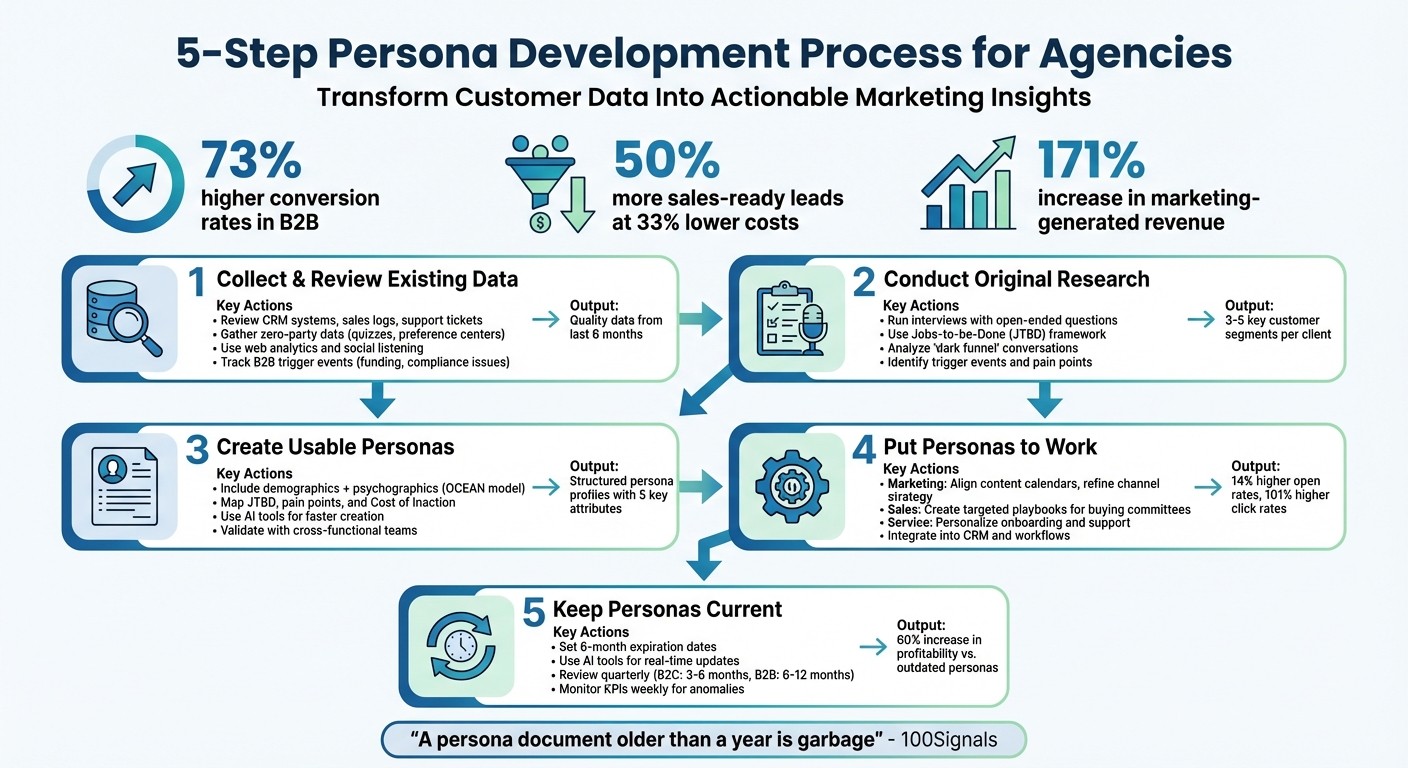
5-Step Persona Development Process for Agencies
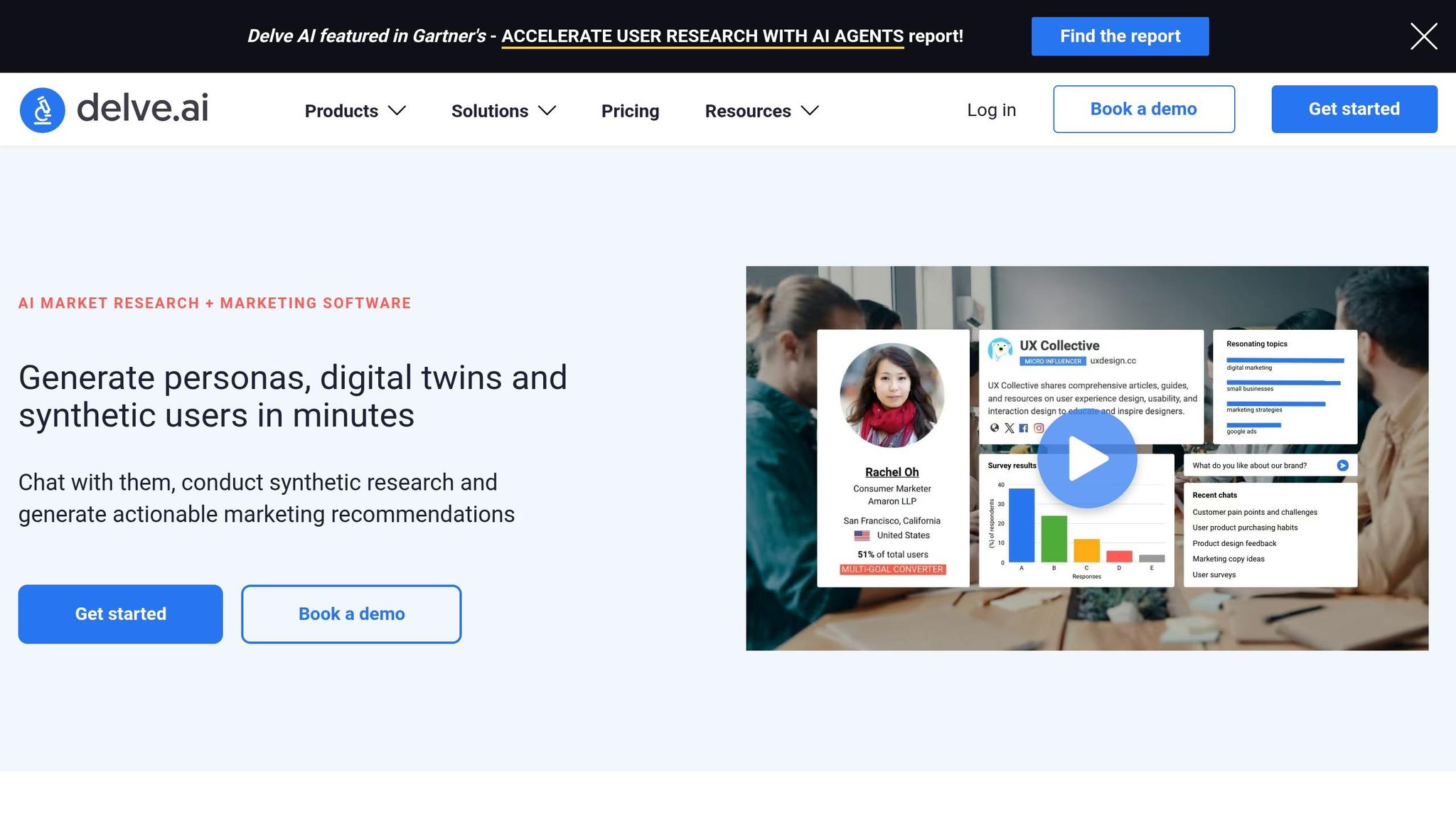
Persona Development For Agencies - Delve AI
Step 1: Collect and Review Existing Data
Before crafting personas, agencies must first examine their current data. The objective is to gather meaningful insights about customer behavior, motivations, and obstacles. When accurate and up-to-date, this data can lead to a 171% increase in marketing-generated revenue [4].
Where to Look for Data
Start by tapping into internal resources that reflect authentic customer actions and language. CRM systems provide essential details like job roles, company size, and industry focus, helping define your target audience [1][4]. Sales call logs and transcripts can uncover frequent objections, decision-making triggers, and customer motivations [4][2]. Meanwhile, support tickets shine a light on recurring frustrations or pain points [4].
With privacy regulations reshaping data collection, zero-party data - voluntarily shared by customers through tools like quizzes, calculators, or preference centers - has emerged as the most reliable source for persona development in 2026 [5]. Additionally, web analytics can map user behavior and identify drop-off points, while social listening tools capture customer sentiment and trending language [1][3]. For B2B clients, it’s worth tracking trigger events such as funding announcements, compliance issues, or personnel shifts that often signal buying intent [2].
Evaluating Data Quality
Not all data is equally valuable. Outdated or incomplete data can lead to personas that miss their mark. As 100Signals puts it:
A persona document older than a year is garbage [2].
To avoid this, limit persona data to a six-month lifespan and conduct formal audits twice a year to catch any shifts in customer behavior [2].
Prioritize zero-party data and direct customer feedback over assumptions. AI tools like Gong or Fathom can analyze sales call transcripts to highlight objections in lost deals - these are critical for refining personas [2][6]. Similarly, review support tickets to capture the exact words customers use to describe their challenges [4]. If gaps appear - like missing job titles or incomplete purchase histories - flag these areas and plan to fill them through original research in the next step.
Once you’ve gathered quality data, organize it systematically across client accounts.
Organizing Data for Multiple Clients
For agencies managing several clients, keeping persona data organized and up-to-date is essential. Assign ownership of persona data within a cross-functional team that includes marketing, analytics, and sales to ensure regular updates and alignment [1].
At scale, AI tools can automate data updates, enabling real-time persona adjustments without requiring manual input [6]. Conduct quarterly reviews to identify any data shifts and ensure personas reflect current market trends [1][5]. Aim to cluster findings into 3–5 key segments per client - more than five can dilute the focus of marketing strategies [5][3].
Step 2: Conduct Original Research
Understanding customer actions through data collection is a great start, but uncovering why they act requires deeper investigation. Original research bridges the gap, transforming raw demographics into actionable personas by exploring motivations, fears, and the language customers use to describe their challenges.
Run Interviews and Surveys
Start with open-ended questions to encourage detailed responses. Questions like "Walk me through a typical day" or "What was happening in your business that made you start looking for a solution?" can uncover valuable context that CRM data alone can't provide. Dig deeper by asking follow-ups like "How did you decide on that?" to uncover the reasoning behind their actions [4].
The Jobs-to-be-Done (JTBD) framework is a powerful tool here, helping you move beyond surface-level traits to understand the "job" customers are hiring your product or service to perform. For example, a company may not just want a new website - they may need it to mitigate risks during a legacy migration [2].
Tailor your interviews to include a diverse range of stakeholders. A CTO might be concerned about "spaghetti code", while a CFO could be more focused on "budget overruns" [2]. Mapping these varied concerns can provide a comprehensive understanding of customer priorities. Additionally, leverage zero-party data whenever available to enrich your insights [5].
Don’t ignore the "dark funnel" - those unfiltered conversations happening in private Slack groups, subreddits, or Discord servers. These spaces often reveal pain points and candid feedback that structured surveys might miss [2].
Analyze Your Research Findings
Once you’ve gathered interview transcripts, survey results, and observations from online communities, look for recurring patterns. Tools like Gong or Fathom can help analyze large volumes of sales call recordings, identifying trends that might otherwise go unnoticed [2]. Use affinity diagramming to group customer quotes by themes, focusing on their goals, challenges, and concerns.
Pay attention to trigger events - specific moments when a problem becomes urgent. Examples include "fresh funding", a "failed compliance audit", or a "key personnel change" [2]. For tech clients, consider segmenting customers by technical maturity, such as "Digital Native" versus "Digital Immigrant", as this often provides more actionable insights than industry-based segmentation alone [2].
These findings form the backbone of a systematic approach to managing research across multiple clients.
Run Research Efficiently Across Clients
When working with multiple clients, organization is critical. Assemble a cross-functional team to oversee persona research [1]. Use reusable interview templates and survey frameworks that can be adjusted for different industries while maintaining consistency in the insights collected. Aim to cluster findings into 3–5 key segments per client - going beyond five can dilute focus [5][3].
It’s also helpful to create anti-personas alongside your target profiles. These "bad-fit" personas, like "The Micromanager" or "The Feature Creeper", help sales teams quickly disqualify leads that could drain resources [2]. The payoff is clear: companies using persona-driven lead nurturing see 50% more sales-ready leads at 33% lower costs [6].
To keep your personas relevant, schedule quarterly reviews to account for market changes [1][5]. As 100Signals aptly puts it:
A persona document older than a year is garbage [2].
Incorporate AI tools to streamline analysis and ensure your insights stay fresh. Regular updates will help align your personas with shifting market dynamics, keeping your B2B marketing strategy effective.
Step 3: Create Usable Personas
Turning research into personas that genuinely drive results requires more than just assembling data. The key lies in crafting profiles that are structured, specific, and easy for teams to use.
What to Include in Each Persona
Effective personas go beyond surface-level demographics. While details like age, location, and income are essential, they’re just the starting point. Adding psychographics - such as values, attitudes, and personality traits - helps paint a fuller picture. The OCEAN model (openness, conscientiousness, extroversion, agreeableness, and neuroticism) is a useful framework for understanding behaviors. For instance, a highly conscientious buyer may need detailed case studies to make a decision, whereas an extroverted stakeholder might respond better to testimonials and social proof [1][3].
Incorporating the Jobs-to-be-Done (JTBD) framework shifts the focus from who the buyer is to what they want to achieve. For example, a SaaS client may not just need a CRM; they might be looking to "reduce hiring timelines to meet a funding milestone" [2][5]. Mapping out pain points and fears is equally important. A CTO might be concerned about "spaghetti code", while a CFO could be more focused on avoiding budget overruns [2].
Don’t overlook the Cost of Inaction - what happens if the client does nothing. Highlighting potential consequences, such as technical debt derailing a product roadmap, can emphasize the urgency to act [2]. For B2B clients, remember that buying decisions typically involve 6 to 10 stakeholders, each with unique concerns, which makes mapping multiple perspectives critical [2].
Attribute Category | Key Elements | Tactical Application |
|---|---|---|
Demographic | Age, Gender, Location, Income | Targeting and platform selection [1] |
Psychographic | Values, Motivations, Personality | |
Behavioral | Purchase Triggers, Browsing Patterns | Offer timing and funnel optimization [1] |
JTBD | Desired Outcome, Success Metrics | |
Barriers | Fears, Objections, Cost of Inaction | Objection handling and risk mitigation [2] |
Once these components are outlined, you can streamline persona creation with templates and AI tools.
Use Templates and AI Tools
Templates ensure consistency, but AI tools can speed up the process and uncover insights that might go unnoticed. AI systems can analyze research data, apply brand context, and draft personas aligned with your strategy [2][5][6]. For example, Averi AI simplifies persona creation by learning from your content and refining profiles over time.
"If your audience definitions are based on a template you downloaded in 2023, you are marketing to ghosts." - Wildnet Marketing Agency [5]
After generating persona drafts, it’s crucial to validate them with input from your teams and clients.
Get Feedback from Teams and Clients
Collaboration across departments ensures personas are practical and relevant. Establish a cross-functional steering group with representatives from marketing, analytics, product, and sales teams to keep personas actionable and up-to-date [1]. Short sessions with Sales and Delivery leaders can help identify the most profitable and manageable client types [2].
Compare AI-generated personas with original research to catch errors or emotional gaps [7]. Use adversarial testing, where team members challenge personas with tough or absurd questions to check for coherence and professionalism [7]. If the persona falters, it needs refinement.
For B2B scenarios, gather input from all stakeholders involved in the buying process, typically 6 to 10 people. Develop a Champion's Kit with tailored materials for each role, such as ROI calculations for the CFO and technical briefs for the CTO [2]. This ensures personas reflect the complexity of real-world decision-making, not just a single perspective.
Regular reviews are essential to keep personas relevant. Companies that excel in persona-driven strategies see 50% more sales-ready leads at 33% lower costs [6]. However, this success hinges on keeping personas aligned with evolving client needs and decision-making processes.
Step 4: Put Personas to Work
Personas only deliver results when they are fully integrated into the daily workflows where key decisions are made. By embedding personas into your operations, you can transform the insights gained during research into tangible outcomes across all departments.
How Marketing Uses Personas
For marketing teams, personas should serve as the cornerstone of campaign planning, not just a static document gathering dust. Start by aligning content calendars with the buyer's journey for each persona. Tailor messaging to address their specific goals and challenges at the right stage. For example, a persona focused on "proving ROI to the CEO" will find value in case studies and ROI calculators during the consideration stage, rather than generic product features.
Personas also refine channel strategy. Instead of spreading resources thin across every platform, focus your budget on the platforms where your audience is most active - like LinkedIn for B2B decision-makers or social commerce sites for direct-to-consumer shoppers. Incorporate persona details directly into creative briefs, specifying preferred channels, key messages, potential objections, and even sample hooks. Use the exact language your customers use - gleaned from support tickets or interviews - to make your copy resonate on a personal level.
Some advanced marketing teams are taking this a step further with synthetic testing. By uploading persona data into AI models, they create "synthetic users" to test ad copy, pricing strategies, and campaign ideas before committing ad spend. This approach sharpens messaging while saving resources, setting the stage for sales teams to act on these insights with precision.
How Sales Uses Personas
For sales teams, personas become actionable through targeted playbooks rather than abstract profiles. Map out the buying committee by persona type: the Economic Buyer prioritizes ROI and cost-effectiveness, the Technical Evaluator focuses on integration and specs, and the End User values usability and workflow impact. Prepare for calls by addressing specific concerns for each role. For instance, a CTO may worry about "spaghetti code" disrupting development timelines, while a CFO might focus on avoiding budget overruns.
Integrating persona data into your CRM ensures that tailored messages are automatically triggered based on where prospects are in their journey. This alignment allows sales teams to deliver the right message at the right time, improving engagement and conversion rates.
As sales teams fine-tune their outreach, service teams can use persona insights to create personalized customer experiences.
How Service Uses Personas
Service teams can leverage personas to craft onboarding experiences and support interactions that match customer preferences and technical abilities. A tech-savvy persona may prefer self-service options like API guides, while less technical users might benefit from step-by-step walkthroughs and proactive check-ins. Identifying "Moments of Truth" - critical touchpoints like the first support ticket or initial setup - allows service teams to tailor these interactions to reduce churn and enhance satisfaction.
AI tools can play a big role here. Use them to review support scripts, onboarding emails, and help center content, ensuring they align with persona needs. Automated responses can be customized to match each persona's tone and address their specific concerns. This approach not only boosts trust but also improves customer satisfaction. Research shows that companies using real-time customer data outperform competitors in revenue growth by 85% [9], while segmented communications achieve 14% higher open rates and nearly 101% higher click rates compared to generic messaging [9].
Service Application | Persona Usage | Expected Outcome |
|---|---|---|
Onboarding | Tailored to technical skills and goals | Faster adoption and higher activation rates |
Support Replies | Personalized tone and issue resolution | Increased satisfaction and trust |
Journey Mapping | Address key touchpoints and frustrations | Higher retention and smoother experiences |
Feedback Loops | Update personas with new insights | Better alignment with evolving needs |
The secret to success is making personas easy to access and apply at decision points. Whether through CRM integrations, AI tools like Averi AI, or embedded playbooks, personas become a driving force for measurable results when marketing, sales, and service teams can reference them in real time.
Step 5: Keep Personas Current
Once personas are integrated into your workflows, their relevance must be safeguarded in an ever-changing market. Personas aren't static snapshots - they're dynamic tools that should evolve as markets shift and customer behaviors change. In 2026, consumers are more privacy-aware and adapt their preferences based on context and platform, making it impossible to rely on outdated assumptions [5].
Failing to update personas can lead to costly mistakes. You risk wasting ad budgets targeting irrelevant audiences, sending sales teams after unqualified leads, or launching campaigns that fail to connect [4]. On the other hand, businesses that consistently refresh their personas report a 60% increase in profitability compared to those that don't [11]. The difference between a thriving campaign and wasted resources often comes down to whether your personas reflect today's reality or yesterday's assumptions.
Know When to Update Personas
Not all personas need updates on the same timeline. The key is knowing when to revisit them. Major events like launching a new product, entering a different market, or shifting business strategies are obvious moments to reassess [4][5]. However, subtler indicators - like declining conversion rates, changes in customer engagement, or new competitors - can also signal it's time for a refresh.
For instance, consumer willingness to make purchases through social media apps surged from 12% in May 2022 to 41% by early 2023 [11]. This behavioral shift could completely alter how you allocate budgets or position products. Similarly, if your sales team begins encountering new objections or support tickets highlight emerging pain points, it's time to take another look [8].
Establish internal triggers for immediate updates, such as entering a new market or responding to technological changes that impact customer buying habits. Be proactive when metrics or competitor actions indicate a shift in the landscape.
Use AI to Update Personas Automatically
Updating personas used to mean months of surveys, interviews, and analysis. Now, AI tools like Gong, Fathom, and SparkToro can process large datasets - everything from sales calls to social media trends - transforming static personas into dynamic profiles that update daily [2][3][5].
By connecting personas to Customer Data Platforms, behavioral data can refresh in real-time instead of waiting for annual reviews [5]. AI tools even send alerts when persona behaviors deviate from expectations, creating an ongoing feedback loop that keeps your messaging sharp and relevant.
Some platforms, like Averi AI, go even further by monitoring market trends and competitor strategies to provide persona-specific insights without requiring constant manual input. Iterative prompting is another effective strategy: feed data into AI systems in stages - starting with goals, then challenges, and finally solutions - to avoid generic outputs [7]. You can also test updates by creating AI versions of your personas and "chatting" with them to validate messaging before launching campaigns [5][3].
Set Up Regular Review Schedules
While AI can streamline updates, a structured review schedule ensures no critical changes are overlooked. For fast-changing B2C markets, review personas every 3–6 months to capture shifts in emotional drivers and social media trends [10][11]. In B2B and SaaS industries, a 6–12-month cadence - aligned with business cycles and regulatory changes - works better [10].
Review Frequency | Activity Type | Purpose |
|---|---|---|
Weekly | KPI Monitoring | Identify immediate performance anomalies or engagement shifts [1]. |
Quarterly | Signal Reviews | |
Annually | Deep-Dive Research | Conduct comprehensive updates with new qualitative data [1][4]. |
Event-Driven | Immediate Refresh | Triggered by product launches, competitor moves, or strategic pivots [1][4]. |
To make these reviews seamless, integrate personas into your CRM, campaign planning tools, and content briefs. Sales teams are invaluable here - they’re often the first to notice new buying behaviors or objections that data might not yet reflect [8]. As NewtonX emphasizes:
"Your B2B buyer personas represent the real humans that buy your product. They must evolve over time to represent both the changes in your buyers and the growth of your business" [8].
The goal isn't perfection but building a system that keeps personas aligned with the market. With regular updates and structured reviews, your marketing, sales, and customer service efforts will stay relevant and effective, ensuring your strategies remain grounded in the realities of your audience.
Conclusion: Build a Repeatable Persona Process
Developing personas isn't just a one-and-done task - it’s an ongoing effort that separates top-performing agencies from those stuck relying on outdated assumptions [12]. The agencies that thrive in 2026 treat personas as dynamic data models rather than static documents [5]. As outlined earlier, they leverage diverse data sources like CRMs, support tickets, and "Dark Funnel" platforms such as Reddit. They validate their insights through targeted A/B tests and synthetic user simulations before committing to media budgets [5][1]. Additionally, they ensure regular updates with scheduled reviews [5][2].
The benefits are undeniable. Companies using detailed personas achieve 73% higher conversion rates in competitive B2B markets, while persona-driven lead nurturing generates 50% more sales-ready leads at 33% lower costs [4][6]. However, these results are only possible when agencies build integrated systems instead of simply compiling static documents.
Key Takeaways
Here are the essential points to embed into your persona process:
Start with data, not assumptions. Combine quantitative analytics with qualitative insights from sales calls and support conversations. The numbers show what customers do, while the conversations uncover why they do it [4].
Validate before scaling. Test messaging through targeted campaigns or AI-powered synthetic users before committing to full-scale budgets [5][1].
Keep personas up to date. Set six-month expiration dates and use AI tools to track behavioral shifts in real time [2][5].
Define anti-personas. Knowing who not to target helps sales teams avoid poor-fit clients, protecting both time and margins [2].
Next Steps
To embed a dynamic persona process into your agency's workflow, start by streamlining your approach. If you're managing personas for multiple clients, tools like Averi's Brand Core can centralize your efforts. With features like /create mode, raw data can be transformed into formatted profiles in minutes, while the Library function ensures every persona is easily accessible for content briefs and campaign planning. Similarly, Human Cortex accelerates the transition from insights to execution.
The goal isn’t perfection - it’s about building a system that improves and compounds over time. Each new persona sharpens your strategy and enhances targeting. Start small: implement this process with one client, document the workflow, and then expand it across your portfolio. With 44% of companies already using personas and another 29% planning to adopt them [2], agencies that systematize this process will gain a clear competitive edge.
FAQs
How many personas should an agency create per client?
When deciding how many personas to create, it often comes down to the complexity of your target audience and the goals of your campaign. A good rule of thumb is to develop somewhere between three and seven detailed personas. This range strikes a balance - it’s enough to capture the diversity within your audience while still allowing for focused, tailored messaging that can drive stronger marketing results.
What’s the fastest way to validate personas before scaling campaigns?
The quickest path to validating customer personas lies in leveraging AI-driven tools and synthetic data. These technologies can rapidly compile and analyze vast datasets - such as live interactions, behavioral patterns, and zero-party data - to generate detailed customer profiles in just a matter of days. This method not only offers ongoing updates but also significantly cuts down on both time and expenses when compared to older, more conventional research techniques. The result? Sharper targeting and campaigns that are ready to roll out faster.
How do you keep personas updated without constant manual research?
To ensure your personas stay current without requiring constant manual updates, leverage AI-powered tools and automated data sources. These tools, such as AI persona generators, can seamlessly integrate live data, perform synthetic research, and automatically refresh profiles. By analyzing customer interactions and tracking market shifts, they help keep your personas aligned with real-world changes. This approach not only saves time but also ensures your insights remain accurate and relevant.
Related Blog Posts

Zach Chmael
CMO, Averi
"We built Averi around the exact workflow we've used to scale our web traffic over 6000% in the last 6 months."
Your content should be working harder.
Averi's content engine builds Google entity authority, drives AI citations, and scales your visibility so you can get more customers.