

In This Article
A practical 5-step guide to build behavioral user personas for consumer apps—research, segmentation, templates, and AI-driven updates for real-time insights.
Updated:
Trusted by 1,000+ teams
Startups use Averi to build
content engines that rank.
User personas are essential for creating consumer apps that connect with your audience. They provide a clear understanding of user goals, behaviors, and challenges, enabling you to craft better features, onboarding experiences, and marketing strategies. This guide outlines five steps to create personas using data, segmentation, and AI tools, ensuring they're accurate and actionable.
Key Takeaways:
Gather user data through interviews, analytics, surveys, and reviews.
Focus on behavioral patterns rather than just demographics.
Use AI tools to speed up research and keep personas updated.
Segment users into manageable groups based on app usage.
Build detailed profiles that include goals, pain points, and motivations.
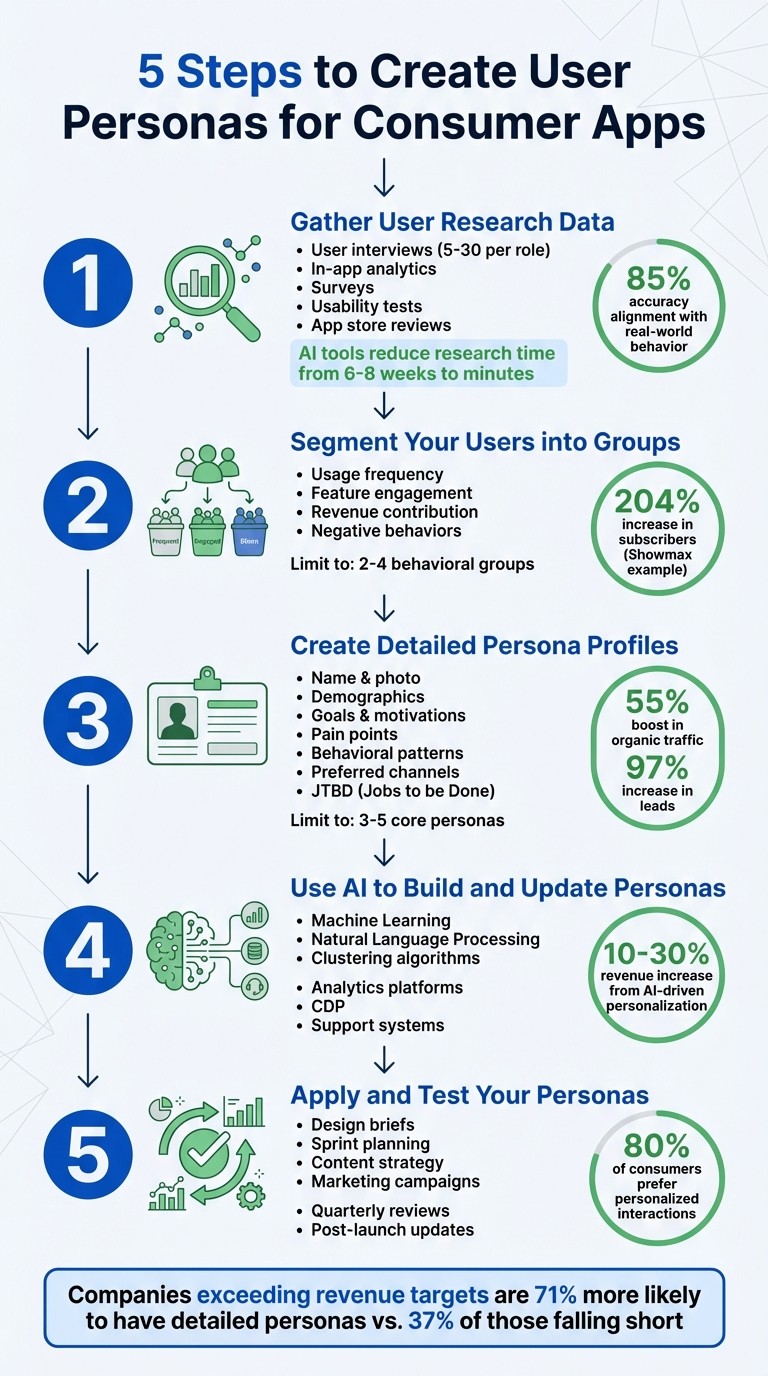
5-Step Persona Development Process for Consumer Apps
Step 1: Gather User Research Data
Research Methods to Use
Creating effective personas starts with gathering a mix of qualitative and quantitative insights. For consumer apps, some of the best methods include:
User interviews: Conduct between 5 and 30 interviews per role; patterns often begin to emerge after just 5 conversations.
In-app analytics: Track how users engage with features and their session behaviors.
Surveys: Capture user goals, frustrations, and preferences directly.
Usability tests: Identify problem areas in your interface by observing users interact with your app.
App store reviews: Analyze ratings, comments, and keywords to uncover sentiment trends and recurring complaints [2].
By 2026, zero-party data - information users willingly share through quizzes, calculators, or preference centers - has become a critical addition to these traditional methods [3]. This approach complements existing data by providing direct insights into user preferences. Don’t forget to leverage your app store presence; reviews and ratings often reveal how users perceive your app [1].
Once you’ve gathered your data, the next step is to identify patterns in user behavior.
Find Patterns in User Behavior
Focus on behavioral clusters rather than demographic categories. Modern personas emphasize "digital body language" - how users interact with your app - over traditional metrics like age or location [3]. For instance, you might identify "power users" who rely on your app daily versus "casual users" who only check in occasionally [2].
"Data tells you what users do. Personas help you understand why." – Samir Yawar, Contributor, Articos [2]
The goal is to uncover recurring patterns in how different groups engage with features, navigate workflows, and articulate their objectives. Companies that base personas on actual behavioral data report a 55% increase in organic search traffic and a 124% boost in sales generated through their website [2].
To speed up this process, AI tools can play a transformative role.
Speed Up Research with AI Tools
Traditional research timelines often stretch to 6–8 weeks, but AI-powered tools can reduce this to mere minutes [2]. For example, platforms like Articos simulate user reactions in under 30 minutes, with synthetic responses aligning with real-world behavior over 85% of the time [2]. Meanwhile, YouGov AI Personas draws from datasets of over 480,000 panel members and 650,000 data points to deliver instant, evidence-backed audience insights [5].
AI particularly excels at organizing and categorizing data. It can process hundreds of user observations or quotes, grouping them into themes and creating affinity diagrams [7][8]. Some tools even transform raw research notes into first-person "voice of the customer" narratives, fostering deeper team empathy [8]. However, it’s crucial to validate AI-generated outputs with human oversight to avoid potential biases or inaccuracies [7][5]. By leveraging these tools, you can ensure your personas remain relevant and actionable.
Step 2: Segment Your Users into Groups
How to Segment by Behavior
Once you've collected your research data, the next step is to group your users based on their behavior. Focus on these four key criteria:
Usage frequency: Are they daily power users or occasional visitors?
Feature engagement: What specific tools or features do they actively use?
Revenue contribution: Are they paid users, free users, or do they have varying lifetime values?
Negative behaviors: Look for patterns like cart abandonment, downgrades, or inactivity.
For example, Showmax, a streaming service in South Africa, used the Braze data platform to segment its audience by lifecycle stage and content preferences. This strategy led to a 204% increase in subscribers, a 71% retention rate, and a 37% boost in ROI [10]. Similarly, Too Good To Go, an app focused on reducing food waste, segmented users based on app sessions and purchase history. This allowed them to send timely notifications about available "Surprise Bags", resulting in a 135% rise in purchases and doubling their message conversion rates [10].
To keep things manageable, limit your segments to 2–4 behavioral groups. Once you've defined these groups, focus on the ones that align most closely with your business objectives.
Choose Which Segments to Focus On
With your segments in place, the next step is to prioritize the ones that will have the greatest impact on your goals. For instance, if revenue growth is your main objective, focus on converting free users into paying customers. If you're aiming for expansion, analyze your power users to understand their behaviors and use those insights to attract new customers. Track metrics like lifetime value (LTV), retention rates, customer acquisition cost (CAC), and conversion speed to guide your decisions.
Thomson Reuters provides a compelling example: by creating detailed customer personas, they achieved a 175% increase in revenue from marketing efforts and reduced lead conversion time by 72% [12]. Research shows that companies exceeding revenue and lead targets are 71% more likely to have detailed personas, compared to only 37% of those falling short [12]. Additionally, defining negative personas - users who are unlikely to engage or convert - can help you avoid wasting resources.
How to Create A User Persona in 2026 [FULL GUIDE]
Step 3: Create Detailed Persona Profiles
Once user segments are in place, the next step is crafting detailed persona profiles to guide decisions with clarity and purpose.
What to Include in Each Persona
Start by giving each persona a name and a photo. This small step makes discussions more relatable - it's easier to ask, "Would this feature help Alex?" than to debate abstract groups like "the 18–24 demographic." Then, layer in key demographic details like age, location, income, and device preferences. Add goals and motivations to help prioritize features, while pain points highlight the challenges your app should address.
Go deeper by documenting behavioral patterns. For example, does this persona check your app quickly on the go or spend longer, more focused sessions? Identify preferred channels - whether it’s TikTok, Instagram, or Reddit - and include a quote in the user's own words, like, "I just need one tool that doesn’t make me feel stupid." These personal touches help align your team around the persona’s needs.
Modern personas, especially by 2026, focus on "Jobs to be Done" (JTBD) - the specific progress users aim to achieve with your product. This approach is often more insightful than relying purely on demographics. Instead of just knowing a user’s zip code, understanding why they "hire" your product reveals their true intent.
Use Templates to Build Personas Faster
Utilizing templates ensures consistency and avoids conflicting data points. Tools like HubSpot’s "Make My Persona" (free), Delve AI (free for one website persona), and Xtensio (free for one persona) provide solid frameworks. UXPressia, starting at about $20 per month, is a specialized tool for creating personas and journey maps.
AI-powered tools can dramatically speed up the process by analyzing CRM data, analytics, and customer interviews, condensing weeks of manual work into minutes. Businesses that adopt standardized persona templates have reported impressive results: a 55% boost in organic search traffic, a 97% increase in website-generated leads, and significantly higher email engagement - open rates doubling and clickthrough rates increasing fivefold [2][11].
To ensure your personas are actionable, ask yourself two key questions: Can the team identify a real user who fits this profile? Would this persona lead to a distinct product decision compared to others? If the answer to either is no, the profile needs more refinement. Limit your focus to 3–5 core personas to keep your strategy sharp and effective.
Below are three sample profiles that translate behavioral insights into actionable strategies.
Example: 3 Sample Consumer App Personas
Persona Name | Primary Goal | Key Pain Point | Typical Behavior | Marketing Guidance |
|---|---|---|---|---|
Cameron (Urban Sneaker Enthusiast) | Access limited-edition releases | High resale prices and bot competition | Binge-watches unboxing videos; active on TikTok/Instagram at night | Target with limited-edition drops and night-time social campaigns |
Heather (Book Lover) | Self-improvement through literature | Low email engagement | Prefers social media and chat messaging over email | Focus on social media and in-app messaging; avoid heavy email marketing |
Ji-ah (Martech Professional) | Find easy-to-use, industry-relevant tools | Complex tools that slow down workflows | Reads success stories and values simple, innovative UI | Highlight customer success stories and emphasize intuitive design |
These profiles show how behavioral details can guide strategy more effectively than traditional demographics. For instance, Cameron’s night-time social media activity suggests the best timing for push notifications. Heather’s dislike of email points to the value of in-app tutorials for onboarding. Ji-ah’s preference for success stories emphasizes the need to showcase case studies prominently on landing pages. By focusing on these specifics, your team can create user experiences that truly resonate.
Step 4: Use AI to Build and Update Personas
Take your persona profiles to the next level by integrating AI. This approach shifts personas from static snapshots to dynamic, ever-evolving tools that provide actionable insights.
AI turns persona creation into an ongoing process. Instead of spending weeks manually analyzing data, AI tools can process thousands of data points in just hours, revealing patterns and trends you might otherwise miss [6].
How AI Generates Persona Insights
AI uses advanced technologies to craft detailed and accurate personas. Machine Learning algorithms dig into purchase histories, app usage, and user interactions to identify shared traits. Natural Language Processing (NLP) adds another layer by analyzing customer feedback - whether it’s app store reviews or social media comments - to gauge sentiment and uncover pain points. Clustering algorithms then group users into segments, reducing the subjective bias that often creeps into manual research [6][4].
Several tools make this process seamless:
Delve AI: Integrates with Google Analytics and CRM systems to create personas from your first-party data.
YouGov AI Personas: Builds profiles using an extensive dataset of over 480,000 US panel members and 650,000 data points [5].
PersonaBuilder: A no-code platform that refines personas in real time as new data streams in, ideal for consumer apps [6].
Interestingly, AI-generated synthetic responses align with human behavior over 85% of the time in usability and concept validation studies [2]. For the best results, try iterative prompting - feeding AI data in stages, starting with user goals, then challenges, and finally behavioral patterns. This method ensures nuanced profiles rather than generic outputs [7].
"If a detail doesn't help your team empathize or make a design decision, it's just noise." – Steve Mulder, author of The User is Always Right [7]
These insights form the backbone of personas that can adapt in real time.
Connect Analytics for Continuous Updates
AI’s role doesn’t end with generating insights. The most effective persona systems are "living profiles" - data models that automatically update as user behavior evolves [3]. By linking AI tools to analytics platforms like Mixpanel or Amplitude, along with your Customer Data Platform (CDP) and support ticket systems, you create a self-updating pipeline. This ensures persona attributes stay relevant without requiring constant manual updates.
Trigger-based updates are particularly useful. For example, you can refresh personas immediately after launching new features, pivoting a product, or spotting trends in support tickets [2]. Automation tools like Zapier can seamlessly funnel data from platforms like Zendesk or Intercom into research databases such as Dovetail for continuous refinement [11]. Companies leveraging AI-driven personalization based on updated personas have reported revenue increases ranging from 10% to 30% [11].
However, it’s crucial to keep a human element in the loop. Team members should periodically review AI outputs to catch errors or cultural nuances that automated systems might overlook. Opt for platforms that offer source-tracing, so you can verify the data behind each persona’s attributes [9].
"A persona with stale data is worse than no persona at all because it gives teams false confidence." – Samir Yawar, Contributor, Articos [2]
Step 5: Apply and Test Your Personas
Creating personas is just the beginning. The true payoff comes when you actively use and refine them.
Bring Personas Into Everyday Workflows
Incorporate personas into your daily processes, such as design briefs, sprint planning, and content strategies. This ensures user needs stay at the forefront rather than letting personas become forgotten files gathering digital dust [2]. When considering new features, refer to the relevant persona to assess whether it addresses a genuine user problem.
For onboarding experiences, use personas to craft flows that deliver an immediate "aha" moment - ideally within the first 60 seconds of app use [1]. If your research indicates users abandon apps when they don’t quickly see value, prioritize showcasing key features before asking for account details or permissions.
Marketing teams can use persona-driven behavioral data to allocate budgets wisely. For instance, a dating app aimed at Gen Z might prioritize TikTok, while a productivity tool for professionals could lean toward LinkedIn [1]. Personalized interactions matter - 80% of consumers are more likely to engage with businesses that tailor their approach [2].
"If your persona document is based on what your CEO thinks the customer looks like rather than what the data shows, you don't have a persona – you have a wish list."
– Samir Yawar, Contributor, Articos [2]
Once personas are actively shaping design and marketing strategies, the next step is validating and updating them regularly.
Keep Personas Relevant Through Validation and Updates
After rolling out your personas, it’s crucial to track their effectiveness and adjust them as needed. This process ensures your personas stay in sync with your evolving audience.
Ask these key questions to test each persona: Can you identify a real user who matches this profile? Does it offer an unexpected insight? Would this persona behave differently from other segments? Can your sales team recognize them? Is the data backed by multiple sources? If you can’t confidently answer "yes" to at least four of these, the persona needs more work [2].
Review personas quarterly, comparing them against analytics and market trends [2][3]. Update them promptly after major product changes, feature launches, or noticeable shifts in customer support inquiries [2].
For quicker validation, leverage AI-powered synthetic user testing to predict how target audiences might respond to new features or messaging before committing to media spend [3][4]. Research indicates AI-generated responses align with real user behavior over 85% of the time for usability and concept testing [2]. However, always include human oversight to catch fake AI marketing tools, algorithmic biases, and subtle nuances that automated systems might miss [5].
Summary
The 5 Steps Reviewed
Creating effective personas for consumer apps involves a structured process: gathering data from analytics, surveys, and support tickets; segmenting users based on behavior; crafting detailed profiles that include goals, challenges, and motivations; leveraging AI for real-time insights [6][9]; and regularly validating and updating those personas.
With AI, personas are no longer static documents. Instead, they become dynamic tools, updated continuously in hours rather than months. Modern personas connect to live data feeds, refreshing daily, so your team always works with the most current insights [3]. This approach ensures every decision aligns with actual user needs.
Why Personas Matter
Effective personas are the foundation of smarter product and marketing strategies. Businesses that use persona-driven approaches consistently see improvements in traffic, leads, and sales [2]. For consumer apps, the impact is even greater. Personalization not only meets user expectations but also drives engagement [4][2]. For example, a skincare brand that shifted to behavioral personas - identifying "The Preventative Planner" segment through zero-party quiz data - achieved a 40% revenue increase in Q1 2026 [3].
The true power of personas lies in their application. They help answer critical questions like: Does this feature address a real user need? Will this messaging connect with the intended audience? Where should marketing efforts focus next? By turning data into actionable insights and keeping personas updated and relevant, they evolve from static profiles into tools that guide decisions and deliver measurable results over time.
FAQs
How many personas do I actually need for my app?
The number of personas you should create hinges on your app's goals and the complexity of your audience. Experts suggest developing personas for each major user segment or role, which could range from just a few essential profiles to several, depending on how varied your audience is. Prioritize creating profiles that are actionable and based on real data, capturing your users' motivations, challenges, and behaviors, while steering clear of overcomplicating the process.
What’s the easiest way to segment users if I don’t have much data yet?
Start by forming initial ideas based on what you know about your product and the early conversations you've had with customers. Dive into any available customer data, or look at social media and what your competitors are doing to spot trends. You can also use AI-driven tools to transform even limited data into useful customer segments. These steps give you a foundation to build on, allowing you to adjust and improve as more information comes in.
How can I use AI for personas without introducing bias?
To minimize bias in AI-driven persona development, it's crucial to start with diverse datasets that offer a balanced representation of various groups. This approach helps reduce skewed outcomes. Techniques like fairness audits and adversarial testing are also essential tools for identifying and addressing hidden biases within the data or algorithms.
Using frameworks like Multi-Persona Thinking can further refine the process by comparing and contrasting different social identities, uncovering discrepancies, and ensuring a broader perspective. The focus should remain on ethical practices, maintaining fairness in data usage, and leveraging advanced methods of bias detection to create user personas that are both inclusive and equitable.
Related Blog Posts

Zach Chmael
CMO, Averi
"We built Averi around the exact workflow we've used to scale our web traffic over 6000% in the last 6 months."
Your content should be working harder.
Averi's content engine builds Google entity authority, drives AI citations, and scales your visibility so you can get more customers.