How to Do Persona Development for Creators & Influencers

Averi Academy
Averi Team
8 minutes

In This Article
Build 3–5 data-driven creator personas using analytics, surveys, and AI to tailor content by platform and improve engagement and conversions.
Updated:
Trusted by 1,000+ teams
Startups use Averi to build
content engines that rank.
Persona development helps creators and influencers connect with their audience by using data, not guesswork. By understanding who your audience is and what they need, you can create content that resonates deeply, improving engagement by up to 40% and boosting conversions by 2.5×. Here’s how to get started:
Research your audience: Use tools like Instagram Insights, YouTube Analytics, and TikTok Creator Tools to gather data on demographics, behaviors, and preferences.
Segment your audience: Group followers into 3–5 key segments based on shared traits, motivations, and challenges.
Create profiles: Build detailed profiles for each segment, including demographics, goals, pain points, and preferred content styles.
Tailor your content: Use these profiles to guide your content strategy, ensuring every piece speaks directly to a specific group.
AI tools like Averi AI can simplify this process, analyzing data and creating personas quickly. Regularly update your profiles to keep them aligned with your audience’s evolving needs. The result? Content that feels personal, relevant, and effective.
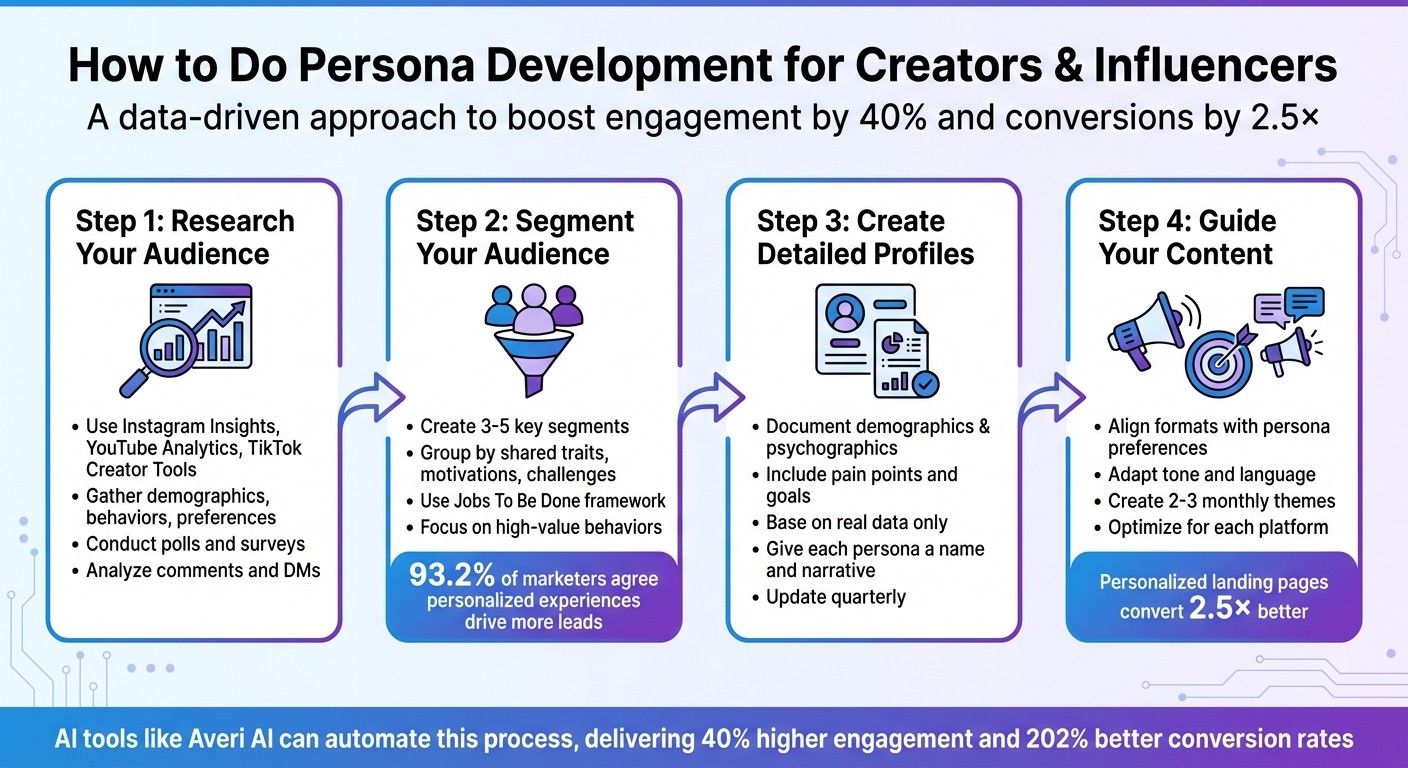
4-Step Persona Development Process for Content Creators
Create Your Ideal Customer Avatar: Target Audience & Persona Creation for YouTube Growth
Step 1: Research Your Audience
To build effective personas, start by collecting meaningful data from the platforms where your audience is most active. Tools like Instagram Insights, YouTube Analytics, and TikTok Creator Tools can provide a wealth of information, such as age groups, locations, gender breakdowns, and peak engagement times. These metrics also shed light on behaviors like video completion rates, post saves, and when your followers are most likely to interact with your content.
Use Analytics Tools to Understand Behavior
Tap into the analytics dashboards available on your main platforms. For example, Instagram Insights shows which Stories generate the most replies or link clicks. YouTube Analytics offers data on average view durations and traffic sources, helping you see whether viewers find you through search, suggested videos, or external links. TikTok Creator Tools can pinpoint which sounds, hashtags, or video lengths drive the most shares. To go even deeper, tools like SparkToro, Google Trends, and AnswerThePublic can help refine your understanding of audience interests [1]. For those juggling multiple platforms, Delve AI integrates data from sources like Google Analytics and social platforms to create detailed audience profiles [2].
Ask Your Audience Directly
While analytics reveal what your audience does, direct feedback uncovers why they do it. Use Instagram polls or question stickers to ask followers about their challenges or what topics they want to see next. Short, focused surveys - five to seven questions - can provide valuable insights. Dive into your comments and DMs to pick up on the language your audience uses to describe their struggles. Reddit and niche subreddits are also goldmines for uncovering frustrations and desires that analytics might overlook.
Organize and Analyze Your Findings
After gathering data, group related insights into themes. For instance, if multiple followers mention struggling to find time for meal prep, that’s a clear topic to address in your content. Track metrics like engagement rates (calculated as likes, comments, and shares divided by total followers) to identify which posts resonate most deeply, rather than just those with broad reach. If you're using AI tools like ChatGPT to analyze survey responses or transcripts, process data in smaller chunks - such as separating goals from challenges - to ensure clarity and actionable results [3].
Step 2: Divide Your Audience into Segments
Once you’ve collected your data, the next step is to sort your followers into meaningful segments. This transforms raw numbers into clear audience profiles that can shape your content strategy. The aim isn’t to create an exhaustive list of every follower type but to focus on three to five key segments that represent your most engaged or valuable communities. These segments will act as the foundation for crafting targeted content that resonates with specific groups.
Group Audiences by Shared Traits
Start by identifying patterns in your data. Go beyond basic demographics and include psychographics, such as motivations and frustrations, as well as behavioral insights like how often they engage with your content. For example, one group might gravitate toward tutorial videos and post beginner-level questions, while another prefers behind-the-scenes content and frequently shares posts. The Jobs To Be Done (JTBD) framework can be especially helpful here - group people by the problems your content helps them solve rather than just surface-level traits. For instance, a 25-year-old and a 45-year-old might both follow you for time-saving meal prep tips, placing them in the same segment despite their age difference.
Dive into CRM records, platform analytics, and social listening tools to uncover recurring engagement patterns and common pain points. Look at which posts generate the most saves versus shares or spark lengthy comment threads. If you’ve conducted audience surveys, pay attention to recurring phrases like “I don’t have time” or “I feel overwhelmed,” as these can highlight shared frustrations. Studying competitors’ audiences can also reveal untapped opportunities or confirm the presence of specific interest groups within your niche.
Keep Personas Straightforward and Practical
Avoid overcomplicating your personas with unnecessary details that don’t contribute to actionable insights. Instead, focus on high-value behaviors - like frequent purchases or affiliate link clicks - rather than sheer follower counts. A smaller, highly engaged audience often has more impact than a larger, passive one. Research shows that 93.2% of marketers agree that personalized experiences drive more leads and purchases [2].
"If a detail doesn't help your team empathize or make a design decision, it's just noise." - Steve Mulder, The User is Always Right [3]
Keep your personas simple and relatable. Give each segment a memorable label and a short narrative, such as “Startup Sarah,” a 32-year-old entrepreneur looking for quick marketing tips during her morning commute. This storytelling approach makes it easier to assess whether a piece of content will connect with a specific group before you publish it. Treat these personas as evolving tools - update them regularly as your audience grows and changes. These segments will later help you leverage AI tools to streamline and refine your content strategies.
Step 3: Create Detailed Persona Profiles
After identifying your audience segments, take the next step by crafting comprehensive profiles for each group. These profiles act as a go-to resource for your team, helping them make informed content decisions. The idea is to include enough detail to clearly picture your audience without overcomplicating things. These profiles should build upon the insights gathered from your segmentation work, serving as a practical guide for tailoring content.
Document Demographics and Psychographics
Start with the basics - age, gender, location, and occupation. Then, layer in psychographics like motivations, values, interests, and lifestyles. For instance, knowing your audience includes a 28-year-old based in Austin, Texas, is helpful. But knowing they’re a freelance graphic designer who values work-life balance, follows productivity influencers, and regularly uses Adobe Creative Cloud adds depth that can shape your content strategy.
Include language cues, brand preferences, and emotional tones in your profiles. Pay attention to the phrases your audience uses in comments or direct messages. If they often say things like, "I'm burnt out" or "I need quick wins", those exact words should make their way into your persona profile. Additionally, consider their intellectual and emotional preferences - are they seeking a mentor, a strategist, or an entertainer? Do they respond better to calm, analytical messaging or high-energy, urgent tones?
Base Personas on Real Data
As you outline these attributes, ensure they’re grounded in real data. Every detail should be supported by analytics, surveys, or direct conversations with your audience. If you can’t back up a trait with evidence, leave it out. To keep the tone authentic, write sections of the persona in the first person, reflecting the customer’s own voice. For example: "I’m tired of clickbait - I want actionable DIY tips I can use this weekend."
Design a template that includes key elements like demographics, psychographics, pain points, goals, brand affinities, and success metrics. Success metrics might include what your audience gains from your content, such as learning a new skill or feeling part of a community. Give each persona a name and a short narrative - something like "Freelance Fiona", a 32-year-old designer who follows productivity creators and needs time-saving workflows to fit between client calls. This makes it easier to ask, "Would Fiona find this post valuable?" before publishing.
For collaboration, tools like Userforge ($20/month per user) can help you document and share these profiles effectively [2]. Remember, personas aren’t static. Treat them as evolving documents - revisit and update them quarterly as new data emerges and your audience’s needs shift.
Step 4: Use Personas to Guide Your Content
With the detailed profiles you’ve built in Steps 1–3, it’s time to create content that resonates directly with each group. Every decision should be guided by this question: who is this for? Crafting content with a specific persona in mind ensures your messaging stays sharp and consistent across all platforms.
Align Content Formats with Persona Preferences
Different personas crave different types of content. For instance, learners appreciate tutorials, buyers gravitate toward product reviews, and community-focused audiences enjoy behind-the-scenes glimpses. If you’re targeting a busy, time-saving persona, consider quick tutorials or curated tool lists. On the other hand, if your audience values expertise, invest in detailed case studies or long-form content.
Your tone also matters. Keep it calm and steady for mentor-like personas, but bring energy and excitement for trend-focused audiences. Decide on your role - are you a teacher, a strategist, or an entertainer? And don’t forget to speak their language. If your audience says, “I need quick wins,” reflect that exact phrasing in your captions, scripts, or posts.
Structure your content around 2–3 monthly themes that cater to your key personas. For instance, dedicate one week to tutorials for learners, another to product reviews for buyers, and a third to live Q&A sessions for community engagement. Personalized experiences pay off - landing pages tailored to specific audiences convert 2.5 times better than generic ones [2].
Adapt Strategies for Different Platforms
Even when targeting the same persona, remember that behavior varies by platform. Your approach needs to shift accordingly. Instagram is perfect for visually polished content, appealing to audiences in fashion, beauty, and lifestyle. TikTok thrives on humor and trends, making it ideal for younger, casual viewers. YouTube excels at long-form tutorials and storytelling, while LinkedIn connects with professionals through insightful, career-focused content.
A great example of platform optimization comes from Averi AI, which repurposed a single anchor piece into platform-specific formats between March and May 2025. The results? A 340% surge in organic traffic and a 220% increase in newsletter signups [2]. The secret was staying true to persona insights while tailoring format and tone to each platform. Ask yourself: would your audience scroll past this on TikTok but pause to engage with it on YouTube? If so, tweak the hook, pacing, or visuals to align with the platform’s style and keep your personas engaged.
Use AI Tools for Persona Development
Integrating AI into persona development streamlines the process and brings precision to data-driven content strategies. Traditional persona creation takes time and relies heavily on manual effort, but AI can automate data analysis, delivering insights far more quickly. Instead of spending hours combing through spreadsheets and searching for patterns, AI processes vast amounts of information in minutes, uncovering trends based on real audience behavior rather than guesswork.
How AI Analyzes Audience Data
AI is incredibly efficient at handling large datasets. Whether you're working with Instagram analytics, YouTube comments, survey results, or website activity, AI can identify patterns in demographics, interests, and engagement habits. It eliminates the need to manually sift through thousands of data points, clustering your audience into meaningful segments almost instantly. AI also pinpoints which topics resonate most, the language your audience uses, and their peak activity times - offering a level of speed and accuracy that manual analysis simply can't achieve.
How Averi AI Builds Personas
Averi AI takes these automated insights a step further by centralizing and refining persona data for consistent and actionable results. Begin by uploading your brand essentials - such as niche, target audience, tone, and visual style - into the Brand Core. Averi then analyzes your website to understand your brand’s positioning and voice, using this information to suggest ideal customer profiles. From there, it crafts content strategies tailored to each audience segment, ensuring your messaging connects with the right people.
The Library feature stores finalized personas, allowing them to automatically inform future content strategies. This eliminates the need for repeated manual input and ensures your messaging remains consistent over time. Unlike freelance platforms that require new briefings for every project, Averi retains persona data in its centralized memory, enabling it to deliver AI-generated drafts in hours rather than days [2].
Conclusion
Clearly defined personas allow you to connect with specific audience segments by addressing their real motivations, challenges, and preferences. This tailored approach fosters trust and encourages deeper engagement, far surpassing the impact of generic messaging.
Start by collecting data through analytics and direct feedback from your audience. Use this information to craft detailed, data-driven persona profiles. These profiles should influence every content choice you make - from the topics you cover and the platforms you use to the tone and style of your messaging.
To take it a step further, advanced tools like Averi AI can refine your strategy. Averi AI simplifies the process by automating data analysis and persona development, making it easier to create targeted, effective content. Studies highlight the power of AI-driven personas, showing they can boost creator engagement by up to 40% and drive 202% higher conversion rates through real-time personalization [2].
By centralizing your personas in one system, rather than scattering them across various documents, you ensure that every piece of content - whether it’s a video, post, or campaign - stays aligned with your audience's needs. This approach minimizes guesswork and maximizes engagement.
Make it a habit to revisit and refine your personas regularly. Doing so will keep your content strategy sharp and help you build meaningful, lasting connections with your audience.
FAQs
How many personas do I need?
The number of personas you should create depends largely on the diversity of your target audience. In most cases, having 3 to 5 well-crafted personas strikes the right balance. This range allows you to dig deep into understanding your audience while keeping your marketing and content strategies manageable and focused. It ensures you can address the most important audience segments without spreading your efforts too thin.
How do I validate a persona is accurate?
To ensure a persona is accurate, compare the AI-generated or initial outputs with data from your original research, such as user interviews and reports. Look for alignment in areas like user goals, challenges, motivations, and behaviors. You can also validate the persona by asking follow-up questions or using adversarial prompts to test whether it genuinely reflects real user traits. This back-and-forth process refines the persona, making it a more reliable representation of your audience’s needs and actions.
How often should I update my personas?
It's a good idea to revisit and refresh your personas about every six months to ensure they stay accurate and relevant. That said, updates are usually only needed when there are notable shifts in your target audience or market conditions. In fast-moving fields like content creation and influencer marketing, regular reviews are especially useful for staying in tune with changing audience preferences and behaviors.
Related Blog Posts

Zach Chmael
CMO, Averi
"We built Averi around the exact workflow we've used to scale our web traffic over 6000% in the last 6 months."
Your content should be working harder.
Averi's content engine builds Google entity authority, drives AI citations, and scales your visibility so you can get more customers.