

In This Article
Build dynamic, data-driven ecommerce customer personas using analytics and AI—segment audiences, map journeys, and test to boost engagement and conversions.
Updated:
Trusted by 1,000+ teams
Startups use Averi to build
content engines that rank.
Creating effective customer personas is essential for ecommerce brands to boost engagement and drive sales. Instead of relying on vague demographics like "women aged 25–40", modern persona development uses detailed profiles based on real customer data and behavior. By 2026, tools like AI-powered platforms have transformed personas from static documents into dynamic, data-driven models that update in real time.
Key Takeaways:
Why Personas Matter: Personalized marketing improves engagement, with 71% of customers expecting tailored interactions and companies seeing 40% higher revenue when they deliver.
Steps to Build Personas:
Set Clear Goals: Define measurable objectives tied to customer behavior (e.g., reducing cart abandonment by 15%).
Gather Data: Use tools like Google Analytics and surveys to combine quantitative data (purchase trends) with qualitative insights (customer motivations).
Segment Customers: Group customers by demographics, behavior, and triggers that drive purchases.
Create Detailed Profiles: Include psychographics, shopping habits, and ecommerce-specific details like payment preferences.
Map Customer Journeys: Identify key stages (awareness, consideration, purchase) and pain points to improve their experience.
Leverage AI: Automate updates to personas using platforms like Averi AI to ensure they stay current and actionable.
Test and Refine: Validate personas with A/B testing, real customer feedback, and regular updates.
Quick Tip:
Start with 3–5 high-value personas and focus on personalization. AI tools can streamline the process by analyzing customer behavior and creating dynamic profiles. Regular updates and testing ensure your personas remain relevant in a fast-changing ecommerce landscape.
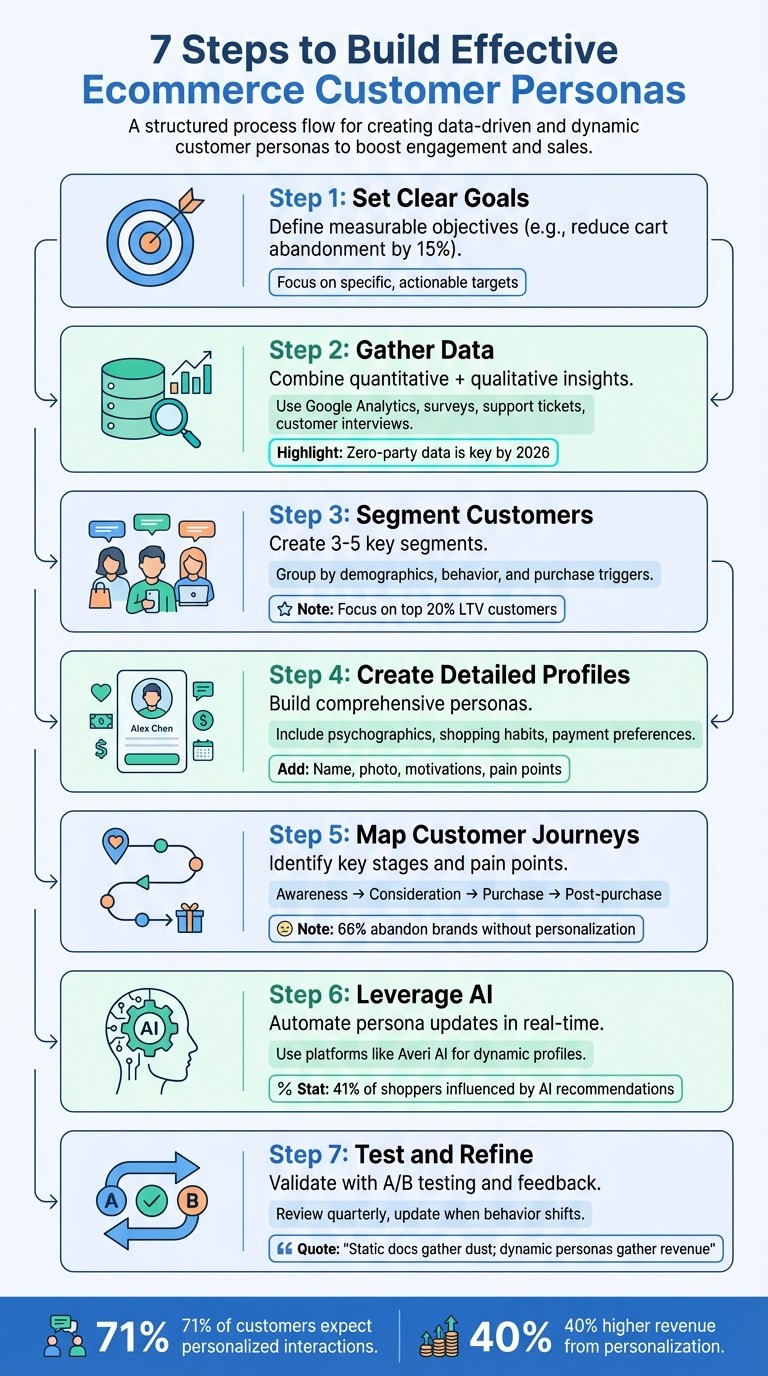
7-Step Ecommerce Persona Development Process
🤖 How to Build a Customer Persona using AI!
Step 1: Set Goals and Gather Customer Data
Before diving into persona creation, it’s essential to define clear objectives. Broad goals like "understand our customers" won’t get you far. Instead, focus on specific, measurable targets tied to your ecommerce performance. For example, you might aim to cut cart abandonment by 15%, increase average order value (AOV) through product bundling, or encourage repeat buyers to join your loyalty program. These goals will guide the type of data you need and how you’ll use it.
Effective personas rely on a mix of quantitative data and qualitative insights. Start by analyzing hard numbers. Tools like Google Analytics, Shopify, or WooCommerce are great for spotting purchase trends and evaluating metrics like Customer Lifetime Value (CLV) and AOV, which help identify your most valuable segments [6].
But numbers alone don’t tell the whole story. That’s where qualitative data becomes invaluable. Dig into customer support tickets and live chat logs to uncover common objections or frustrations that might be blocking purchases. Product reviews and survey responses offer a window into your customers’ emotional triggers and motivations. When conducting customer interviews, focus on four essential questions: Why did you buy? What alternatives did you consider? Where did you look for information? Why did you buy now? [1]. These answers provide a deeper understanding of what drives customer behavior.
Looking ahead, zero-party data - information customers willingly share - will play a key role by 2026 [7]. For instance, a skincare brand might use an interactive quiz to learn about a customer’s skin type and budget, while a furniture store could offer a room calculator to gather insights on space and style preferences.
With this data in hand, modern AI tools can take persona development to the next level. These tools can process massive amounts of data - such as sales calls, support tickets, and product reviews - and transform them into detailed customer profiles within hours instead of months [7]. Platforms like Averi AI are designed to create dynamic, real-time profiles by combining behavioral signals, psychographics, and intent data [3]. This unified view of the customer becomes the cornerstone for crafting detailed, actionable personas in the steps that follow.
Step 2: Identify Your Customer Segments
After gathering your data, the next move is to organize your audience into meaningful groups. Effective segmentation digs deeper than surface-level categories - it uncovers patterns in purchasing behavior, shopping habits, and the triggers that drive decisions. Aim to focus on 3–5 key segments to keep your marketing efforts sharp and targeted [3].
Segment by Demographics
Demographics answer the "who" by highlighting measurable traits like age, location, income (in USD), occupation, and family status [6]. These factors influence your choice of marketing channels and pricing strategies. For instance, targeting younger audiences might mean investing in short-form video content for platforms like TikTok or Instagram [2]. On the other hand, a furniture retailer could prioritize location-based segmentation, catering to urban apartment dwellers differently than rural homeowners.
Income plays a crucial role in shaping price sensitivity. Mid-income customers may respond better to bundled deals, while higher-income groups might lean toward premium features over discounts.
Start by analyzing your top 20% of customers based on Lifetime Value (LTV). Look for commonalities - are they clustered in certain metro areas, or do they share similar roles? This high-value group should form the core of your primary personas [6]. To enrich your insights, consider third-party tools like Experian Mosaic, which can provide additional details like socioeconomic status, household makeup, and geographic trends that your internal data might overlook [3].
"If your audience definitions are based on a template you downloaded in 2023, you are marketing to ghosts." - Wildnet Marketing [7]
You can also gather extra context with optional checkout questions like "Is this a gift?" or "Do you have a pet?" These small additions can provide valuable insights without disrupting the user experience [6].
Once demographics establish who your customers are, behavioral data can help explain why they act the way they do.
Segment by Behavior
Demographics are just the starting point - behavioral data dives into the "why" behind customer actions [6]. This includes factors like purchase frequency, browsing habits, device preferences, and responses to specific triggers. Behavioral segmentation often reveals patterns that demographics alone might miss. For example, you could identify "Efficiency Seekers" who carefully review product specs before purchasing, compared to "Spontaneous Buyers" who act on emotional cues. A skincare brand that shifted from broad age-based categories to a segment called "The Preventative Planner" saw a 40% boost in Q1 revenue [7].
Understanding where your audience gathers information - whether it’s Instagram, Google reviews, or YouTube - can help you allocate your marketing budget effectively [1]. Additionally, analyzing support tickets or live chat logs can uncover pain points that stop certain segments from completing their purchases [5]. Post-purchase surveys, such as asking "Who do you typically shop for?" can help distinguish between "gifter" and "end-user" personas [3]. The goal is to pinpoint the "buying moment" - the specific event or reason that turns a browser into a buyer. Asking questions like, "What made you purchase today instead of last week or next month?" can provide valuable insight [1].
Use Tools to Automate Segmentation
Manually segmenting your audience can be a slow process, and it’s prone to becoming outdated. AI-powered tools can step in to analyze massive datasets and keep segments updated in real time based on customer behavior. Customer Data Platforms (CDPs) like Lexer can consolidate ecommerce, email, and web data, while AI automation tools like Klaviyo and Omnisend, along with ad platforms like Meta Ads Manager, can continuously refine your segments [3][5].
For ecommerce, platforms like Shopify Magic and BigCommerce's Feedonomics offer predictive analytics to anticipate customer behavior and streamline product discovery [5]. Personalization tools like Nosto, Rebuy, and Clerk.io can also create real-time segments to deliver tailored product recommendations [5].
To get the most out of these tools, start by unifying your first-party data in a CRM or CDP [3]. Automated segmentation not only simplifies the process but also converts raw data into actionable customer groups, helping you build dynamic personas. AI can even identify "negative personas" - those low-margin customers who frequently return items or rarely convert - so you can exclude them from your paid advertising campaigns [1].
Step 3: Build Detailed Persona Profiles
Once your audience segments are defined, the next step is creating detailed, adaptable personas that guide your marketing strategies. These aren't meant to be static documents buried in a folder but active tools that reflect your evolving understanding of your audience.
Core Persona Elements to Include
Start by humanizing the personas with essential details: a name, a representative photo, age range, location, occupation, income (in USD), and family status. These elements make the profile relatable and help your team visualize the customer. Then, dig deeper into psychographics and motivations - exploring their personal values, lifestyle choices, emotional triggers, and goals. For instance, instead of labeling someone as a "35-year-old marketing manager", you might describe them as someone who prioritizes efficiency and seeks tools to automate reporting so they can wrap up their workday by 5 PM [7].
To further enrich the persona, include a "virtual shelf" that lists the brands and products they already use, giving insight into their aesthetic preferences and quality standards. Note their pain points and objections - what frustrates them about current solutions, their hesitations, or indicators that they might not be a profitable customer. Finally, outline how your product addresses their needs and identify potential alternatives they might consider.
Ecommerce-Specific Persona Details
For ecommerce, you’ll need to go a step further by adding transactional and behavioral details. Pinpoint what triggers a purchase - whether it’s a life event, seasonal change, or even the start of a new year. Identify how they shop: Are they mobile-first, or do they prefer desktop? What platforms do they use for research - Instagram, TikTok, Reddit, or Google? Also, include their payment and delivery preferences, such as favoring PayPal, Venmo, or Buy Now Pay Later options like Klarna. Note their sensitivity to shipping costs and delivery speed. These details transform personas from generic profiles into actionable tools for optimizing checkout processes, targeting ads, and more.
Using AI to Improve Personas
AI tools can streamline persona creation and keep them relevant as customer behaviors shift. With the right prompts, AI can turn raw data into concise, day-in-the-life narratives that highlight a persona’s routine and challenges [5]. For example, you might use a prompt like: "Create a detailed ecommerce customer persona for my Shopify store. Include name, demographics, shopping behavior, pain points, and preferred marketing channels" [5].
In one example from early 2026, a B2B software company analyzed 5,000 sales calls using AI and discovered that their true product champion was the "Implementation Specialist" rather than the VP, cutting their sales cycle by three weeks [7]. AI can also generate synthetic users, allowing you to test ad copy or pricing strategies against simulated customers before launching live campaigns.
"In 2026, customer personas are living, breathing data models that update in real-time, not dusty documents stuck in a Google Drive folder."
– Wildnet Marketing Agency [7]
While AI can enhance persona profiles, always validate the results with real customer feedback to ensure accuracy. Tools like Averi AI can analyze customer data and competitor insights, turning traditional templates into dynamic profiles that evolve alongside your audience. These refined personas lay the groundwork for mapping customer behaviors and journeys in the next stage.
Step 4: Map Customer Behaviors and Journeys
Once you’ve built detailed personas, the next step is to dive into how these individuals navigate the buying process. Journey mapping transforms these static profiles into dynamic narratives, uncovering where customers first encounter your brand, what might make them hesitate, and what ultimately motivates them to complete a purchase.
Create Day-in-the-Life Scenarios
Start by illustrating how your product fits seamlessly into a customer’s daily routine. Instead of listing traits, paint a vivid picture of their day. For instance, imagine Mark - a millennial dad juggling morning chaos. He quickly reorders diapers through his voice assistant while getting the kids ready for school and makes impulse purchases during brief work breaks prompted by push notifications. These scenarios breathe life into raw data, showing exactly when and why customers make decisions.
"The most important job of a buyer persona is to give clarity on how your business can specifically serve this person."
– Lizzie Davey, Shopify
Map the Full Customer Journey
Break the buying process into key stages: Awareness (when they recognize a need), Consideration (when they explore options), Purchase (when hesitations are addressed), and Post-purchase (when loyalty is nurtured). For each stage, identify what propels customers forward. Interviews can uncover pivotal moments - asking "why now?" often reveals the triggers behind their decisions. Document where they seek information, whether scrolling TikTok during lunch or catching up on podcasts during their commute. Also, note the alternatives they evaluate, which might range from DIY solutions to entirely different product categories. This comprehensive mapping helps pinpoint obstacles and uncovers practical ways to improve the experience. By 2026, effective journey mapping will lean heavily on psychographics and digital behavior patterns, such as content preferences, rather than relying solely on demographics like age or gender [7].
Find Pain Points and Opportunities
Mapping the journey often reveals both friction points and opportunities for improvement. Tools like heatmaps and session recordings (e.g., Hotjar) can provide insights into where users struggle - whether it’s navigating your site or completing checkout. Feedback from support tickets and post-purchase surveys can also highlight recurring issues. For example, customers may experience "comparison fatigue" during the research phase or encounter checkout frustrations due to hidden fees or slow page loads. Keep in mind that personalization is critical - 66% of customers will abandon a brand that fails to deliver a tailored experience [8].
Step 5: Use AI to Update Personas
Keeping your customer personas up-to-date is essential in a constantly shifting market. Static personas can quickly lose relevance as trends evolve. Consider this: 41% of global shoppers have recently made purchases influenced by AI recommendations [10]. This highlights the importance of leveraging AI to ensure your personas stay relevant and effective.
Analyze Competitor Gaps and Trends
AI tools excel at scanning competitor websites, social media, and product listings to identify changes in messaging, pricing, or value propositions. When competitors adjust their strategies, AI can flag these updates and suggest revisions to your personas, particularly in areas like objections and alternatives [9]. For example, if AI uncovers that competitors are ignoring a recurring pain point in customer reviews, you can tweak your personas to address this gap directly, giving you an edge in meeting customer needs.
Automate Persona Updates
Tools like Averi AI connect with analytics platforms and Customer Data Platforms (CDPs) to monitor engagement patterns in real time. This builds on the data-driven foundation established in earlier steps. Whether it’s shifts in email click-through rates, changes in cart abandonment behavior, or new device preferences, these tools automatically refresh behavioral data within your personas [7].
To illustrate, in 2024, Tanger used AI-powered predictive models to cut forecasting time from 84 hours annually to just 12 hours. By analyzing historical data, economic trends, and seasonal patterns, they achieved faster, more accurate insights. CEO Stephen Yalof explained:
"AI now gives us the ability to recapture that personalized touch at scale, combining the warmth of human connection with the precision of data-driven insight" [11].
While quarterly persona reviews are a good baseline, real-time systems ensure behavioral data is updated daily to reflect emerging trends [7]. This combination of competitor insights and real-time updates ensures your personas stay both informed by external changes and accurate internally.
Generate Content for Each Persona
Once updated, personas can guide the creation of highly targeted content. AI can analyze customer language from support tickets and chats to craft messaging that resonates with each persona. This approach helps tailor product descriptions, email campaigns, and landing pages to specific customer segments. The result? A stronger connection with your audience - 73% of customers report feeling uniquely recognized, and 61% are willing to pay more for personalized experiences [9].
However, maintaining authenticity is crucial. Andrew Katz, CMO of Athletic Brewing Company, underscores this point:
"If you let AI do all the thinking, it feels inauthentic, and consumers can tell. For us, AI is a tool to listen, learn, and adapt faster - but the ideas and storytelling come from our teammates" [10].
The takeaway? AI can scale personalization and streamline processes, but human oversight ensures your messaging remains genuine and aligned with your brand’s voice. By blending AI-driven insights with human creativity, you can create content that feels both personal and authentic.
Step 6: Test and Refine Your Personas
Personas need consistent testing and updates to stay relevant as customer behaviors change. For instance, a 2025 merchant survey revealed that 21% of businesses conduct market research to validate their product or business ideas [4]. The same principle applies here - validation ensures your personas are grounded in reality, not assumptions.
Test Personas with A/B Campaigns
One of the quickest ways to validate personas is through targeted A/B campaigns. Design email campaigns, ad sets, or landing pages that address the specific pain points and preferences of each persona. Then, monitor metrics like conversion rates, click-through rates, and engagement levels to identify which personas resonate best. If a campaign falls flat, it’s a sign that your assumptions about that audience may need rethinking.
To enhance this process, consider using synthetic users - AI models trained on persona data - to test messaging before rolling out full-scale campaigns [7]. This allows you to simulate how different groups might respond to your ads, pricing, or content, helping you catch potential missteps early. Below is a quick overview of common testing methods and their objectives:
Testing Method | Primary Metric | Purpose |
|---|---|---|
A/B Campaign | CTR / Conversion Rate | Checks if messaging aligns with the persona. |
Synthetic Users | Qualitative AI Feedback | Stress-tests assumptions pre-launch. |
Usability Testing | Task Completion Rate | Confirms product features meet persona needs. |
Social Listening | Sentiment / Engagement | Ensures persona language reflects real users. |
These tools and metrics help fine-tune your personas, keeping them relevant and actionable.
Get Input from Other Teams
Once you’ve tested campaigns, widen the feedback loop by involving other teams. Marketing teams aren’t the sole keepers of customer insights - sales reps, customer support, and customer experience teams engage with your audience daily and can offer valuable perspectives that analytics might overlook [6]. Organize cross-team reviews to compare personas against real customer interactions.
A helpful exercise is to match your personas against your top 20 lifetime value (LTV) customers [6]. If none of your personas align with these high-value customers, you may be targeting the wrong segments. To encourage participation in feedback sessions or surveys, consider offering incentives like free shipping or gift cards.
Update Personas Regularly
Feedback and testing results should guide when to update your personas. By 2026, many leading brands are treating personas as "living profiles", integrated with Customer Data Platforms (CDPs) that update in real time based on customer behavior [7]. While quarterly reviews are a good baseline, sudden shifts - like drops in engagement, new use cases, or economic changes - might call for immediate updates [4].
Kathryn Marr, Co-founder of Blue Ivory Creative, emphasizes:
"Personas should be reviewed at least once or twice a year, or more frequently if you notice significant changes in customer behavior, market conditions, or product offerings" [6].
Balancing regular reviews with real-time updates is essential. Tools like Averi AI can automate persona adjustments by syncing with your analytics platforms, flagging changes in behavior as they occur. This ensures your personas stay aligned with your audience’s current needs. As Neeraj from Wildnet Marketing Agency cautions:
"The biggest mistake in buyer persona creation is relying on internal assumptions instead of external data. You are not your customer" [7].
Keeping your personas up to date is critical for staying connected to your audience and driving effective marketing strategies.
Conclusion
Persona development lays the groundwork for precise targeting, stronger engagement, and increased conversions. By focusing on behavioral signals and addressing pain points, you can create messaging that connects on a deeply personal level. Consider this: 71% of customers expect personalized interactions [2], and companies that excel in personalization see 40% more revenue from those efforts [5].
The move from static to dynamic personas represents a major shift in ecommerce marketing strategies. As Wildnet Marketing Agency aptly states:
"Static docs gather dust; dynamic customer personas gather revenue" [7].
Tools like Averi AI are leading this charge by automating persona updates, analyzing real-time behavioral data, and generating tailored content for specific segments. This automation frees you to focus on strategic decisions rather than repetitive tasks.
Start by building 1–5 high-value personas and test them through A/B campaigns. Collect feedback from cross-functional teams and make adjustments based on conversion data [1][6]. To stay ahead, establish a quarterly review process to identify behavioral changes early, and update personas whenever engagement drops or new trends emerge [4]. Use insights from purchase histories, support tickets, and zero-party data like quiz responses to ensure your personas are rooted in real customer behavior - not assumptions.
In today’s competitive landscape, guesswork isn’t an option. Rely on real data to refine your personas, and watch your engagement and conversions soar.
FAQs
How many personas should I create?
The right number of personas varies based on your business objectives and how diverse your audience is. In most cases, 3 to 5 thoroughly researched personas strike the perfect balance. This range helps you cover key customer segments without overwhelming your efforts. Having too many personas can scatter your focus, while too few could leave out crucial audience groups. Prioritize creating detailed, data-backed profiles that truly represent your core audience.
What data do I need to build accurate personas?
To create precise personas, start by collecting zero-party data - details that customers voluntarily provide. Combine this with behavioral signals to understand their motivations, challenges, and preferences. Use a mix of tools such as analytics platforms, surveys, interviews, and social media insights to gather comprehensive information. Modern methods now incorporate AI to build dynamic, real-time profiles that focus on behaviors and Jobs to be Done, offering a richer understanding than static demographic data alone.
How often should I update my personas?
The frequency of updating your personas hinges on how fast your business moves and the volume of data you gather. Ideally, treat personas as living models that adapt in real-time. At the very least, review and adjust them every quarter or whenever significant changes occur in customer behavior or market trends. Keeping them updated ensures they remain relevant and accurately reflect your audience, steering clear of outdated and inflexible profiles.
Related Blog Posts

Zach Chmael
CMO, Averi
"We built Averi around the exact workflow we've used to scale our web traffic over 6000% in the last 6 months."
Your content should be working harder.
Averi's content engine builds Google entity authority, drives AI citations, and scales your visibility so you can get more customers.