

In This Article
Practical guide to building personas for education platforms: research methods, segmenting users, detailed profiles, AI analysis, and persona-driven marketing.
Updated:
Trusted by 1,000+ teams
Startups use Averi to build
content engines that rank.
Developing user personas for education platforms is essential to align product features, marketing strategies, and user support with the needs of diverse stakeholders. Education platforms often serve an "audience multiverse", including students, teachers, administrators, and parents, each with distinct goals and challenges. Without clear personas, platforms risk building features or campaigns that fail to meet user expectations.
Key Takeaways:
Why Personas Matter: Personas ensure your platform resonates with its end users (students, teachers) while addressing buyer priorities (administrators, parents).
Steps to Build Personas:
Research: Collect quantitative (surveys, analytics) and qualitative (interviews, field studies) data.
Group Users: Identify patterns in user behaviors and motivations.
Create Profiles: Develop detailed personas that include demographics, goals, pain points, and decision factors.
Leverage AI: Use tools like Averi AI to analyze data and refine personas efficiently.
Apply Personas: Tailor marketing, product design, and support strategies to each user segment.
Example Persona Insights:
Students: Need mobile-friendly tools and quick feedback.
Teachers: Prioritize time-saving features and curriculum integration.
Administrators: Focus on ROI, compliance, and scalability.
Parents: Value progress tracking and ease of use.
By building accurate personas, education platforms can improve engagement, streamline product development, and enhance user satisfaction.
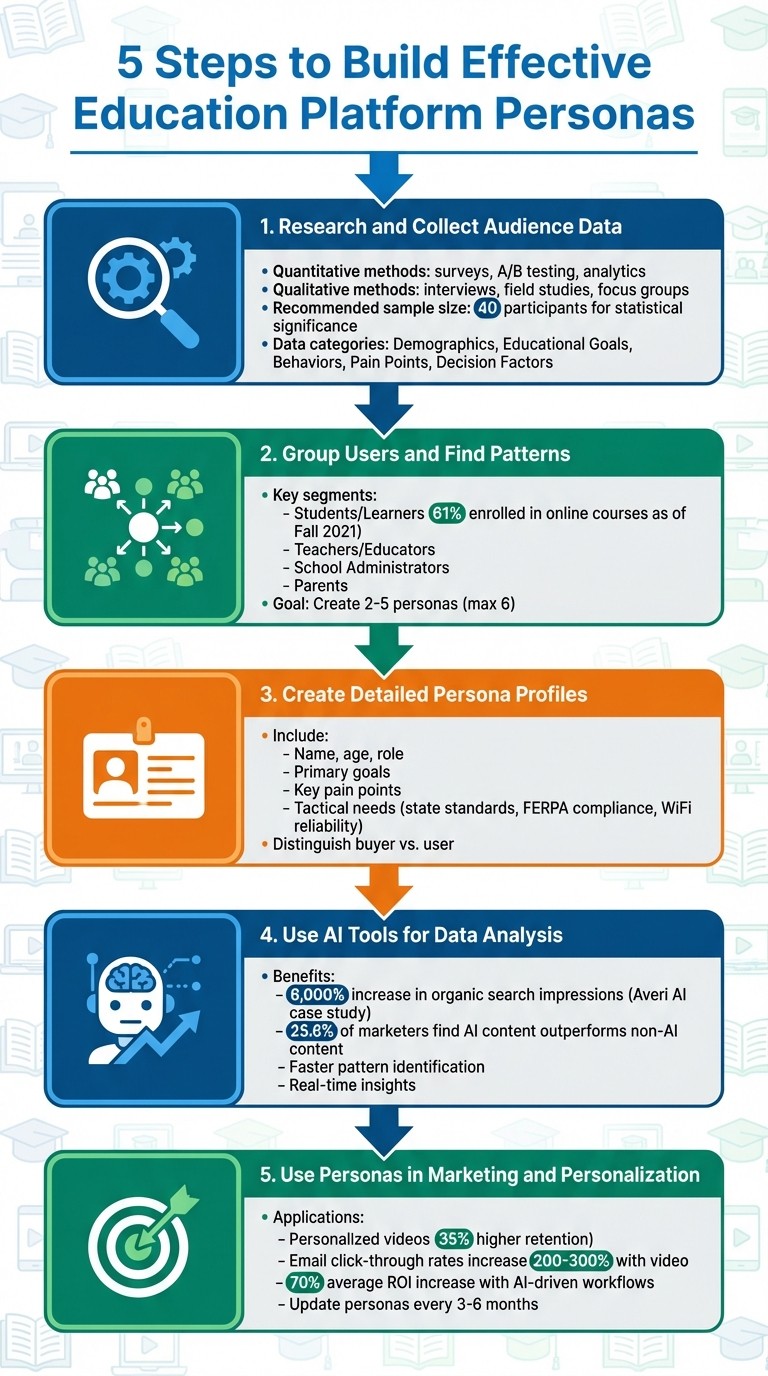
5-Step Persona Development Process for Education Platforms
How to Create and Use Student Personas in Your Higher Ed Marketing
Step 1: Research and Collect Audience Data
Trying to build personas without real data is like planning a lesson without knowing who your students are. To get it right, you need both quantitative research (to measure scope and trends) and qualitative research (to uncover the reasons behind those trends). Quantitative methods include tools like surveys, A/B testing, web analytics, and usability benchmarking. On the other hand, qualitative approaches focus on one-on-one interviews, field studies, focus groups, and diary studies [5][6].
Understanding the difference between attitudinal and behavioral research is key. Behavioral research - methods like A/B testing, eyetracking, and analytics - reveals what users actually do, rather than what they say they do [5][8]. In education, this gap can be striking. For instance, a teacher might claim to prefer desktop tools, but usage data could show they rely heavily on mobile devices.
How to Research Your Audience
To get a complete picture of your audience, mix methods. Use analytics to identify problem areas, such as where users drop off, and then apply qualitative research to understand why [9]. For education platforms, this could mean studying how a student navigates a course catalog or how an applicant completes a university application [7].
Contextual inquiry is especially useful in education. By observing users in their natural environments - whether a classroom, library, or home - you can see how external factors shape their experience [5][7]. For example, a teacher using your platform during a class may have entirely different needs than one exploring it during a quiet planning period. Diary studies can also provide valuable insights, as users log their thoughts after completing tasks like finishing a lesson or tackling a challenging quiz [8].
"Our beliefs about our users' behavior really help to structure good questions and get to the root of the problem and its solution." - Tanya Nativ, Design Researcher, Sketch [8]
While the Nielsen Norman Group suggests a sample size of 40 participants for quantitative research to ensure statistical significance [8], don’t underestimate the value of small-scale qualitative research. Even a handful of interviews can uncover critical pain points. Be sure to include educators from underserved or low-income communities. This ensures you account for challenges such as unreliable WiFi or shared devices, which can significantly impact user experience [2].
These research methods are the building blocks for creating detailed persona profiles in the next phase.
What Data to Collect
Once you’ve chosen your research methods, focus on gathering specific data in five key areas: demographics, educational goals, behaviors, pain points, and decision factors [4].
In EdTech, it’s important to remember that the buyer isn’t always the primary user [2]. For example, administrators might prioritize ROI and compliance with regulations like FERPA, while teachers need tools that align with state standards and integrate quickly. Meanwhile, students care about mobile access and fast feedback. Your research must address these distinct roles and their often-conflicting priorities.
Data Category | Specific Data Points | Why It Matters |
|---|---|---|
Demographics | Age, location, educational level, job title | Helps with segmentation and accessibility planning |
Educational Goals | Desired skills, degree requirements, career objectives | Aligns features with what users want to achieve |
Behaviors | Preferred devices, study times, research habits | Optimizes user interface design and marketing strategies |
Pain Points | Technical issues, time constraints, navigation problems | Identifies key problems your product needs to solve |
Decision Factors | Price sensitivity, accreditation, peer reviews | Shapes messaging for different user types |
To ensure accuracy, combine market research, persona workshops with front-line staff, and consumer surveys [10]. Cross-check qualitative insights from interviews with quantitative data from your learning management system [2]. Including front-line staff - like teachers, support teams, and sales reps - in validation workshops can provide a more accurate understanding of your audience than relying solely on executives [10].
Avoid introducing bias in your surveys. Instead of asking, "How much do you love our mobile app?" ask, "How do you typically access our platform?" Supplement self-reported data with real behavioral insights - sometimes where users actually click tells a more honest story than what they say they prefer [11].
These findings will directly shape the persona profiles developed in Step 3, ensuring they reflect real user motivations and behaviors.
Step 2: Group Users and Find Patterns
Once you've gathered your data, the next step is to organize it into meaningful groups. This involves identifying recurring behaviors and motivations among your users. In the education sector, this can be particularly tricky due to the sheer diversity of user needs. Tony Zayas, Chief Revenue Officer at Insivia, captures this challenge perfectly:
"In EdTech, your audience spans from a ten-year-old who thinks in emojis to a sixty-year-old superintendent who still prints emails. That's not a spectrum - it's a multiverse" [1].
Typical User Segments for Education Platforms
Education platforms generally focus on four main user groups: students/learners, teachers/educators, school administrators, and parents [2]. While these categories may echo the personas outlined in Step 1, segmentation here dives deeper into motivations and challenges unique to each group. For instance, adult learners aiming for career growth have very different needs compared to K–12 students. In Fall 2021, 61% of undergraduates were enrolled in at least one online course [3]. This means your "student" segment could include both traditional campus learners and remote professionals juggling work and family responsibilities.
Teachers often prioritize tools that save time and align with curriculum requirements. Administrators are more concerned with ROI, compliance with regulations like FERPA, and scalability. Parents, who have become increasingly savvy EdTech users since the rise of remote learning, look for clear progress tracking and user-friendly technology that works on shared devices [2]. Each group revolves around a core motivation, such as boosting reading scores, saving preparation time, or proving measurable outcomes to secure funding [2].
User Segment | Primary Motivation | Key Pain Point |
|---|---|---|
K-12 Teacher | Student outcomes & time-saving | Technology integration challenges |
School Admin | Efficacy & ROI | Budget constraints & implementation |
Adult Learner | Career advancement | Juggling work and education |
Parent | Student support & communication | Issues with shared home technology |
How to Identify Patterns in User Data
After defining your initial segments, the next step is to uncover patterns within these groups. Focus on identifying specific, actionable needs rather than broad goals. For example, if teachers frequently mention the need for state standard alignment or administrators highlight FERPA compliance, these are clear patterns you can use to refine your segmentation [2]. Similarly, if over 60% of students rely on mobile devices for research [3], device preference becomes a critical factor.
One effective approach is to pinpoint areas where users are improvising. For instance, if teachers are using external tools for science experiments, this could signal a gap in your content offerings [2]. Psychographic segmentation can also be valuable, grouping users by motivations such as career advancement or personal growth [13]. Narrowing each segment to a single primary goal ensures a sharper focus for your product strategy and messaging [2]. Aim to create 2–5 personas; managing more than six can make the process unnecessarily complicated [12].
These well-defined segments will serve as the foundation for building detailed persona profiles in the next step.
Step 3: Create Detailed Persona Profiles
Once you've defined your segments and identified patterns, the next step is to create comprehensive persona profiles. This is where raw data turns into actionable insights, giving you a clear picture of your users. These profiles should be detailed enough to influence decisions about product features, marketing strategies, and customer support approaches. The goal is to capture the essence of each persona so they feel like real, relatable individuals.
What to Include in Each Persona
A persona should go beyond basic demographics. Start with the essentials - assign a name, age, and role. For instance, you might have "Maya", a 34-year-old high school math teacher who interacts with 150 students daily. Her main priority could be saving time on grading and lesson planning [2], while her biggest challenge might be engaging students in algebra [13].
In the EdTech world, tactical needs are critical. These include practical requirements like state standard alignment, FERPA compliance to ensure data security, and overcoming technology limitations such as unreliable school Wi-Fi [2]. It's also important to capture the persona's voice. For example, Maya might express her frustrations and desires like this:
"I love teaching math, but it can be hard to get my students excited about it. I wish I had a tool that could help me make math more interactive and personalized for them, and also save me time and hassle" [13].
Another key aspect is distinguishing between the buyer and the user. For example, an administrator might control the budget and require ROI metrics, while a teacher is the one interacting with your platform daily [2]. Persona profiles should reflect these differences. An administrator might prioritize scalability and compliance reporting, whereas a teacher would focus on ease of use and seamless classroom integration.
Using Tables to Compare Personas
To highlight the differences between personas effectively, consider using a comparison table. This format helps you quickly identify variations in motivations, challenges, and needs, making it easier to tailor product decisions or marketing campaigns.
Persona Component | Teacher (Maya) | Administrator (Robert) | Adult Learner (James) |
|---|---|---|---|
Primary Goal | Save time on grading and lesson planning [2] | Demonstrate ROI and ensure compliance [2] | Career advancement and skill mastery [13] |
Key Pain Point | Budget constraints and staff adoption challenges [2] | Juggling work, family, and coursework | |
Tactical Need | State standard alignment; reliable classroom Wi-Fi [2] | FERPA compliance; district-wide reporting [2] | Mobile-first design; flexible scheduling |
Marketing Focus | Efficiency and ease of integration [2] | Scalability and measurable outcomes [2] | Career relevance and self-paced learning |
This table clearly illustrates how Maya, Robert, and James differ. Maya seeks tools that simplify her classroom tasks and boost engagement. Robert, on the other hand, is focused on big-picture goals like district-wide implementation and compliance. Meanwhile, James, as an adult learner, needs flexibility and mobile access - especially since over 60% of students use mobile devices to research educational programs [3]. These distinctions should guide your messaging, feature development, and support strategies for each group.
Step 4: Use AI Tools for Data Analysis
Creating personas manually can take weeks, but AI tools dramatically speed up the process by identifying patterns in a fraction of the time. For education platforms juggling multiple user groups, this means initial persona frameworks can be developed quickly and fine-tuned with ongoing, real-time insights.
Let’s dive into how Averi AI simplifies persona creation and delivers actionable insights.
How Averi AI Supports Persona Development
Averi AI analyzes your platform's content to understand your product’s positioning, features, and brand voice. From there, it suggests ideal customer profiles and potential segments, such as educators and administrators [16].
Its Strategy Map feature connects your content pillars directly to specific persona challenges. For example, it links adaptive learning tools to a teacher’s need for differentiated instruction or compliance reporting to an administrator’s requirements [16]. This approach has proven highly effective - between April 2025 and February 2026, Averi’s team used this method to boost their organic search impressions from 2,100 to an astonishing 1.68 million, achieving a 6,000% increase in just 10 months [14][16].
"We built Averi around the exact workflow we've used to scale our web traffic over 6000% in the last 6 months. It's intuitive, efficient, and highly customizable" [14].
Enhancing Personas with AI Insights
Once your initial personas are drafted, AI tools can uncover deeper insights into user behavior and content performance. Averi AI provides ongoing analysis of industry trends, competitor content gaps, and keyword opportunities that align with your personas [16]. For instance, if the data shows that adult learners prefer mobile-first experiences, the AI will flag this and suggest updates to your persona profiles and content strategy.
AI not only accelerates the process but also improves the precision of your personas and content. Research indicates that 25.6% of marketers find AI-generated content outperforms content created without AI assistance [15]. While AI excels at recognizing patterns, your expertise ensures the personas remain nuanced and relevant.
"We accomplished more in two weeks using Averi's AI-powered platform than we had in three months with a traditional marketing agency" [3].
For education platforms working within tight budgets and deadlines, this efficiency enables faster go-to-market strategies and more precise user targeting. With AI-enhanced personas in hand, you can customize your marketing and personalization efforts with greater impact.
Step 5: Use Personas in Marketing and Personalization
Once you've refined your personas, the next step is to weave these insights into your marketing strategies. By tailoring emails, landing pages, social media campaigns, and more, you can engage each user segment with content that speaks directly to their needs and interests.
Adjusting Content and Messaging for Each Persona
Craft messaging that resonates with each persona's unique goals and challenges. For instance, a "Career Starter" eager for community and guidance might connect with student ambassador profiles or alumni success stories. On the other hand, a "Career Changer", balancing family responsibilities with education, would likely appreciate videos about managing study-life balance or scholarship opportunities. Research shows that personalized videos can increase retention rates by 35% compared to generic content [17].
Your content should address the specific concerns of each audience. For example:
Teachers often focus on learning objectives and classroom efficiency, so emphasize how your offerings align with curriculum goals.
Administrators prioritize ROI, data integration, and compliance. Highlight scalability, effectiveness metrics, and compatibility with systems like SIS or LMS [18][1].
As Pinkston Digital explains:
"The primary benefit of developing user personas is to facilitate an approach to marketing communications that is more user-centric and less product or stakeholder-centric" [18].
Choosing the right platform to engage each persona is just as critical. Use your persona data to determine where your audience spends their time. For example, administrators are more likely to engage on LinkedIn, while younger students gravitate toward Instagram and TikTok [1][3]. Career Starters respond well to Instagram, TikTok, and Facebook, whereas Career Changers are more engaged with Instagram Stories, email campaigns, and search engines [17].
Once your content is tailored, the next step is to ensure its efficient delivery through automation.
Setting Up Automated Personalization Workflows
Personalization at scale requires automation. Start by setting up trigger-based workflows to respond to user behavior. For example, if a visitor repeatedly checks your tuition page, you can automatically send them resources about financial aid [17]. Similarly, when a prospective student fills out a form, an automated email sequence tailored to their persona can provide immediate follow-up, keeping the lead engaged [3].
To optimize a full-funnel marketing strategy — spanning awareness, interest, evaluation, application, and decision — map persona-specific content to each stage [21]. Marketers who incorporate AI-driven tools into these workflows report an average 70% increase in ROI [17]. Adding video to emails can further amplify engagement, boosting click-through rates by 200–300% [17]. For platforms like Teachable, consider creating multiple versions of key sales pages with headlines and content tailored to different personas, such as "Hobbyists" versus "Professionals" [19].
Combining AI technology with human oversight often yields the best results. AI can handle tasks like data analysis and drafting, while humans ensure strategic alignment, brand consistency, and quality control [20]. Schedule regular reviews to confirm that AI-generated content aligns with your personas' voices and needs [20]. This blend of efficiency and human insight ensures your personalization efforts remain effective and genuine.
Conclusion: Key Points for Persona Development
Why Understanding Your Users Matters
For education platforms, persona development isn't just a nice-to-have - it’s the backbone of effective strategy. When your buyers are district administrators, but your end users are teachers and students, a one-size-fits-all approach simply doesn’t work. Personas bridge this divide, ensuring that both decision-makers and users get what they need: administrators want proof of ROI and compliance, while teachers need tools that work even on unreliable school Wi-Fi [2].
But the benefits don’t stop at better marketing. Accurate personas help reduce product risks by steering you away from flashy features that flop in real classrooms [2]. They also give you a window into the emotional challenges educators face, like staff shortages and tight budgets. This deeper understanding fosters genuine connections that raw data alone can’t provide. With these insights in mind, let’s look at how to build personas that truly deliver.
How to Start Building Your Personas
Start small - three to five personas are enough to represent your key segments without overcomplicating things. Use empathy mapping to dig deeper than surface-level demographics and uncover users’ unspoken needs. This approach creates an emotional framework that makes your messaging hit home [1].
Don’t rely solely on assumptions. Validate your ideas through focused research: tap into CRM data, monitor discussions on platforms like Reddit and LinkedIn, and conduct interviews with five to ten people from each segment [2]. Once created, centralize these profiles so your sales, marketing, and product teams all work from the same playbook.
Keep your personas fresh. Update them every three to six months to reflect changes in the education landscape, which evolves quickly. For example, as of Fall 2021, 61% of undergraduates were enrolled in at least one distance education course [3]. Staying current ensures your personas remain relevant and actionable.
FAQs
How do I choose the right number of personas?
When it comes to creating personas, there’s no one-size-fits-all formula for deciding how many to develop. However, starting with a focused number - typically 3 to 5 - often works well. This range allows you to cover key audience segments while keeping the insights practical and easy to work with. Aim to focus on personas that represent clear, actionable user roles. This is especially important in fields like edTech, where users often have diverse needs and behaviors.
What’s the best way to validate personas with real user data?
The most effective way to refine and confirm personas is by blending qualitative insights with quantitative analysis. Start by conducting interviews and surveys to uncover user motivations, challenges, and behaviors. Complement this with tools like Google Analytics to spot patterns and validate assumptions. Then, test your hypotheses by gathering data and soliciting feedback to ensure the personas align with real user behavior. This ongoing, iterative approach sharpens personas, making them a reliable foundation for both product development and marketing strategies.
How often should I update personas for an education platform?
To keep personas for an education platform accurate and useful, it's important to update them regularly. Experts suggest reviewing them at least once a year or whenever major changes happen, like shifts in user behavior, the introduction of new platform features, or emerging market trends. Ongoing research and adjustments ensure personas stay aligned with the ever-changing needs of users in the fast-paced education industry.
Related Blog Posts

Zach Chmael
CMO, Averi
"We built Averi around the exact workflow we've used to scale our web traffic over 6000% in the last 6 months."
Your content should be working harder.
Averi's content engine builds Google entity authority, drives AI citations, and scales your visibility so you can get more customers.