

In This Article
Create data-driven, compliant buyer personas for financial services using a five-step process: collect data, segment by behavior, build profiles, test, and apply.
Updated:
Trusted by 1,000+ teams
Startups use Averi to build
content engines that rank.
Creating effective buyer personas for financial services is essential to better understand your clients and tailor your offerings to their needs. Personas are research-based profiles that represent your ideal customers, capturing details like demographics, financial goals, and challenges. For financial services, this approach improves targeted messaging, boosts lead generation, and increases sales. Here's what you need to know:
Strong Results: Companies using personas see a 55% increase in organic traffic, 97% more leads, and 124% higher sales.
Data-Driven Approach: Use CRM data, customer interviews, and behavioral insights to group clients by financial habits, goals, and preferences.
Compliance Matters: Always follow privacy laws like GDPR and CCPA when handling sensitive financial data.
Behavior Over Demographics: Focus on how clients manage money and their motivations instead of just age or location.
Testing and Refinement: Regularly update personas to reflect changing customer behaviors and validate them through real-world testing.
Personas help align marketing, sales, and customer service teams, ensuring everyone is focused on client needs. By using AI tools and real-time data, you can create dynamic profiles that evolve with your audience, driving better engagement and ROI.
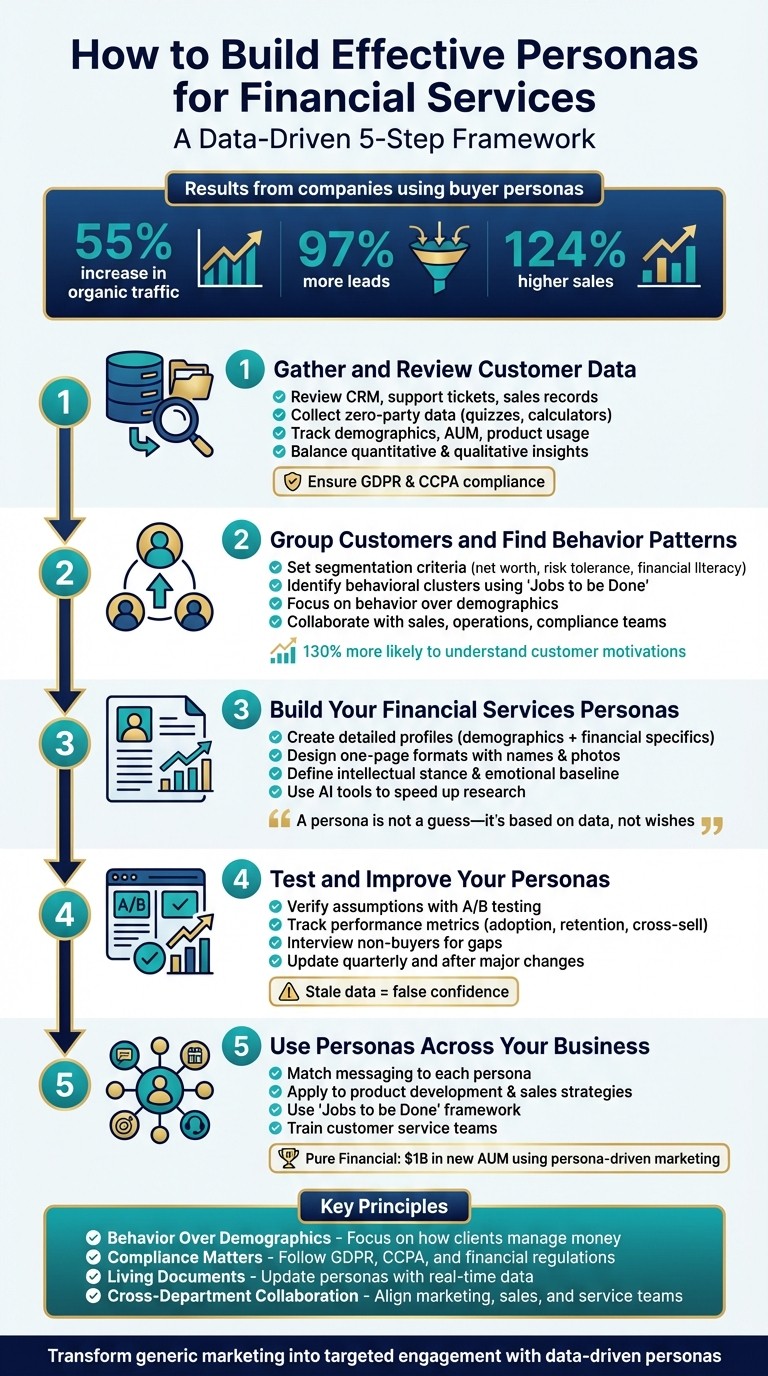
5-Step Persona Development Process for Financial Services
How to Create a Buyer Persona That Actually Helps You Sell
Step 1: Gather and Review Customer Data
Creating actionable financial personas starts with collecting and analyzing detailed customer information. Dive into your CRM, support tickets, and sales call records to track key metrics like demographics, account details, product usage, and even customer language. For wealth management firms, Assets Under Management (AUM) data is crucial for identifying segments based on firm size and purchasing power [1].
Locate Your Data Sources
Financial services firms have access to a treasure trove of data. Begin with zero-party data - information directly shared by customers through quizzes or calculators. Regulatory filings, such as those from the SEC or FINRA, can also provide insights into compliance-driven behaviors [1][2][4]. For instance, Pure Financial Advisors attributed $1 billion in new AUM to investor referrals via the SmartAsset platform, highlighting the value of structured data collection [2]. Social platforms, both consumer and business-focused, can add another layer of insights [3].
"Compliance is a key driver to technology purchases, so I wanted to understand how this might affect the buying process."
Shelley Pringle, Head of Marketing, Synthesis Technology[1]
Don’t overlook "lost deal" interviews - these conversations with prospects who chose competitors (recorded with consent) can reveal valuable insights into customer decision-making [1][3].
Balance Quantitative and Qualitative Data
Numbers tell part of the story, but narratives bring it to life. Quantitative data - like account balances, credit scores, age, location, and website activity - helps define broad customer groups such as "High Net Worth Millennials" or "Pre-Retirees with $500K-$1M in assets." On the other hand, qualitative insights - covering aspects like risk tolerance, legacy goals, or concerns about market volatility - add a human touch, creating personas like "Retirement-Ready Rachel" [2][5].
Collect quantitative data through closed-ended surveys and CRM systems.
Source qualitative insights via one-on-one interviews, focus groups, and open-ended survey questions.
If you’re leveraging AI to craft personas, start by inputting quantitative data to establish a framework, then enrich it with qualitative transcripts to add depth and personality [9]. Throughout this process, ensure compliance with privacy laws.
Maintain Compliance and Protect Privacy
Handling financial data comes with strict regulatory requirements. Adhere to frameworks like GDPR, CCPA, and any relevant financial regulations. Lean on zero-party data and safeguard customer interviews with NDAs. Regularly clean and validate your data to meet privacy standards [1][4][7][8].
"Privacy is the new premium. Deeply effective profiles are now built on zero-party data - information customers willingly share - rather than invasive third-party tracking."
Neeraj, Digital Marketing Expert, Wildnet Marketing Agency[4]
Step 2: Group Customers and Find Behavior Patterns
Now that you've gathered your data, it's time to organize your customers into meaningful groups. Forget about broad, generic categories like age brackets - focus instead on how people actually interact with their money and what drives their financial choices. By identifying behavior-based groupings, you can pinpoint the specific criteria that define these patterns.
Set Your Segmentation Criteria
Using the data you've collected, establish criteria that reflect the financial behaviors and motivators of your customers. Traditional demographics like age and location no longer suffice in 2026. The most effective segmentation digs deeper, focusing on psychographics, intent, and digital habits - for example, whether someone prefers in-depth technical guides or quick video reviews [4]. Break down customers by net worth, investment approach, risk tolerance, and financial literacy [2]. Life stages are equally important: consider grouping individuals by their financial journey, such as "executives planning for retirement", "retirees managing withdrawals", or "first-time homebuyers" [3][5].
"Behavior beats demographics. Modern profiles focus on 'Jobs to be Done' and behavioral signals rather than arbitrary age or gender brackets."
Wildnet Marketing Agency [4]
If you're working with business clients, adjust your criteria accordingly. Segment by firm type (e.g., Hedge Fund, Wealth Manager), Assets Under Management (AUM), and the regulatory frameworks they follow, such as SEC or FINRA guidelines [1]. Compliance often plays a major role in influencing technology and service purchases in these sectors [1].
Identify Behavioral Clusters
Once you've set your segmentation criteria, the next step is to uncover patterns that reveal deeper behavioral clusters. Focus on the specific tasks your customers aim to accomplish. For instance, instead of labeling someone as "VP of Finance", think of them as "The Efficiency Seeker who prioritizes automating financial reporting to save time" [4]. Use tools like your CRM and analytics software to identify trends in preferred communication methods, research habits, and digital engagement [2][4].
For B2B clients, consider factors like "internal political pressures" that may shape their purchasing decisions. For individual customers, explore how early financial experiences influence their current attitudes toward money [2][9]. When leveraging AI for clustering, feed data in stages - start with transcripts, then layer in goals and challenges. This step-by-step approach helps avoid generic outputs and uncovers more nuanced patterns [9]. AI can play a critical role in sharpening your customer segments, aligning perfectly with a data-driven approach to persona development.
Work with Other Departments
Building accurate customer segments requires collaboration across your organization. Tap into insights from sales, operations, and compliance teams to validate and refine your segmentation criteria [1]. A great example of this is Thrive Wealth Management, which emerged from a merger of multiple Saskatchewan credit unions. In 2024-2026, they adopted Maximizer CRM as their "operational backbone", allowing VP of Operations Matt Welykholowa to lead efforts to segment clients by portfolio size, service history, and financial objectives. This approach enabled advisors to quickly match clients with services suited to their life stages [11].
Your CRM should serve as the central hub for all departments. Use custom fields and tags to categorize clients by investment goals, engagement history, and risk preferences [11]. Companies that implement segmentation effectively are 130% more likely to understand their customers' motivations and 60% more likely to identify their challenges [10].
Step 3: Build Your Financial Services Personas
With customer segments outlined in Step 2, the next step is creating personas that are both practical and easy for teams to use. These profiles should strike a balance between including key details and being simple enough for everyday reference.
Create Persona Profiles
Start with the basics: demographics like age, location, marital status, dependents, education, and occupation. Add financial specifics, such as net worth range, household income, investment style, risk tolerance, and financial expertise. For B2B clients, include details like firm type, assets under management (AUM), and applicable regulatory frameworks like SEC or FINRA.
But don’t stop at surface-level information. Build profiles that reflect actual customer behaviors, such as how they research financial services or their preferred communication methods. As Samir Yawar from Articos explains:
"A persona is not a guess. If your persona document is based on what your CEO thinks the customer looks like rather than what the data shows, you don't have a persona – you have a wish list."
A real-world success story comes from Pure Financial Advisors, which in August 2025 hit $1 billion in new assets under management through investor referrals via the SmartAsset Advisor Marketing Platform. CEO Joe Anderson credited this growth to the firm’s use of detailed persona profiles, which allowed them to scale effectively while keeping client acquisition costs low.
"A financial plan is only as good as your understanding of the person behind it."
Sarah Sciandra, VP, Enterprise Business Solutions, Docupace
Design Easy-to-Use Formats
To make personas practical, keep them concise - one page is ideal. Use memorable names like "Executive Eleanor" or "Retiree Robert" and include a headshot along with direct quotes from client interviews. These elements help humanize the profiles and ensure they resonate with teams.
For added depth, define each persona’s "Intellectual Stance" (e.g., teacher vs. strategist) and "Emotional Baseline" (e.g., calm vs. urgent). These traits help guide consistent messaging and content creation.
"The buyer persona is an idea that gets your entire team on the same page and helps your marketing programs stay on track."
Shelley Pringle, Financial Marketing Specialist
Use AI Tools to Speed Up Research
Once your initial personas are set, refine them using AI tools. AI can process vast amounts of data - like sales calls, support tickets, and CRM records - to identify patterns that might otherwise be missed. Tools like Averi AI can highlight specific concerns, such as compliance or regulatory challenges, turning months of manual research into just a few hours of analysis.
When using AI, input data in stages - starting with a basic outline, then adding depth, and finally building a narrative. This step-by-step approach ensures the insights are actionable and precise. Always cross-check AI-generated outputs with your original research to ensure accuracy. For teams handling sensitive financial data, opt for tools with strong privacy features, such as ChatGPT Team.
Modern personas are no longer static documents. They’re evolving profiles connected to live data feeds, updating in real time as customer behaviors shift. This dynamic approach ensures your personas remain relevant and ready for testing and application in business strategies.
"Using AI for buyer persona creation turns months of research into an afternoon of synthesis."
Wildnet Marketing Agency
Step 4: Test and Improve Your Personas
After crafting detailed personas, the next essential step is to test and refine them to ensure they accurately reflect your audience and drive meaningful results. As Samir Yawar from Articos aptly puts it:
"A persona with stale data is worse than no persona at all because it gives teams false confidence." [6]
Verify Your Persona Assumptions
Begin by checking your personas against actual customer data. Use A/B testing in campaigns tailored to specific persona traits. For instance, test whether "Executive Eleanor" engages more with messaging around "speed of implementation" or "long-term ROI." Analyze click-through rates and other engagement metrics to validate your assumptions.
Collaborate with sales and customer success teams to confirm your personas align with real customer behaviors. Don’t stop there - interview prospects who chose not to buy. For example, in 2025, Synthesis Technology conducted interviews with both clients and non-buyers. This revealed gaps in their lead nurturing process that their personas had overlooked. By incorporating direct customer feedback and refining pain points, they improved their sales pipeline health and close rates within a year. [1]
To further validate your personas, apply the "Persona Stress Test" by asking key questions: Can your team identify a real client who fits this persona? Does the persona reveal unexpected insights about customer behavior? Would it influence product or marketing decisions differently than other profiles? If the answers fall short, the persona needs more work.
Track Performance Metrics
Once your personas are verified, measure their impact. Use performance metrics like product adoption, retention rates, and cross-sell success. A validation dashboard comparing persona assumptions with CRM and Google Analytics data can help track their effectiveness. Research shows that B2B companies with refined personas experience a 55% boost in organic search traffic, a 97% increase in website-generated leads, and a 124% rise in sales. [6]
One example is FNBO, which successfully integrated multiple personas into its monthly performance tracking. This shift allowed the company to move from transactional interactions to more advisory-focused client engagements. [13]
Update Personas Regularly
In fast-changing industries like financial services, personas can quickly become outdated due to regulatory updates, market shifts, and technological advancements. Regular updates ensure they remain relevant. Schedule quarterly reviews and make immediate changes in response to new regulations, mergers, or shifts in customer behavior.
Tools like Google Search Console can help track emerging trends. For instance, data shows that people searching for "optimize equity compensation" are 130.1% more likely to use ChatGPT than the average searcher. [12] Such insights can inform timely persona adjustments.
Treat personas as living documents that are continuously updated with real-time data from your customer data platform (CDP). Brent Carnduff, Founder of Advisor Rankings, emphasizes this approach:
"If you view them as living reflections of your audience, they become one of your most valuable tools for building trust." [12]
Step 5: Use Personas Across Your Business
Once you've developed and validated detailed personas, the next step is to weave them into the fabric of your business processes. These personas should influence everything - sprint planning, design briefs, customer service training, and even onboarding new hires. This ensures that every team understands what drives your customers and can align their efforts accordingly [3][6].
Match Messaging to Each Persona
Crafting effective messaging means focusing on digital behavior and intent rather than just demographics [4]. For example, instead of targeting a generic "Marketing Manager", tailor your message to someone like an "Efficiency Seeker" who’s looking to automate reporting so they can leave work by 5 PM [4]. This pivot from demographic labels to behavioral insights, as outlined in Step 2, makes your campaigns more relevant and actionable.
Align your content with the buyer's journey. For the Awareness stage, create educational blogs that address key pain points. During the Consideration phase, offer comparison checklists and case studies. At the Decision stage, provide workshops, fee discounts, or personalized consultations [5].
Apply Personas to Business Decisions
In industries like financial services, it’s common for the person using the tool to differ from the one making the purchase decision. Product development should focus on solving the user’s daily challenges - such as automating compliance reporting - while sales strategies should address the buyer’s priorities, like cost and implementation timelines [6].
The "Jobs to be Done" (JTBD) framework can help pinpoint the specific task a customer wants your product to accomplish. For instance, a client might aim to "build a portfolio to retire at 62 with $1.5 million" or "automate factsheets to meet regulatory requirements" [2][4]. This approach prevents creating overly complex products that try to cater to everyone’s needs, often referred to as "Frankenstein" products [6].
Stress-test your personas by asking: Would this persona choose this product? If the answer is no, refine the persona further [6]. Personas can also guide customer service teams in anticipating objections, such as concerns over commission-based fees or the difficulty of switching advisors [3][2].
See Real Examples in Action
To understand the impact of persona-driven strategies, here are some real-world applications:
Synthesis Technology used refined personas to tackle regulatory challenges, which led to better close rates and a healthier sales pipeline within just 12 months [1].
Pure Financial Advisors leveraged persona-based marketing through the SmartAsset AMP platform, gaining $1 billion in new assets under management from validated referrals [2].
For a Retirement Planning Persona, messaging focused on long-term security and tax-efficient strategies. In contrast, a Small Business Banking Persona centered on cash flow management and quick access to credit. These persona profiles also served as training materials for customer service teams, helping them better understand and empathize with specific client goals [3].
Conclusion
Creating accurate personas plays a central role in financial services, shaping everything from product development to compliance-friendly messaging. Without well-researched, data-backed profiles, marketing efforts risk being overly generic. As Shelley Pringle, an expert in financial marketing, aptly states:
"Marketing strategies and tactics developed without the benefit of buyer personas are likely to be generic. And a lot less likely to encourage purchase" [3].
The five-step approach - collecting customer data, spotting behavioral patterns, crafting detailed profiles, testing assumptions, and applying personas across your business - can revolutionize how you engage with clients. For instance, when Synthesis Technology refined their buyer personas in 2024, they saw notable gains in content performance, an increase in qualified inbound leads, healthier pipelines, and improved close rates - all within a year [1]. Likewise, Pure Financial Advisors achieved $1 billion in new assets under management through persona-driven marketing and targeted investor referrals [2].
This shift highlights the growing importance of dynamic personas in modern markets. The transition from static PDF profiles to real-time, adaptive personas is already underway. By 2026, tools like Agentic AI are expected to synthesize vast amounts of data into cohesive narratives instantly [4]. Similarly, platforms like Averi AI simplify the process, from identifying behavioral clusters to crafting persona-specific messaging, enabling teams to focus more on strategic execution rather than manual data crunching. This integration is essential for running smarter, more targeted campaigns.
Integrating persona development into all facets of your business ensures that these profiles become actionable, data-driven tools for guiding decisions in marketing, sales, and customer service. To ensure your personas are effective, ask yourself: Can you identify a real user who fits this profile? Does the persona influence decisions in a way that wouldn't have been considered otherwise?
Continuous validation and refinement are critical. As markets evolve, so should your personas. Over time, better targeting and engagement lead to compounding returns, ensuring that every interaction delivers improved ROI.
FAQs
What data should I use to build financial services personas?
To create effective financial services personas, focus on gathering data that provides a clear understanding of customer motivations, challenges, behaviors, and decision-making processes. Key sources to consider include:
Hard customer data: Information from client interactions and existing records.
Quantitative data: Metrics like website analytics that reveal engagement patterns.
Qualitative insights: Feedback from surveys, interviews, and social media discussions.
Zero-party data: Information customers voluntarily share, emphasizing privacy and preferences.
By blending these sources, you can develop well-rounded, tailored personas that truly reflect the needs of your financial services audience.
How do I segment clients by behavior, not demographics?
To group clients based on behavior, start by examining their actions, motivations, and decision-making patterns. This can be achieved through tools like analytics platforms, direct interviews, and AI-powered research. Begin by forming hypotheses about their behaviors, then collect and analyze data to validate these ideas. Focus on building dynamic profiles that highlight behavioral signals and Jobs to be Done, rather than relying solely on static demographic information. This method allows for real-time insights that align closely with how clients actually behave, rather than just who they are on paper.
How often should I update and retest my personas?
To keep your personas accurate and aligned with current trends, it's essential to update and retest them regularly. Think of personas as living profiles that adapt to changes in customer behavior and market dynamics. Experts suggest revisiting and refining these profiles every 6 to 12 months or whenever there are major shifts in the market. This approach helps ensure your marketing strategies remain in sync with evolving customer needs and preferences.
Related Blog Posts

Zach Chmael
CMO, Averi
"We built Averi around the exact workflow we've used to scale our web traffic over 6000% in the last 6 months."
Your content should be working harder.
Averi's content engine builds Google entity authority, drives AI citations, and scales your visibility so you can get more customers.