

In This Article
Research, segment, and build patient personas for healthcare and wellness using interviews, EHR/CRM data, AI tools, and ongoing testing.
Updated:
Trusted by 1,000+ teams
Startups use Averi to build
content engines that rank.
Effective healthcare marketing starts with understanding your audience. Personas are fictional profiles that represent different types of patients, helping you tailor your messaging to their unique needs. Without them, your communication may miss the mark, failing to connect with the people you aim to serve.
Key Steps to Build Personas:
Research Your Audience
Gather data through patient interviews, surveys, and internal systems like EHR or CRM platforms. Look at demographics, behaviors, and preferences.
Identify Pain Points and Motivations
Understand the challenges patients face (e.g., long wait times, insurance confusion) and what drives them to act (e.g., relief from pain, convenience).
Segment Your Audience
Group patients by life circumstances or health needs, not just by age or condition. Examples include "Busy Caregivers" or "First-Time Mothers."
Create Detailed Profiles
Combine demographics (age, location) with psychographics (values, emotional triggers) to make personas relatable and actionable.
Leverage AI Tools
Use platforms like
Averi to analyze data and refine personas, ensuring your messaging stays relevant and compliant.
Test and Update Regularly
Validate personas using campaign results and patient feedback. Update them periodically to reflect changing needs.
Why It Matters
Brands using well-defined personas see 3.5x higher engagement and 23% better retention rates. Personas also help you align with patient emotions, making your messaging more relatable and effective.
Creating personas isn’t just about marketing - it’s about building trust and meeting patients where they are.
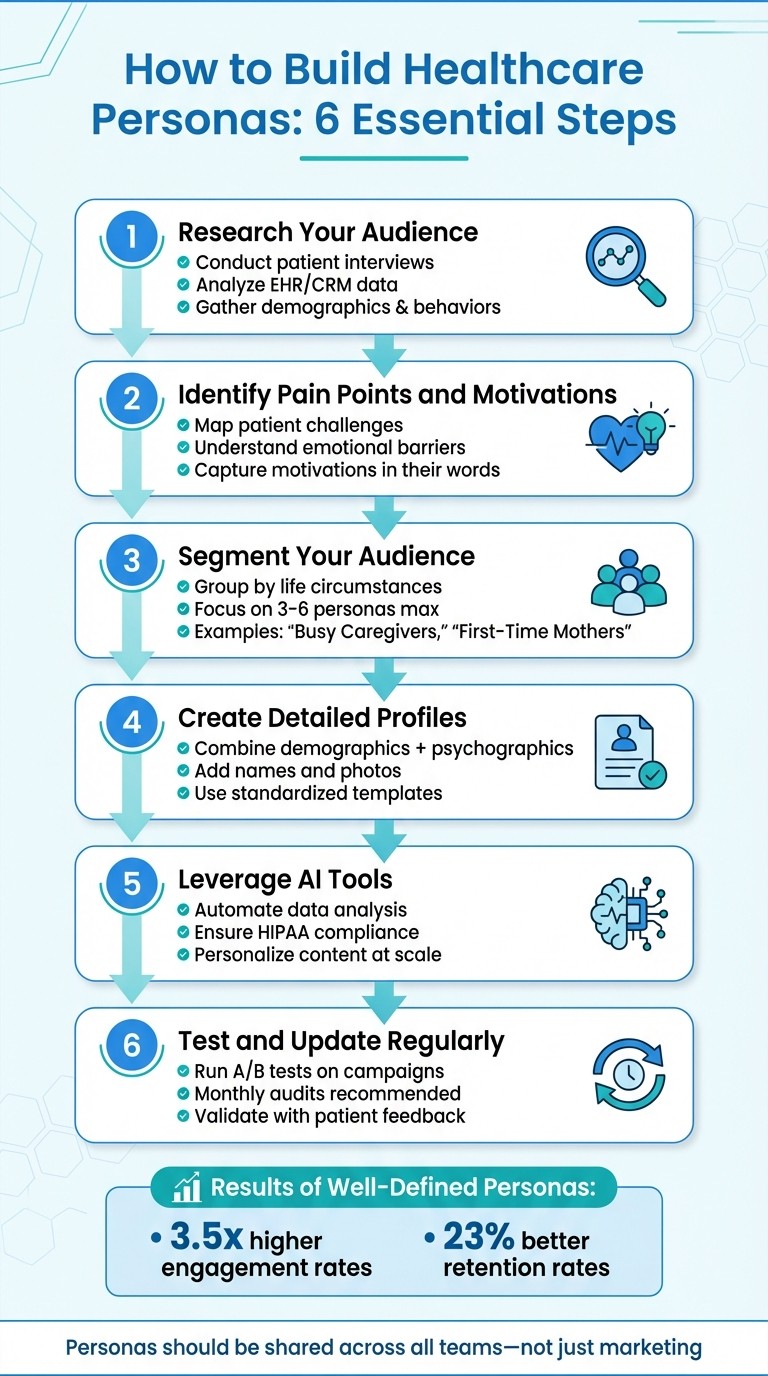
6 Steps to Build Healthcare Personas for Better Patient Engagement
Target Audience Personas for Healthcare Businesses: The Definitive Guide (2024)
Step 1: Research Your Target Audience
Creating effective personas begins with a deep dive into both quantitative and qualitative data to uncover who your patients are and what influences their choices [2][1]. Start by conducting one-on-one interviews with patients, clinical staff, and stakeholders. These conversations can reveal motivations, goals, and emotional pain points that shape healthcare decisions [2][1]. Pair these insights with internal data to gain a more complete understanding of patient behavior.
Your internal systems are a treasure trove of information. Utilize data from PMS, EHR, and CRM platforms to identify patterns in service use, patient volume, and specific clinical specialties [6][1]. By combining interview findings with system data, you can form a well-rounded view of your audience.
Collect Demographic and Behavioral Data
Gather basic demographic details such as age, income, location, and insurance status, alongside behavioral data like preferences for virtual appointments, portal usage, and online booking habits [7]. To go deeper, survey patients about their communication preferences and how they search for information.
For a more precise approach in healthcare marketing, tools like Definitive Healthcare's "Population Intelligence" can be invaluable. These tools merge consumer and clinical data sets [8]. Additionally, firmographic data - such as bed count, patient volume, and revenue trends - sourced from industry reports and financial indicators, can provide further context [6]. The ultimate goal is to build a robust data set that captures both demographic and engagement insights.
Once collected, organize this data into actionable segments that address both clinical needs and emotional factors.
Segment by Healthcare and Wellness Needs
After gathering comprehensive data, it’s time to segment your audience based on both their healthcare needs and individual life circumstances. Relying solely on demographics won’t cut it. As Linda Watts, Healthcare Digital Strategy Leader at Perficient, explains:
"You don't connect with demographics, you connect with people - individual human beings" [2].
Rather than grouping patients by service lines like orthopedics or cardiology, consider segmenting them by life situations or health statuses. For instance, you might identify personas such as "Commander in Care" for caregivers, "Unengaged Millennial" for younger adults avoiding preventive care, or segments focused on managing chronic conditions like diabetes [2].
This approach emphasizes emotional readiness alongside clinical needs. Most healthcare organizations should aim to create three to six personas. Developing more than eight can overwhelm teams and dilute their effectiveness [2][1]. Focus on the personas that represent the largest opportunities or the most underserved groups.
Step 2: Identify Pain Points and Motivations
Once you've segmented your audience, the next step is to uncover the challenges that hold them back from seeking care and the factors that drive them to take action. In healthcare, these challenges, or pain points, often go beyond physical symptoms. They might include issues like complicated insurance processes, long wait times, or unclear steps in accessing care [7]. For example, someone considering joint replacement surgery might know they need the procedure but delay it for up to a decade due to fears about recovery or uncertainty about choosing the right provider [3].
Pinpoint Common Pain Points
To better understand your audience, map out the specific challenges they face based on their life stages and healthcare needs. For instance:
The "Commander in Care" persona, who manages the health of children, a spouse, and aging parents, often struggles with time constraints and coordinating multiple schedules [2].
Busy professionals lean toward telehealth and flexible scheduling options since traditional office visits disrupt their workday [1].
Women nearing menopause (typically around age 51) may grapple with bone density concerns and symptoms that affect their daily lives [3].
Joint replacement patients, often between 60 and 80 years old, cite losing the ability to enjoy activities like golfing or playing with grandkids as an emotional tipping point that pushes them to seek treatment [3].
Other barriers include emotional readiness, where individuals know what steps to take but aren’t mentally prepared to act. Routine services, like mammograms, also face resistance due to anxiety over results and inconvenient processes [2][3]. As Linda Watts from Perficient notes:
"Chances are you're not viewing through their lens... Healthcare Consumer: May or may not know [the next step], but regardless isn't going to act on that information until emotionally ready to do so" [2].
Understanding these obstacles is just one part of the equation. To truly connect with your audience, you also need to tap into what drives them.
Discover What Motivates Your Audience
Motivations can vary widely depending on the service or life stage. For example:
Joint replacement patients are often driven by the desire to relieve pain and regain the ability to enjoy meaningful activities [3].
OB/GYN patients, with the average first-time mother now being 26 years old, prioritize feeling heard, receiving compassionate care, and having easy access to services [3].
Mammography patients value preventive care and early detection but expect a process that is both comfortable and hassle-free [3].
To make these motivations resonate, capture them in the patients' own words. Using direct quotes from interviews or surveys can help your team empathize with the emotional context behind each decision [7][4].
When analyzing transcripts or survey data with AI tools, structure your approach by feeding in transcripts, followed by goals and challenges. This method allows you to extract actionable insights that go beyond surface-level demographics. The result? Personas that reflect the complexity of real people, whose decisions are often shaped by emotional readiness. These insights will later serve as the basis for creating detailed persona profiles.
Step 3: Build Persona Profiles
Using the pain points and motivations you've identified, it's time to create detailed profiles that shape your messaging. These persona profiles should combine key demographics (like age, location, and profession) with psychographics (such as values, emotional triggers, and healthcare goals) to bring your audience to life [2][4]. Start by laying out measurable details, then dive into the subtle behaviors and motivations that define your audience.
Add Demographics and Psychographics
Start with the basics - age, occupation, and household composition - then layer in key drivers like decision-making habits, communication preferences, and core values. For instance, a 42-year-old caregiver balancing work and family responsibilities will have vastly different priorities than a 68-year-old managing chronic pain [2][3].
Give each persona a name and photo to make them relatable for your team. This simple step transforms raw data into a vivid, humanized profile that your marketing, clinical, and product teams can easily connect with [3]. Instead of a generic label like "Female, 35-50, Primary Care", you might create "Sarah, 42, Commander in Care", a persona that reflects specific challenges and aspirations [2].
Psychographics should answer deeper questions: What motivates this person to seek care? What worries them the most? Do they value convenience over advanced technology, or vice versa? [3] For example, joint replacement candidates - typically aged 60 to 80 - may be driven by a desire to return to hobbies like golfing or spending time with grandchildren. In contrast, first-time mothers (average age 26 in the U.S.) often prioritize empathetic care and feeling understood [3].
Use Persona Templates
Organize your findings into standardized templates to make the information actionable. These templates can help distinguish broad brand-level personas from more targeted service-line personas, each reflecting unique emotional and practical needs [3]. For instance, the "female head of household" often serves as a foundational brand persona in healthcare, as she typically makes decisions for her family - children, spouse, and aging parents included [3].
Service-line templates should address specific goals and challenges. A joint replacement candidate might focus on "relieving chronic pain" and "building confidence in recovery", while a mammography patient would prioritize "easy scheduling" and "a compassionate experience" [3]. Jane Crosby from True North Custom highlights the importance of tailoring personas for specific services:
"By taking your brand persona and making adjustments to your tone, style and voice to fit a unique service line level patient persona, you'll be connecting with consumers with messaging designed specifically to resonate with them" [3].
To ensure consistency, include a Phrase Bank of approved language and a Banned Phrases list to maintain your brand's voice [5]. Consistent messaging can boost engagement by 3.5 times, and 73% of consumers are more likely to trust brands with a clear, distinct style [5]. Keep your focus sharp by limiting yourself to three to six personas. Fewer than three risks overlooking key audiences, while more than eight can make execution overly complex [2].
With these well-rounded profiles, you'll be ready to use AI tools for fine-tuning in the next step.
Step 4: Use AI Tools Like Averi for Persona Development
After gathering research and crafting your initial persona profiles, leveraging AI tools can streamline and enhance the refinement process. Platforms like Averi take raw audience data - such as CRM records, patient interviews, survey results, and website analytics - and transform it into polished, standardized persona documents. This is especially important in healthcare, where effective communication must address a wide range of patient needs. By letting AI handle the complex data analysis and content structuring, you can focus on strategic decision-making.
Automate Data Analysis and Persona Creation
Averi's Synapse architecture offers two modes to suit your needs: Express mode for quick persona generation and Deep mode for detailed, clinically precise research. Whether you're targeting wellness programs or managing chronic disease communication, this system integrates multiple data sources to reveal patterns within patient segments. Using its /create mode, Averi converts raw inputs - like interview transcripts or survey data - into structured, actionable persona documents.
The Brand Core feature centralizes audience profiles, compliance guidelines, and approved terminology, ensuring consistent messaging across teams. This centralized hub allows the AI to learn from historical performance, improving its recommendations over time. Such consistency is invaluable, as healthcare brands with a unified voice achieve 3.5x higher engagement compared to those with inconsistent messaging [5].
A practical tip for using AI tools effectively: upload data incrementally. Begin with patient goals, then layer in challenges, followed by demographic details. This step-by-step approach minimizes the risk of AI hallucinations and keeps personas rooted in actual research [4].
Once the automated persona creation is complete, you can fine-tune your communication strategies using AI-driven personalization.
Personalize Content with AI
After structuring persona data with Synapse, the next step is tailoring content to meet the needs of each audience segment. Using the AGM-2 model, you can adjust tone and complexity to suit diverse groups, while the Human Cortex feature ensures all content undergoes expert review to meet HIPAA and regulatory standards.
To guide the AI in creating personalized messaging, use "few-shot prompting" by providing three to five high-quality examples for each patient segment [4]. For instance, you might set a reassuring tone for anxious new parents or use straightforward, action-driven language for busy caregivers. As highlighted by Harvard Business Review:
"AI doesn't reduce work - it intensifies it... shifting work from creation to curation, editing, and brand alignment" [5].
The aim is to use AI content tools that amplify creativity rather than replace human oversight, freeing your team from repetitive tasks, allowing them to focus on strategic insights and emotionally resonant communication that connects with patients.
These tools not only simplify persona development but also ensure that messaging adheres to healthcare regulations while addressing patients’ emotional and informational needs.
Feature | Function in Persona Development | Healthcare Benefit |
|---|---|---|
Synapse (Deep Mode) | Conducts in-depth research on complex topics | Delivers clinically accurate medical personas |
Human Cortex | Triggers mandatory expert review | Ensures HIPAA and regulatory compliance |
Brand Core | Centralizes ICPs and audience profiles | Maintains consistent messaging across teams |
AGM-2 Model | Adjusts tone and complexity levels | Adapts content for varying health literacy levels |
Step 5: Test and Refine Your Personas
In the ever-changing world of healthcare, keeping your personas up-to-date is crucial to stay aligned with patient needs. Creating personas isn’t a one-and-done task. The healthcare industry constantly shifts - patient expectations evolve, new treatments emerge, and regulations change. To ensure your personas remain effective and grounded in reality, you need to validate them with real-world data. Testing and refining these profiles over time transforms them from static documents into dynamic tools that enhance targeting and campaign performance.
Validate Personas with Analytics and Campaigns
The first step in refining your personas is testing them against actual campaign results. A/B testing is one of the most effective ways to do this. By running two versions of the same message, each tailored to different persona segments, you can determine which resonates more effectively. Metrics like patient education engagement, appointment bookings, and retention rates offer clear indicators of how well your personas align with real behaviors.
Quantitative data is essential, but don’t overlook qualitative insights. Collect feedback from contact form reviews, patient advisory sessions, and user testing [2]. Another useful method is adversarial testing, where you intentionally challenge your personas by posing difficult or unexpected scenarios. For example, if your “busy caregivers” persona feels generic or stereotypical under scrutiny, it’s a sign that it needs further refinement [4].
The impact of validated personas is clear: brands that maintain a consistent voice through well-tested personas achieve 3.5x higher engagement rates compared to those with inconsistent messaging. Additionally, companies with a distinct brand voice report 23% higher customer retention rates [5]. These improvements directly influence cost per lead and lifetime patient value, making persona validation a critical step in your strategy.
Once your personas are validated, use the insights gathered to make updates and keep them relevant.
Update Personas Based on Data
With validated data in hand, establish a monthly audit schedule to review how your personas are performing. A great way to assess this is through voice recognition tests to ensure your messaging is consistently on-brand. If your audience can’t clearly identify your voice, it’s time to refine your personas [5]. Regular updates should incorporate new insights, such as patient goals from surveys, challenges identified in support tickets, and demographic trends from analytics.
Platforms like Averi’s Library feature can help track how persona-driven content performs over time. This tool automatically analyzes which topics and approaches resonate with specific segments and suggests improvements. For instance, it might flag content targeting “anxious new parents” that’s underperforming and recommend strategies to boost its visibility, or it could identify opportunities to counter a competitor’s new content on chronic disease management. This continuous feedback loop ensures your personas remain fresh and relevant, avoiding the stagnation that caused 42% of businesses to abandon AI content projects in 2025 due to generic and ineffective outputs [5].
It’s worth noting that 60% of marketers report AI-generated content often feels generic [5]. The solution lies in human-validated personas built on real patient data. To add depth and emotional nuance, schedule quarterly interviews with clinical staff and other stakeholders. These conversations often uncover details that analytics alone can’t provide, such as workplace challenges, professional motivations, or even political factors that influence patient care. These insights can transform basic demographic profiles into personas that truly connect and deliver measurable results.
Conclusion
Creating effective personas for healthcare and wellness marketing is an ongoing process that strengthens patient and customer engagement. By following five fundamental steps - researching your audience, identifying pain points and motivations, building detailed profiles, leveraging AI tools, and continuously testing and refining - you can craft personas that lead to meaningful connections and tangible results.
The healthcare industry comes with unique challenges, making persona development especially important. As Linda Watts, Healthcare Digital Strategy Leader at Perficient, points out:
"Without meaning to or realizing that you're doing it, you begin to build and design and write for yourself, not your audience" [2].
Personas help your team shift perspective, focusing on the emotional factors that influence health decisions rather than treating healthcare as routine.
Data supports the value of well-crafted personas. Brands that maintain a consistent voice - built on validated personas - achieve 3.5x higher engagement rates and 23% higher customer retention compared to those with inconsistent messaging [5]. At the same time, 60% of marketers feel AI-generated content often lacks depth [5]. As the Vizologi Strategy Framework highlights:
"As AI democratizes content creation, your brand voice is your moat" [5].
This differentiation becomes most effective when personas are specific and well-defined.
To maximize impact, limit personas to three to six profiles, enabling your team to connect with each on a deeper level [2]. Whether addressing anxious new parents, busy caregivers, or complex B2B buying committees with multiple stakeholders [6], precision is key. Consider the nuances of each service line - a joint replacement candidate has completely different motivators than a first-time mother [3].
Finally, personas should extend beyond the marketing team. As Linda Watts emphasizes:
"Personas generally originate with marketing because that group owns 'voice of the consumer.' But ideally, every person in your organization will champion your healthcare personas" [2].
When integrated across strategy, content, clinical, and support teams, personas help build trust and drive long-term success.
FAQs
How do I choose which patient personas to prioritize?
To make patient personas a priority, concentrate on segments that can have the greatest impact on healthcare marketing and engagement. Begin by clearly outlining your goals and diving into data that reveals patient behaviors, needs, and motivations.
Focus on personas that represent frequently encountered or high-priority groups with specific health concerns or preferences. Make sure your selections align with strategic goals, such as increasing patient engagement or improving satisfaction, to ensure your efforts are directed toward the most meaningful segments.
What data can I use if I don’t have much patient feedback yet?
If patient feedback is scarce, tap into alternative data sources to shape your personas. Begin with educated assumptions drawn from your product knowledge and initial interactions. Dive into existing customer data, sift through social media trends, and study competitors to spot recurring patterns. Leverage tools like Google Analytics, conduct surveys, or arrange interviews to gather further insights. As more feedback rolls in, use it to fine-tune and improve your personas over time.
How do I keep persona-based messaging HIPAA-compliant?
To craft persona-based messaging that aligns with HIPAA regulations, it’s crucial to use secure platforms equipped with safeguards like encryption, access controls, audit logs, and a Business Associate Agreement (BAA). Steer clear of unsecured communication channels, such as standard SMS or widely used apps like iMessage and WhatsApp, as they do not meet HIPAA compliance requirements.
When designing personas, ensure that all personalized messages comply with HIPAA by leveraging tools specifically built for this purpose. Additionally, avoid transmitting any Protected Health Information (PHI) through non-secure methods to maintain confidentiality and compliance.
Related Blog Posts

Zach Chmael
CMO, Averi
"We built Averi around the exact workflow we've used to scale our web traffic over 6000% in the last 6 months."
Your content should be working harder.
Averi's content engine builds Google entity authority, drives AI citations, and scales your visibility so you can get more customers.