

In This Article
Build guest personas for hotels and travel: gather data, segment audiences, craft profiles, use AI, and apply insights to marketing and operations.
Updated:
Trusted by 1,000+ teams
Startups use Averi to build
content engines that rank.
Customer personas are profiles that help hotels and travel businesses understand their guests' preferences, behaviors, and needs. By using data like booking habits, feedback, and spending trends, you can create targeted strategies to improve guest experiences and boost revenue. For example, a Texas micro-resort used personas to achieve $860,000 in bookings during its first year, contributing to a $7 million property sale.
Key takeaways:
Data sources: Use booking systems, CRMs, and guest reviews to gather insights.
Persona types: Segment guests by travel intent, demographics, and behaviors (e.g., business travelers, leisure seekers, or eco-conscious guests).
AI tools: Platforms like Averi AI can simplify persona creation and campaign targeting.
Personalization: Tailor marketing campaigns and guest experiences to match each persona's preferences.
Continuous updates: Refresh personas quarterly to adapt to evolving trends.
This approach helps businesses optimize marketing, reduce ad spend, and create memorable guest experiences.
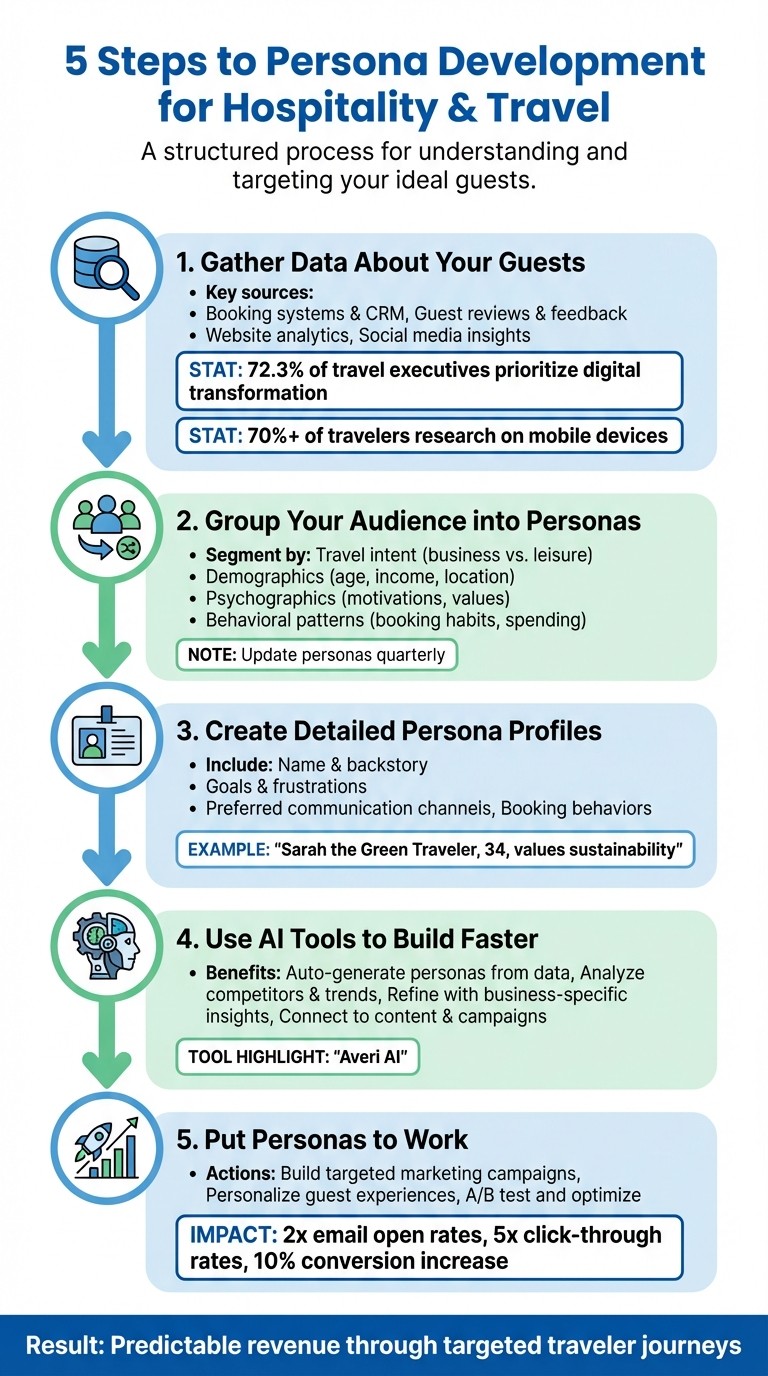
5-Step Persona Development Process for Hospitality and Travel Businesses
How to Build a Customer Persona for your Business (Free Templates)
Step 1: Gather Data About Your Guests
Creating detailed guest personas starts with gathering the right data. With 72.3% of travel executives prioritizing digital transformation in their strategies [3], there’s no shortage of tools to help you gain insights into your audience. The challenge lies in knowing where to focus and how to extract meaningful information.
Start by examining behavioral data - things like search filters, booking patterns, and digital interactions. These details provide a clearer picture of intent than basic demographics. For instance, if a guest consistently filters for "pet-friendly" and "high-speed Wi-Fi", they’re likely a remote worker traveling with a pet [2].
"Behavioral data - search filters, booking paths, and digital engagement - provides the clearest signals of intent and motivation." - Pedowitz Group [2]
Your CRM and loyalty programs add another layer of insight. These systems track spending habits, loyalty progression, and preferences such as room types or amenities. A guest who frequently books high-rate rooms and earns loyalty rewards will have different priorities than one who opts for bundled deals and dining experiences [1][2].
Website analytics and social media data also play a role. Google Analytics can show traffic sources and browsing habits, while social platforms help you understand demographics and engagement trends. With over 70% of travelers researching trips on mobile devices [3], mobile analytics are particularly important. Additionally, user-generated content can drive engagement five times more effectively than branded campaigns [3].
Leverage Booking Systems and CRM Data
Your Property Management System (PMS) and CRM platforms are treasure troves of operational and relationship data. By analyzing booking behaviors - such as lead times, preferred channels (OTA vs. direct), device usage, and stay frequency - you can uncover patterns that form the foundation of actionable guest personas [2].
CRMs consolidate data from multiple touchpoints, including website visits, email interactions, and loyalty program activity, into a comprehensive guest profile. Integrating your PMS with your CRM ensures a seamless flow of data, allowing you to track a guest’s journey from their first website visit to their post-stay review. This integration provides a complete view of their preferences and behaviors.
Analyze Guest Feedback and Online Reviews
Guest reviews from platforms like TripAdvisor, Google, and post-stay surveys are invaluable for understanding booking motivations. These reviews, combined with insights from front-line staff, can help identify recurring themes - whether it’s praise for spa packages or complaints about slow Wi-Fi.
Automated sentiment analysis tools can scan platforms like Reddit and TripAdvisor to spot emerging trends. For example, a spike in mentions of "wellness retreats" or "solo travel" could signal a shift in guest preferences [2].
Sending follow-up emails within 24–48 hours of checkout, with links to review platforms, can help gather fresh, detailed feedback that is both timely and actionable.
Use Website Analytics and Social Media Insights
Digital behavior on your website and social media channels offers additional ways to refine your personas. Google Analytics provides data on page visits, time spent, and drop-off points, while search filters and booking paths reveal which amenities - such as eco-friendly practices, high-speed Wi-Fi, or pet-friendly options - are most appealing to different guest segments [1][2].
Social media platforms further enhance your understanding by offering demographic details and engagement metrics. You can even use lookalike audiences by uploading email lists of satisfied guests to Facebook or Google Ads to target high-intent travelers with similar profiles [3].
Finally, make it a habit to refresh your personas every quarter. Guest behaviors and preferences evolve quickly, and staying updated ensures your marketing efforts remain effective and relevant [2].
Step 2: Group Your Audience into Personas
After gathering your data, the next step is to organize guest information into meaningful and actionable segments. The idea is to group data in a way that highlights unique booking habits, spending preferences, and travel motivations. This process helps transform raw data into detailed profiles that can guide your marketing strategies. Start by segmenting guests based on their travel intent, demographics, and behaviors to create well-rounded personas.
Identify Common Persona Types
Start by examining your guests' travel intent. For instance, business travelers usually book through Global Distribution Systems (GDS) or corporate platforms, prefer mid-week stays, and prioritize convenience - such as being close to transit hubs and having reliable Wi‑Fi [2]. On the other hand, leisure travelers often follow seasonal booking trends, interact more with online travel agencies (OTAs), and focus on experiences [2].
Don’t overlook emerging groups like "bleisure" travelers, who combine work trips with leisure activities [2]. Other potential personas might include families seeking kid-friendly amenities, solo travelers looking for social environments, or remote workers in need of ergonomic workspaces and networking opportunities [1]. Each of these groups has distinct preferences that can refine your persona profiles.
Add Demographics and Psychographics
Once you’ve identified broad persona categories, enrich them with demographic and psychographic details. Demographics like age, income, and location add depth. For example, a Gen Z solo traveler will respond to different marketing messages than a Baby Boomer planning a family reunion, even if both are booking leisure stays [1]. Income levels can also help differentiate between budget-conscious travelers and those willing to splurge on premium experiences.
Psychographics - covering motivations, values, and lifestyles - bring even more specificity. Are your guests seeking adventure and exploration, or do they prefer rest and relaxation? Do they prioritize sustainability, or is convenience their main concern? These insights can influence everything from the tone of your email campaigns to the amenities you highlight on your website.
Map Behavioral Patterns and Booking Habits
Dive deeper into behavioral patterns by analyzing booking lead times and preferred booking channels, such as direct website bookings versus third-party platforms. Keep in mind that over 70% of travelers now research trips on mobile devices [3].
Spending habits can also provide valuable clues about what each persona values. For example, business travelers may focus on higher room rates and loyalty rewards, while leisure travelers often seek bundled packages. A guest prioritizing high-speed Wi‑Fi and workspaces will have entirely different needs compared to one searching for family-friendly amenities.
Dimension | Business Traveler | Leisure Traveler |
|---|---|---|
Priorities | Convenience, speed, reliability | Experiences, price, exploration |
Booking Behavior | Short lead times, predictable | Seasonal, event-driven, longer research |
Spend Focus | ADR, loyalty programs | Packages, dining, tours |
Finally, remember to revisit and update your personas regularly. Guest behaviors evolve based on seasons, economic shifts, and digital trends [2]. What resonates with your audience today might not work tomorrow, so treat persona development as an ongoing effort rather than a one-time task.
Step 3: Create Detailed Persona Profiles
Once you've segmented your audience, the next step is to build detailed persona profiles that go beyond surface-level demographics. These profiles should capture the motivations, challenges, and decision-making factors that influence each type of guest. Think of these as the bridge between your data and your marketing strategies, helping you tailor your efforts for maximum impact.
Add Core Profile Elements
Each persona should have a name and backstory that reflects their travel habits and preferences. For instance, "Sarah the Green Traveler" could be a 34-year-old marketing manager from Portland who values sustainability, actively seeks out eco-certified hotels, and prefers locally sourced dining options [1].
Go deeper by including:
Goals: What does this persona want to achieve from their trip?
Frustrations: What obstacles or service gaps do they typically encounter?
Preferred Communication Channels: How do they like to interact? For example, a Gen Z traveler may favor Instagram DMs and digital check-ins, while a Baby Boomer might appreciate detailed email itineraries and phone support [1].
These details allow your team to anticipate guest needs and tailor their approach accordingly.
Convert Data into Narrative
Take the raw data you've gathered and transform it into a story that illustrates each persona's journey. For example, "Sarah researches eco-friendly hotels during her daily commute, checks for certifications, and books directly to avoid extra fees." Stories like this bring the data to life, making it easier for your team to understand the guest experience and identify where targeted interventions can make a difference.
Use surveys and interviews to validate these narratives. For example, if business travelers frequently complain about slow mobile check-ins, that frustration becomes part of their story - and a clear area for operational improvement [2]. This narrative approach not only highlights gaps in your marketing funnel but also lays the groundwork for AI tools that can scale these insights for broader use.
Design Personas for Quick Reference
To make these profiles practical, create one-page summaries for each persona. Include a photo, key demographics, psychographics, booking behaviors, and preferred offers. A Persona Maturity Matrix can help you track the evolution of your personas, from simple demographic profiles to more advanced predictive tools that incorporate customer lifetime value (CLV) and behavior trends [2].
Here’s a comparison of persona types to guide your development:
Dimension | Basic Persona | Differentiated Persona | Predictive Persona Engine |
|---|---|---|---|
Data Sources | Booking data only | PMS + CRM + loyalty + behavioral | Real-time multi-source data |
Detail Level | Simple demographics | Motivations, needs, friction points | Persona-level CLV and propensity scores |
Activation | Basic email targeting | Channel-specific messaging | Real-time web/mobile personalization |
Business Impact | Unclear ROI | Higher conversion & engagement | Predictable revenue from targeted journeys |
As your data capabilities grow, your personas should evolve from static descriptions to dynamic tools that adapt to real-time guest behavior [2]. This approach ensures your marketing remains relevant and effective.
Step 4: Use AI Tools like Averi AI to Build Personas Faster
When it comes to creating detailed persona profiles, AI tools like Averi AI can significantly speed up the process while enhancing your overall marketing strategy. These tools help analyze guest data, identify trends, and generate rich personas quickly - perfect for the fast-paced demands of the hospitality and travel industries.
Generate Personas from Data Automatically
Averi AI starts by diving into your business context, analyzing your product, positioning, and brand voice. Using this information, it suggests ideal customer profiles tailored to your market. It doesn’t stop there - Averi also keeps an eye on your competitors, continuously researching the landscape to identify trends and uncover insights into booking habits, travel motivations, and communication preferences. This eliminates the need for manual data analysis and keeps you focused on strategy.
The platform prioritizes mobile-first behavior, reflecting how modern travelers engage with brands today. Once the AI generates these initial personas, the next step is refining them to address the specific needs of your hospitality business.
Edit and Refine AI-Generated Personas
While AI provides a strong foundation, fine-tuning is essential to capture the subtleties of your audience. Averi’s editing tools make it easy to customize personas using your property’s unique data. For instance, you can integrate booking patterns, lead times, and loyalty behaviors from your Property Management System (PMS), CRM, or loyalty programs. This allows you to differentiate between business travelers chasing loyalty status and leisure travelers redeeming points [2].
"AI tools are most powerful when paired with human insight. Use Averi to identify patterns, but let your team's creativity, empathy, and understanding of your target audience guide the final call." – Averi [3]
It’s a good idea to refresh your personas quarterly to reflect changes in seasonal demand, pricing strategies, and loyalty trends [2].
Connect Personas to Content and Campaigns
Once your personas are polished, Averi AI helps you create marketing content tailored to each one. It organizes ideas by journey stage, from inspiration-phase destination guides to booking-phase testimonials. For instance, if you’ve developed a persona for "Green Travelers", Averi can suggest blog topics about eco-certifications, generate FAQs addressing sustainability concerns, and even recommend A/B tests for headlines that highlight environmental commitments.
The platform also retains brand memory, meaning each update to your personas improves future outputs. This transforms your personas into dynamic tools, enabling real-time personalization across your website, email campaigns, and social media channels.
Step 5: Put Personas to Work in Marketing and Operations
Use your personas to fine-tune campaigns, enhance guest experiences, and optimize operations for measurable results.
Build Marketing Campaigns for Each Persona
Tailor your campaigns to the unique behaviors and motivations of each persona. For instance, business travelers prioritize speed, convenience, and dependable Wi-Fi, while leisure travelers focus on experiences, affordability, and family-friendly options[2]. Adjust subject lines, ad copy, and landing pages to reflect these preferences.
Incorporate behavioral triggers into your targeting strategies. For example, if a guest views a suite with a workspace but doesn’t book, retarget them with ads highlighting features like ergonomic workstations and high-speed internet. Organize website content into distinct themes - like "family beach escapes" or "solo wellness retreats" - to guide guests along a personalized journey[3].
These tailored campaigns set the stage for equally personalized guest experiences.
Personalize Guest Experiences
Personas should influence not only your marketing but also the on-site experience. Offer services that align with each persona's values. For example:
Remote workers: Provide ergonomic workspaces and quiet areas.
Eco-conscious travelers: Use refillable toiletries and source food locally.
Gen Z guests: Enable digital check-ins and create Instagram-worthy spaces[1].
After guests check out, keep the connection alive with personalized thank-you emails, discounts for return visits, and feedback surveys. Encourage user-generated content by inviting guests to share photos and reviews, then feature this content near "Book Now" buttons to ease decision-making and boost engagement[3]. Additionally, offer perks like free breakfast or room upgrades for direct bookings to enhance the personalized experience[3].
Test and Improve with A/B Campaigns
Validate your strategies through A/B testing. Focus on one variable at a time - such as headlines, calls-to-action, or hero images - to determine what resonates most with each persona[5][6]. For example, test whether "pet-friendly rooms" or "luxury suites" appeals more to family travelers.
Run tests for at least two weeks to gather meaningful data, and split your budget evenly between audience segments to avoid bias[5][6]. Studies show that email campaigns based on buyer personas can achieve twice the open rate and five times the click-through rate, while personalized emails can increase conversion rates by 10%[4]. Regular testing not only validates your approach but also helps refine personas as guest preferences evolve. This iterative process complements the earlier recommendation to keep personas up-to-date.
"Experimentation holds the key... Did we hit the mark or were we off-base? What matters most to your users? We know what their goals are, but what is the best way to speak to that goal?" – Jon Crowder, Head of Website Experience, Journey Further[4]
Conclusion
Persona development is redefining how hospitality and travel businesses engage with their guests. The process begins with collecting data from sources like booking systems, CRM platforms, and guest feedback. From there, you can segment your audience into specific personas using demographics, psychographics, and booking behaviors. Once grouped, develop detailed profiles that transform raw data into actionable insights. Tools like Averi AI can help automate and speed up this process. Finally, apply these personas to create targeted marketing campaigns, personalize guest experiences, and refine strategies through A/B testing.
This shift from basic demographic profiles to predictive persona engines represents a major leap for the industry. By integrating PMS, CRM, and loyalty data with real-time behavioral signals, hotels can move from vague marketing outcomes to predictable revenue streams through highly targeted traveler journeys[2]. This approach not only attracts new guests but also nurtures loyalty among existing ones[3].
As guest preferences evolve with the seasons, economic changes, and digital trends, persona models must remain flexible and current. Keeping these profiles up-to-date ensures your marketing efforts stay relevant and effective.
AI tools simplify this entire process. For example, Averi AI combines AI-driven research with human collaboration, ensuring long-term brand consistency through its Infobase while also providing built-in quality control. This integrated approach keeps personas tied directly to content and campaigns, eliminating the need for manual adjustments.
FAQs
What’s the fastest way to build accurate guest personas if my data is messy or incomplete?
To efficiently craft precise guest personas from messy or incomplete data, leverage AI tools like Averi AI. These tools simplify tasks such as data collection, segmentation, and analysis. Pay attention to critical patterns - like stay habits, trip purposes, spending behaviors, and engagement trends - to distinguish guest segments, such as business versus leisure travelers. By combining AI capabilities with industry-specific knowledge, you can create accurate personas without needing flawless data, speeding up the personalization process.
How many personas should a hotel or tour operator create to start seeing results?
Creating 3 to 5 personas is often suggested for hotels and tour operators. This range allows businesses to focus on key guest segments, tailor experiences to individual preferences, and align more closely with what customers are looking for. By starting with this manageable number, companies can maintain a targeted strategy without overcomplicating the process.
How do I connect personas to revenue (bookings, upsells, and repeat stays)?
To link guest personas to revenue, focus on building detailed profiles that allow you to customize marketing strategies aimed at increasing bookings, upsells, and repeat visits. Group guests based on their preferences, behaviors, and specific needs to design promotions and packages that truly connect with them. Tools like Averi AI can help refine personalization efforts, simplify campaign management, and encourage direct bookings, all while strengthening loyalty and driving sustained revenue growth.
Related Blog Posts

Zach Chmael
CMO, Averi
"We built Averi around the exact workflow we've used to scale our web traffic over 6000% in the last 6 months."
Your content should be working harder.
Averi's content engine builds Google entity authority, drives AI citations, and scales your visibility so you can get more customers.