

In This Article
Audience personas built on behavioral and psychographic data—not demographics—drive higher engagement for media and entertainment.
Updated:
Trusted by 1,000+ teams
Startups use Averi to build
content engines that rank.
Persona development in media and entertainment is about building detailed audience profiles that go beyond demographics to include motivations, barriers, and triggers. This helps brands create targeted strategies that increase engagement and retention. Here’s a quick overview of the process:
Collect Data: Use sources like streaming analytics, social media insights, and surveys to understand behaviors and preferences.
Segment Audiences: Group users based on shared motivations, barriers, and triggers using frameworks like Motivation-Barrier-Trigger (MBT) or AI clustering tools.
Build Profiles: Create actionable personas with details like emotional drivers, platform usage, and content preferences.
Test and Refine: Validate personas through A/B testing, audience feedback, and real-time analytics.
Apply Insights: Use personas to guide personalized content, campaigns, and user experience improvements.
AI tools like Averi AI streamline these steps by automating data analysis and persona creation, saving time while keeping human input central. Personas built on this approach can drive 2.8x higher engagement compared to demographic-based strategies. Start by identifying your key audience segments and iteratively refine your personas for better results.
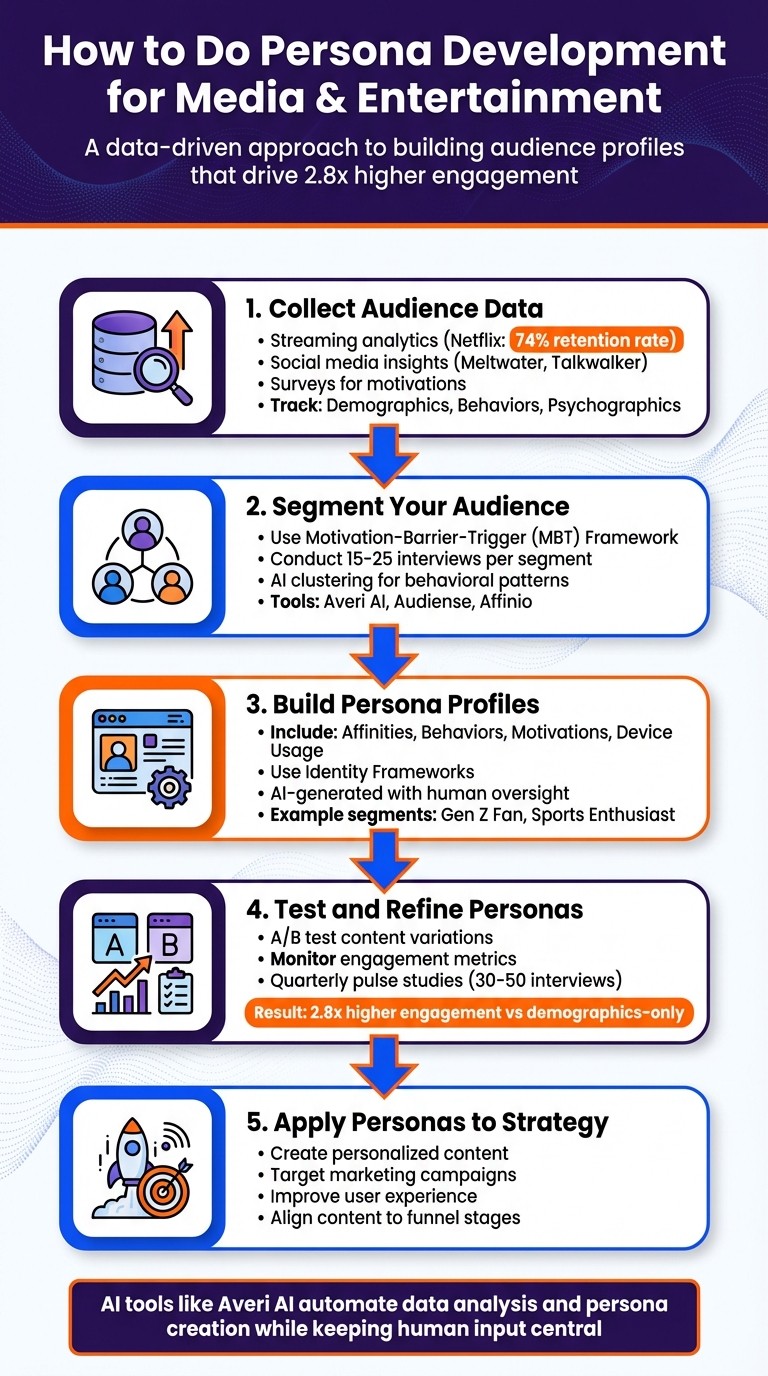
5-Step Persona Development Process for Media & Entertainment
Step 1: Collect Audience Data
Data Sources for Media and Entertainment
Streaming analytics give a clear picture of how, when, and what people watch. For instance, Netflix tracks viewing habits and content preferences on a massive scale, achieving a 74% retention rate compared to competitors who struggle to hit 30% [8].
Social media insights are invaluable for uncovering live discussions and trending topics. Tools like Meltwater (3.7/5 stars on Gartner Peer Insights) and Talkwalker help monitor what people are talking about and sharing across platforms [5]. Platforms like Audiense (4.4/5 stars on G2) and Affinio go a step further by grouping users based on shared interests rather than just demographics, offering a more nuanced understanding of audience personas [6].
Surveys fill in the gaps by capturing motivations and emotional drivers that analytics might miss. Additionally, competitor analysis tools like Sparkt can highlight areas where your content could stand out.
Once these data sources are in place, the next step is identifying specific metrics to track.
Demographics, Psychographics, and Behaviors to Track
To get a complete picture of your audience, track a mix of demographics, behaviors, and psychographics:
Demographics: Age, gender, location, income, education, and occupation.
Behaviors: TV viewing patterns, podcast listening habits, app usage, browsing history, and social media activity like likes, shares, and comments.
Psychographics: Motivations, values, and fears - such as missing out on trending content or wasting time on irrelevant shows [9][10][11].
It's also crucial to monitor content preferences - whether your audience prefers videos, blogs, or podcasts - and their favored topics like sports, politics, or entertainment [11][12]. Lastly, track engagement metrics like email open rates, video completion rates, and newsletter sign-ups to see what resonates most [9][11].
AI Tools for Automated Data Collection
AI tools can streamline data collection by pulling insights from multiple platforms automatically, saving time and enhancing accuracy.
These tools aggregate data from social media, CRM systems, website analytics, and streaming logs, making it easier to identify patterns like viewing frequencies and content preferences [5][8]. For example, Netflix uses AI to analyze audience and financial data, guiding investments in original content like Squid Game and Bridgerton [8].
Platforms like Veritone and Revedia (SymphonyAI) automate tasks like content tagging and consumption analysis, offering a deeper understanding of audience behavior [7][8]. AI can even link online social activity to offline identities, enriching first-party data with social insights for a more complete view of your audience [6].
Averi AI takes automation further by analyzing your website, identifying competitors’ content gaps, and suggesting initial audience personas. This approach reduces manual effort while still allowing for human oversight to ensure quality and relevance.
Step 2: Segment Your Audience
Identify Key Audience Segments
After gathering your data, the next task is to divide your audience into segments that genuinely reflect their behaviors and preferences. In the media and entertainment world, this means digging deeper than basic demographics like age or location and instead focusing on the psychological factors that shape viewing habits.
The Motivation-Barrier-Trigger (MBT) Framework is a powerful tool for this. It helps you uncover the emotional drivers behind audience behavior: Motivation (the underlying need, such as seeking escapism after a long day), Barrier (what’s stopping them, like subscription fatigue), and Trigger (the situational prompt, such as a friend's recommendation) [2]. For example, you might identify segments like casual streamers who watch to unwind, gamers drawn to competitive content, live event enthusiasts seeking real-time experiences, or fans devoted to niche genres like true crime or K-dramas.
To develop these segments, structured qualitative conversations with 15–25 participants per group are typically conducted. The goal is to reach "thematic saturation" - the point where you start hearing the same motivations and barriers repeated. This ensures your segments are based on recurring insights, not one-off responses [2].
From here, AI clustering methods can take your segmentation to the next level.
Clustering Methods for Media Audiences
AI-based clustering can make segmentation faster and more precise by grouping users based on shared behaviors and preferences. A practical approach involves feeding data into the AI incrementally - starting with interview transcripts, then layering in goals, and finally challenges. This step-by-step process minimizes the risk of the AI producing generic or inaccurate results [4].
For qualitative insights, AI tools can perform affinity diagramming at scale, analyzing hundreds of user quotes and grouping them into meaningful themes. This allows you to identify audience motivations far more quickly than traditional manual analysis [4]. Some organizations are even using AI to moderate hundreds of qualitative interviews simultaneously, a feat that would be nearly impossible for human moderators [2].
Tools That Simplify Segmentation
Certain tools can make segmentation more efficient and effective.
Averi AI: This platform automates segmentation by analyzing your website, identifying gaps in competitors' content, and proposing initial personas based on real-time behavioral data. It also refines these personas over time, with human input at key decision points to ensure quality.
Audiense and Affinio: These platforms focus on grouping users by shared interests rather than demographics, offering a richer and more detailed view of audience personas [6].
How to Make AI Personas for Marketing
Step 3: Build Persona Profiles
Once you've segmented your data, the next step is to transform those abstract groups into detailed, actionable personas.
Components of a Persona Profile
When creating persona profiles for media and entertainment, it's not enough to rely on basic demographics. What truly matters is understanding the "why" behind their consumption habits. Are they looking for escapism, inspiration, or a sense of community? These emotional and motivational factors provide deeper insights than just age or location [1][4].
Start with the fundamentals - name, demographics, goals, and challenges - but go further by incorporating media-specific details. This includes their favorite brands, platform usage patterns, motivations, and preferred devices. The more precise these details, the more actionable the persona becomes.
To take it a step further, consider using Identity Frameworks. These frameworks categorize personas based on their intellectual approach - whether they act as teachers, strategists, or curators. This perspective helps you understand not just who they are, but how they engage with and share content [4].
Persona Component | Media & Entertainment Focus | Example Detail |
|---|---|---|
Affinities | Favorite brands, tools, creators | Follows MrBeast; uses Letterboxd |
Behaviors | Platform-specific habits | Binge-watches on weekends; skips intros |
Motivations | Emotional drivers | Wants "watercooler" moments for social status |
Device Usage | Preferred hardware | Mobile-first for TikTok; Smart TV for movies |
Using AI to Generate and Refine Personas
AI tools can simplify and accelerate the process of building personas. The "Skeleton → Depth → Narrative" method works well: start with a basic outline, layer in behavioral data, and then add qualitative insights. This ensures the personas remain grounded in real-world patterns rather than generic assumptions [4].
Platforms like Averi AI can automate much of this process. By analyzing your website and identifying gaps in competitor content, Averi AI can propose initial personas based on real-time behavioral data. The tool refines these personas over time, incorporating human input at key stages to ensure quality. Once a persona is developed, you can stress-test it with adversarial prompts to confirm its accuracy and make adjustments as needed [4]. These refined profiles become the foundation for testing and strategic planning.
Example Persona Profiles for Media & Entertainment
Here’s how segmented data can evolve into actionable personas:
Persona Segment | Primary Platform | Content Interest | Key Behavior |
|---|---|---|---|
Gen Z Fan | TikTok / Instagram | Reality Series / Creators | Follows creators across platforms [3] |
Sports Enthusiast | OTT / Social Media | Live Events | Watches on OTT; interacts on social [3] |
To make these personas more relatable, assign them names, backstories, and unique traits like favorite shows or hobbies. This structured approach ensures your strategy aligns with your audience's behaviors and preferences, turning data into actionable insights.
Step 4: Test and Refine Personas
Creating personas is just the beginning; the real challenge lies in validating and refining them with actual audience data. Testing ensures that your personas stay aligned with the shifting behaviors of your audience in the media and entertainment space.
A/B Testing with Content
Start by crafting different versions of content tailored to each persona, then measure which performs better. For media and entertainment, this could involve testing variations in video thumbnails, email subject lines, or social media captions - each designed to appeal to a specific persona. Metrics like click-through rates, watch time, and shares can help confirm or challenge your initial assumptions.
To enhance A/B testing, consider using adversarial prompts to uncover flaws in the persona's design [4]. Another method is revealed preferences testing: instead of asking if a persona would like something, present two options and observe which one it chooses. This approach reveals whether the persona's stated priorities align with its actual decision-making [4].
One common issue to watch out for is when AI-generated personas "hallucinate" priorities that don't match reality. For example, if your audience is concerned about rent affordability but the AI assumes they care about scalability, you've identified a mismatch. Always compare AI-generated insights with your original research to catch these discrepancies [4].
Once you’ve tested and refined your personas, integrate audience feedback to make further adjustments.
Feedback Loops and Real-Time Adjustments
To keep your personas aligned with real-time trends in media consumption, establish continuous feedback loops. This involves monitoring engagement metrics, analyzing user comments, and reviewing support tickets.
Organize this feedback using the MBT Framework: Motivations (emotional drivers), Barriers (obstacles), and Triggers (situational factors). This structure helps creative teams turn insights into actionable strategies [2]. Additionally, conducting quarterly pulse studies with 30–50 AI-moderated interviews can help identify shifts in motivations or barriers [2].
Platforms now have the capability to conduct hundreds of simultaneous qualitative interviews using "laddering" techniques. These methods move beyond surface behaviors to uncover deeper psychological motivations, ensuring that your personas reflect current realities rather than outdated assumptions [2].
With a steady flow of feedback, use analytics to fine-tune personas at every stage of your marketing funnel.
Using Analytics for Persona Optimization
Different stages of the funnel require different metrics to optimize personas effectively. At the top, focus on reach, impressions, and click-through rates to evaluate whether your persona's "hook" is drawing attention. In the middle, track metrics like time spent on the site, email signups, and read depth to ensure your content resonates. At the bottom, monitor conversion rates, trial starts, and customer acquisition costs to confirm that you're addressing your persona's pain points.
Campaigns built on personas informed by qualitative research tend to perform much better, delivering 2.8x higher engagement rates compared to those relying solely on demographics [2]. This underscores the difference between informed strategies and guesswork.
Tools like Averi AI can make persona optimization more efficient by analyzing content performance and identifying which topics resonate most with specific segments. These tools provide actionable recommendations, such as which content to prioritize, what needs updating, and where to focus next. With each iteration, the system learns and sharpens future persona-driven content.
Metric Category | Key Indicators | What It Tells You |
|---|---|---|
Awareness | Reach, CTR, Cost per view | Is the persona's "hook" drawing attention? |
Engagement | Time on page, Shares, Read Depth | Does the content meet persona expectations? |
Conversion | Sign-ups, Purchases, CAC | Are you addressing pain points effectively? |
Loyalty | Churn rate, CLV, Active Days | Is the persona staying relevant over time? |
If you find yourself constantly revising content, it could signal that your persona profiles lack the level of detail needed for precision.
Step 5: Apply Personas to Your Strategy
Use your refined personas to shape content, campaigns, and user experiences that resonate with your audience.
Create Personalized Content
Personas can be a powerful guide for crafting content that speaks directly to your audience. Start by building an Identity Framework for each persona. This framework should outline their intellectual preferences (e.g., do they want expert insights or light entertainment?), emotional tone (e.g., calm storytelling or energetic content), and communication style (e.g., industry-specific terms or plain language). This approach ensures your brand voice stays consistent while catering to the unique needs of each segment.
Next, organize your content into Content Buckets - reliable formats that appeal to specific personas. For example, in media and entertainment, you might create behind-the-scenes clips for superfans, cast interviews for casual viewers, fan reaction videos for community-driven audiences, and interactive polls for highly engaged followers.
Tailor your content to different stages of the funnel:
Funnel Stage | Content Goal | Example Formats |
|---|---|---|
Awareness | Spark interest | Trailers, teasers, behind-the-scenes clips |
Consideration | Build trust | Cast interviews, expert reviews, feature breakdowns |
Decision | Drive action | Promotional offers, personalized emails, clear CTAs |
Timing is everything. Align your content releases with key industry moments - like award shows, holidays, or seasonal trends that matter to your audience. Maximize your efforts by repurposing content. For instance, a single behind-the-scenes video can become a week's worth of posts, including quotes, GIFs, and short vertical videos optimized for different platforms.
Once your content strategy is in place, focus on integrating these insights into targeted campaigns.
Target Marketing Campaigns
Personas allow you to refine your messaging to reflect the values of specific audience groups. For example, if one persona prioritizes "escapism" and another values "community", adjust your emotional appeal to align with each group's preferences. This approach transforms generic campaigns into meaningful experiences.
Structure your campaigns around the customer journey. At the awareness stage, focus on discovery with search ads, educational blogs, trailers, and social media challenges. For the consideration stage, help audiences evaluate your offering with case studies, webinars, cast interviews, and expert reviews. At the decision stage, encourage action with product demos, free trials, and email offers.
In today’s landscape, users expect a seamless, multi-platform brand experience. Media companies increasingly rely on creator partnerships to grow their reach. Designing campaigns that mirror cross-platform behaviors is essential. For subscription-based models, personas can help you build loyalty strategies - like offering early access to superfans - to reduce churn and increase lifetime value. Steer clear of mistakes like chasing viral trends without a conversion plan, relying only on short-term hype, or recycling the same creative assets across all funnel stages.
Beyond campaigns, personas can also refine every interaction your audience has with your brand.
Improve User Experience
Take persona-driven insights a step further by optimizing digital platforms and recommendations to enhance engagement. Streaming interfaces, app layouts, and event experiences can all be tailored to fit audience preferences. For instance, a persona focused on discovery might enjoy curated playlists and hidden gems, while one seeking familiarity may prefer quick access to favorite content.
Use tools designed for personalization to streamline these efforts. Platforms like Mutiny can help you tweak websites and landing pages without needing extensive developer resources, while Persado can refine your messaging to better connect emotionally with your audience. If you’re building personas through user interviews, tools like HeyMarvin provide secure, AI-assisted options for gathering and analyzing feedback.
When using AI to simulate personas, feed data in small, manageable batches rather than overwhelming the system with large datasets. Regular testing ensures that personas stay aligned with your brand’s unique character. Consider leveraging Retrieval Augmented Generation (RAG), a method that allows AI to reference persona documents and brand history during content creation, ensuring outputs remain rooted in your research and goals.
Conclusion
Key Takeaways
Developing personas in the media and entertainment world isn’t something you can set and forget - it’s a process that grows and adapts alongside your audience. Relying on outdated personas can leave brands scrambling to catch up, putting them in a reactive position rather than staying ahead of the curve.
The most impactful personas are built on a mix of solid data collection, smart audience segmentation, and regular updates. Start by tapping into behavioral and psychographic data from sources like streaming analytics, social media interactions, and direct interviews. AI tools can help identify patterns and group audiences into meaningful clusters. From there, create persona profiles that go beyond surface-level demographics to include motivations, barriers, and decision triggers. Incorporating qualitative research into this process can significantly improve how well campaigns connect with your audience.
Keeping personas up to date is key to gaining deep, actionable insights that competitors can’t easily copy. While others might replicate your content formats or marketing techniques, they won’t have the same nuanced understanding of your audience. Few marketers succeed in executing a full-funnel strategy, but personas provide a roadmap for tailoring content to every stage - from trailers that build awareness to cast interviews that drive consideration, and personalized offers that nudge decisions.
Next Steps
To put these ideas into action, start gathering audience data from analytics platforms, social media, and customer support channels. Use this data to pinpoint two or three core audience segments that represent your most engaged or valuable users. Then, craft your first persona profiles using the Motivation-Barrier-Trigger framework, which focuses on understanding why your audience makes decisions, not just who they are.
Once your personas are ready, test them in real-world scenarios. Run A/B tests to see how different messages, visuals, and campaign strategies perform. Schedule quarterly pulse studies - using 30 to 50 AI-moderated interviews - to ensure your personas remain accurate and relevant over time [2]. Tools like Averi AI can streamline this process, helping you quickly create data-driven personas and integrate them into your content strategy, transforming insights into campaigns without unnecessary manual effort.
FAQs
What’s the fastest way to build my first media persona?
The fastest path to crafting your first media persona is to begin with data-informed assumptions grounded in your product expertise and initial customer interactions. From there, confirm these assumptions by conducting focused consumer interviews and analyzing data to identify key motivations and obstacles. Resources such as Google Analytics and AI-facilitated interviews can simplify this process, enabling you to create and fine-tune practical personas within a matter of days.
How can I segment audiences beyond age and location?
To reach deeper insights than simple demographics, prioritize behavioral and motivational factors. Frameworks such as the Motivation-Barrier-Trigger (MBT) model can reveal the underlying reasons behind actions, obstacles that hinder them, and the triggers that influence decisions. Pair this with AI-driven consumer interviews and social media analytics to uncover platform-specific habits and objectives. Tools like SparkToro and direct audience feedback are invaluable for refining personas, focusing on motivations and decision-making patterns. This approach allows for segmentation that goes far beyond basic factors like age or location.
How often should I update personas for streaming and social trends?
Keeping up with the rapid shifts in media and entertainment audiences means revisiting personas every 3 to 6 months is a smart move. Frequent updates ensure they align with the latest trends and behaviors, especially when leveraging AI-driven tools and real-time analytics. Personas grounded in fresh, qualitative research are also better at predicting campaign outcomes, underscoring the value of keeping them current and accurate.
Related Blog Posts

Zach Chmael
CMO, Averi
"We built Averi around the exact workflow we've used to scale our web traffic over 6000% in the last 6 months."
Your content should be working harder.
Averi's content engine builds Google entity authority, drives AI citations, and scales your visibility so you can get more customers.