

In This Article
Step-by-step guide to build startup communities that lower CAC, boost retention, and scale engagement with AI.
Updated:
Trusted by 1,000+ teams
Startups use Averi to build
content engines that rank.
Startups can cut customer acquisition costs by 30–50% and reduce churn rates by up to 3x with community-led growth. This approach builds a loyal user base that engages, refers others, and provides actionable feedback faster than traditional methods. Here's how to get started:
Set clear goals: Define your community's purpose and target a specific audience.
Choose the right platform: Focus on one platform where your audience is active (e.g., Discord for developers, Slack for B2B professionals).
Recruit early members: Personally invite 20–50 initial members to set the tone.
Launch with structure: Use a 30–60 day content plan with consistent events and resources.
Encourage interaction: Enable member-to-member connections and offer perks like exclusive access or resources.
Track key metrics: Monitor Weekly Active Members (15–25%), member-initiated threads (60%), and retention improvements.
Leverage AI tools: Automate repetitive tasks like moderation and content creation to save time.
Start small, track results, and scale gradually. A thriving community can double customer lifetime value and drive growth faster than traditional marketing channels.
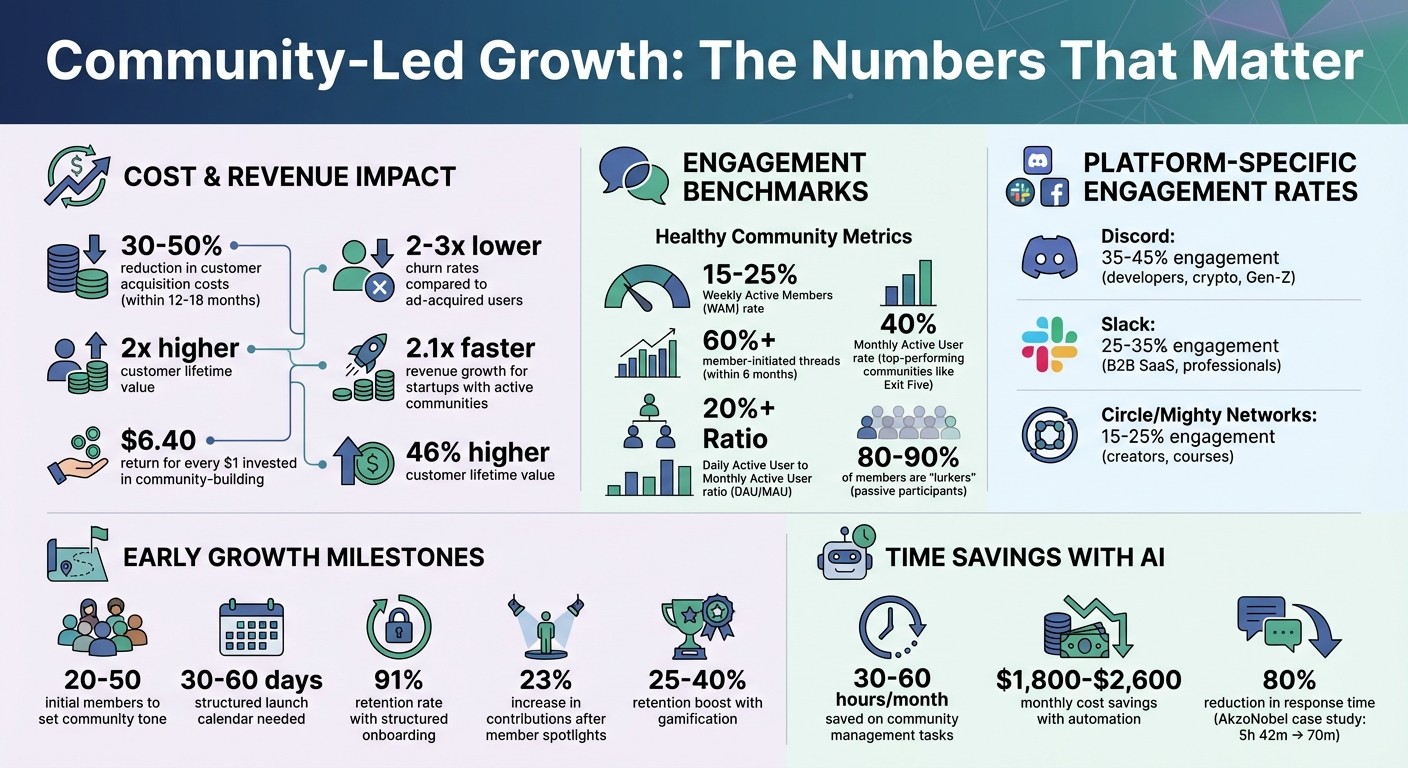
Community-Led Growth Impact: Key Statistics and Metrics for Startups
Step 1: Set Your Community Goals and Identify Your Audience
Define Your Community's Purpose
A strong community starts with a clear purpose. This isn't just a casual gathering - it's a space designed to help members achieve a specific result. To test your clarity, try the one-sentence rule: "[Community name] is where [specific people] come to achieve [specific outcome]." For instance, Indie Hackers isn't just a forum for entrepreneurs; it's a community where founders demonstrate they can build businesses without venture capital [3]. If you can't articulate this clearly, it's worth delaying your launch until you can.
Consider Exit Five, a B2B marketing community led by Dave Gerhardt and Matthew Carnevale. As of October 2024, it had grown to over 4,300 members and generated $1.5 million annually. They achieved a 40% Monthly Active User rate by keeping the focus sharp: enforcing a "no self-promotion" rule and introducing a monthly one-on-one member matchmaking program. This ensured new members experienced a "first win" within their first week [10].
"Without giving people topics on a regular basis or making it clear what types of information they should be exchanging, the vibe dies." – Camille Ricketts, Operating Partner, Emergence Capital [8]
A "first win" is a tangible result that a new member can achieve in their first week. It could be as simple as gaining access to a useful template, getting a peer's advice on a pressing issue, or forming a valuable connection. Communities with structured onboarding processes retain 91% of new members through their first week [11].
Identify Your Target Members
Once your community's purpose is defined, the next step is to identify the specific audience that will benefit most from it. Start with a narrow focus. Broad communities often fail because members struggle to find shared interests or goals [8]. To build momentum, align your initial audience with your Ideal Customer Profile (ICP), targeting a highly specific segment before expanding.
A great example is Guillaume Moubeche, CEO of Lemlist, who launched "The Sales Automation Family" Facebook group. Instead of marketing directly to Lemlist users, he targeted salespeople who were grappling with automation challenges. By focusing on their broader needs rather than just product support, the group grew to nearly 10,000 members and helped Lemlist surpass a $2 million run rate [4].
To find your target members, identify where they already gather. This could be LinkedIn groups, Twitter threads, Reddit forums, or niche Slack channels. Your customer success team can help identify "Champions" or "Super Users" who are already vocal advocates [8]. Finally, segment potential members based on their current revenue value, growth potential, and alignment with the community's culture [7]. A thriving community typically maintains a Daily Active User to Monthly Active User (DAU/MAU) ratio of at least 20% [9].
Step 2: Choose Your Platform and Recruit Initial Members
Pick the Right Platform
Select a platform where your target audience is already active to make joining seamless. For instance, Discord is a great fit for developers, crypto enthusiasts, and Gen-Z audiences, often achieving 35–45% engagement rates. Slack works well for B2B SaaS and professional communities, with typical engagement ranging from 25–35%. LinkedIn Groups cater to enterprise buyers and B2B founders, while Circle or Mighty Networks are ideal for creators offering courses or structured content, seeing about 15–25% engagement [3][12].
To avoid spreading yourself too thin, focus on one platform until your community reaches at least 200 engaged members. Managing multiple platforms early on can dilute your efforts and create an inactive, "ghost town" vibe [3]. Follow a proven strategy: "Participate → Partner → Build." Start by engaging in existing groups to learn how members communicate and establish credibility. Once you've built trust, invite them to your dedicated space [2]. After choosing your platform, shift your attention to recruiting your first members, as they will define your community's tone and culture.
Invite Your First Members
Your initial 20–50 members will set the tone for your community's culture and standards. Instead of relying on generic invite links, personally recruit these members through direct outreach [3][12]. Reach out to power users, active social media followers, or loyal customers with personalized messages. For example: "We're launching an exclusive community for X professionals, and we’d love for you to be one of our founding members" [12].
Take inspiration from Sarah Hawley and the GrowMotely team, who built a pre-launch waitlist of 5,300 people by engaging them through a "Future of Work" survey. This approach converted 793 professionals and 50 companies into active users within their first month [4]. Similarly, Jared Robin transformed RevGenius from a LinkedIn chat into a thriving Slack community of over 15,000 sales and marketing professionals, generating over $500,000 annually through sponsorships [4].
To deepen commitment, offer early adopters perks like a "Founding Member" title or exclusive access [3]. Recruit in manageable waves: aim for 20–30 members in the first two weeks and then add 50–70 more in the following two weeks [12]. Keep in mind that community members tend to churn at rates 2–3 times lower than users acquired through ads and often deliver twice the lifetime value [3][12].
Step 3: Launch with a Content Plan and Clear Rules
Build a 30-60 Day Launch Calendar
The first 30–60 days of your community launch should follow a structured schedule rather than relying on sporadic posts. A consistent weekly rhythm can make all the difference. For example, include one interaction-focused event (like an AMA or a Decision Clinic), one practical resource (such as a checklist or template), and one member spotlight each week [2]. This kind of predictability helps your community feel lively and engaging, even in its early stages.
To keep the momentum going, manually seed content by posting 3–5 times a week [3]. A great example of this approach comes from Mikael Dia, founder of Funnelytics, who launched a Facebook group in 2021. By consistently sharing valuable content, he grew the group to 3,000 members in just two months. This strategy not only generated $28,000 in revenue within the first 48 hours of his product launch but also contributed to the company reaching $1.5 million in its first year [4]. Similarly, Derek Steer, CEO of Mode, used a recurring tutorial series called "SQL School" to attract hundreds of thousands of visitors monthly, scaling the company to $19 million in annual recurring revenue [4].
Your content plan should focus on creating "first wins" - moments where new members achieve something meaningful within their first week [2]. Since the majority of members (roughly 80–90%) tend to be "lurkers" who rarely post, include activities that require minimal effort, like polls or emoji-based reactions, to encourage participation [3]. Keep in mind that successful communities aim for at least 60% of conversation threads to be initiated by members, rather than founders, within the first six months [3]. With a solid content calendar in place, you'll also need clear community rules to maintain engagement and quality.
Set Community Guidelines
During the first 30 days, establish clear rules that define your community’s purpose and the outcomes you’re aiming for [2][3]. Be explicit about your self-promotion policy - many thriving communities adopt a "no self-promotion" rule to ensure discussions remain valuable and trustworthy [2]. Annie Liao, founder of Build Club, demonstrated the power of strong guidelines by growing her AI-focused community to over 50,000 members across 60+ cities in just one year. She achieved this by implementing a "Community Manifesto" and conducting 1:1 onboarding sessions with City Leads to maintain consistency [1].
"If your community's primary function is answering product questions, members will leave once their problem is solved. Build around identity and aspiration, not troubleshooting."
– Monolit [3]
Your guidelines should also outline procedures for conflict resolution and decision-making to promote transparency [2]. Go beyond listing rules by providing examples of what "good" and "great" behavior look like. This sets a high standard for interactions [5]. For instance, Strapi, an open-source software company, builds trust with its community by maintaining a public roadmap and operations handbook. They also use GitHub’s Request for Comments (RFCs) process to let members influence product development, ensuring transparency and collaboration [5].
Community-Led Growth: The Flywheel Framework
Step 4: Encourage Member Interaction and Provide Member Benefits
Once your content plan and guidelines are firmly established, it’s time to focus on sparking member connections and delivering perks that make your community indispensable.
Enable Member-to-Member Conversations
The key difference between traditional audience-building and community-led growth lies in shifting from one-to-many (brand-to-follower) relationships to many-to-many interactions. In this approach, members engage with and support each other, reducing reliance on your team [2].
A great example comes from Exit Five, a B2B marketing community with over 4,300 members. In October 2024, they achieved a 40% Monthly Active User (MAU) rate by introducing a member matchmaking program for one-on-one connections. Head of Community Matthew Carnevale also tagged internal experts to answer questions, easing the workload for his team [10].
"It's so hard to re-engage people if their first week or month isn't good. So you want to get engagement right." – Matthew Carnevale [10]
To make large communities less intimidating, consider breaking them into smaller, focused sub-groups. For example, in April 2024, Notion created targeted channels for sharing templates, splitting them into "individual templates" and "business templates" to help members find like-minded peers without feeling overwhelmed [8].
"If you think about ten thousand people being in a space, it's basically like a small concert. People don't really know who else is there, and I think people get nervous. That's one of the reasons you have to figure out how to break down big communities." – Camille Ricketts, Operating Partner, Emergence Capital [8]
Introduce recurring rituals like weekly AMAs, office hours, or "win threads" to make participation a habit. Encourage new members to complete simple tasks - such as asking a question, using the search feature, or joining a matchmaking session - to ease them into the community [10]. Keep in mind that 80–90% of your members may prefer to "lurk" rather than post, so offer low-effort engagement options like polls or emoji reactions to include everyone [3]. A healthy community typically aims for a Weekly Active Member (WAM) rate of 15–25% and should strive for 60% or more of threads to be member-initiated within six months [3].
While organic conversations are vital, offering exclusive perks can deepen member commitment.
Offer Exclusive Access and Resources
Exclusive benefits can be a powerful way to sustain participation. The most effective perks generally fall into three categories: product access, educational tools, and networking opportunities.
For product access, consider offering beta testing slots, early previews of new features, or VIP sessions with your product team [8][6]. Educational tools could include shareable resources like templates (e.g., Notion templates), tutorials, decision-making frameworks, or access to exclusive "academy" content [8][6][2]. Lemlist CEO Guillaume Moubeche showcased this strategy by creating "The Sales Automation Family" Facebook group. Focused on helping salespeople thrive rather than just supporting the product, the group grew to nearly 10,000 members and helped drive revenue from $600,000 to over $2 million in ARR [4].
Networking opportunities also resonate strongly. These might include one-on-one matchmaking, member-led events, or private meetups [10][1]. For instance, Weekend Club, a community for bootstrappers, transitioned from in-person meetups to a paid virtual co-working space. Their exclusive weekly "virtual sprints" provided structure and accountability, generating over $2,000 in monthly recurring revenue [4].
Recognition can also fuel engagement. Communities that spotlight active members often see a 23% increase in contributions from the featured members' networks within 30 days [12]. Adding gamification elements like badges or featured roles can further boost retention by 25–40% [6].
Step 5: Track Performance and Grow Your Community
Once you've built engagement and started delivering real value to your members, the next challenge is showing how your community contributes to business outcomes - and scaling it in a way that lasts.
Monitor Community Health Metrics
Focus on metrics that reveal the health of your community. Start with Weekly Active Members (WAM) - this measures the percentage of members who post or react weekly. A healthy community typically has a WAM of 15% to 25% [3][12]. If your numbers are lagging, it might be time to revisit your content strategy or engagement tactics.
Another critical metric is member-initiated threads, which tracks how many conversations are started by members rather than your team. Aiming for 60% or more within six months indicates your community is becoming self-sufficient [3]. Also, keep an eye on time-to-first-response - quick responses can significantly improve member retention [2].
For business impact, measure the retention delta by comparing churn rates between community members and non-members. This data helps validate the community's role in boosting retention. Use surveys like "How did you hear about us?" to track community-attributed signups, and calculate member lifetime value (LTV) to show that community-acquired customers often deliver 2x higher LTV compared to other channels [12]. Additionally, companies with active communities often see 30% to 50% lower customer acquisition costs (CAC) within 12 to 18 months [3].
One standout example is HackerEarth, led by Sachin Gupta, which built a developer community of 4.5 million between 2025 and 2026. This community became a powerful top-of-funnel engine, helping the company reach a $6 million run rate with over 500 enterprise customers [4].
"A community of 5,000 lurkers is 5,000 vanity metrics. A community of 500 active contributors is a distribution channel." – The Growth Terminal [12]
By tracking these metrics, you can demonstrate the value of your community while also identifying areas for strategic growth.
Collect and Act on Member Feedback
Once you're measuring engagement effectively, leverage member feedback to refine your approach. Think of your community as a live focus group: form hypotheses, test them, gather feedback, and adjust accordingly. Pay attention to discussions on platforms like Slack, Discord, or forums to uncover bugs, feature requests, and unexpected use cases.
Maintain a log of insights, noting why members join, the problems they solve, and the alternatives they consider. Share this information with your marketing team to update landing pages, sales copy, and value propositions [3].
For example, in 2024, Matthew Carnevale, Head of Community at Exit Five, noticed members frequently requesting 1:1 introductions. In response, he launched a monthly matchmaking program, which helped the community grow to over 4,300 members with a 40% Monthly Active User (MAU) rate [10].
"You learn what's broken in your product 6–8 weeks faster when your most invested users are in a space where they can tell you directly." – Monolit [3]
To make feedback actionable, implement rituals like weekly AMAs, office hours, or "Decision Clinics" where members can test ideas in a structured way. Conduct regular 1:1 interviews with active members to understand why they stay and what specific value they seek. As the community grows, consider breaking it into smaller groups based on shared interests or industries for more targeted feedback.
Launch an Ambassador Program
With strong metrics and actionable feedback in place, the next step is to empower your most engaged members to become ambassadors. Focus on turning super-users into ambassadors by letting them volunteer rather than recruiting them cold [8][1].
Between 2025 and 2026, Annie Liao grew Build Club into a 50,000+ member AI community spanning 60+ cities worldwide. Her strategy relied on "City Leads" who emerged organically from engaged members. These leaders were equipped with a manifesto and branding guidelines to host local co-working events, creating a zero-CAC growth engine that benefited AI companies like Gemini and Manus [1].
"Don't recruit city leads. Attract them. They emerged from engaged members, often via referrals." – Annie Liao, Founder, Build Club [1]
This approach transforms active members into growth drivers. Define roles like "Champion", "Ambassador", or "City Lead" to give participants a sense of identity and status [6][1]. Provide them with resources like branding kits, playbooks, and a community manifesto to ensure consistency while allowing for local customization [1]. Incentives can include perks like early access to new features, VIP sessions with your team, exclusive content, or revenue-sharing opportunities for enterprise deals [6][3][8].
Start small: once your community reaches 100–500 members, identify your top 5–10 contributors and invite them to take on moderator roles or test the ambassador program [3]. Encourage ambassadors to lead webinars, create tutorials, organize meetups, or mentor new users, expanding your community's reach and educational impact [6][8]. Keep ambassadors engaged by addressing their needs and challenges, treating them as valued partners [1].
Step 6: Use AI Tools to Automate Community Management
As your community grows and your ambassador program gains momentum, managing daily tasks can quickly become overwhelming. On average, these responsibilities can take up 30–60 hours each month [14]. AI tools like Averi can help by automating repetitive tasks such as content creation, scheduling, and monitoring. This allows you to dedicate more time to strategy and building meaningful relationships.
Automate Content Creation with Averi
Averi simplifies content creation by generating discussion prompts, event announcements, and weekly summaries. It can craft platform-specific content that aligns with your community's tone across platforms like Slack, Discord, LinkedIn, or Instagram [15]. Additionally, Averi can take your most successful posts and repurpose them into fresh formats, turning a single idea into multiple opportunities for engagement [15].
Consider this example: In September 2025, the Circle community team, managing a group of 10,000 active members, adopted AI workflows to streamline moderation. By automating tasks like renaming vague post titles (e.g., "Help!") into more descriptive ones, they processed 313 posts in one month, saving 5 hours of manual effort. Their automated enforcement of community guidelines saved each manager between 30 and 60 hours monthly by hiding off-topic or promotional posts before they reached members [14].
"AI handles the busywork of moderation - so you can lead your community without burning out."
Pedro, Community Manager, Circle [14]
AI can also assist in drafting surveys, onboarding guides, and blog posts inspired by community discussions. This creates a feedback loop where insights from your members fuel external content, drawing in new users [3]. Reviewing AI drafts ensures the content matches your community's unique voice.
Streamline Scheduling and Monitoring
AI workflows operate on a "Trigger → Filter → Action" system [14]. For instance, if a post is published (Trigger) and has a vague title (Filter), AI can automatically rename it with something more descriptive (Action). AI can also monitor posts and take actions like adding promo codes or lead magnets once a thread reaches a certain level of engagement [15].
Moderation gets a boost as well. AI-powered filters can distinguish genuine queries from spam, hiding promotional content and flagging guideline violations based on tone and context, not just keywords [14].
A compelling case comes from AkzoNobel UK, which used Sprinklr's unified contact center solution in 2025 to manage social customer care across six brands and 19 accounts. With AI detecting intent and streamlining responses, their average response time dropped by 80%, going from 5 hours and 42 minutes to just 70 minutes [13].
To get started, focus on automating one high-friction task, such as welcoming new members or renaming vague titles [14]. Once comfortable, you can expand to include workflows that track engagement, flag unanswered questions, and summarize sentiment trends [15]. This approach can result in monthly cost savings of $1,800–$2,600, assuming a $40 per hour management benchmark [14].
"AI isn't here to replace you. It's here to scale you. And if used right, and well, it'll give you more space to do what you love."
Mathilde Leo, Head of Community, Circle [14]
Conclusion
Building a strong, engaged community isn’t just a feel-good initiative - it’s a proven driver of business growth. Startups with active communities grow their revenue 2.1 times faster than those without, while also enjoying a 46% higher customer lifetime value [11]. And the financial returns are hard to ignore: for every dollar invested in community-building, businesses see an average of $6.40 in value [11]. It’s one of the most efficient growth strategies available today.
The six steps outlined earlier - setting clear goals, selecting the right platforms, launching with structure, fostering interaction, tracking results, and incorporating AI - create a powerful, self-reinforcing growth system. Community members tend to stay loyal, with churn rates 2–3 times lower than those acquired through traditional advertising. On top of that, companies report 30–50% lower customer acquisition costs within 12–18 months of implementing this approach [3].
In the early stages, the first 90 days often require focused effort without immediate returns. But patience pays off - most founders begin seeing tangible results like increased referrals, reduced churn, and faster feedback loops between months 4 and 9 [3]. Leveraging AI tools like Averi can simplify repetitive tasks such as content creation, moderation, and scheduling, giving you the bandwidth to focus on strategy and relationship-building.
Start small by automating one time-consuming task and aim for an early success. Each small win builds trust and momentum, paving the way for long-term growth through improved retention, stronger customer relationships, and increased revenue. The effort you put into your community today will shape your success tomorrow.
FAQs
When should a startup start a community?
Startups should consider building a community once traditional paid acquisition methods start losing their effectiveness and the importance of trust and user engagement becomes undeniable. This approach tends to thrive after reaching product-market fit and establishing a core group of active users. A well-nurtured community can lower acquisition costs, improve retention, and create a long-term growth engine fueled by user advocacy and genuine social proof.
How do I prove community ROI to leadership?
To convince leadership of the return on investment (ROI) for community initiatives, focus on metrics that tie directly to business outcomes. Showcase results such as lead generation, boosted sales through referrals, fewer support inquiries, lower customer acquisition costs (CAC), and higher retention rates. Emphasize the impact of community-driven content, testimonials, and engagement that surpass the performance of traditional marketing efforts. These insights illustrate how community programs transition from being seen as a cost to becoming a key driver of revenue, aligning seamlessly with the company’s measurable goals.
How do I monetize a community without killing engagement?
To generate revenue from a community without disrupting engagement, the key is to prioritize value in every interaction. Aim to build trust and loyalty by encouraging user-generated content, nurturing a sense of belonging, and introducing premium options or exclusive perks. By rolling out monetization gradually, you can maintain the community's trust while reaping benefits like reduced acquisition costs, stronger retention, and genuine social proof that keeps members invested.
Related Blog Posts

Zach Chmael
CMO, Averi
"We built Averi around the exact workflow we've used to scale our web traffic over 6000% in the last 6 months."
Your content should be working harder.
Averi's content engine builds Google entity authority, drives AI citations, and scales your visibility so you can get more customers.