How to Execute Positioning Audits for Hospitality & Travel

Averi Academy
Averi Team
8 minutes

In This Article
Step-by-step guide to map guest touchpoints, benchmark competitors, fix misalignment, and use AI to speed positioning audits.
Updated:
Trusted by 1,000+ teams
Startups use Averi to build
content engines that rank.
Does your hospitality or travel brand deliver on its promises? A positioning audit helps you answer this question by evaluating your brand’s guest experience, market presence, and differentiation from competitors. With 72.3% of travel executives prioritizing digital transformation and over 70% of travelers researching on mobile, consistency across all guest interactions is critical to securing bookings.
Key Takeaways:
Guest Journey Mapping: Analyze touchpoints from discovery to post-stay.
Data Collection: Use internal metrics (e.g., booking history, surveys) and competitor analysis (5 Ps: Proximity, Pricing, Positioning, Product, Purpose).
Alignment & Differentiation: Ensure your messaging matches guest experiences and identify market gaps to stand out.
Action Plan: Prioritize findings, fix critical issues, and implement targeted strategies with measurable KPIs.
AI Tools: Leverage platforms like Averi AI to streamline audits, analyze reviews, and enhance visibility in AI-driven search results.
This four-step framework ensures your brand consistently meets guest expectations and stays ahead in a competitive market.
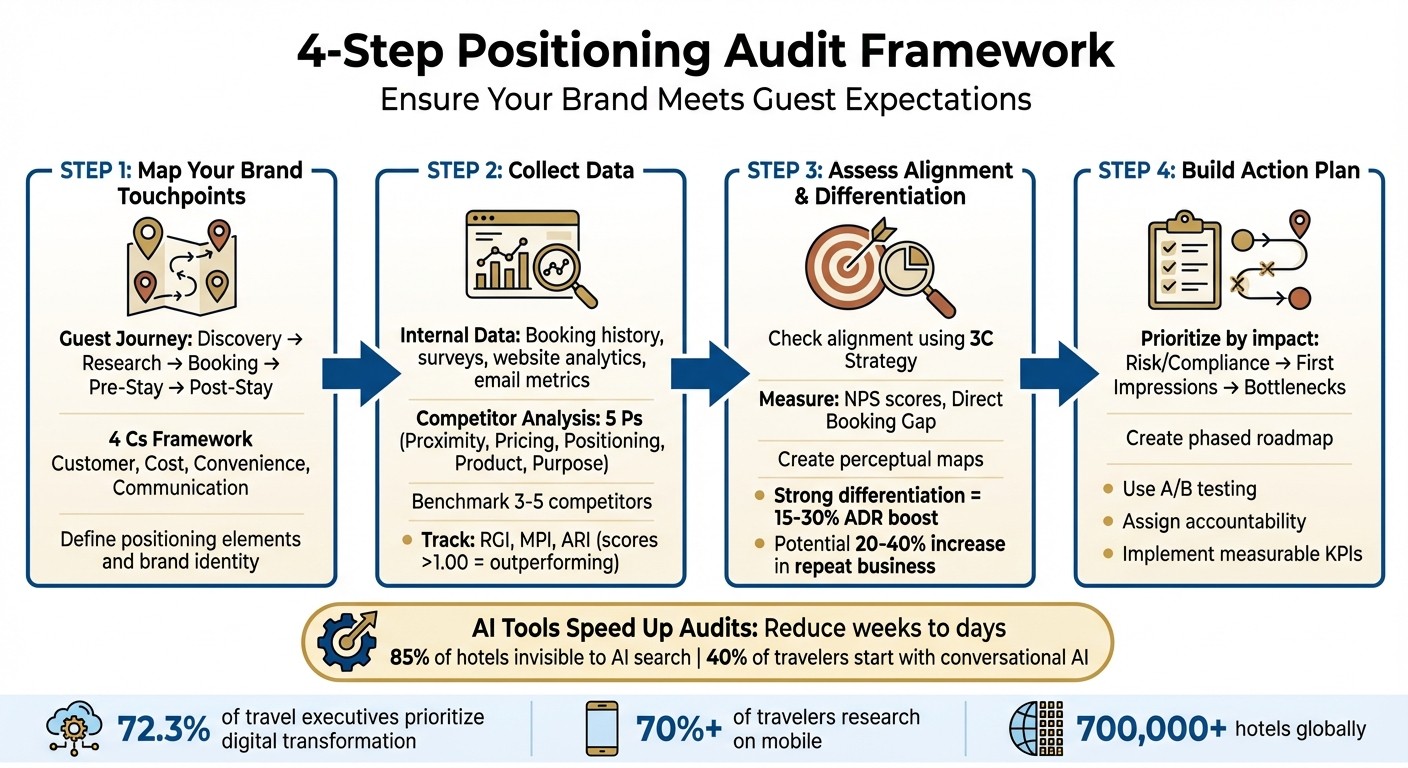
4-Step Positioning Audit Framework for Hospitality Brands
Bonus Analyst Sessions: Hotel Owner Operating and Branding Strategies
Step 1: Map Your Brand Touchpoints and Positioning Elements
To start your audit, identify every interaction and message that shapes your brand's presence.
Map the Guest Journey
Outline guest interactions across five key stages: Discovery (social platforms and search engines), Research (reviews and guides), Booking (website and mobile experience), Pre-Stay (confirmation emails and checklists), and Post-Stay (thank-you messages and surveys) [2].
Pay close attention to the Research phase. This is where trust is built, and interest turns into action. Your audit should evaluate whether the content in this stage effectively guides potential guests toward booking. Also, assess how these touchpoints perform on mobile devices, as this is often the primary platform for engagement.
Once the journey is mapped, shift your focus to the key elements that define your position in the market.
Define Your Core Positioning Elements
Your market position rests on four foundational pillars: a distinct brand identity and storytelling approach, a clear market segmentation strategy (defining your audience), unique experience differentiation (what sets you apart), and the integration of technology to enhance the guest experience [5].
To refine this, use the 4 Cs framework:
Customer: Tailor your offerings to meet specific needs.
Cost: Highlight the value guests perceive.
Convenience: Ensure a seamless and enjoyable experience.
Communication: Foster responsive and meaningful engagement [6].
Document your brand positioning statement, living brand systems, and the story of your brand's origins. As Prakash K, Co-founder & CEO of dhi Hospitality, emphasizes:
"Brand positioning is the deciding factor between thriving hotels and those struggling to stay afloat" [5].
With more than 700,000 hotels globally [5], defining these elements clearly is not just helpful - it’s essential for survival.
Step 2: Collect Data on Brand Perception and Competitors
Once your touchpoints and positioning elements are mapped out, the next step is to dig into the data. This involves understanding how your guests perceive your brand and measuring where you stand in the competitive landscape.
Review Internal Data
Start by leveraging the data you already have. Booking history can reveal patterns like how long guests stay, which amenities they prefer, and how often they return. Post-stay surveys and satisfaction ratings offer direct insights into whether your brand is delivering on its promises.
Dive into website analytics to uncover trends - traffic to FAQ pages, for instance, can show if your content is clear and helpful. Email performance metrics such as open rates, click-through rates, and revenue per email can signal how well your messaging resonates. Don’t forget to include guest reviews and user-generated content to see how your intended positioning aligns with actual guest perceptions.
Benchmark Against Competitors
Once you've reviewed your internal data, it’s time to analyze the competition. Identify 3–5 competitor properties and evaluate them using the 5 Ps: Proximity, Pricing, Positioning, Product, and Purpose. Rate them on critical attributes like amenities, room quality, location, and review scores. Tools like the Revenue Generation Index (RGI), Market Penetration Index (MPI), and Average Rate Index (ARI) can provide additional context - scores over 1.00 indicate you're outperforming your competitors.
For a deeper understanding, visit competitor properties yourself and keep an eye on review platforms like TripAdvisor and Google. These can reveal their strengths and weaknesses. Make it a habit to update your competitive analysis every quarter or whenever a new competitor enters the market to stay ahead of industry shifts [7].
Step 3: Assess Alignment and Differentiation
Now that you’ve gathered the data, it's time to evaluate how well your messaging reflects guest experiences and identify areas where your brand can stand out.
Check Customer Alignment
Start by ensuring your brand promise aligns with what guests actually experience. Use the 3C Strategy to match consumer needs with gaps in your competitors' offerings and your company’s strengths [3]. This framework helps confirm that your messaging resonates with your target audience.
Dive into metrics like Net Promoter Scores (NPS) and post-stay ratings to measure how well you’re meeting guest expectations. Pay close attention to the Direct Booking Gap - the percentage of visitors to your site who end up booking through OTAs instead. A high gap may indicate a disconnect between your messaging and guest needs [5].
Evaluate your performance across the entire booking funnel. If mobile conversion rates are lagging, it could signal misalignment [2]. Make sure your content speaks to every stage of the guest journey - discovery, research, and decision-making - while staying true to your brand promise. This step builds on your journey map by verifying that every interaction reinforces your message.
Find Differentiation Opportunities
After confirming alignment, focus on identifying unique ways your brand can excel. A perceptual map is a great starting point. Plot your property alongside 3–5 competitors on a matrix that highlights criteria important to your guests, such as "Authentic/Local" versus "Standardized/Global" or "Budget-Friendly" versus "Luxury Experience" [8][9]. This exercise can uncover market gaps where your brand can shine.
Keep an eye on your Average Daily Rate (ADR) compared to competitors. Strong differentiation can boost ADR by 15–30% and increase market share by 10–25% [5]. If your ADR is stagnant or lower than comparable properties, it might mean your differentiation strategy isn’t hitting the mark.
Use tools like social listening and competitor review analysis to spot areas where competitors fall short [9]. Monitor trends in ADR premiums, Revenue Per Available Room (RevPAR), and market share to see if your efforts are driving more direct bookings. Offering exclusive perks for direct bookings - like free breakfast, room upgrades, or flexible cancellations - can also help you stand out from OTAs [2]. When differentiation aligns with guest expectations, it can boost repeat business by 20–40% [5].
Step 4: Prioritize Findings and Build an Action Plan
Turn your insights into a clear set of prioritized actions. Not all issues carry the same level of importance, so it’s essential to rank them based on their impact on guest perception and your business performance.
Rank Findings by Impact
Evaluate each finding to determine its significance, tackling the most critical issues first while planning minor fixes for later. Start with risk and compliance concerns - anything tied to food safety, health regulations, or legal requirements must be addressed immediately, as these can lead to serious penalties or even closures.
Next, focus on issues that shape first impressions and trust. Guests quickly notice cleanliness and professionalism, so addressing gaps in these areas should be a priority. For digital interactions, pay special attention to the consideration phase, where potential guests evaluate their options. Ensure your mobile booking process is intuitive and free of obstacles to avoid losing bookings.
Identify and resolve service or operational bottlenecks that affect efficiency. If you manage multiple locations, prioritize inconsistencies where individual properties stray from your core brand standards. Use measurable KPIs like revenue per email, retargeting ROI, and customer lifetime value to pinpoint areas where lapses are costing you the most.
Once you’ve ranked your findings, create a focused and actionable plan.
Create Your Action Plan
Design a phased roadmap that aligns with your team’s capacity. Begin by addressing mid-funnel issues, as these are crucial for keeping potential guests engaged. Simplify the booking process by eliminating unnecessary steps and adding trust signals like SSL certificates, verified badges, and guest reviews near your "Book Now" buttons.
Assign each task to a specific team member to ensure accountability. Use A/B testing to refine landing page messaging and confirm that changes improve click-through rates. Incorporate user-generated content and video testimonials to boost engagement and credibility. Don’t forget to implement post-stay strategies, such as automated thank-you emails and satisfaction surveys, to encourage repeat visits and build guest loyalty.
"A corporate travel audit is more than a health check, it's a strategic tool for transformation."
Michael Brennan, Managing Partner and Co-Founder, KesselRun Corporate Travel Solutions
Use AI Tools to Speed Up Positioning Audits
Traditional audits often take weeks and may overlook critical details. AI tools, however, can reduce this process to just a few days, uncovering insights that manual methods might miss - especially in conversational AI searches, where 40% of travelers now begin their research [10].
Benefits of Tools Like Averi AI
AI-powered platforms streamline the most tedious aspects of positioning audits. Tasks like monitoring competitor pricing across multiple OTAs or analyzing hundreds of reviews for sentiment patterns can be automated. For instance, Averi AI combines industry-specific data with campaign-level insights to provide a detailed view of your market position. Similarly, MARA Solutions uses natural language processing to analyze guest feedback, identifying recurring themes and trends [12].
Other tools offer predictive capabilities: Cloudbeds Signals forecasts demand with up to 95% accuracy for the next 90 days, while PriceLabs users report an average 26% increase in RevPAR within three months [12].
The transition from traditional SEO to Generative Engine Optimization (GEO) has made these tools indispensable. Currently, 85% of hotels remain invisible to AI search tools because they haven’t optimized for platforms like ChatGPT or Perplexity [10]. AI auditing tools simulate real guest searches - like "best boutique hotels in Austin" - across various platforms to evaluate whether your property is being recommended and how it compares to competitors [10][11].
Using AI for Competitive Analysis
AI visibility tests can help you understand how your property appears in conversational searches. By running 10–15 queries that reflect real guest searches - such as "eco-friendly resort with yoga near Santa Fe" - in tools like ChatGPT, Claude, or Perplexity, you can track mentions of your property and observe language patterns used by AI [11]. This approach also reveals content types that resonate with AI, such as FAQs, detailed guides, or structured data.
AI tools can also benchmark competitors with precision. Platforms like Pathmatics track competitor ad spend and creative strategies, while others with PMS integration provide real-time insights into reservations, rates, and guest profiles for hyper-local intelligence [2][12]. Additionally, MARA Solutions analyzes guest feedback to identify sentiment patterns that influence AI recommendations [12].
To further enhance visibility, implement structured data markup across all digital content. This ensures AI models can classify and recommend your property accurately. Tracking AI citations as a performance metric can provide valuable insights into the frequency and quality of your brand mentions across AI platforms [11].
Conclusion
Positioning audits are a continuous effort that separates brands prepared for the future from those merely reacting to change. Doug Radkey of KRG Hospitality captures this idea perfectly:
Hospitality isn't just about serving food and beverage, or providing a bed. Hospitality is about creating memories that guests carry with them long after they've experienced your brand [4].
The process outlined in this guide offers a structured way to ensure that your brand promise consistently matches the experiences you deliver. However, the challenge lies in execution. As Trail emphasizes:
Audits aren't just about meeting regulations, they should be seen as an opportunity to improve efficiency [1].
By shifting the focus from simply solving problems to fostering continuous improvement, audits can evolve from routine checks into powerful tools for growth.
This disciplined mindset also creates opportunities for leveraging technology. AI tools like Averi AI provide quick, data-driven insights that traditional methods may overlook. For lean teams competing against larger players, automation fueled by a marketing strategy for hospitality becomes essential. Combining AI insights with thoughtful human oversight allows you to concentrate on crafting experiences that turn first-time visitors into loyal supporters.
When continuous audits are paired with AI-powered insights, your brand stays in sync with guest expectations while maintaining a competitive edge.
FAQs
How often should I run a positioning audit?
There's no hard-and-fast rule for how often you should conduct a positioning audit, but it’s generally a good idea to do so on a regular basis to keep up with shifting market dynamics. For businesses in the hospitality and travel sector, running these audits once a year or after significant market shifts or internal changes can be particularly helpful. Regular evaluations ensure your positioning stays current and competitive in this fast-changing industry.
What KPIs best prove my positioning is working?
To gauge your standing in the hospitality and travel industry, focus on key metrics like occupancy rate, average daily rate (ADR), revenue per available room (RevPAR), gross operating profit per available room (GOPPAR), and total revenue per available room (TRevPAR). These indicators provide insights into performance, profitability, and customer demand. By analyzing them, you can assess whether your messaging resonates with your audience and aligns with your business objectives.
How can I test if AI search tools recommend my property?
To see if AI search tools are recommending your property, you can start with simple, free methods. Tools like ChatGPT or Google Search Console are great starting points. Enter relevant details or keywords about your property and check if it appears in the AI-generated results. For those looking for more detailed insights, you can manually monitor visibility or explore specialized AI tracking tools. However, these basic approaches are often enough to get a clear picture.
Related Blog Posts

Zach Chmael
CMO, Averi
"We built Averi around the exact workflow we've used to scale our web traffic over 6000% in the last 6 months."
Your content should be working harder.
Averi's content engine builds Google entity authority, drives AI citations, and scales your visibility so you can get more customers.