How to Execute Positioning Audits for Media & Entertainment

Averi Academy
Averi Team
8 minutes

In This Article
Seven-step guide to running positioning audits for media brands using AI, audience research, competitor analysis, and measurable metrics.
Updated:
Trusted by 1,000+ teams
Startups use Averi to build
content engines that rank.
In the fast-moving media and entertainment industry, how your audience perceives your brand determines your success - not just what you say about yourself. Regular positioning audits are essential to stay relevant, especially as audience behaviors evolve and competition shifts. Using AI tools can make this process faster and more precise. Here’s a quick breakdown of what you’ll learn:
Why positioning audits matter: Audience preferences and market dynamics change constantly.
How to structure your audit: Set clear goals, define metrics like engagement rates and sentiment, and focus on what matters most.
Tools and strategies to analyze data: AI speeds up competitor analysis, audience research, and messaging reviews.
Turning insights into action: Identify gaps, refine messaging, and implement changes effectively.
Measuring results: Track key metrics like brand trust, audience perception, and ROI to ensure continuous improvement.
This guide walks you through a practical, seven-step framework to analyze your brand’s position, adjust strategies, and maintain relevance in a competitive landscape.
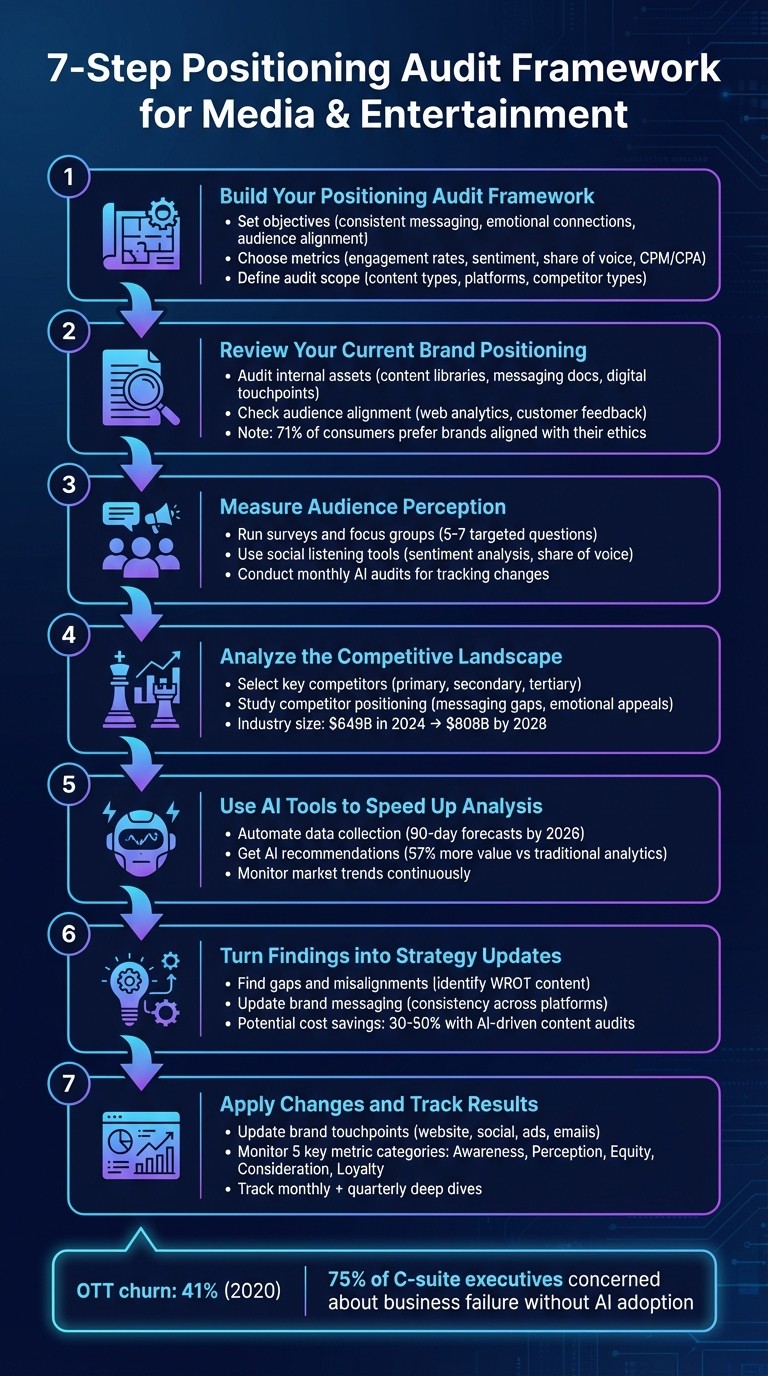
7-Step Framework for Media & Entertainment Positioning Audits
Step 1: Build Your Positioning Audit Framework
To get meaningful insights from your positioning audit, start with a clear framework that outlines your goals, the metrics you'll track, and the specific areas you'll review. For media and entertainment brands, this framework should address three core questions: What are your goals?, How will you measure success?, and What will you analyze?
Set Your Objectives
Define precise, business-oriented objectives. For media and entertainment companies, common goals include ensuring consistent brand messaging across platforms, identifying unique emotional connections that competitors haven't tapped into, and aligning with audience perceptions to bridge any gaps between how you present your brand and how audiences interpret it [4][1].
Looking ahead to 2026, many companies are adding a new focus: redefining quality to match shifting consumer preferences. Modern audiences often value relatability and engaging experiences over flashy, high-budget productions. Your audit should evaluate if your brand's definition of "quality" aligns with what your audience expects [2]. As Deloitte's Center for Technology, Media & Telecommunications explains:
"Success is no longer defined by production budgets alone, but by the experiences content creates and the value audiences take away from it" [2].
Once your objectives are clear, the next step is identifying metrics that directly measure your progress toward these goals.
Choose Your Metrics
The metrics you choose should align with your objectives and provide actionable insights. For media and entertainment brands, key metrics often include engagement rates (likes, shares, comments, saves), sentiment analysis to gauge emotional responses, share of voice to measure competitive standing, and cost efficiency metrics like CPM (cost per thousand impressions) and CPA (cost per acquisition) [3][5]. However, transparency in ad spend remains a pressing issue for marketers. Bob Liodice, CEO of the ANA, highlights this challenge:
"Marketers do not have a fully transparent line of sight into their programmatic supply chains. The lack of transparency for ad delivery and ad quality is costing advertisers billions of dollars in waste" [3].
Alarmingly, only 36% of every dollar spent on programmatic advertising effectively reaches the intended audience [3].
Here’s a breakdown of key metric categories:
Metric Category | Key KPIs | What It Measures |
|---|---|---|
Efficiency | CPM, CPA, Programmatic Traceability | Cost-effectiveness and transparency |
Engagement | Engagement Rate, Shares, Saves, Views | Content resonance and audience interaction |
Perception | Sentiment Score, Share of Voice | Brand reputation and competitive positioning |
Impact | ROI, ROAS, Conversions | Financial returns from campaigns and content |
With your objectives and metrics established, the final step is to outline the boundaries of your audit.
Define the Audit Scope
A well-defined scope ensures your audit remains focused and manageable. Specify the content types you'll review (e.g., short-form social videos, streaming series, microdramas), the platforms where your audience spends the most time, and the types of competitors you’ll analyze [1][2]. Don’t limit your analysis to direct competitors - include indirect and substitute competitors that vie for your audience’s attention.
For example, if you're a streaming service, your audit should go beyond other streaming platforms to include gaming platforms and social media apps that compete for the same leisure hours. Use customer feedback and transaction data to exclude competitors with minimal impact on your market [1]. This targeted approach ensures your audit delivers insights that truly matter.
Step 2: Review Your Current Brand Positioning
To address gaps in your brand positioning, you first need to understand what you're communicating now. Start by taking a close look at your existing brand assets to uncover inconsistencies or areas where your messaging might not align.
Audit Internal Assets
Gather and review all your current brand materials. For media and entertainment companies, this includes content libraries and IP catalogs, brand messaging documents (such as taglines, "About Us" pages, and value propositions), digital touchpoints (like website copy, streaming app interfaces, and social media bios), and marketing materials (including press releases, ad campaigns, and social feeds) [6][1][2].
As you go through these, take note of recurring themes. What are your 3–4 core messaging pillars? Are they consistent across all platforms, or does your Instagram tell a different story than your website? Look for alignment in your brand voice across every piece of content [1].
It's also important to assess whether your emotional messaging is cohesive. For instance, does your brand describe itself as "trusted and premium" in one place but "innovative and disruptive" elsewhere? Mixed signals like this can confuse your audience.
Additionally, evaluate whether your content library reflects the current trend of prioritizing relatability and immediacy over high-budget production. As Deloitte points out:
"the 'quality' of content may be increasingly determined by how much audiences value their experience consuming it, not by how much was spent to produce it" [2].
If your messaging still emphasizes production budgets rather than audience value, you've identified a significant gap that needs addressing.
Once you've built a clear understanding of your internal messaging, the next step is to see how it aligns with what your audience expects.
Check Audience Alignment
Now, compare your internal messaging with audience insights. This exercise is rooted in the Perception Pillar - the gap between how you see your brand and how your audience perceives it [9].
Start by analyzing web analytics to determine if you're reaching the right audience [8]. For example, if you're targeting Gen Z but your visitors are primarily millennials, your messaging might not be hitting the mark.
Dive into sales data and customer feedback to uncover where your messaging falls short [7]. Review support tickets, social media comments, and sales call transcripts to identify areas where your brand values don't align with audience needs. Revenue intelligence tools can also help pinpoint customer objections, offering clues about where your messaging might be missing the mark [1].
This comparison will highlight the discrepancies between your intended messaging and how your audience perceives it, giving you clear areas for improvement.
Keep in mind that 71% of consumers prefer to buy from brands that align with their ethics, and 9 out of 10 millennials are more likely to support brands that champion a cause [9]. If your internal messaging doesn’t clearly communicate your values and mission, you’re missing a critical opportunity to connect with your audience.
Step 3: Measure Audience Perception
Once you've evaluated your internal assets, it's time to understand how your audience perceives your brand. As Mash Bonigala, Creative Director & Brand Strategist at Spellbrand, explains:
"Brand perception lives in the minds of real customers, shaped by experiences that AI cannot observe - a frustrating customer service call, a delightful unboxing experience, a recommendation from a trusted friend." [1]
Run Surveys and Focus Groups
Surveys and focus groups are essential tools to uncover how your brand resonates emotionally with your audience. Craft surveys that test your positioning in a neutral way. For instance, use AI to generate unbiased descriptions of your brand and include 5–7 targeted questions. Instead of directly asking, "Do you think our streaming service is premium?" try something more open-ended like, "How would you describe our service to a friend?"
While AI can help structure surveys, human-led focus groups are critical for capturing subtleties. Run sessions with different audience segments - like Gen Z versus millennials - to identify how perceptions vary. When analyzing responses, focus on "emotional white space", which represents unmet emotional needs or gaps in the market. For example, if competitors emphasize being "innovative" but your audience values "trustworthiness", you've uncovered a potential area to differentiate. Combine these insights with real-time social listening for a broader perspective.
Use Social Listening Tools
Social listening tools complement direct feedback by offering ongoing insights into audience sentiment. AI-powered sentiment analysis can process unstructured data - like social media posts, reviews, and customer support tickets - categorizing it as positive, negative, or neutral while identifying nuanced emotions like sarcasm or frustration [12] [13] [14].
For example, HubSpot's free AI Sentiment Analyzer examines how AI models like GPT, Perplexity, and Gemini evaluate your brand across dimensions such as sentiment, presence quality, brand recognition, share of voice, and market competition [10]. This holistic view can shape how potential customers perceive your brand. Regularly conduct AI audits - at least monthly - to track changes in sentiment as AI training data evolves. Benchmark your brand's recognition and share of voice against competitors to stay ahead [10].
For deeper insights, tools like Enterpret and Brandwatch offer advanced features, including AI-driven theme clustering and detailed demographic analysis, helping you refine your strategy further [11] [12].
Step 4: Analyze the Competitive Landscape
After gaining insights into your audience, the next step is to evaluate your position within the competitive landscape. This involves understanding how your brand measures up against both traditional and emerging competitors. In the media and entertainment industry, competition has expanded beyond established studios to include tech-driven platforms that use algorithms to reshape how content is consumed, particularly through user-generated videos [2]. With the U.S. Media and Entertainment industry valued at $649 billion in 2024 and projected to grow to $808 billion by 2028, staying ahead requires sharp competitive intelligence [16].
Select Key Competitors
To get a clear picture of your competition, organize them into three categories:
Primary competitors: Direct rivals offering similar content.
Secondary competitors: Indirect players addressing the same audience needs differently, like gaming platforms competing with streaming services.
Tertiary competitors: Emerging disruptors, such as AI-powered independent studios [1][15].
It’s essential to look beyond obvious competitors and consider alternative solutions your audience might turn to. For instance, platforms like TikTok and gaming services often act as substitutes for traditional streaming, especially for younger demographics like Gen Z and Millennials.
Pay close attention to competitors skilled at building fandoms, particularly those that integrate intellectual property (IP) across films, games, and music [2]. Evaluate not only high-budget productions but also short-form, creator-led formats and microdramas, which are increasingly resonating with younger audiences [2]. Use AI tools to map this broader competitive landscape, but refine the results with your market knowledge to ensure relevance and accuracy [1]. Finally, examine how competitors craft their brand narratives to identify potential opportunities to differentiate your own.
Study Competitor Positioning
Once you’ve identified your key competitors, delve into how they position themselves emotionally, not just in terms of features or offerings. Use AI tools to analyze their website copy, taglines, and social media bios to uncover their core messaging, value propositions, and the themes they consistently highlight [1]. While AI can process large volumes of data to identify patterns, your judgment is crucial to interpret emotional subtleties that machines might overlook.
Search for gaps in messaging that competitors haven’t claimed. For example, if most competitors focus on "innovation" but none emphasize "radical transparency", that could be an untapped space for your brand to occupy [1][15]. Review their blogs, podcasts, and webinars to uncover content gaps or underexplored themes. A competitive positioning map can help you visualize where competitors are concentrated and highlight areas where your brand can stand out.
Step 5: Use AI Tools to Speed Up Analysis
After gathering data on your audience and competitors, the next challenge is making sense of it all. Processing these vast datasets manually can be time-consuming, but AI tools can dramatically shorten the timeline while revealing patterns that might otherwise go unnoticed.
Automate Data Collection and Trend Analysis
AI thrives on identifying patterns in large datasets. Tools like Averi AI can analyze your assets to define your product, positioning, customer profile, and brand voice almost instantly - eliminating hours of manual effort. These tools can also scan competitor websites, social media channels, and press releases, identifying their key messaging pillars and emotional appeals.
For media and entertainment brands, this means rapidly mapping competitor messaging strategies. For example, if most streaming platforms focus on "innovation" but none emphasize "radical transparency", AI can highlight this opportunity in minutes. Additionally, AI can track how your brand is referenced by generative engines like ChatGPT and Perplexity, providing insights into your digital presence.
Looking ahead, predictive media monitoring platforms are expected to offer 90-day forecasts for reach and engagement metrics with impressive accuracy by 2026 [17]. Semantic AI tools can condense data into actionable insights, and for brands heavily reliant on video, visual intelligence tools can monitor broadcasts, podcasts, and platforms like TikTok [17].
This automated analysis builds on the earlier competitive and audience research, ensuring all elements of your audit are cohesive. These insights pave the way for AI-generated strategic recommendations.
Get Recommendations from AI
Once your data has been organized, AI can deliver tailored positioning strategies. Advanced systems provide prescriptive intelligence, offering actionable strategies drawn from the insights collected. For instance, AI might detect that your competitors predominantly focus on "premium quality" messaging while leaving "community-driven" messaging untapped. It could then suggest three specific positioning approaches, complete with rationale and trade-offs for each.
In the media and entertainment sector, leveraging AI can result in capturing 57% more value compared to traditional analytics methods [18]. However, AI's recommendations often lean toward safe, logical options. To stand out, instruct AI to identify bold, unconventional positioning strategies that are harder for competitors to replicate. While AI can help design neutral interview questions and validation frameworks, real customer testing is essential to capture the emotional nuances that machines might miss.
These AI-driven recommendations complement manual reviews, bridging objective data with actionable insights. Tools like Averi AI can also monitor market trends and competitor content continuously, generating content ideas with targeted keywords and summaries. This creates a feedback loop where performance data informs future strategies - helping you decide which content to prioritize, update, or create next.
Step 6: Turn Findings into Strategy Updates
Now that you've gathered insights from your AI-driven audit, it's time to translate that data into actionable strategies. By analyzing surveys, competitor landscapes, and AI-generated insights, you can redefine your brand's position in the market.
Find Gaps and Misalignments
Start by identifying areas where competitors dominate and where opportunities remain untapped. Brand positioning is all about how your audience perceives you. For instance, two streaming platforms offering the same content can occupy entirely different spaces - one might be seen as the "luxury option", while the other is viewed as the "groundbreaking disruptor."
AI can help you spot patterns in competitor messaging. If every brand in your space overuses terms like "innovative", those words lose their impact. Instead, look for ideas or emotions that no one else is owning. For example, if competitors focus on technology but ignore themes like simplicity or community, these could become your unique angle [1].
Also, identify any WROT content - Weak, Redundant, Outdated, or Trivial [19]. A great example comes from 2025 when a state university worked with Palantir.net to audit over 4,000 pages of content. By using AI tools, they uncovered inconsistencies and outdated material, cutting costs by an estimated 30-50% compared to manual reviews [19]. For media brands, this could mean streamlining multiple "About Us" pages that tell conflicting stories or removing old press releases that no longer align with your brand. Always tie these updates back to your original audit goals and metrics.
When deciding which gaps to address, consider what would challenge your competitors the most or be hardest for them to imitate [1]. Bold moves often pay off. If a strategy feels slightly risky, it might just be the one that sets you apart - because it demands a level of commitment competitors can't easily match.
Update Brand Messaging
With the gaps identified, the next step is refining your messaging. Consistency is key across all platforms. AI tools can help by flagging jargon, acronyms, or shifts in tone that might confuse your audience [19].
For media and entertainment brands, where rapid changes are the norm, align your messaging with what your audience values now. For instance, if your audit reveals that transparency is a top priority for your audience but your messaging leans on exclusivity, it's time for a shift. Update your core messaging pillars to reflect what your audience truly cares about - not just what you assume they want.
Use AI tools to track trends and create a feedback loop for continuous improvement. This will help you decide which content to update, keep, or create next. The trick is combining AI's ability to spot patterns with human insight to ensure your messaging resonates emotionally and fits within the broader cultural context [1].
Step 7: Apply Changes and Track Results
Roll out your updated strategy across all platforms and keep a close eye on how it performs. This isn't a one-and-done process - it's a continuous loop of implementing, monitoring, and fine-tuning.
Update Brand Touchpoints
Ensure your refreshed positioning is consistently reflected across every channel - your website, social media profiles, ad campaigns, email templates, and sales presentations. Mixed messaging can confuse your audience. For instance, if your homepage promotes "community-driven entertainment" but your Instagram bio leans on "cutting-edge technology", it creates a disconnect.
A brand consistency checklist can help you maintain uniformity in both visuals and messaging. Tools like Jasper ($49/month) and Averi ($100/month) are excellent for keeping your brand voice consistent and improving geo-targeting. For teams leveraging CRM platforms, HubSpot Breeze ($800/month) allows you to integrate your updated positioning into automated workflows seamlessly [1].
As Mash Bonigala, Creative Director & Brand Strategist at Spellbrand, wisely notes:
"The strategy that makes you slightly nervous is often the right one" [1].
While AI tools can analyze and streamline messaging, interpreting the emotional and cultural nuances of your brand is something only humans can do effectively.
Once your updates are live, it's time to measure their impact systematically.
Monitor Key Metrics After Implementation
Tracking the right metrics removes the guesswork and turns your strategy into a data-driven effort. Christopher Pappas, CEO of eLearning Industry, underscores this point:
"Brand strategy succeeds when CMOs track metrics that measure perception, trust, and long-term demand, not just short-term campaign performance" [20].
Organize your measurements into three main categories: performance, perception, and behavior metrics [21]. Focus on high-value indicators like branded search volume and direct traffic trends, which highlight growing interest in your brand. Before implementing changes, establish a baseline - without it, you can't track meaningful long-term trends [20][21].
Adopt a dual tracking approach: run monthly checks to capture immediate shifts and conduct quarterly or biannual deep dives for a more thorough analysis [20][21]. For national studies, aim for at least 400 respondents per survey wave to ensure reliable data with a manageable margin of error [21].
Combine survey results with behavioral data. For example, if customer favorability scores rise but repeat purchase rates stay flat, this could signal a need to adjust your approach. Share these findings with leadership regularly, ideally on a quarterly or biannual basis, to inform ongoing decisions [20].
Metric Category | Key Indicators | Strategic Question |
|---|---|---|
Awareness | Unaided/Aided awareness, Share of Voice | Do the right buyers know we exist? |
Perception | Brand trust, Favorability, Associations | What do buyers think about us? |
Equity | Willingness to pay, Preference vs. Competitors | Does the brand create pricing power? |
Consideration | Branded search volume, Direct traffic | Are buyers more likely to choose us? |
Loyalty | Net Promoter Score (NPS), Retention rate | Are our relationships durable? |
Conclusion
Positioning audits are an ongoing priority in the fast-evolving media and entertainment industry. With OTT churn reaching 41% in 2020 and 75% of C-suite executives expressing concern about business failure within five years if they fail to embrace AI [18], the stakes are high. Every new competitor, cultural shift, or algorithm tweak can reshape audience perception - staying idle simply isn’t an option.
The seven-step framework discussed here - from setting up your audit structure to monitoring post-implementation metrics - offers a practical, repeatable approach to refining brand positioning. Combining AI with human expertise ensures your audits remain flexible and relevant. Speed is critical in this process. Traditional methods can’t keep up with the pace of today’s market shifts. AI tools, such as Averi (available at $100/month for the Plus Plan), can condense weeks of research into mere hours, helping you pinpoint messaging gaps and uncover untapped opportunities in your competitive landscape [1].
Successful brands make intelligence a core part of their operations. Track key metrics like awareness, perception, equity, consideration, and loyalty on a monthly basis, while conducting more in-depth reviews quarterly to fine-tune your strategy. Integrating these insights with AI-driven analytics allows you to stay ahead in a market that’s always in flux. Regularly update messaging, refine positioning, and measure impact with precision.
Consider mapping indirect competitors and alternative solutions to sharpen your strategy [1]. Leverage AI tools to identify inconsistencies in competitor messaging and validate your differentiation approach through real customer feedback.
"The strategy that makes you slightly nervous is often the right one" [1].
FAQs
How often should we run a positioning audit?
There isn’t a universal rule for how often you should perform a positioning audit, but consistent reviews are key to keeping your strategy in sync with shifting market trends and audience perceptions. Many experts recommend conducting audits quarterly, semi-annually, or annually - particularly in fast-changing fields like media and entertainment - to ensure your brand remains relevant and impactful.
Which metrics best prove positioning changes worked?
When assessing changes in positioning, focusing on metrics like audience engagement, reach, and visibility is critical. Key performance indicators (KPIs) to keep an eye on include engagement rates, impressions, website sessions, page views, and unique visitors. By consistently tracking these figures, you can gauge shifts in how your audience perceives your brand and how visible it is in the market. Using verified data, such as audited social media or website analytics, adds an extra layer of credibility to your evaluation process.
How do we validate AI insights with real audiences?
To ensure AI insights align with reality, compare them against actual audience data and observed behaviors. Incorporate methods such as surveys, user feedback analysis, and third-party tools to verify the accuracy and relevance of the findings. Be transparent about the data sources used, confirm they reflect consumer behavior patterns, and adopt frameworks that help non-experts evaluate the credibility of the insights. These approaches make AI-driven conclusions more reliable and practical for decision-making.
Related Blog Posts

Zach Chmael
CMO, Averi
"We built Averi around the exact workflow we've used to scale our web traffic over 6000% in the last 6 months."
Your content should be working harder.
Averi's content engine builds Google entity authority, drives AI citations, and scales your visibility so you can get more customers.